Clapp Weekly: Fed spooks crypto, Ethereum reset, $1.9M in fake Polymarket bets

BTC price
Bitcoin tested a two-week low near $62k as traders digested a hawkish Fed backdrop. US spot Bitcoin ETFs extended their losing streak to six straight weeks, while a nearly 20% drop in open interest suggests excess leverage has now been flushed out. Focus now shifts to the May PCE print due June 25, followed by a $10.6 billion Deribit options expiry a day later. Meanwhile, Strategy faces its sharpest stress test yet, with its BTC holdings sitting roughly 14.6% below its cost basis.
After touching $66k on June 17, BTC slid sharply to a low of $62,304 the following day before beginning a gradual recovery that peaked at $65,468.63 on June 22. The rebound quickly faded, however, with the price falling back to a low of $62,171 on June 23 and struggling to regain momentum.
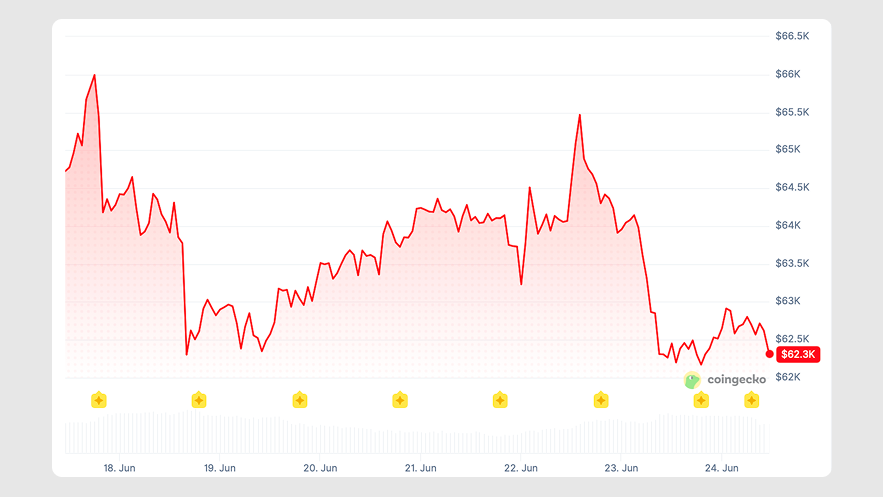
Currently trading at $62,404.60, BTC is up 0.2% over the past 24 hours but remains down 3.8% on the week.
ETH price
Ether fell below $1,700 as ETF outflows, geopolitical uncertainty, and weakening derivatives activity pressured sentiment. Spot ETH ETFs shed another $82.35 million on June 23, extending their withdrawal streak to four sessions. Investors are also digesting layoffs and a reported 40% budget reduction at the Ethereum Foundation, although supporters such as BitMine chairman Tom Lee argue that staking demand and private capital will offset the impact.
Mirroring BTC's weakness, ETH retreated after reaching $1,785.54 on June 17 and found support near $1,677.17 the following day. The recovery extended through June 22, when the price briefly climbed to $1,773.96 before another wave of selling pressure emerged. After bottoming at $1,646.24, ETH began a modest rebound.
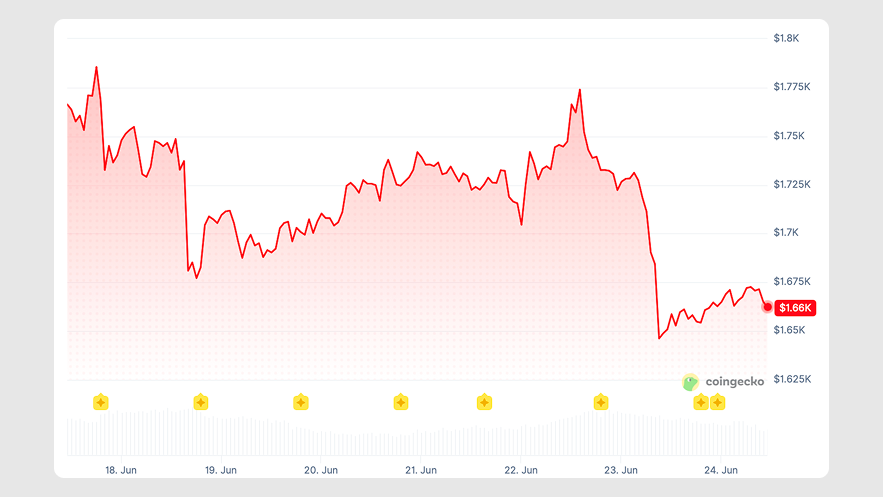
Currently trading at $1,672.03, ETH is up 0.7% over the past 24 hours but remains down 6.1% over the past seven days.
Seven-day altcoin dynamics
The Fed's rate decision and fragile US-Iran peace talks have largely shaped the market backdrop over the past seven days. As rate-hike risks overshadowed ceasefire relief, sentiment remained firmly in the "Extreme Fear" zone (23/100). Risk-off positioning drove a broad sell-off across both AI and crypto markets.
Bitcoin's dip to $62k coincided with a pullback in tech stocks following a frenetic rally. On Wall Street, names tied to the AI boom — including chipmakers Micron Technology and SanDisk — dragged the Nasdaq lower. AI-heavy indexes in Asia also led regional losses.
From Fed cut hopes to hike fears
The June 18 FOMC meeting — the first under new Fed Chair Kevin Warsh — left rates unchanged at 3.50%–3.75%, a widely anticipated decision. What moved markets was a statement devoid of dovish language, alongside a dot plot implying a potential future hike.
Half of the eighteen participants now expect at least one rate increase this year. In CME FedWatch pricing, the odds of a hike are now above 36% for July and over 70% for September.
The median dot for year-end rose to 3.8% from 3.4% in March. Meanwhile, the Fed’s year-end forecast for the Personal Consumption Expenditures (PCE) index — its preferred inflation gauge — climbed to 3.6% from 2.7%.
Morningstar Wealth's associate portfolio manager Alfonzo Bruno commented:
“Based on the removal of the dovish bias in the statement, how the labor market is trending, still-sticky inflation, and very elevated asset prices, it certainly feels like the Fed is starting to lay the groundwork for its next move being a hike.”
US-Iran peace deal collapses
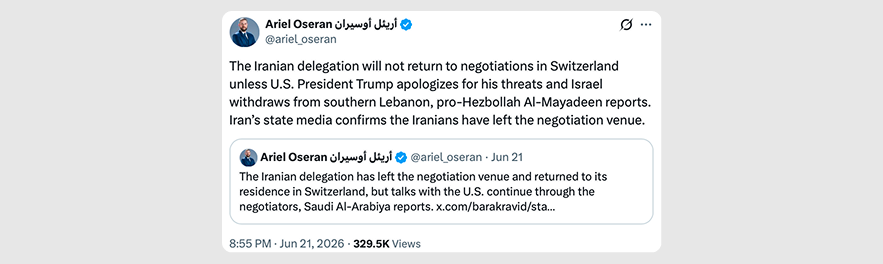
On Friday, June 19, crypto markets reacted in real time as the US-Iran peace deal collapsed at the signing ceremony in Switzerland. Iran walked out in protest over fresh threats from President Trump and Israeli strikes on southern Lebanon. The breakdown of negotiations revived fears of an oil shock and triggered a broader risk-off move into Monday.
The following day, oil prices edged lower as tanker traffic through the Strait of Hormuz began to resume slowly. A limited number of vessels are reportedly being allowed through daily under oversight from Iran's Revolutionary Guards Navy.
Meanwhile, the US Senate passed a bipartisan resolution invoking the War Powers Act to end the Iran war. The resolution, though largely symbolic, lifted S&P 500 and Nasdaq 100 futures at press time.
Top weekly winners
- DEXE (+24.0%) decoupled from Bitcoin's decline, with its market cap briefly surpassing the $1 billion psychological threshold. The momentum appears driven by inclusion in MEXC’s futures trading section.
- ADI (+17.6%) neared its all-time high on news of a strategic partnership between DAZN and ADI Predictstreet for the FIFA World Cup 2026. The collaboration integrates the tournament’s official prediction market partner into live sports viewing.
- RAIN (+10.6%) surged following its listing on Gate.io, including zero-fee convert functionality and an airdrop. The rally is also supported by a live buyback-and-burn program and rumors of a partnership with a top-10 blockchain for a cross-chain lending product.
Top weekly losers
- WLD (-25.1%) came under pressure as a Robinhood listing failed to offset allegations involving Sam Altman-linked Orb. A report suggested internal investigations at Orb examined payments to a foreign entity allegedly intended to influence WLD’s market performance.
- VVV (-19.0%) corrected sharply as traders took profits after a rally in AI tokens fueled by the US clampdown on Anthropic’s AI models. Bulls argue the move strengthens the case for decentralized, censorship-resistant AI infrastructure.
- ZEC (-18.9%) faced selling pressure after a vulnerability in the “Orchard” shielded privacy pool came to light. Sentiment remains mixed despite a successful patch and progress on the Ironwood upgrade.
Cryptocurrency news
Ethereum Foundation slashes budget 40% in the biggest reset in years
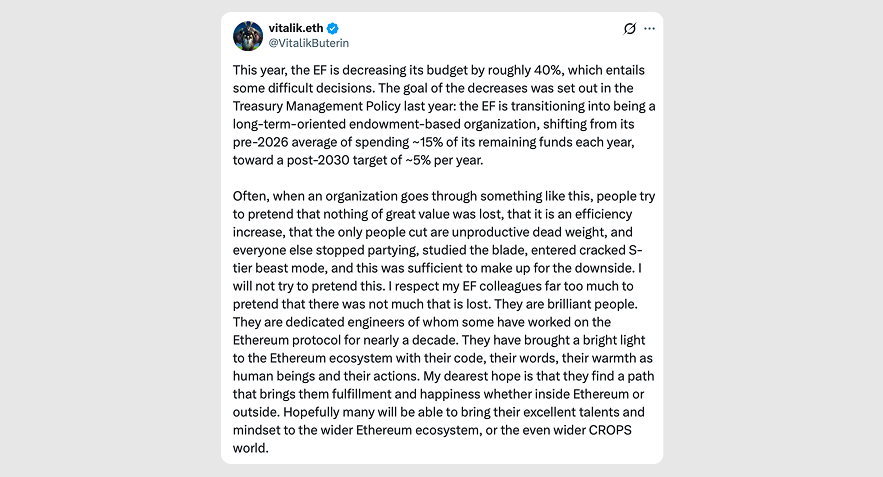
Vitalik Buterin has announced that the Ethereum Foundation will cut its annual budget by roughly 40% as part of a shift toward a leaner, endowment-style operating model. This move is designed to transition it from spending around 15% of its remaining treasury annually to a long-term target of roughly 5% per year after 2030.
The cuts came with a human cost. The foundation confirmed a 20% reduction in headcount — 54 staff members are leaving. They'll receive severance at the higher of one month's pay per year worked or locally mandated amounts, plus transition support and ecosystem placement assistance.
A wave of departures
The layoffs follow a months-long leadership exodus. Nine senior Ethereum Foundation figures have left since January, including co-Executive Director Hsiao-Wei Wang, who resigned this month. Tomasz Stanczak, her co-director, departed in February. Protocol team leads Tim Beiko and Barnabe Monnot, researchers Carl Beek and Julian Ma, and others have also moved on.
Buterin acknowledged the gravity of the moment. "I respect my EF colleagues far too much to pretend that there was not much that is lost," he wrote, noting the cuts involve "difficult decisions" and the departure of experienced engineers who have worked on Ethereum for years.
A new structure
The reorganization emerges as a five-cluster structure: protocol layer, access layer, user layer, community layer, and institutional layer, alongside dedicated operations and management clusters.
The protocol cluster will focus on hardening and scaling Ethereum against capture and censorship, with long-term work on post-quantum security, zkEVM development, and L1 privacy. The access layer ensures users can read the chain and transact without relying on unverifiable intermediaries.
Institutional layer handles engagement with financial institutions, governments, and universities. The community cluster will differentiate the EF from "zero-sum financial crypto" and "corpo-compromised crypto."
The new organigram is shown in the official Ethereum blog.
What gets cut
The Privacy and Scaling Explorations (PSE) unit is winding down. Devcon conferences will become smaller and less costly. Institutional strategy will narrow.
Buterin reiterated his preference for a "lean-and-done" future for Ethereum once the current roadmap is complete — protocol development focused on security fixes and limited high-impact upgrades rather than continual feature expansion.
External pressure
The cuts come as Ethereum faces mounting competition from rival blockchains. Just days ago, Ethlabs — a new nonprofit backed by Joe Lubin, BitMine, and SharpLink — launched to focus on institutional adoption. Several departed EF researchers are involved.
For now, the EF is preserving funding for Ethereum's "third iteration" after the Merge. The rest is being trimmed. Whether that strengthens Ethereum or leaves it weaker will be the story to watch.
Polymarket's viral growth was built on $1.9M in fake bets
A Wall Street Journal investigation published Saturday found that Polymarket paid dozens of mostly college-age creators to film themselves placing fake bets on dummy versions of its website. The paper reviewed 1,105 videos from 10 creators posted since December — and found that none of the roughly $1.9 million in wagers shown was real.
The fake wins
One video showed a creator celebrating a $100,000 win on a bet that President Trump would say "McDonald's" in January. The footage was filmed two months earlier. Trump never said the word publicly that month, and more than 50 real accounts that placed the same bet on Polymarket all lost.
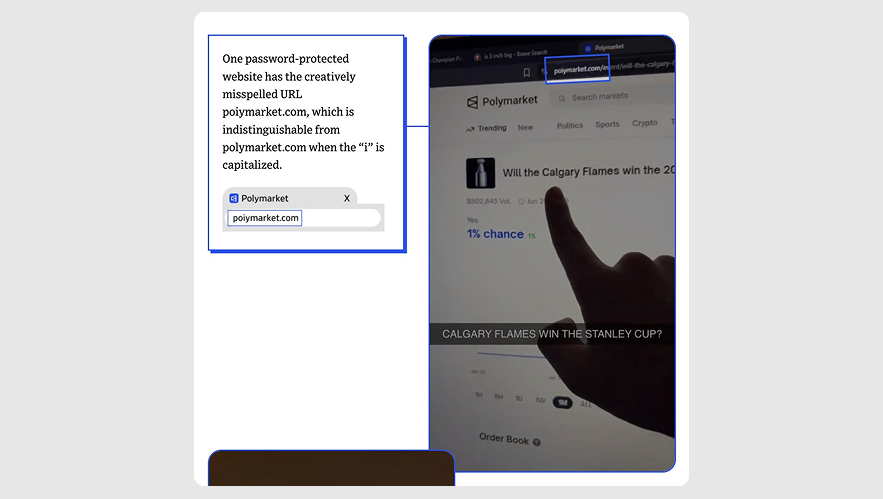
Creators were seen entering trades into dummy sites, including one at the misspelled domain "poiymarket.com." A source familiar with the matter said the dummy site was built by Polymarket. Other videos indicated the sites were test environments for the company's engineers.
Across 118 videos, creators touted nearly $900,000 in fabricated winnings on bets that would actually have lost more than $166,000. They were paid roughly $2,000 to $3,000 a month and told not to disclose the arrangement. A marketing firm managed the network, and creators were only paid when at least 60% of their audience was based in the U.S. — despite Polymarket's main site being geo-blocked for American users.
Awkward timing
The scandal lands at a delicate moment for Polymarket. The company was fined $1.4 million by the CFTC in 2022 for running an unregistered market. It later reincorporated in Panama — with its headquarters reportedly a shared law office that also worked with FTX.
After winning a regulated US market entry in late 2025, Polymarket is pushing onshore. The fake campaign specifically targeted American users, who can still reach the offshore site through a VPN.
Regulatory headwinds
The findings complicate Polymarket's push for mainstream credibility. State regulators are circling. Kentucky has just sued Polymarket and rival Kalshi over alleged unlicensed sports wagering. The Trump administration has sued states including Illinois and Arizona to defend prediction markets.
Senator Elizabeth Warren has accused the CFTC of being "steamrolled" by the industry. Donald Trump Jr. is an investor in Polymarket and an adviser to both it and Kalshi.
Polymarket told the WSJ it is "committed to maintaining accurate, fair, and transparent markets" and plans a comprehensive audit of its promotional content.
The question is whether that audit will be enough — or whether the damage to trust has already been done.