Flexible vs. fixed savings: Which actually makes you more money?

Crypto savings sounds simple enough: deposit your assets, earn passive income, and let compounding do the work.
Then you open a platform and see two options.
Flexible Savings.
Fixed Savings.
One promises higher returns; the other lets you withdraw whenever you want.
Which one actually makes you more money? The answer seems obvious. But a higher advertised rate doesn't always leave you better off if locking your funds means missing an opportunity or needing the money before maturity.
Let's look at how the two products actually differ.
TL;DR
- Flexible Savings usually earns yield with daily compounding and lets you withdraw whenever you want.
- Fixed Savings pays a higher interest rate in exchange for locking your assets for a fixed period.
- Flexible Savings prioritizes liquidity. Your money is available whenever you need it.
- Fixed Savings prioritizes returns. The longer you can leave your funds untouched, the more the higher rate matters.
- Many experienced investors don't choose one or the other — they use both for different parts of their portfolio.
Overview of crypto savings products
Crypto savings accounts work much like traditional savings products, except they hold digital assets instead of fiat currencies—and the yields are often considerably higher.
For comparison, the average US savings account currently pays around 0.38% APY, while crypto savings products can offer several times that on supported assets.
Most yield-generating products fall into three broad categories:
- Centralized Finance (CeFi) — the platform manages everything for you.
- Decentralized Finance (DeFi) — users interact directly with smart contracts.
- Proof-of-Stake (PoS) staking — rewards are earned by helping secure blockchain networks.
For most newcomers, CeFi is the simplest option because there are no wallets to configure, validators to choose, or smart contracts to manage.
You deposit crypto or stablecoins, and the platform may lend them to institutional borrowers, market makers, or margin traders. Part of the revenue is then shared with depositors as yield.
Most CeFi platforms offer two versions of the product:
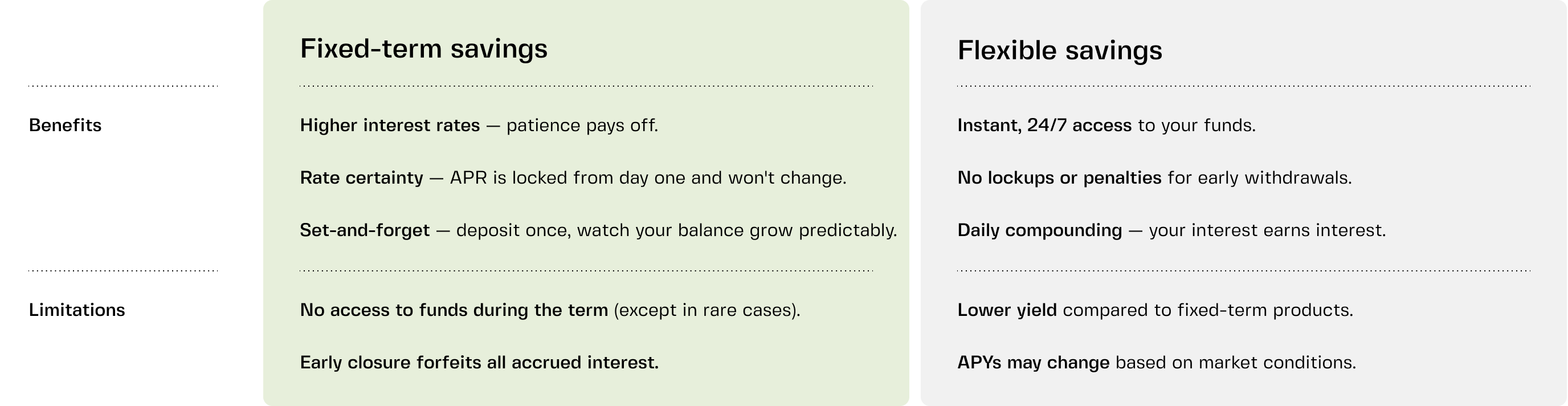
- Flexible Savings — lower yields, daily interest, and withdrawals whenever you want.
- Fixed Savings — higher yields in exchange for locking your assets for a predefined term, typically between one and twelve months.
Flexible Savings: Money you might need tomorrow
Your assets earn APY, which includes the effect of compounding. Because interest is regularly added back to your balance, you gradually begin earning interest on previous interest—not just on your original deposit.
On many crypto platforms, compounding happens daily, allowing your balance to grow automatically without any action on your part.
The biggest advantage, however, isn't compounding. It's liquidity. If an unexpected expense comes up — or the market suddenly presents an opportunity — you can usually withdraw part or all of your funds without penalties.
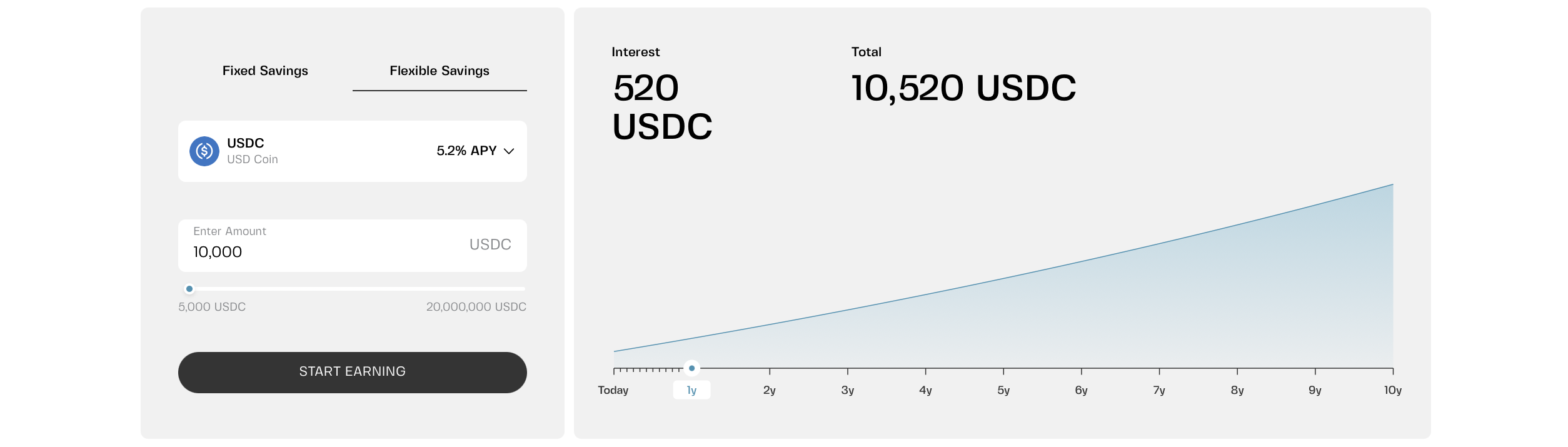
The trade-off is straightforward: that flexibility comes with a lower return.
On Clapp, Flexible Savings pays up to 5.2% APY with daily compounding on supported assets, including EUR, BTC, ETH, USDC and USDT.
Fixed Savings works differently
Flexible Savings gives you access to your money whenever you need it; Fixed Savings rewards you for giving up that flexibility.
You commit your assets for a chosen period — typically 1, 3, 6 or 12 months — and receive a higher fixed rate in return. On Clapp, Fixed Savings offers up to 8.2% APR on EUR, USDC and USDT.
The rate is locked in from day one, giving you predictable returns regardless of what happens to market interest rates during the term.
When does the extra 3% matter?
At first glance, three percentage points hardly seem worth worrying about.
But over time — and on larger balances — the gap becomes meaningful.
If you deposit $10,000 for one year, the difference is roughly $300. At $50,000, it's around $1,500. Stretch that over several years, and the extra return can become a noticeable part of your overall gains.
The catch is that higher returns only matter if you can leave the money untouched for the entire term. If locking your funds forces you to miss an opportunity or scramble for cash elsewhere, that additional yield can disappear surprisingly quickly.
That's why the real question isn't "Which pays more?" It's "Can I realistically leave this money alone?"
What the numbers actually look like
The following example shows estimated balances based on a 10,000-unit deposit (USDT/USDC).
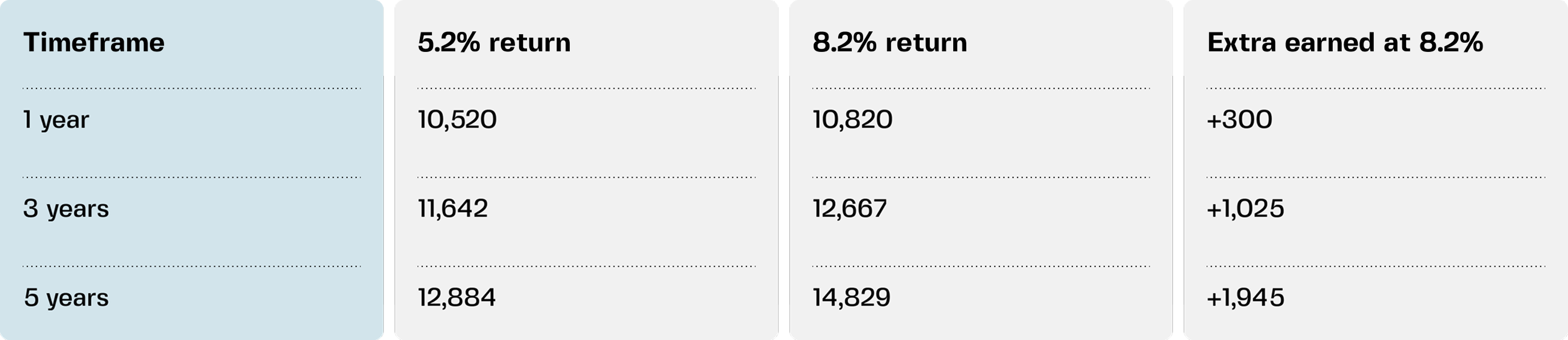
The larger the balance — and the longer the investment period — the more meaningful the difference becomes.
For a small emergency fund, flexibility may easily outweigh an extra 150 USDT a year. But for a large cash reserve that you know won't be touched, the higher return can be well worth the commitment.
When does flexibility become more valuable than yield?
Liquidity doesn't have a percentage attached to it, which is why people often underestimate its value.
Imagine you've locked all your stablecoins into a 12-month fixed product. Three months later, Bitcoin drops 35%.
If you want to buy the dip, add collateral to reduce your LTV, or simply cover an unexpected expense, your higher interest rate suddenly matters much less than your inability to access the funds.
Flexible Savings is essentially insurance against uncertainty.
You're accepting a lower return in exchange for having your money available whenever life — or the market — throws you a surprise. Sometimes, earning 5.2% on accessible funds is better than earning 8.2% on money you can't use.
Not an either-or decision
Many experienced investors split their cash according to purpose.
- Money that might be needed within the next few months stays in Flexible Savings, where it continues earning yield while remaining available.
- Money they know they won't need for a year can go into Fixed Savings to earn a higher return.
Think of it as giving every asset a job. Some funds generate maximum yield; others provide liquidity. Together, they create a portfolio that's both productive and resilient.
When you probably shouldn't use Fixed Savings
Higher yields are attractive, but locking money away isn't always the right decision. Fixed Savings may not be suitable if:
- It's your emergency fund. Unexpected expenses rarely wait until your term ends.
- You're actively investing. If you expect to deploy capital over the coming weeks or months, flexibility is likely more valuable.
- You may need to support an existing crypto loan or credit line. Having accessible stablecoins can make it much easier to manage your LTV during volatile markets.
- You're unsure about your cash needs. If there's a realistic chance you'll need the money, forcing yourself into a fixed term can become an unnecessary constraint.
One useful rule of thumb is simple: Only lock away money you're genuinely comfortable not touching until maturity.
Everything else is usually better kept flexible, even if the headline yield is lower.
There's no universally "better" product
The highest return isn't always the smartest decision, because the best strategy is the one that fits how you'll actually use your money.
Flexible Savings pays you for keeping your assets available. Fixed Savings pays you for committing to leave them untouched. The right choice depends less on the advertised rate than on what that money is meant to do.
- If it's your emergency fund or capital you may need soon, flexibility is often worth more than a few extra percentage points of yield.
- If you're setting aside money for a goal months away, locking in a higher return can make sense.
Many experienced investors don't choose one over the other. They use Flexible Savings for liquidity and Fixed Savings for longer-term reserves, allowing different parts of their portfolio to serve different purposes.
Frequently asked questions
1. Is Flexible or Fixed Savings better?
Neither is objectively better. Flexible Savings prioritizes access to your funds, while Fixed Savings prioritizes higher returns. The better choice depends on how soon you might need the money.
2. Can I withdraw money from Fixed Savings early?
That depends on the platform. Some providers don't allow early withdrawals, while others may reduce or forfeit your earned interest. Always check the product terms before committing to a fixed period.
3. Why is the interest rate higher on Fixed Savings?
Because you're giving up liquidity. Locking your funds for a predetermined period allows platforms to plan the use of those assets more efficiently, which often translates into higher yields for savers.
4. Should I put all my savings into Fixed Savings?
Usually not. Many investors keep an accessible emergency reserve in Flexible Savings and only lock away money they know they won't need before maturity.
5. Can I use both at the same time?
Yes—and many experienced investors do. Flexible Savings can hold emergency funds or capital for future opportunities, while Fixed Savings can earn higher returns on money intended for longer-term goals. This approach balances liquidity with yield.