Clapp Weekly: BTC bounces, Coldcard breach, BlackRock puts $311B on-chain

BTC price
Bitcoin reclaimed $64k ahead of a reported Iran-US-Oman agreement on reopening the Strait of Hormuz, expected today. The coin continued recovering from its dip to around $62,200, shrugging off the Coldcard wallet hack and Strategy's latest Bitcoin sale. Strategy offloaded 1,638 BTC between July 27 and Aug. 2 — its third sale this year — to fund STRC dividends and buybacks. Meanwhile, US spot Bitcoin ETFs attracted over $380 million in net inflows, snapping a recent stretch of withdrawals.
BTC briefly slipped below $64k before climbing to $64,926.99 on July 30, then reversed lower. After rebounding from $62,562.73 on July 31, it traded just below $63.5k before another dip below $62.5k on Aug. 3, followed by a sharp recovery.
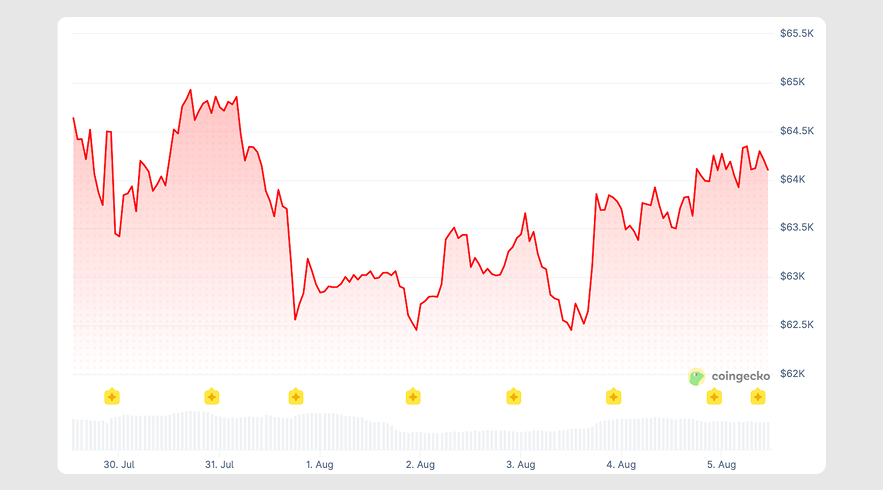
Now trading at $64,063.68, BTC is up 0.8% over the past 24 hours and down 0.1% over the past seven days.
ETH price
Despite shrinking exchange balances, muted US demand has kept ETH below key resistance. On-chain activity continues to outpace price action: Ethereum smart contract deployments have risen 82.3% over the past three months, while transfer volumes across externally owned accounts and smart contracts are up 50%–80%. BitMine added another 10,399 ETH ($19.1 million) last week as Chairman Tom Lee pointed to Ether's strongest monthly performance against the Nasdaq in a year.
ETH reclaimed the $1.9k level before briefly stumbling on July 30, tracking Bitcoin's pullback. After falling to $1,835.29 on Aug. 1, it recovered to $1.9k on Aug. 3, briefly dipped again, and has since climbed back above $1.86k.
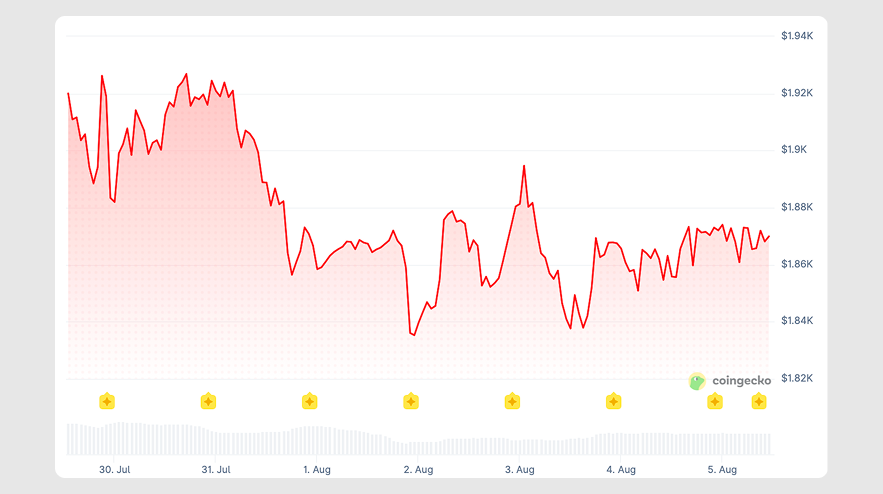
Currently trading at $1,867.73, ETH is up 0.6% over the past 24 hours but remains down 2.8% on the week.
Seven-day altcoin dynamics
Crypto has shown a muted response to ceasefire hopes as falling oil prices and a risk-on equity rally have failed to lift digital assets for a third straight session. Sentiment has climbed to the "Fear" zone (27/100), while major tokens are edging higher after largely ignoring fresh all-time highs in equities fueled by renewed AI enthusiasm.
Ether and XRP have lagged, while BNB and Hyperliquid's HYPE have outperformed among major tokens.
Hormuz deal today?
According to Axios, the US, Iran, and Oman are "closing in on an interim agreement to reopen the Strait of Hormuz." Earlier, Trump called off planned strikes against Iran over the weekend, citing a deal in the making — a claim Tehran initially denied.
Axios' regional sources state the deal would separate inbound and outbound shipping lanes. Inbound traffic would pass through the Iran-controlled northern lane, while outbound vessels would use the southern route via Omani waters. Neither side would charge fees or tolls during the initial 60-day period.
Brent crude fell from $86 to $78.5 per barrel — a three-week low — after Treasury Secretary Scott Bessent confirmed the US and Iran appeared close to an agreement.
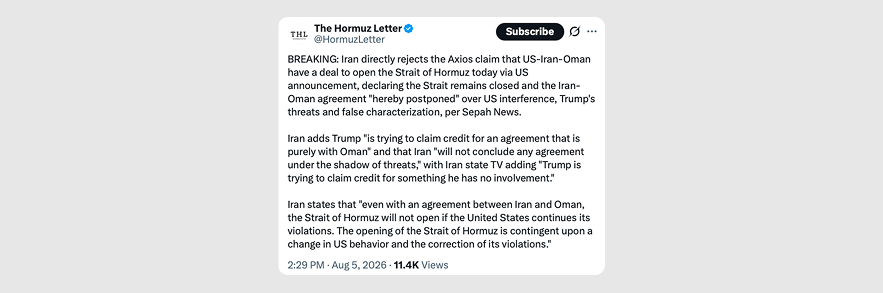
However, at press time, Iran has been reported to reject the Axios claim, sending Brent back above $80 per barrel.
AI trade returns
The S&P 500 and the Dow Jones Industrial Average hit fresh record highs on Tuesday, Aug. 4, as AI optimism returned after a brief but sharp midsummer correction. Strong Q2 corporate earnings and higher forward guidance from enterprise software, chip-design, and cloud companies helped ease concerns over massive AI infrastructure spending.
SpaceX earnings top expectations
SpaceX's first earnings as a public company revealed a 92% jump in Q2 revenue to $7.8 billion, largely driven by AI computing deals and Starlink growth. The company still reported a net loss of $541 million, though that marked an improvement from the $1.0 billion loss recorded a year earlier.
Shares tumbled as investors remained skeptical about SpaceX's ability to deliver on lofty expectations. The report showed continued heavy investment in AI: 86% of capital expenditures — which totaled $18.4 billion, above expectations — went toward the company's AI division.
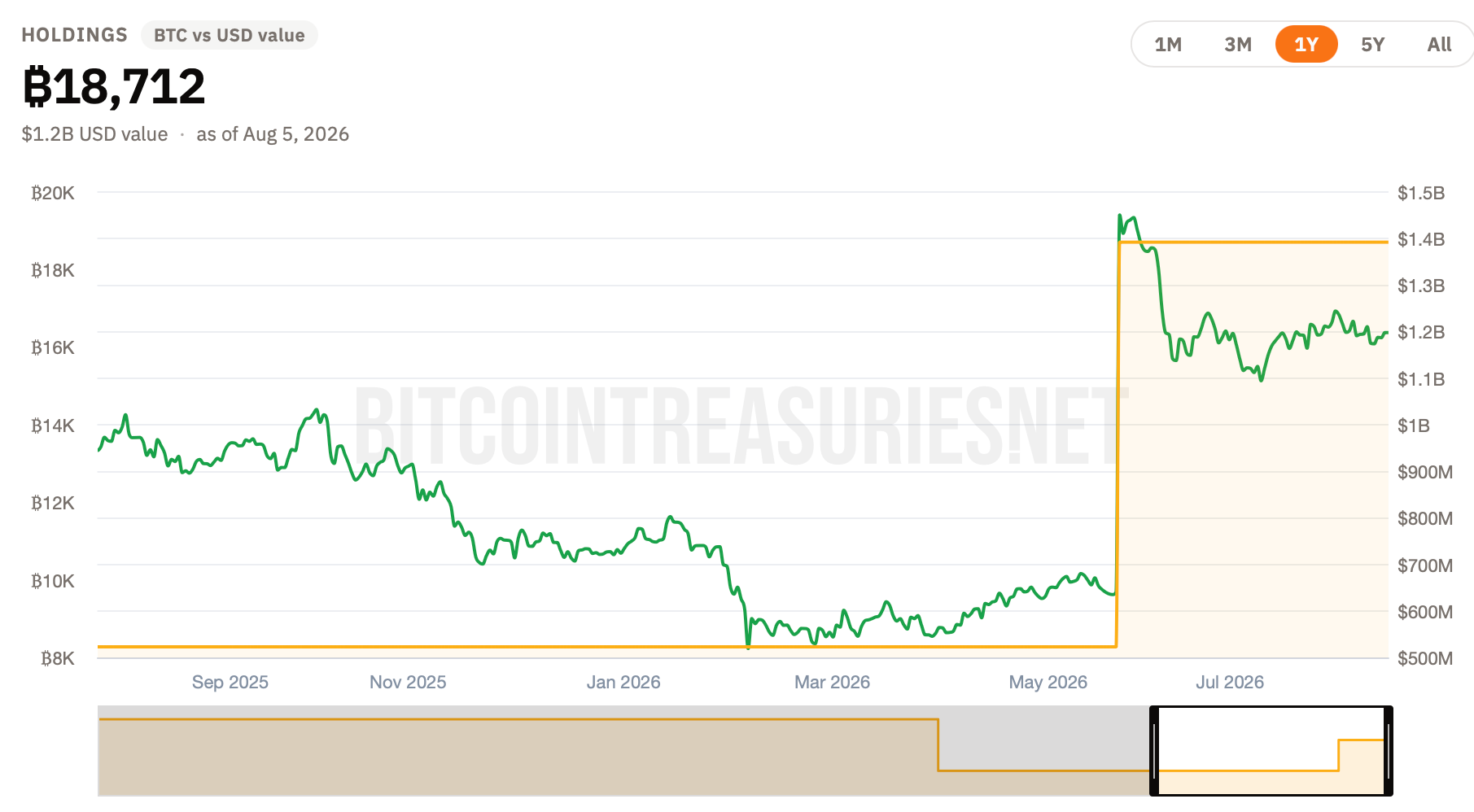
The company still holds 18,712 BTC. Those holdings are now worth about $1.2 billion, down from $1.64 billion at the end of 2025, reflecting Bitcoin's decline over the period.
SpaceX's earnings arrived less than two months after its record-breaking $86 billion IPO, with another key milestone just around the corner. On Aug. 6, roughly 912 million shares held by employees and early investors become eligible for sale, significantly expanding the stock's tradable float.
Traders focus on jobs data
Friday’s US jobs report is set to be the next major market catalyst. Economists expect nonfarm payrolls to rebound to 88K from June’s weaker 57K print, with unemployment holding steady at 4.2%. A softer-than-expected report could reinforce expectations for Fed rate cuts, potentially giving crypto and other risk assets a boost.
Top weekly winners
- PUMP (+25.3%) — Jumped after Pump.fun launched 0% fee multi-chain token transfers and USDC trading, supported by strong revenue and buybacks. Meanwhile, a wallet dormant for seven months withdrew 73.95 million PUMP (about $156,000) from Bybit on Aug. 4, a move widely interpreted as accumulation.
- ADA (+18.8%) — Gained after the first steps of the Dijkstra hard fork were unveiled, alongside whale accumulation of roughly 240 million ADA over five days. The upgrade aims to boost network throughput and transaction finality.
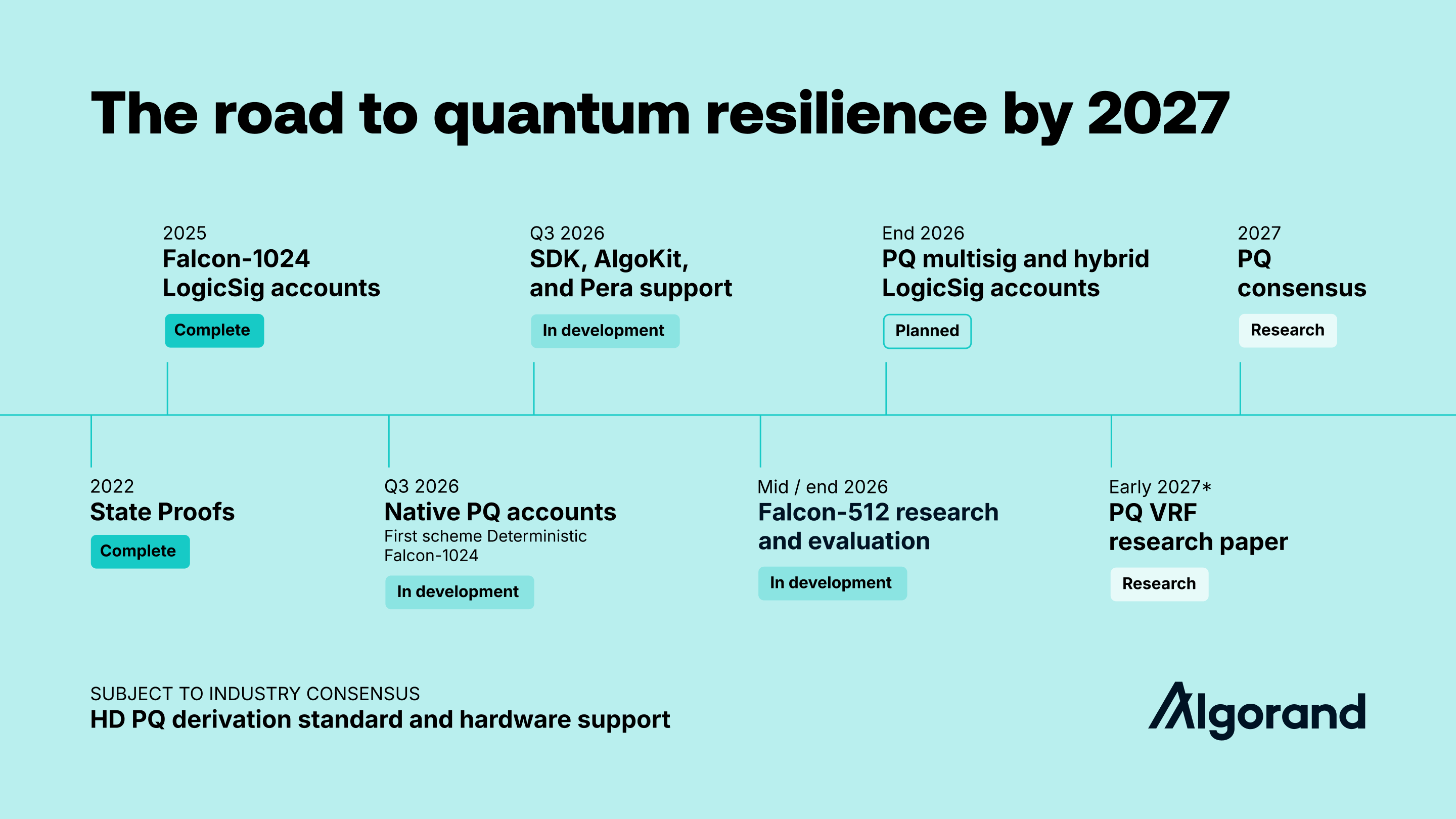
- ALGO (+14.5%) — Climbed on a combination of a mention in a Google Quantum AI research paper, the launch of Revolut's ALGO staking, and dip-buying following a recent all-time low. The paper highlighted Algorand's post-quantum security, placing it among the leading blockchain networks in this area.
Top weekly losers
- BEAT (-25.4%) — Came under pressure from profit-taking and leveraged liquidations following the Aug. 1 token unlock. Audiera released 21.25 million BEAT (roughly $67.8 million), equivalent to about 1.8 times the token's recent average daily trading volume. The decline followed a 40–50% weekly rally driven by strong on-chain revenue and an aggressive buyback-and-burn program.
- 币安人生 (BinanceLife) (-15.4%) — Fell after breaking below the $0.55 support level, while a 403.96% surge in Binance Futures volume pointed to heavy leveraged trading and likely liquidation cascades that accelerated the sell-off.
- STABLE (-10.2%) — Declined ahead of the Aug. 8 token unlock, which will release 3.61% of the circulating supply, adding to selling pressure. The launch of a trading competition with more than 8,000 USDT in rewards failed to offset supply concerns.
Cryptocurrency news
$116M Coldcard hack: 'I did everything right' — and still lost it all
A critical flaw in Coldcard firmware version 4.0.0, shipped in March 2021, has resulted in over $116 million in Bitcoin being stolen from more than 5,200 addresses since July 30. The device bypassed its dedicated hardware randomness chip during key generation, resulting in seeds attackers could enumerate.
The flaw caused the to use a predictable software substitute seeded from the chip's serial number and clock registers. The incident has been dubbed "the worst hit in bitcoin history" for self-custody, highlighting hardware wallet fragility.
Galaxy Research counted the largest sweep at 1,082 Bitcoin from 1,196 wallets, broadcast inside 41 minutes.
Jonathan Goodman, whose Coldcard sat in a safety deposit box, lost 18.25 Bitcoin — worth about $1.6 million — on the night of July 29. He had never shared his seed phrase; his devices had never even touched the internet.
"Perhaps the hardest part about this is that I did everything right," he wrote in an X post, viewed roughly 7.8 million times.
The industry reacts
Coldcard CEO Rodolfo Novak posted an apology: "I'm sorry and I'm devastated. Our team is heartbroken." Coinkite — the company behind the Coldcard wallet — urged all users to migrate funds immediately. "Please treat this as urgent," the advisory read.
But then Novak named a suspect that wasn't a person: AI. "AI-assisted code review can now find latent bugs at a speed that is outpacing even the industry's most seasoned experts," he wrote. "If your firmware is open-source, assume it's already being read by attackers."
Security specialists pushed back. A build flag that disables a hardware random number generator is a human engineering failure, they argue. Conventional review should have caught it years before any model read the repository.
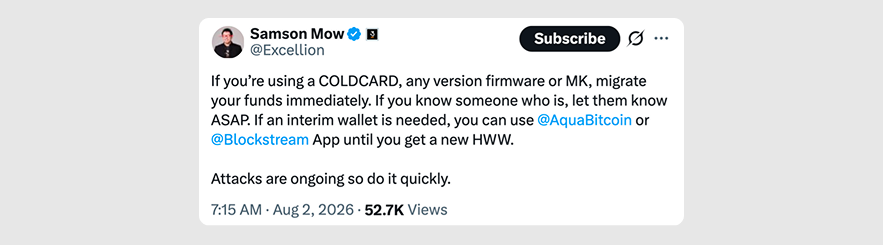
Jan3 CEO Samson Mow wrote on X: "If you're using a COLDCARD, any version firmware or MK, migrate your funds immediately. If you know someone who is, let them know ASAP... Attacks are ongoing so do it quickly."
The bigger debate
"This is the worst hit in bitcoin history to the most knowledgeable and 'properly secured' bitcoiners," said bitcoin commentator Guy Swann.
Taproot developer Udi Wertheimer wrote that "the idea of your bitcoin resting easy in some secret location while you enjoy life not worrying about it is currently unrealistic."
Institutional custodians made their pitch within days. Strive's Joe Burnett argued that regulated custodians like Fidelity suit large balances better than a hardware wallet with one point of failure.
Binance founder Changpeng Zhao, known as CZ, weighed in with a pragmatic take: spread your risk. "Even hardware wallets can have bugs. Even old wallets (with long history) can have bugs," he wrote on X. "How to mitigate? Split your funds in a few wallets maybe? This has a different set of risks. Nothing is 100%. Stay informed. Stay SAFU!"
Looking ahead
Coinkite is helping users file police reports and insurance claims. It has not offered to make anyone whole.
For Bitcoin's self-custody ethos, this is a body blow. The question now: will users trust hardware wallets again — or will they outsource security to institutions?
CZ's suggestion acknowledges that diversification comes with its own practical challenges, including more complex key management. But in a world where even hardware wallets can fail, it may be the most honest advice anyone has offered.
BlackRock puts $311B on-chain with Ethereum and Solana as rails
BlackRock is taking tokenization mainstream. The asset manager has launched tokenized share classes for a range of European money market funds holding a combined $311 billion. The 12 new share classes sit across six funds covering euro, sterling, and dollar strategies.
Tokens are minted on Ethereum using JP Morgan's Kinexys blockchain unit, which handles minting and burning while acting as the bridge between on-chain activity and the traditional share register.
Each token represents a share in the underlying fund. Smart contracts move holdings between approved investor wallets, delivering round-the-clock peer-to-peer transferability and near real-time visibility.
"Tokenization has moved from concept to execution," said Kara Kennedy, global head of market development at Kinexys.
Solana gets the nod too
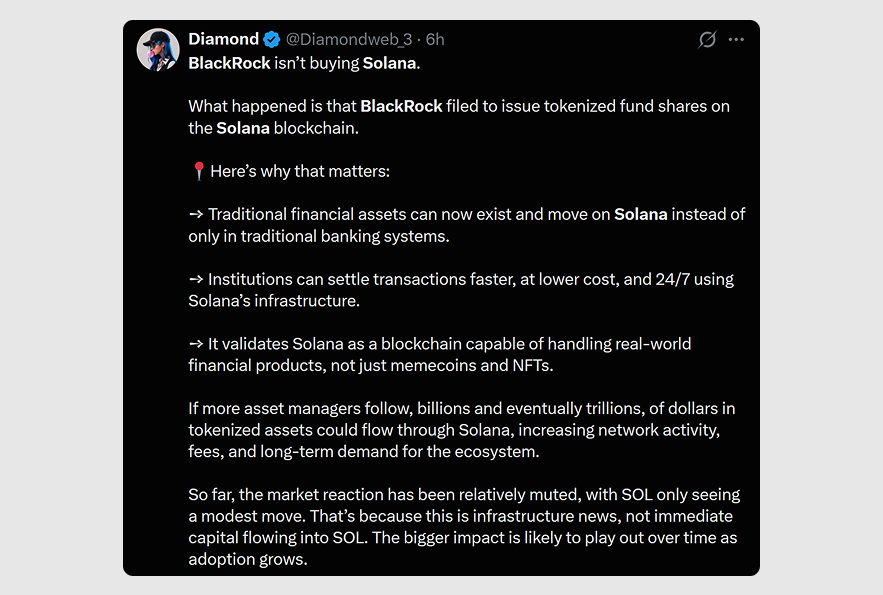
Ethereum isn't the only chain getting BlackRock's attention. The firm also filed for the BlackRock Daily Reinvestment Stablecoin Reserve Vehicle (RSVXX) — a tokenized money market fund that records ownership on Solana, Ethereum, and Stripe's Tempo.
The fund invests entirely in cash, short-term US Treasuries, and overnight repurchase agreements. It's designed to qualify as an eligible reserve asset under the GENIUS Act, meaning stablecoin issuers could hold shares of BlackRock's fund as part of the reserves backing their coins.
Credibility signal for Solana
The network is being treated as serious financial infrastructure, not just a memecoin chain. Payment networks care about speed and cost. Asset managers care about compliance and liquidity. Solana is now speaking to both.
Ethereum still matters. The ICS share classes on Ethereum represent $311 billion in existing assets, and BlackRock's Select Treasury Based Liquidity Fund is also using Ethereum with BNY Mellon handling official ownership records.
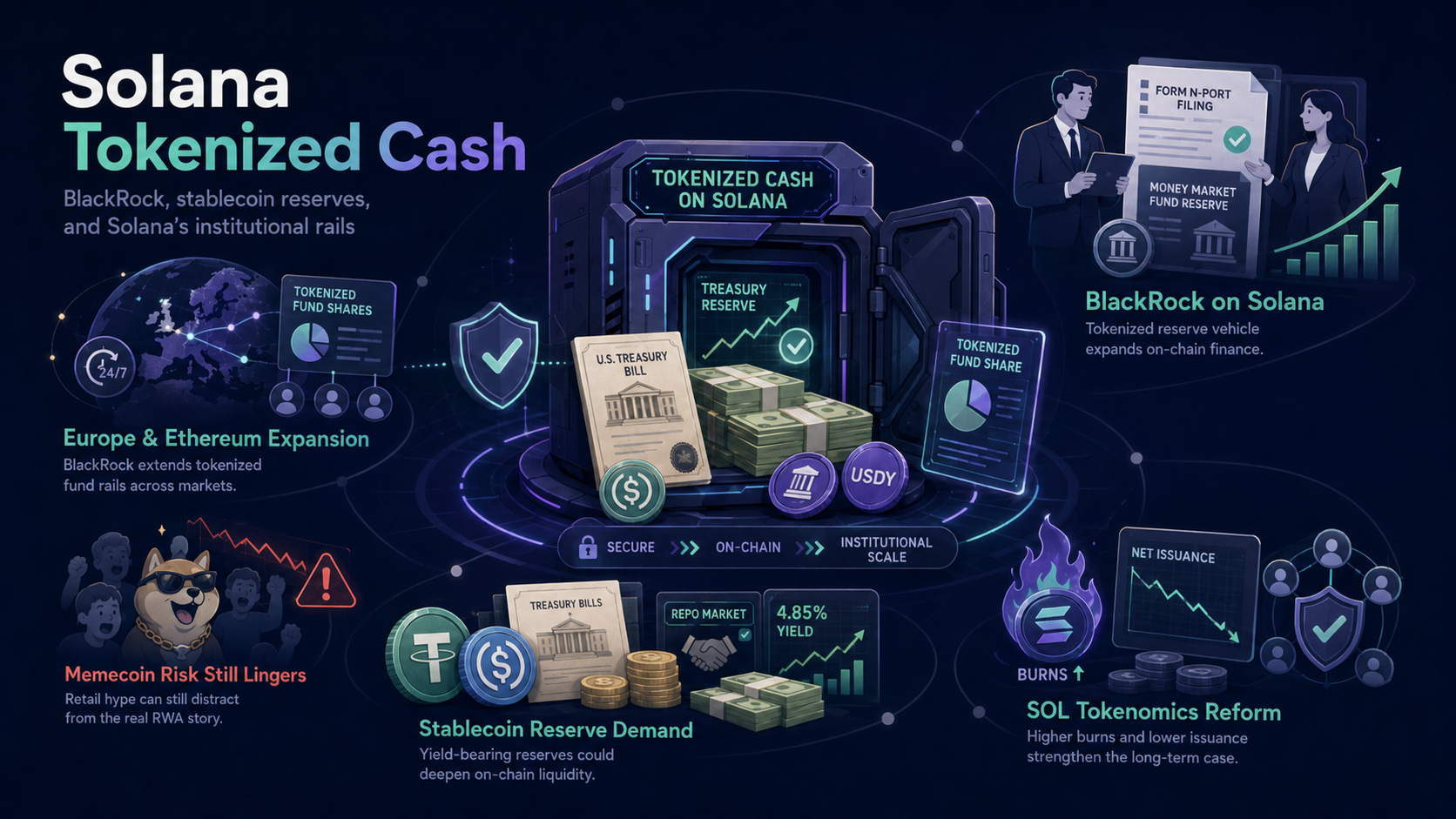
But Solana's role is expanding. Tokenized funds, stablecoin reserves, and payment rails are beginning to converge on the network. If more issuers follow BlackRock's path, Solana could become a chain where money-market shares, stablecoins, and DeFi collateral all start interacting.