Clapp Weekly: Pre-Fed AI rally, SEC defines crypto, Mastercard’s stablecoin push

BTC price
Bitcoin has retreated to $74k, slipping from the $76k zone ahead of the March 18 Fed rate decision. Despite oil prices soaring above $100 per barrel again, the coin has posted a 9-day streak of gains for the first time in four years — outshining stocks and gold. Institutional buyers and corporate treasuries appear to be absorbing supply on every dip.
The BTC price bounced off $69k and approached $73.5k on Friday, March 13, before retreating briefly and pushing further. On Tuesday, March 17, the coin hit a 7-day high of $75,632.41, then returned to the $74k mark.
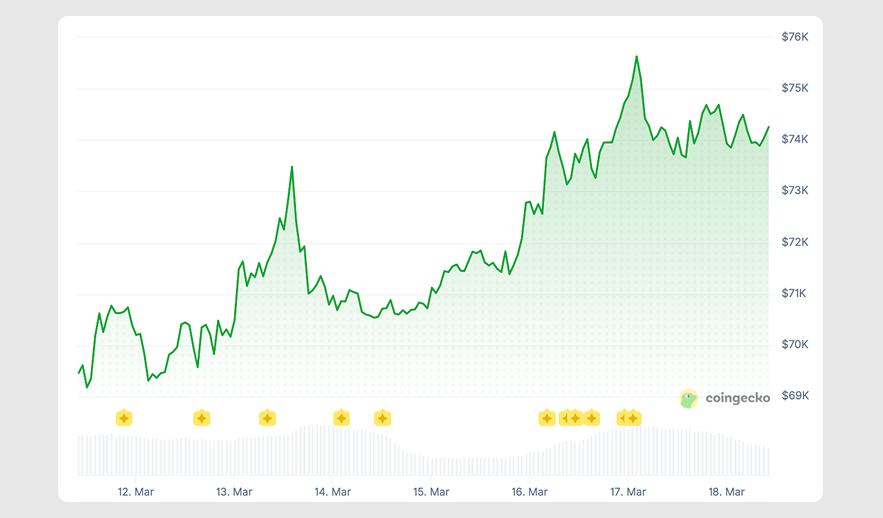
Currently at $74,260.59, BTC has gained 0.8% over the past 24 hours and 6.9% over the past 7 days.
ETH price
Ether climbed to $2.3k for the first time in six weeks, supported by a short squeeze and converging institutional demand from ETFs and corporate treasuries. Tom Lee's BitMine added another 60,999 ETH (worth roughly $138 million) last week — while US spot ether ETFs attracted the strongest weekly inflow since mid-January.
Amplifying BTC's rally, ETH surged above $2k, touched $2,188.53 on Friday, March 13, and briefly stabilized around $2.1k for two days. On Sunday, March 15, the coin jumped to $2,361.51, and has since teetered just above the $2.3k mark.
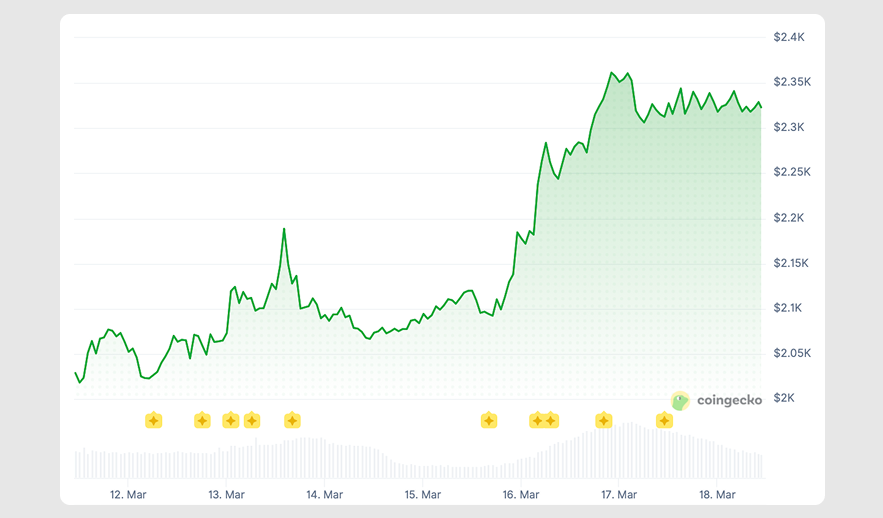
Changing hands at $2,330.44, ETH is up 0.7% over the past 24 hours with a stunning 15.5% weekly gain.
Seven-day altcoin dynamics
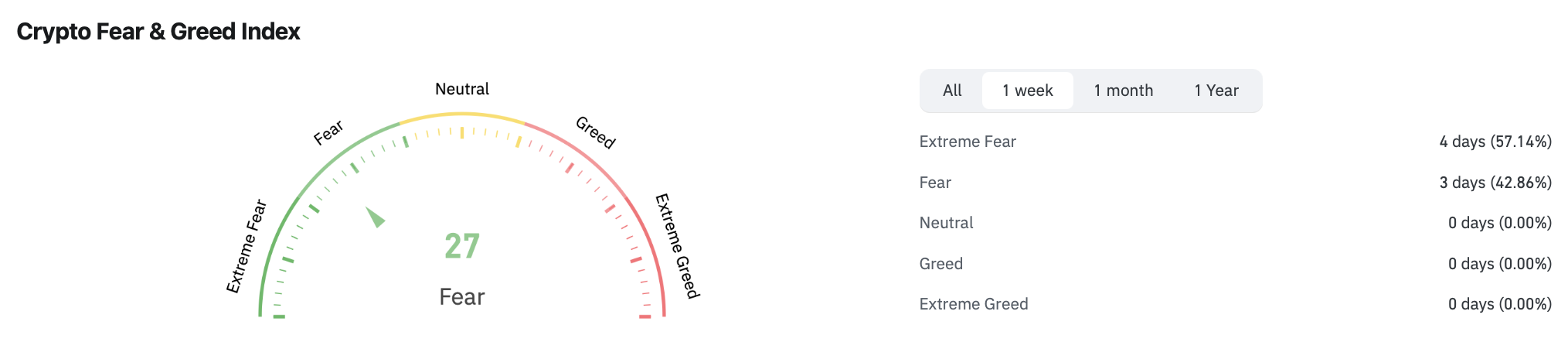
Like Bitcoin, altcoins are bracing for volatility ahead of the next FOMC decision. Sentiment has slightly improved over the past week, leaving the "Extreme Fear" zone following a brief dip in oil prices. The total market cap has ticked up by roughly $140 billion.
Fed & inflation triggers on the way
The market has effectively priced out a Fed rate cut at the March 18 meeting (less than 1% odds), but the tone of the Fed Chair's press conference remarks will be crucial. Combined with the latest wholesale inflation report (PPI), any hawkish signals could weigh on risk assets across the board.
With Brent currently trading at $101.82 per barrel amid the war in Iran, market observers are focusing on soaring oil prices and their possible inflationary effect. Signs that the Fed is viewing the oil price shock as only temporary could extend the crypto rally.
The FOMC press conference is scheduled to begin at 2:30 PM on March 18.
AI tokens surge
As BTC touched $75k in Monday's recovery rally, AI and privacy-related assets forged ahead. The rally was reportedly driven by infrastructure demand, not spot buying. According to Michael Heinrich, CEO of decentralized AI protocol OG Labs,
“AI agents need settlement layers, decentralized compute needs coordination, and on-chain privacy is no longer a nice-to-have, it's a prerequisite."
A fresh wave of agentic hype, the virality of projects like OpenClaw, and Nvidia's recent announcements have all contributed to capital rotation into the sector.
Speaking at Nvidia's annual GTC developer conference on Monday, CEO Jensen Huang outlined the tech giant's next phase of AI infrastructure, predicting $1 trillion in chip demand through 2027. His keynote also praised new agentic AI tools, describing ongoing work to adapt OpenClaw into an enterprise-ready version called NemoClaw.
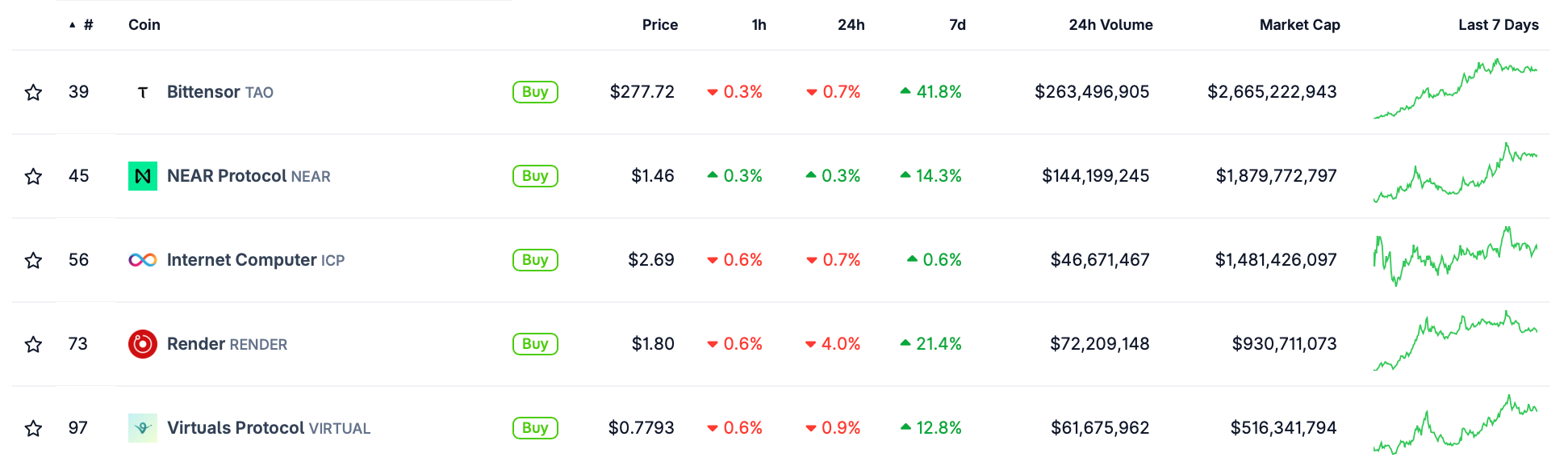
FET, NEAR, GRASS and WLD each gained over 10% during the day.
Top weekly winners
- SIREN (+69.6%) secured a new all-time high ($0.8291) after a rebound on March 17, though falling volume reflects weakening spot participation. This "bearish divergence" suggests the BSC-based token might be propelled by momentum rather than fresh capital inflows; some experts suspect bot activity.
- FET (+49.7%) soared with other AI tokens as news about declining oil prices earlier in the week and AI sector growth fueled a broad rally. Nvidia's annual GTC developer conference (March 16-19) is the latest catalyst (see above).
- TAO (+40.9%) joined the broader AI rally (see above). Like FET, it has climbed through the week, following the broader rebound linked to the US authorizing purchases of stranded Russian oil at sea to ease energy pressures. The launch of Bittensor's Covenant-72B model also attracted fresh capital.
Top weekly losers
- PI (-24.9%) has seen a massive correction following excitement around Pi Day and a Kraken listing. Despite a successful protocol v19.9 migration and ecosystem upgrades, the price has dipped in what appeared to be a classic "sell-the-news" moment, amid limited new investor participation.
- HASH (-14.1%) has tumbled in the absence of Provenance-specific news; its correction from February highs continues amid relatively modest RWA liquidity.
- MORPHO (-6.7%) is under pressure by an impending 22.6% token unlock, combined with profit-taking after a month of strong outperformance.
Cryptocurrency news
SEC finally draws the line on what's a security — and what's not
For years, the crypto industry has operated under a cloud of uncertainty, guessing which tokens might trigger the SEC's wrath. This week, that fog finally lifted.
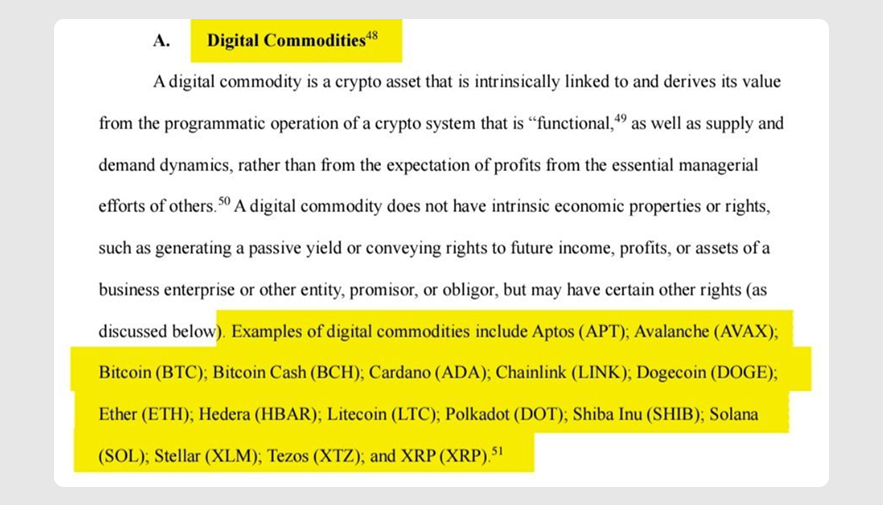
In its new interpretive guidance issued Tuesday, the Securities and Exchange Commission delivered what Chair Paul Atkins called a "token taxonomy" — a clear framework defining which digital assets fall under its jurisdiction and which belong to the CFTC.
"We're not the securities and everything commission anymore," Atkins told an audience at the Digital Chamber's DC Blockchain Summit, drawing enthusiastic applause. The line captured the essence of the shift: after years of enforcement-first regulation under Gary Gensler, the SEC is finally drawing boundaries.
For an industry weaned on regulatory ambiguity, it was nothing short of a revolution.
Five categories
The guidance, issued jointly with the CFTC, splits crypto assets into five buckets:
- Digital commodities — including major tokens like Bitcoin, Ether, Solana, XRP, and Avalanche — are deemed non-securities, falling under the CFTC's purview.
- Digital collectibles like CryptoPunks, Chromie Squiggles, and even dogwifhat (WIF) get the same treatment.
- Digital tools — think Ethereum Name Service domains — are also exempt.
- Stablecoins compliant with the GENIUS Act are classified as non-securities.
- Digital securities, the only category that remains under SEC oversight, are traditional financial instruments wrapped in new technology.
Clear rules for the industry
The interpretation clarifies that a token becomes a security only when offered as an investment contract with promised profits based on others' efforts. Crucially, that status isn't permanent — once the issuer fulfills its obligations, the token can shed its security label.
The guidance also addresses longstanding industry pain points: airdrops, protocol staking, protocol mining, and wrapping non-security assets do not constitute securities offerings.
CFTC Chairman Mike Selig hailed the move as long overdue. "For far too long, American builders, innovators, and entrepreneurs have awaited clear guidance," he said.
What's next
Atkins told reporters to "hold on to your seats," promising a formal rulemaking proposal within weeks — a 400-page document that will include an "innovation exemption" for crypto firms. Formal rulemaking will cement these changes, though Atkins acknowledged only congressional legislation can guarantee permanence.
Mastercard's $1.8B push: Are stablecoins the future of payments?
For years, the question hovering over traditional finance was simple: will stablecoins disrupt the card networks, or coexist with them? This week, Mastercard delivered its answer — with a check for $1.8 billion.
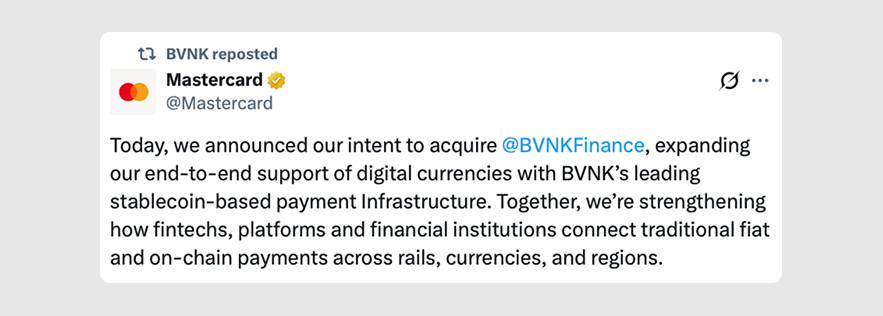
The payments giant announced Tuesday it has agreed to acquire BVNK, a London-based stablecoin infrastructure firm, in a deal that could reach $1.8 billion including performance-based earnouts.
It's Mastercard's largest crypto bet to date, and a clear signal that digital dollars are moving from niche curiosity to mainstream payments rail.
Why BVNK?
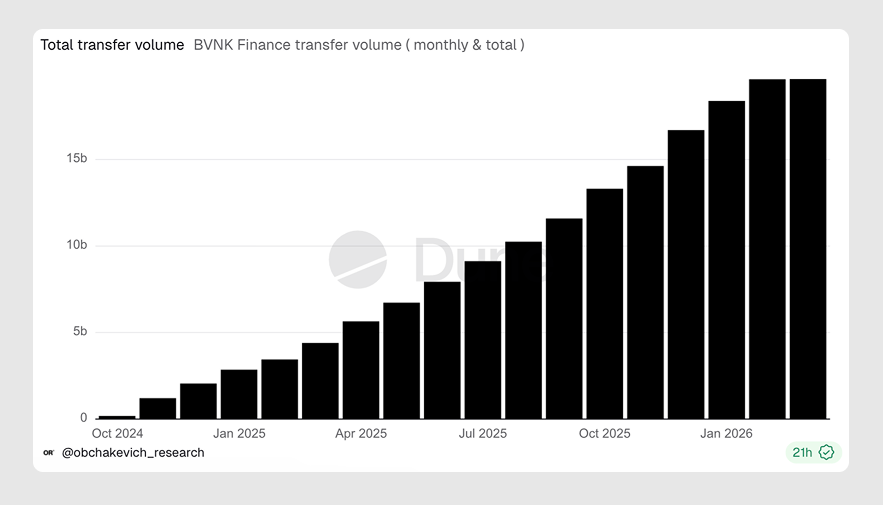
BVNK isn't a household name, but in crypto circles, it's infrastructure gold. The company enables businesses to send, receive, store, and convert stablecoins across more than 130 countries. In 2025 alone, it processed over $30 billion in stablecoin payments — a number that caught Mastercard's attention.
The acquisition gives Mastercard something it couldn't easily build itself: a direct pipeline between its vast traditional network and the 24/7 world of blockchain-based settlement. Cross-border payments that once took days can now move in minutes. Transfers that relied on intermediaries can now happen directly.
"We expect that most financial institutions and fintechs will in time provide digital currency services," said Jorn Lambert, Mastercard's chief product officer.
The bigger picture
Wall Street sees this as more than just a tech upgrade. Mizuho analyst Dan Dolev framed the deal as validation that stablecoins are becoming "integral to the future of payments." TD Cowen called it "a clear answer" to lingering questions about Mastercard's crypto strategy.
The timing makes sense. Stablecoin transaction volumes have reached an estimated $350 billion annually, and regulatory clarity is improving under the current administration.
The GENIUS Act created a federal framework for stablecoin issuers. The SEC just issued its first clear definitions of what is and isn't a security. For traditional finance giants, the message is clear: the window to enter is now.
Defensive move, offensive bet
Oppenheimer analysts see the deal as expanding Mastercard's ability to support end-to-end digital asset flows — converting between fiat and stablecoins, settling around the clock, and reducing reliance on legacy intermediaries. But there's also a defensive angle.
"Card networks are the most exposed payment rail to stablecoin disruption," said Harvey Li, founder of Tokenization Insight. If stablecoins can move money faster and cheaper without touching card rails, incumbents risk being bypassed entirely. Mastercard's move ensures it stays in the flow.
More to come?
BVNK isn't the first stablecoin infrastructure play to get scooped up. Stripe acquired Bridge last year for $1.1 billion. Morgan Stanley backed Zerohash. Now Mastercard has joined the club.
With both Mastercard and Visa now viewing stablecoins as core infrastructure, the consolidation wave may just be starting.