Prediction markets 101: Scandals, platforms & how they work

What do Fed rate cuts, crypto prices, and Oscar winners have in common? They're all tradeable on prediction markets — a sector that ballooned to $44 billion in annual volume in just two years.
In 2026, you can bet on just about anything — from Bitcoin moves to regime change — and millions of people are doing exactly that. Here's a look inside the platforms, the players, and the regulation shaping this space.
TL;DR
- Prediction markets let you trade binary contracts on real-world events, with prices reflecting crowd-sourced probability.
- The sector has seen explosive growth in just two years, morphing from academic curiosity to crypto mainstream phenomenon.
- Polymarket (decentralized) and Kalshi (centralized) lead the pack, with different approaches to order matching, settlement, and regulation.
- Insider trading scandals have rocked the industry — most recently, a $553,000 Polymarket win hours before an Israeli strike killed Iran's Supreme Leader.
- Regulatory cracks are showing, with at least 12 US states cracking down and the CFTC scrambling to police pseudonymous trading.
From niche bet to $44B frenzy
Prediction contracts began as a niche experiment in political betting — once confined to low-volume platforms and academic circles. That simple concept has now smashed into the crypto mainstream as another earning opportunity for traders.
Platforms like Polymarket have become a pulse check on social sentiment, quoted by major news outlets. Will the oil price shatter $100 per barrel this year? Who will secure the next US presidential election? A question becomes a tradable contract worth between $0.01 and $0.99.
Quick history: Iowa to insiders
The first glimpse of a prediction market dates back to 1988, when the University of Iowa rolled out The Iowa Electronic Markets for research purposes. That platform was built for trading on US election outcomes.
For the next few decades, the concept lingered within academia and small-scale platforms like PredictIt.
The tipping point came in 2024, during the US presidential election cycle. Polymarket took center stage while rival Kalshi scored a crucial legal victory greenlighting its right to list political event contracts. In 2025, the sector processed $44 billion in volume.
By early 2026, this market had exploded to cover a broad spectrum of events — from tech milestones to the Super Bowl to cultural outcomes like Oscar winners. Prediction contracts evolvedinto a new asset class at the crossroads of traditional finance and real-world data.
What actually is a prediction market?
Technically, a prediction market is a trading platform where users can buy and sell contracts linked to the outcome of future events — reminiscent of trading stocks or currencies.
An event contract functions like a binary option tied to an observable real-world event — with a "Yes" and "No" position available to buy. The price (between $0.01 and $0.99) reflects the market's implied probability, hammered out by the collective trading activity of all market participants.
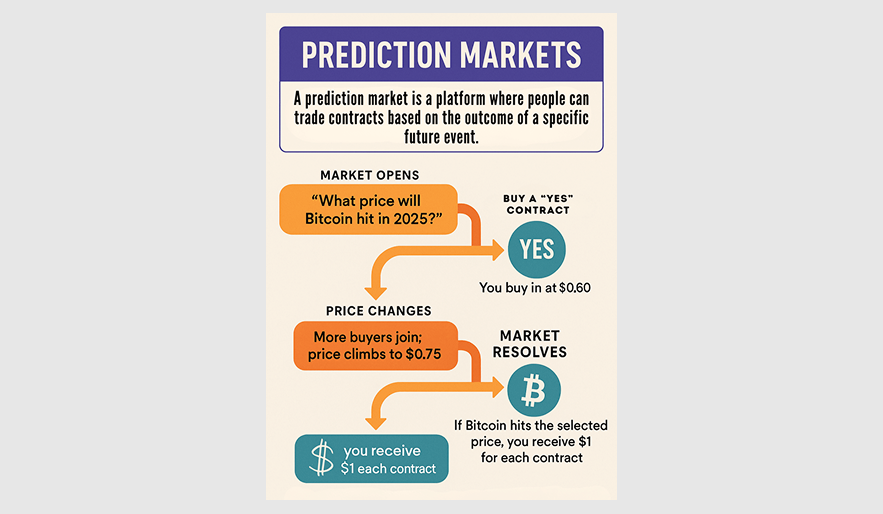
For instance, a "Yes" contract trading at $0.72 implies 72% odds of that event occurring. If a trader's call is right, they pocket the difference between that initial cost ($0.72) and the $1.00 payout. If not, they lose that $0.72.
Magic behind the contracts
One of the keys to prediction markets' popularity is the absence of margin calls and stop losses. Their all-or-nothing payoff profile means the maximum loss for a user is capped at what they paid for the contracts. Partial recovery is impossible unless they sell before settlement.
The inner logic involves three consecutive stages:
- Contract creation. Every contract is listed with clear resolution criteria specifying how the outcome will be determined, the expiration date, and the settlement rules. For example, in a contract on a Fed rate cut decision, the FOMC post-meeting statement officially seals the outcome.
- Trading. Depending on the platform, orders from buyers and sellers are either matched similarly to a stock exchange or stitched together from on-chain and off-chain elements.
- Settlement. Once the event resolves based on the specified criteria, winning contracts are paid either via traditional banking channels (Kalshi) or through crypto wallets (Polymarket). The losing side of the trade walks away with nothing.
Example
Suppose you're bullish that the price of crude oil will blow past $200 per barrel by the end of June 2026. You believe the odds are higher than the market suggests, although the "Yes" contract is currently trading at just $0.15 — meaning the market sees only a 15% chance of that playing out.
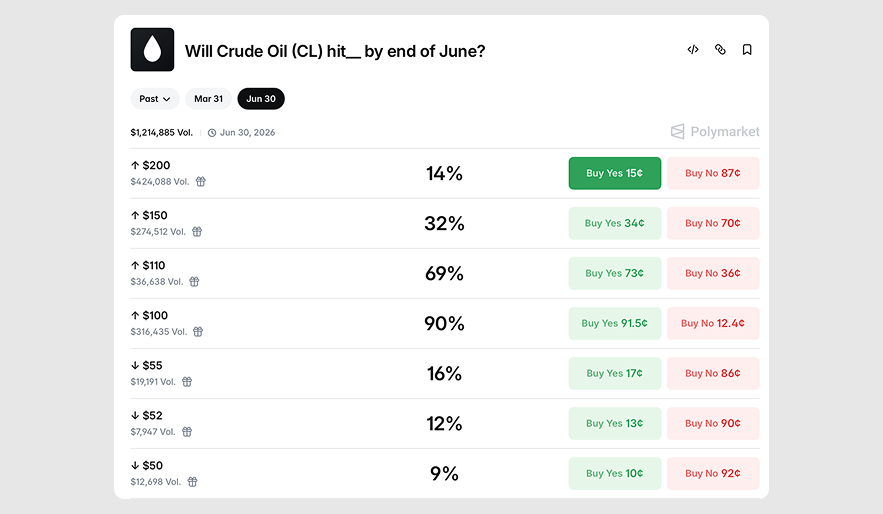
You buy 100 contracts, spending $15 in total. If the price indeed rips to $200 by June 30, those 100 contracts will settle at $1.00 each — netting $85 in profit ($100 - $15). Otherwise, all your contracts expire worthless, meaning you kiss that $15 goodbye.
Kalshi vs. Polymarket: Two platforms, two philosophies
As a centralized provider, Kalshi relies on a Central Limit Order Book (CLOB) — a matching engine architecture borrowed straight from stock and futures exchanges. The exchange matches buyers' and sellers' orders (limit and market).
Kalshi must maintain sufficient funds to maintain liquidity across all contracts. Currently, it allocates around $35,000 daily for market-making incentives. That adds up to roughly $12.7 million per year.
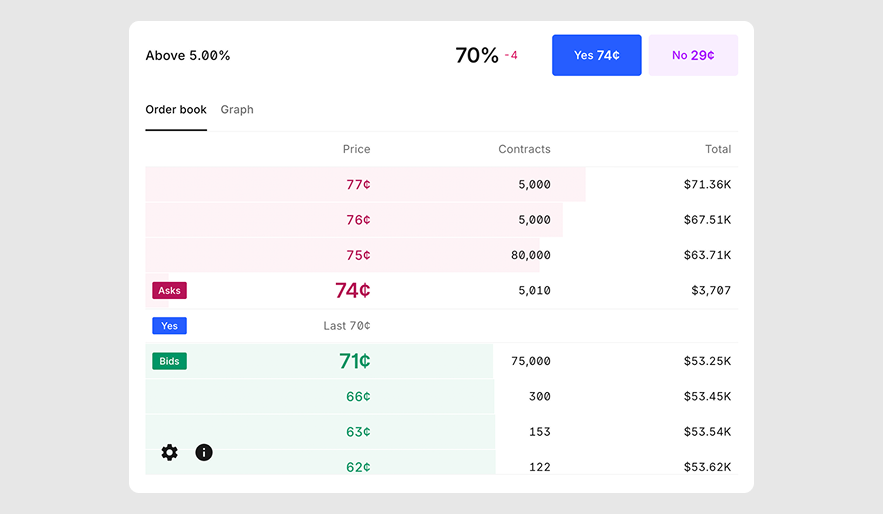
Upon resolution, winning contracts pay $1.00 each, landing in the user's account via traditional banking.
The hybrid decentralized model, embodied by Polymarket, fuses off-chain order matching and on-chain settlement. All positions are settled in USDC via Polygon, which lets the platform serve international users without ties to US banks.
Instead of a classic matching engine, at the heart of this system are cryptographic signatures (EIP-712). They ensure orders are authenticated. Winners receive USDC to their connected crypto wallet.
What can you trade on prediction markets?
As we mentioned, prediction markets have roared far beyond their political betting origins — evolving from a single-event novelty into a continuous trading product.
As of early 2026, prominent contract categories include:
- Macroeconomic events: Federal Reserve interest rate decisions, inflation indicators like the Consumer Price Index (CPI) and Personal Consumption Expenditures (PCE) releases, GDP growth updates, and labor market dynamics.
- Politics and elections: Policy decisions and elections around the world, legislative outcomes.
- Sports: Super Bowl outcomes, prediction market products rolled out by DraftKings (proprietary CFTC-licensed exchange) and FanDuel (exchange-traded sports contracts in partnership with CME Group).
- Crypto and technology: Price predictions (e.g., will BTC price tap $100k by the end of 2026), crypto-related regulatory decisions, product launches, protocol upgrades, and other tech milestones.
- Culture and entertainment: Award ceremonies, media releases, and viral moments.
Contracts tied to macro events like Fed decisions allow users to trade their outcomes directly, without jumping through derivatives. Economic data releases, sports seasons, and crypto events create a constant firehose of tradeable opportunities.
Categories beyond finance and sport typically attract modest volume in comparison. However, they widen the platform's appeal, reeling in audiences that might not participate otherwise.
Not so fast: The risks you need to know
The regulatory maze
Even within the United States, laws vary. At least 12 states have cracked down on prediction market platforms. Elsewhere, prediction market platforms navigate shifting regulatory treatment.
Rather than being seen as financial instruments or derivatives, trading contracts may be pigeonholed as gambling products, triggering different taxation rules for winnings, weaker consumer protections, and licensing requirements borrowed from casinos.
The irony isn't lost on pop culture.
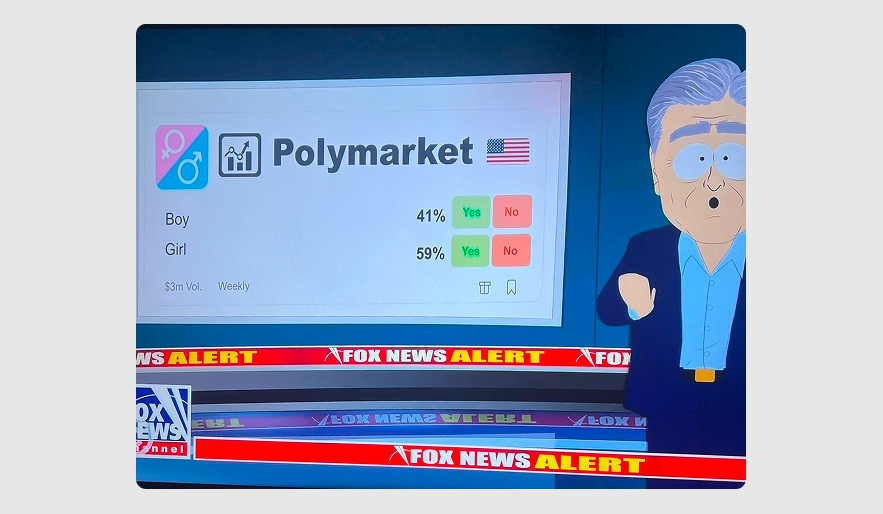
In September 2025, the same week the CFTC handed Polymarket a regulatory green light, South Park devoted an entire episode to prediction market satire (Season 27, Episode 5). In "Conflict of Interest," fourth-graders turned into degens, betting avidly on everything from cafeteria lunch to geopolitical crises.
The joke landed close to home: real platforms like Polymarket and Myriad (another on-chain market launched in 2025) immediately listed contracts on whether the show would name-drop them. It didn't — but the episode did take aim at Trump Jr.'s advisory role at Polymarket.
The insider edge
Market integrity gets murky fast here, as information asymmetry becomes profitable. Prediction markets are wired for this kind of information advantage — it's both their strength and their vulnerability.
Polymarket's ties to the establishment run deeper than its tech stack. Donald Trump Jr. advises the platform, and his venture capital firm 1789 Capital has invested millions.
- That connection made headlines in March 2026, when an account trading as "Magamyman" pocketed over $553,000 betting on the death of Iran's Supreme Leader — just before an Israeli strike killed him.
- Just weeks prior, another anonymous Polymarket account netted over $400,000 after successfully predicting the US invasion of Venezuela and the extraction of President Maduro. Even more suspiciously, the bettor doubled down hours before the offensive started.
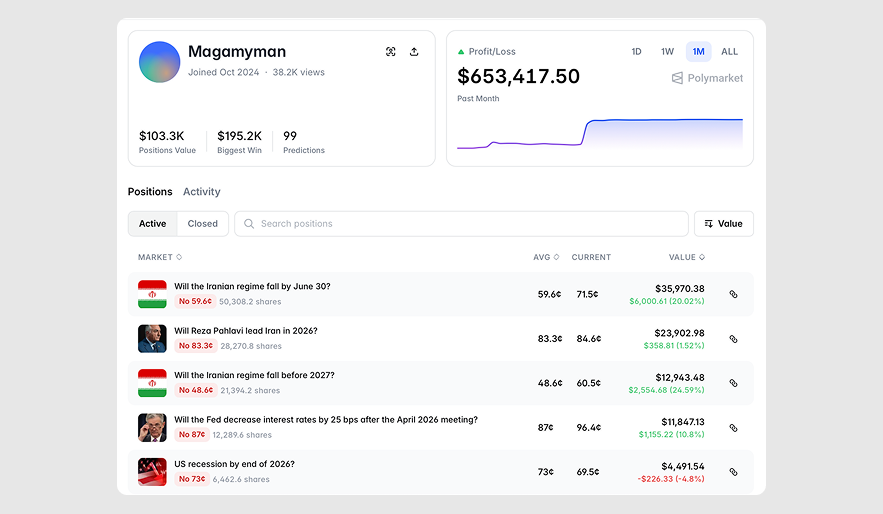
While the White House denied anyone in Trump's orbit had inside information, the episode made one thing clear: sometimes, traders really do know something the market doesn't.
The CFTC is currently sketching out frameworks to police insider trading, but enforcement in a global, pseudonymous environment won't be straightforward.
Rumor-driven speculation & hype
In September 2025, rumors about Donald Trump's health spiraled so wild that they sparked over $1.6 million in bets across prediction markets.
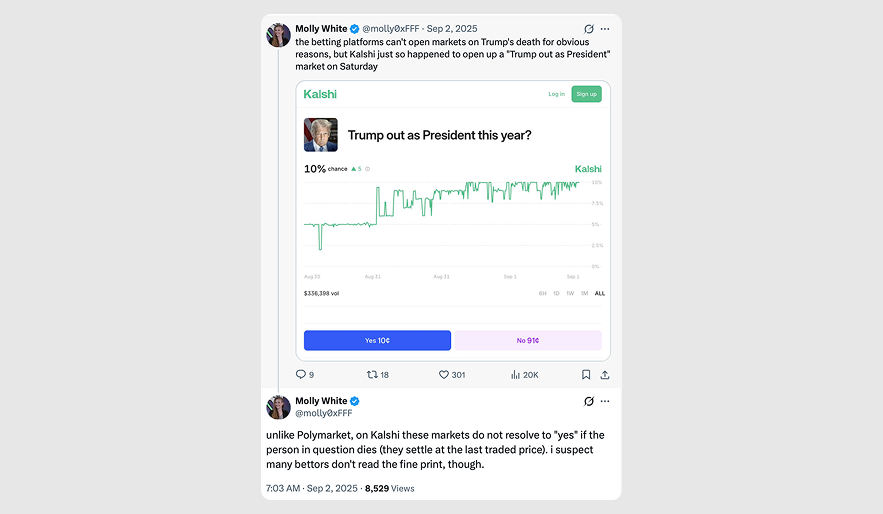
The president was fine, despite fewer public appearances, but the episode showed how quickly online speculation crystallizes into real-money action.
Liquidity deserts
The more popular an event, the deeper the order books and the tighter the bid-ask spreads. Participants in niche markets like tech upgrades may face thin liquidity, wide spreads, and difficulty exiting positions at fair prices.
Where the systems can break
- Decentralized architecture may expose users to smart contract risk (e.g., code bugs) and potential network congestion during high-volume events.
- Centralized rivals carry traditional counterparty risk, with a history of freezing up during peak demand periods.
- Finally, there are white-label solutions that make vendors and brokers entirely dependent on the provider's performance.
From ivory tower to multi-billion industry
Prediction markets have given traders something TradFi never could: a direct line to betting on the news as it happens, not just the assets attached to it. Whether it's a Fed decision, a Super Bowl matchup, or the fate of a world leader, there's probably a contract for it now.
But growth brings growing pains.
The same features that make these markets powerful — open access, pseudonymity, real-time settlement — also make them a magnet for bad actors. Where prediction markets land next depends on how they navigate this moment: clean up the insider edge, survive the regulatory squeeze, and keep delivering on the promise of letting anyone trade on what happens next.