AI agents in crypto: Future of automated payments

Payments are no longer exclusive to humans. The financial world is bracing for an automated future with autonomous, AI-powered agents at the core. Big Tech’s approval-based systems must accommodate this tectonic shift, but one question remains — will platforms or open protocols take center stage?
The answer could determine who controls the next era of digital commerce.
What are AI agents?
Humans have been making payments for thousands of years. Now, for the first time in history, AI agents can conduct transactions on their behalf. These software systems interpret their environment, reason, plan, and take autonomous actions to achieve specific goals.
Recent advances in artificial intelligence (AI) go far beyond retrieving and organizing data through passive chatbots. For instance, unlike ChatGPT or Gemini, OpenClaw enables AI agents to execute tasks directly on a user's PC or server — from sending emails to checking you in for flights.
Now, there is even a social network just for AI agents. On Moltbook, over a million of them share, discuss, and upvote while humans watch from the sidelines.
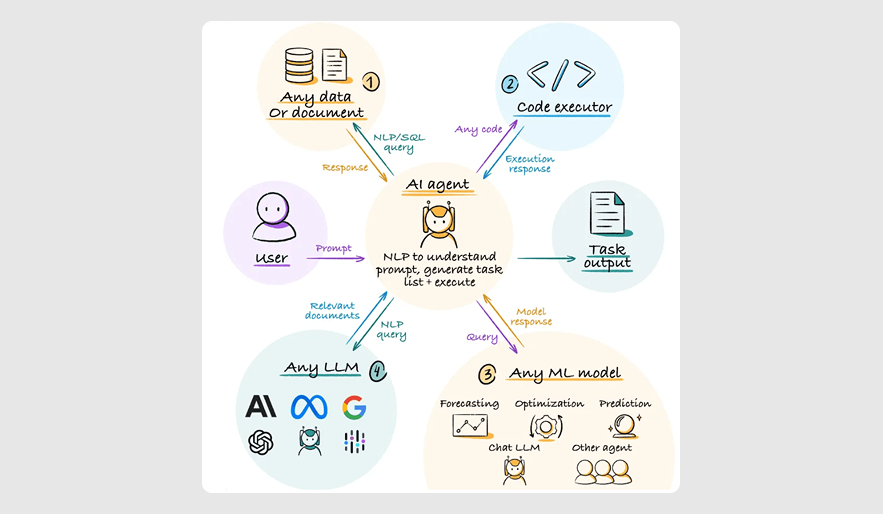
What AI agents can and cannot do
In crypto, AI agents aren’t just digital assistants — they can perform and manage transactions, monitor markets, and interact with decentralized platforms on your behalf. To issue commands, one may use popular messengers like Telegram.
An AI agent can:
- Observe. By sifting through vast amounts of data (for example, user input, market trends, or blockchain transfers).
- Plan. By making decisions based on real-time data after analyzing it via advanced algorithms and machine learning models.
- Take action. By executing tasks automatically, such as opening a trade or sending a notification.
- Learn. By refining performance based on prior actions and feedback loops.
- Adapt. By continuously optimizing strategies, adjusting dynamically based on experience.
These capabilities become especially powerful in environments that are digital, programmable, and always on — which is exactly what crypto offers.
Yet even the smartest AI agents have limits. They can’t improvise in messy, unpredictable situations or read the bigger strategic picture. Human judgment and relationship-building remain essential for edge cases, conflicting data, or decisions that require context beyond pre-programmed rules.
In short, AI amplifies your capabilities, but it can’t replace the reasoning and foresight that only humans bring to the table.
Applications of AI agents in crypto
Crypto is one of the first industries where autonomous agents can operate without friction, thanks to programmable money and open financial infrastructure. Always on, they can spot trading opportunities faster than any human being.
Existing applications include:
- Trading automation. AI agents can analyze real-time data, identify high-probability entry and exit points, and execute trades instantly. They are also capable of adjusting strategies to manage risk more effectively as market conditions shift.
- Streamlined DeFi. Known for its complex interfaces, decentralized finance becomes more navigable as AI agents optimize yield farming strategies, automate lending and borrowing, and detect smart contract vulnerabilities.
- Intelligent NFTs (iNFTs). AI agents can create and manage a dynamic class of digital assets that learn and evolve based on user preferences.
- General ease of use. By managing wallets, approving transactions, and interacting with smart contracts, AI agents lower the technical barrier to blockchain adoption.
- Cybersecurity. AI agents leverage advanced technologies like multi-party computation (MPC) to fortify digital assets and transactions, making exploits significantly harder.
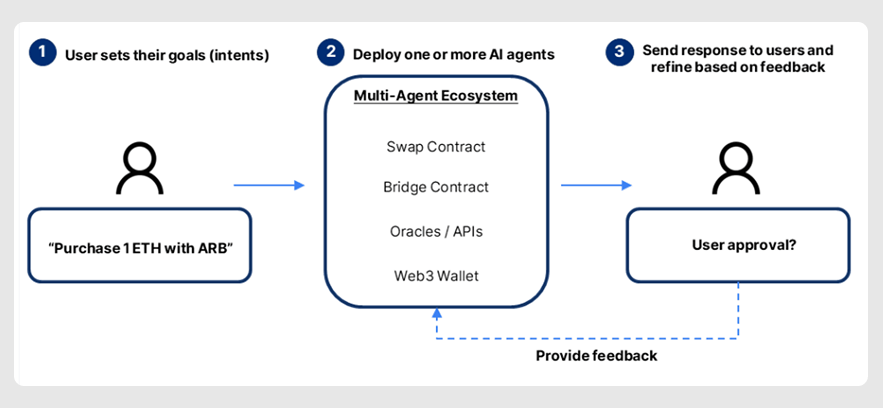
Top crypto AI agent projects
- Artificial Superintelligence Alliance (FET) – Decentralized AI consortium; powers staking, agent registration, and access to AI tools.
- Virtuals Protocol (VIRTUAL) – Turns AI agents into tokenized assets; users gain fractional ownership and profit potential.
- OriginTrail (TRAC) – Decentralized knowledge graph; ensures data authenticity and secures Core Nodes.
- elizaOS (AI16Z) – Framework for autonomous AI investment agents; tokens enable governance and DAO exposure.
- Freysa AI (FAI) – Sovereign agent operates independently of humans; token utility still evolving.
- PAAL AI (PAAL) – Practical AI tools like Paal X for crypto trading; offers staking and revenue-sharing.
Challenges that remain
For all their enormous potential, AI agents still have shortcomings that slow mainstream adoption.
Hallucinations
AI models are not infallible; they remain prone to miscalculations, particularly in high-stakes scenarios like trading or smart contract audits. They may fabricate statistics, apply wrong tools, ignore rules, and even claim success when failing.
Hallucinations are inherent to how LLMs work. They may be intrinsic (false output generated based on the system's internal knowledge) and extrinsic (contradicting or disregarding retrieved documents or externally provided sources).
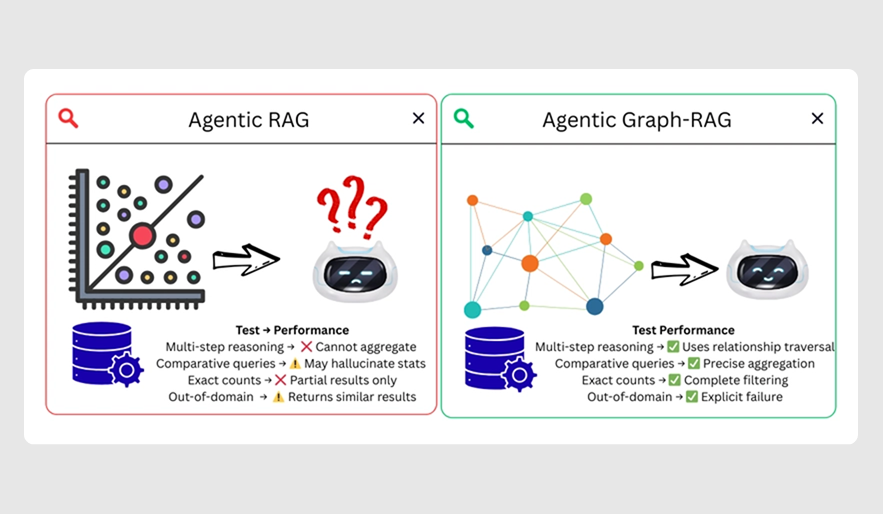
A seemingly minor error may trigger substantial — and irreversible — financial losses. Existing solutions like Retrieval-Augmented Generation (RAG) still require further refinement.
RAG combines LLMs with external, dynamic, or private data sources to provide accurate, context-aware, and up-to-date responses. However, this solution is imperfect and susceptible to extrinsic hallucinations.
Developers focus on detecting, containing, and mitigating those flaws before they cause damage. Examples of such techniques include multi-agent validation and Graph-RNG.
Trust & transparency
For AI agents to be truly autonomous, they must provide a high degree of transparency so users can verify actions and decisions. While blockchain offers a public ledger, meaningful confidence requires robust verification mechanisms and decentralized governance.
Ethics & regulation
Like any digital technology, AI agents may be exploited for manipulation or fraud. Continued development requires clear legal frameworks to prevent tampering and bias in decision-making. The industry must strike a careful balance between oversight and innovation.
Scalability
For thousands, let alone millions, of AI agents to execute real-time transactions, blockchains must overcome congestion bottlenecks. Major chains like Ethereum still face network strain and soaring fees during peak demand. This makes layer 2 solutions and alternative chains essential for realizing AI-driven payments at scale.
Among all these limitations, payments remain the most critical bottleneck. Until agents can move funds independently, true autonomy remains incomplete.
Using AI agents for payments
Here, one critical limitation remains.
When it comes to payments, AI agents can discover and compare products and add items to a shopping cart — and that’s where autonomy currently stops. Final payment authorization still requires a human to review and click "approve."
That is why, over the past year, big tech firms and crypto projects have been developing technical frameworks to enable true agent-level payments. Two distinct models are emerging to solve this challenge: one rooted in open, self-custodial infrastructure, and another layered onto existing platform ecosystems.
The key difference between them is whether the AI agent needs to ask for permission to pay, or if it can pay on its own.
Crypto-native solutions: ERC-8004 & x402 standards
The crypto industry is building its own payment infrastructure tailored to AI agents. It starts with a simple question: can autonomous agents be trusted without centralized oversight?
Currently, two primary standards address identity, reputation, and validation.
- ERC-8004 (Ethereum) functions like a digital identity layer. It assigns each AI agent a unique identifier — an NFT comparable to a government-issued ID. Every agent also receives a credit score from 1 to 100, updated after each transaction, with additional verification required for high-stakes interactions.
- x402 (Coinbase) provides the payment rail. This standard enables agents to transact in stablecoins through smart contract execution. Human intervention is unnecessary, as settlement occurs strictly according to conditions embedded in code.
Tiger Research illustrates how these standards operate in a crypto-native environment, where a buyer's agent purchases a laptop from a seller's agent for $800.
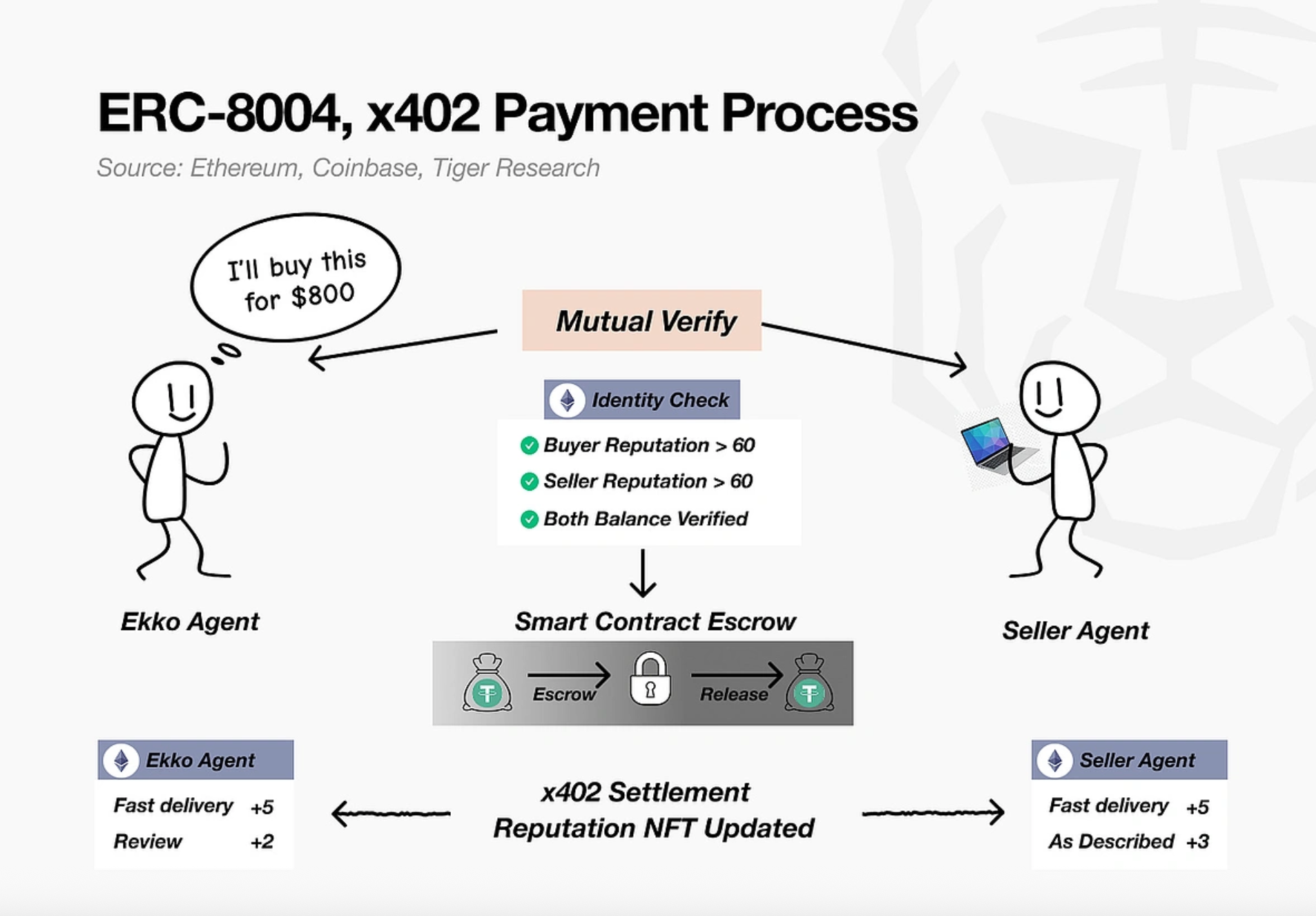
Both agents transact directly without platform approval. Verification and settlement occur on-chain.
- Before the transaction begins, parties verify each other's reputation (ERC-8004 NFTs) and confirm that the laptop meets the agreed specifications.
- Funds are transferred and confirmed via the x402 protocol using escrow logic. The buyer's wallet transfers $800 to a smart contract that automatically releases payment upon delivery confirmation.
- Post-settlement, both agents’ reputations are updated and written to their ERC-8004 NFTs — boosted if everything proceeds smoothly, reduced if disputes arise.
Big Tech solutions: Leveraging existing infrastructure
Companies like Google and OpenAI are pursuing a different path, layering approval-based automation onto existing ecosystems. Google's AP2 Agent Payment Protocol 2.0 represents the first structured implementation framework, operating on top of Google Pay and existing user credentials.
Here’s how it works at a glance.
The transaction process is divided into three mandate layers: intent, cart, and payment. The agent can access pre-registered card details and shipping addresses without additional user input.
- Intent Mandate: This layer records the user’s instruction and stores it on-chain as a digital contract. For example, the user may authorize purchasing a down jacket for up to $200.
- Cart Mandate: The AI agent executes the search logic, finds a matching product within budget (e.g., $199.99), adds it to the cart, and confirms the shipping address.
- Payment Mandate: The buyer reviews the selected item and approves payment with a click. From there, payment proceeds either via Google Pay or automatically based on predefined parameters.
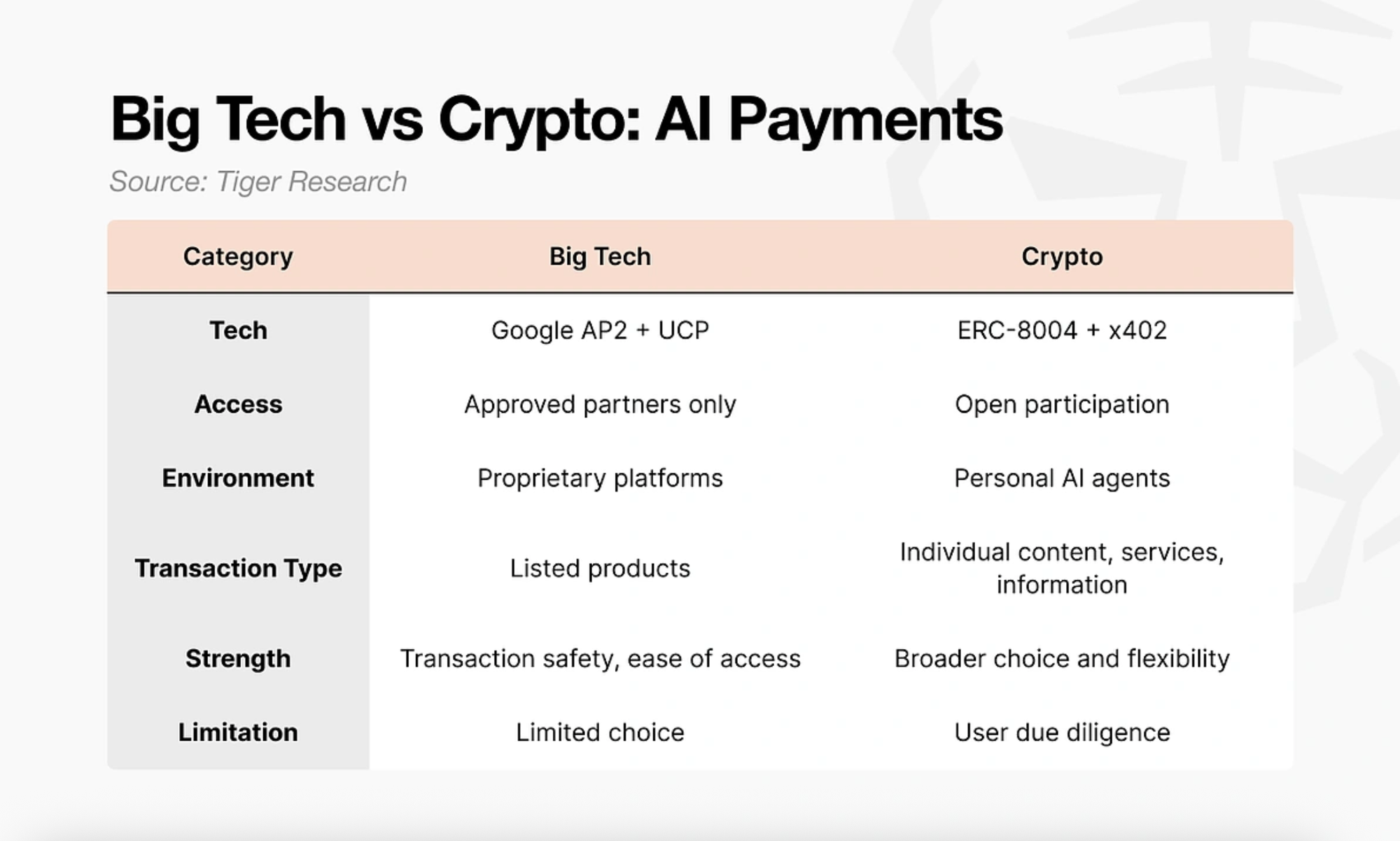
So, where does this leave us?
We’re standing at the very beginning of a shift that feels both exciting and slightly unsettling. For the first time, money is not just moving between people; it’s flowing between machines acting on our behalf. The idea of an AI negotiating a deal or settling a payment while we sleep is no longer science fiction — it’s actively being engineered.
Whether this future runs on the open, permissionless rails of crypto or within the controlled ecosystems of big tech remains unresolved. What is becoming clear, however, is that autonomous commerce is advancing rapidly. And as it does, it will reshape not only how we transact, but how also we define participation in the digital economy itself.