AI IPO boom: OpenAI, Anthropic and the next trillion-dollar listings

2026 is shaping up to be a breakout year for IPOs. After SpaceX tested public appetite for trillion-dollar listings, major AI-related names are forming a much-anticipated pipeline.
With that debut as a bellwether, Goldman Sachs expects roughly 100 listings this year, potentially signaling a renewed IPO boom. Here’s a look at the most anticipated AI names and how crypto investors may seek exposure.
TL;DR
- OpenAI and Anthropic are leading a new wave of AI IPO candidates, with valuations already approaching the trillion-dollar mark.
- The SpaceX IPO reignited investor appetite for mega-listings and could help drive a broader IPO boom in 2026.
- Retail investors may gain exposure through public IPO shares, tokenized stocks, pre-IPO marketplaces, or crypto-based perpetual futures.
- Not all IPO-linked products provide actual ownership — many offer only synthetic price exposure without voting rights or dividends.
- Before investing, understand the risks, including lockups, valuation uncertainty, liquidation risk, counterparty exposure, and misleading marketing claims.
SpaceX success sparks IPO boom expectations
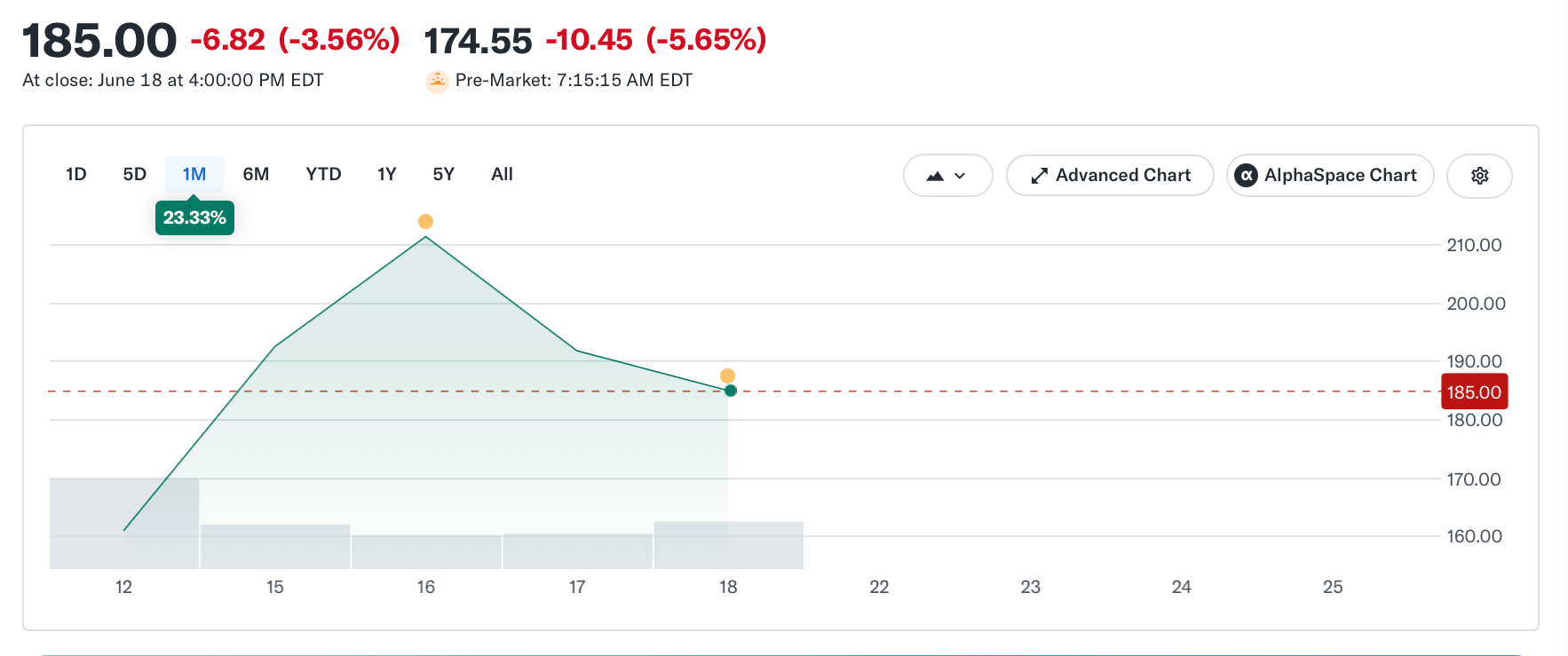
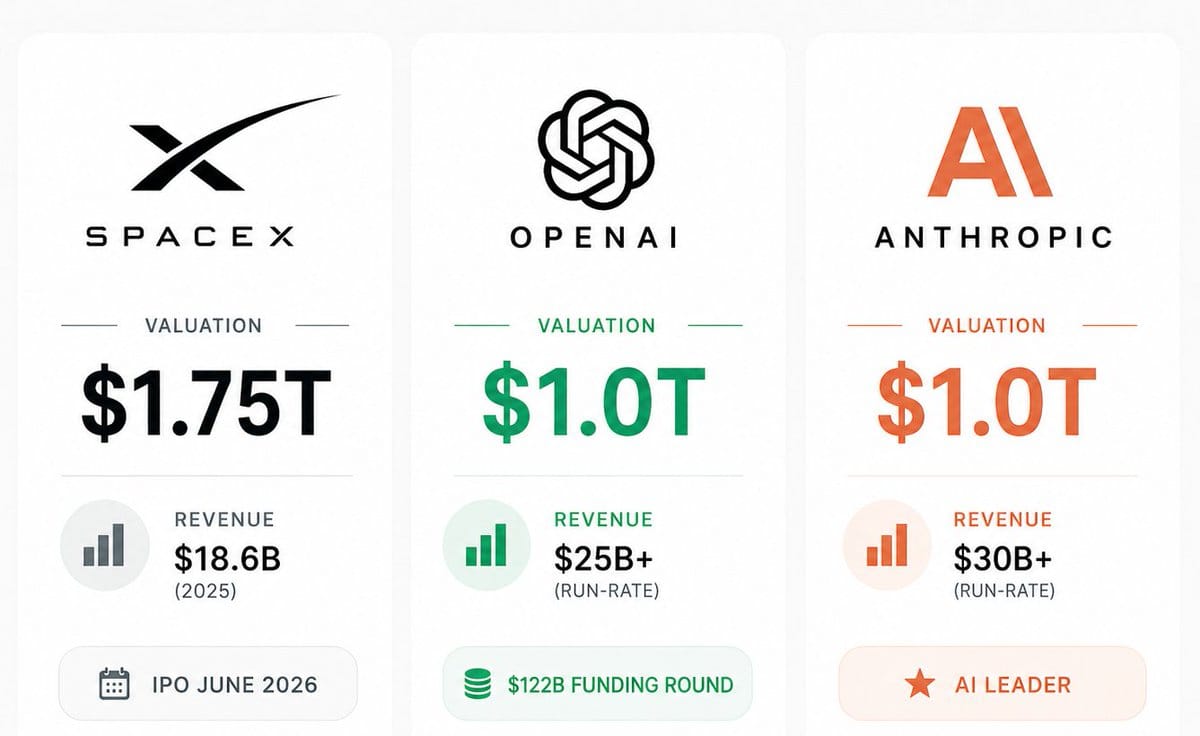
The SpaceX IPO on June 12, four times oversubscribed, became the largest public offering ever and reportedly made CEO Elon Musk the world’s first trillionaire. The listing carried a valuation of slightly under $2 trillion, with shares priced at $135 each.
However, whether investors will see quick profits remains unclear. By comparison, it took Tesla several years to achieve consistent quarterly profitability.
Most-anticipated AI IPOs
While the debut triggered a boom in AI crypto valuations, SpaceX is an adjacent listing rather than a pure AI play. Its ties to the sector run through investments in xAI, Grok, X, and AI compute infrastructure.
Meanwhile, the most hotly anticipated IPOs come directly from the companies building artificial intelligence models.
Anthropic IPO
Anthropic, the AI research company behind the Claude chatbot, emphasizes efficiency over sheer scale, focusing on enterprise adoption. Backed by titans like Amazon and Google, it is gearing up for a blockbuster IPO that could value the company well into the hundreds of billions.
The firm confidentially filed its prospectus with the SEC one week before OpenAI. Its details will be released at least 15 days before Anthropic’s roadshow pitch to institutional investors.
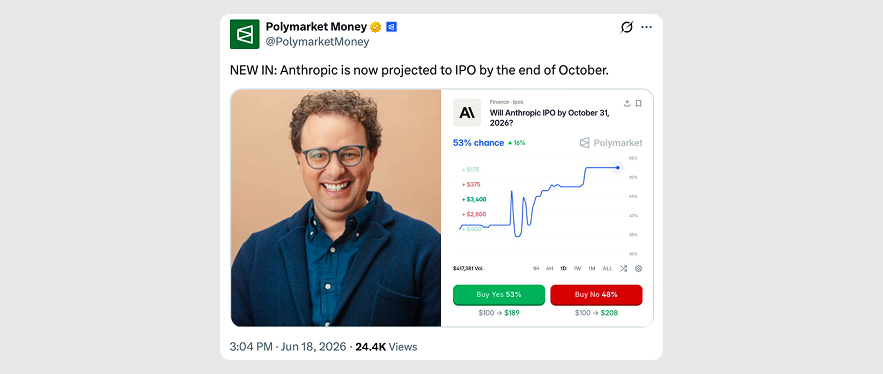
The latest private funding round valued the company at $965 billion, placing it just shy of the trillion-dollar mark. Market observers expect its IPO valuation to cross that threshold.
The company's chatbot still trails ChatGPT and Gemini in popularity, with those rivals commanding roughly 50% and 22% market share, respectively. According to Yahoo Finance, Claude accounted for just 10% of the market in March 2026.
However, Claude's capabilities are advancing rapidly as it increasingly “builds itself.” According to Anthropic, the number of tasks it can reliably complete without human intervention is doubling roughly every four months. It is now able to cope with an underspecified engineering problem, finding the method on its own. In research, it can execute a well-specified experiment while matching or outperforming human cognition.
Anthropic’s enterprise and safety-first focus sets it apart. CEO Dario Amodei has recently called for thorough and binding regulation of AI due to “the very real risks” it poses to cybersecurity. The company also restricts public access to the full capabilities of its Mythos model, which has proven too powerful in areas like hacking and vulnerability chaining.
Amodei explained:
"I believe the best analogy, at least at the current stage of the exponential, is to cars, airplanes, or drugs — powerful technologies essential to the modern economy, but capable of killing large numbers of people if designed or operated poorly."
OpenAI
Sam Altman's OpenAI has the strongest brand recognition and market penetration in the AI industry. The creator of ChatGPT is seeking a potential valuation close to $1 trillion, according to its confidential S-1 filing submitted on June 8.
In March, the company disclosed a valuation of $852 billion during a funding round. In the first quarter of 2026, the ChatGPT maker generated $5.7 billion in revenue against $3.7 billion in operating expenses.
The numbers underline just how cash-hungry the AI race remains, even for the biggest players. Beyond the flagship chatbot, the company is diversifying its offerings with enterprise solutions, developer infrastructure, and platform-as-a-service products.
It is also introducing advertising, though analysts worry it risks upending one of its key selling points — working for the users. Axios projects advertising revenue of $2.5 billion this year.
The company has emphasized the fact that there is no set timing for the IPO. It says:
“We have not decided on timing yet. It may be a while because there are things we want to do that are likely easier as a private company. But it’s a complicated set of trade-offs, and this gives us the option to go public sooner if that ends up being best.”
The expected timeline
Both Anthropic and OpenAI have only filed confidential listings, which usually precede public versions of those S-1 forms — with public listings coming several months later. This means their IPOs may only be expected in the second half of 2026, with no confirmed dates as of this writing.
Top candidate: Databricks
The leading lakehouse platform remains one of the most closely watched candidates in enterprise AI, known for helping store and analyze massive volumes of unstructured data. As per the latest reports, it appears focused on another private funding round. However, it has been preparing for a public listing since at least 2021.
CEO Ali Ghodsi has called 2026 a “terrible year to list” due to a crowded listing calendar. Currently, the firm plans to raise capital in private markets at a valuation approaching $175 billion.
Can I get pre-IPO access to these stocks?
The SEC cautions against pre-IPO investment in the private space due to the high risk of fraud. This is particularly true for any Databricks-related products, as its IPO may only come in 2027 at the earliest.
At present, only private shares are available on secondary markets, but access is typically restricted to institutions and accredited investors — i.e., buyers meeting income or net-worth thresholds under US securities rules.
In the case of OpenAI and Anthropic, retail investors can access pre-IPO perpetual futures, which provide no equity rights. Geographic restrictions and lock-up rules may apply, settlement methods and fees vary, and liquidation risk also exists. Check the issuer and product terms thoroughly.
Major crypto platforms are likely to race in with IPO-linked products — just as they did with SpaceX tokenized shares and derivatives. Examples include SPCX — a tokenized representation of SpaceX equity backed 1:1 by real shares — and pre-IPO perpetual futures on Hyperliquid (for a full breakdown of SpaceX-linked products, see our in-depth guide).
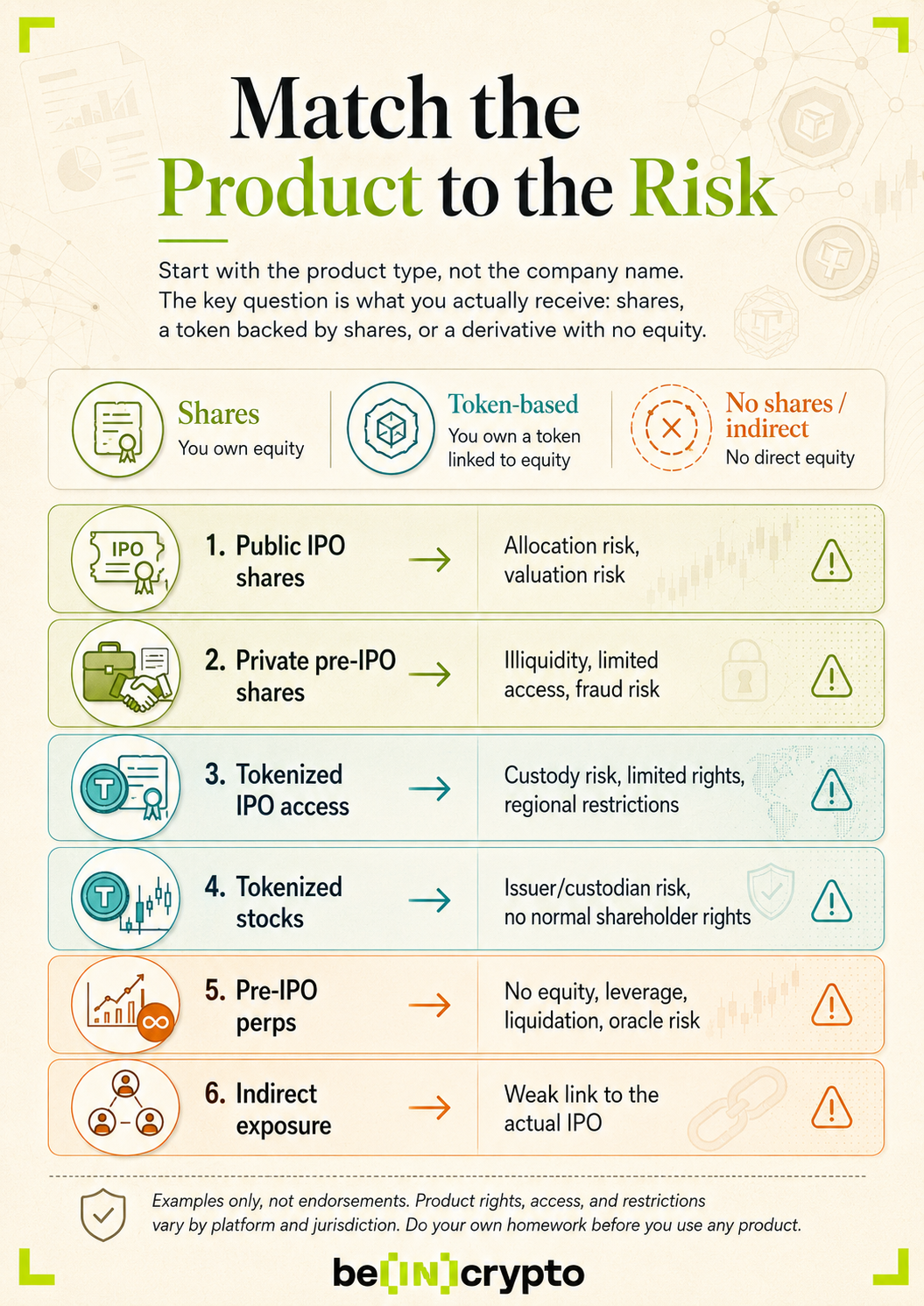
Investors will likely have several routes to choose from:
Pre–IPO:
- Pre-IPO marketplaces offering private shares or fund exposure, accessible only for accredited investors; illiquidity risk.
- Tokenized IPO access. Buying tokens backed by allocated shares, subject to limits on allocation, custody, and geographical access.
- Pre-IPO perpetuals providing synthetic price exposure. The biggest risks include leverage, liquidation, and pricing oracles.
Post-IPO:
- Public IPO shares. These are actual shares distributed through an IPO, with allocations that are hard to secure.
- Tokenized stocks. Buying tokens backed by public shares, subject to custody and counterparty risk.
Should you buy an early IPO?
Let's weigh the pros and cons of getting in early. The hype around IPOs like SpaceX revives hopes of finding the next Google or Nvidia. Investors dream of spotting the next Amazon — but it's crucial to be wary of survivorship bias.
History has also seen plenty of disappointing IPOs, including Lyft, Uber, WeWork, and Robinhood. Slowing trading activity, thinning revenues, or scrutiny of governance have spelled the collapse of many “market darlings.”
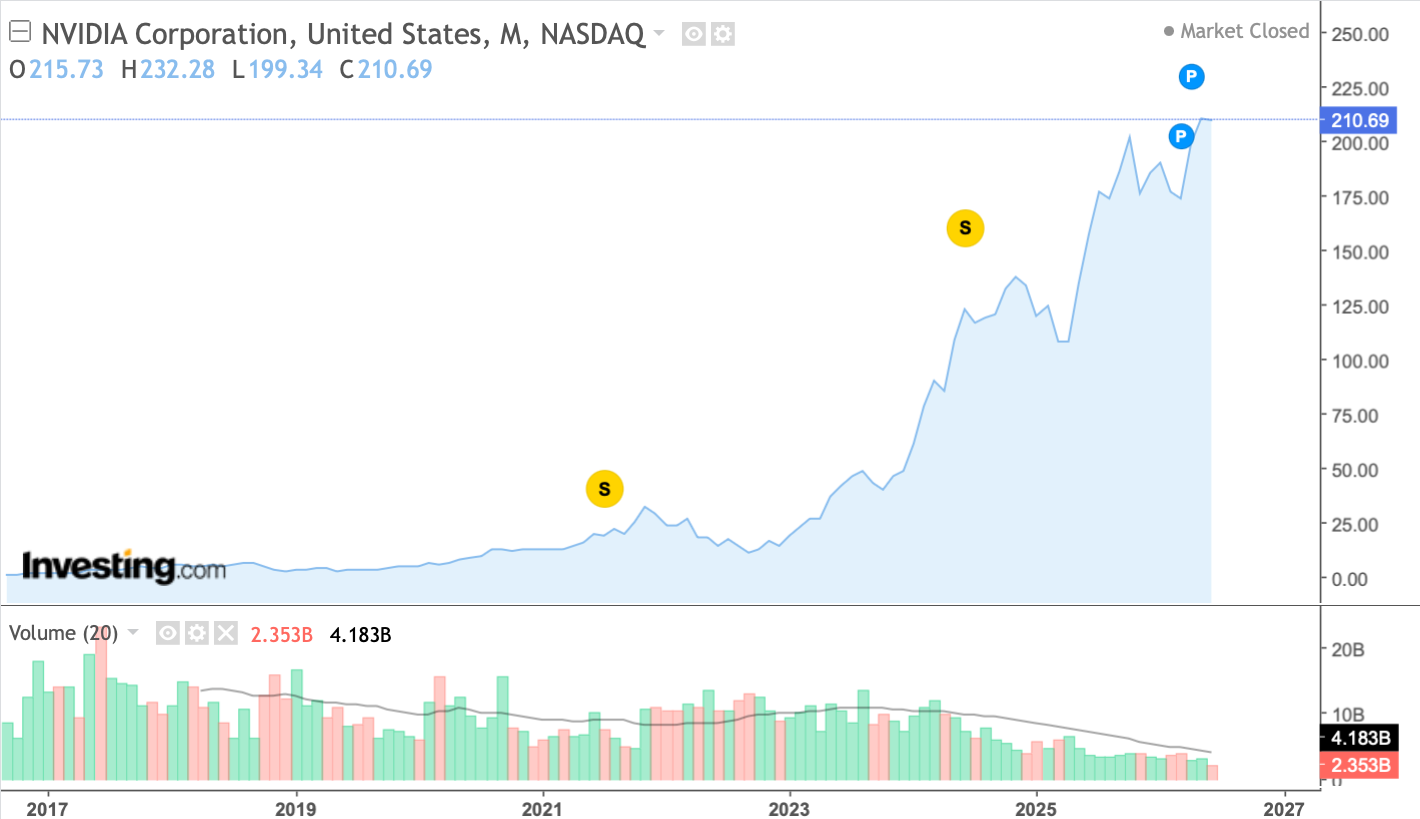
At the same time, some tech companies that went public decades ago are now multi-trillion-dollar companies dominating the S&P 500. Nvidia, which had its IPO in 1999 at $12 per share, now trades at more than $200, driven by its dominance in graphics processing and AI infrastructure.
Key considerations for safe IPO exposure
Every pre-IPO investment route comes with its own trapdoors, while every company going public brings a different mix of valuation, business, and execution risk. Valuations may prove difficult to justify, and even hot listings can lose momentum once early demand fades.
Risks for public IPO buyers
- Profitability uncertainties. Some IPOs become generational winners for patient investors — those willing to endure sharp drawdowns along the way. Amazon is a classic example. Its 1997 IPO was a runaway success, but the stock later suffered through the dot-com crash before eventually growing into a company worth nearly $3 trillion. Its shares now trade around $244, more than twelve times their split-adjusted IPO price.
- Lockup periods and opportunity cost. Shares distributed through IPOs are often subject to lockup periods of 90 to 180 days. As a result, holders risk watching capital sit on the sidelines while other opportunities emerge — which is particularly distressing if the stock proves overhyped.
Risks from indirect IPO exposure
- No shareholder rights. Note that most crypto-based products provide price exposure to the underlying equity, but holders have no votes, dividends, or legal claims on the company. A derivative or token does not provide direct equity.
- Cancellation risk. A public offering may be delayed or canceled, in which case pre-IPO contracts can be delisted from exchanges and settled at a price decided by those platforms.
- Misleading advertising. Unscrupulous providers may market derivatives or tokens as IPO access even when they provide no direct equity ownership or shareholder rights. The actual AI exposure may also be indirect. SpaceX-linked products largely provide exposure to satellites, launch services, and related infrastructure rather than artificial intelligence itself.
- Leveraged liquidations. Holders of pre-IPO perpetuals may find their position closed due to volatility. In the absence of public reference price points, such contracts may swing stronger than perpetuals on listed stocks.
- Oracle pricing risk. Before a public S-1 becomes available, crypto exchanges may rely on estimated share counts when pricing perpetual contracts. After real share counts are unveiled, those positions are adjusted.
- Counterparty risk. Buying a tokenized stock makes you fully reliant on its issuer and custodian.
Wrapping up
The rush into SpaceX-related products shows how hungry investors remain for growth stories, especially when traditional markets are outperforming crypto. That enthusiasm is now shifting toward the next generation of AI companies. If OpenAI and Anthropic listings reach public markets in the coming months, they could become some of the largest and most scrutinized IPOs of the decade.
For investors, the challenge is separating genuine exposure from marketing hype. Pre-IPO shares, tokenized stocks, and perpetual futures all offer different ways to participate, but they come with very different rights, risks, and limitations. Whether you're chasing the next breakout AI winner or simply looking for exposure, understanding what you actually own matters just as much as the company behind the ticker.