Tom Lee vs. the bears: What both sides get right about Ethereum

Shifting macroeconomic conditions, ETF outflows, and declining transaction fees have weighed on Ethereum for months. With the coin down over 60% from its all-time high, headlines are gloomy — but Wall Street's most vocal Ethereum supporter sees the weakness as an opportunity, not a reason to exit.
Tom Lee, head of research at Fundstrat and executive chairman of BitMine, has earned a reputation as the "biggest Ethereum bull" for a reason. He's laid out price targets ranging from $12,000 to $250,000 — forecasts that have drawn both support and skepticism from the market.
So who's right? Let's examine both sides.
TL;DR
- Tom Lee's bull case: Ethereum could become the dominant settlement layer for tokenized real-world assets and AI infrastructure. He sees ETH reaching $22,000–$250,000 over the long term.
- The bear case: Ethereum faces structural flaws, rising competition from faster Layer-1s, and persistent underperformance against Bitcoin.
- Where Lee is right: Tokenization of real-world assets is real and growing. Institutions are building on Ethereum, and the long-term trend points toward blockchain-based infrastructure.
- Where the bears are right: Markets don't care about narratives. Ethereum remains down more than 60% from its all-time high, has lost significant ground to Bitcoin, and faces increasingly credible competition.
Tom Lee and BitMine
As noted by Arkham, Thomas Jong Lee, better known as Tom Lee, is often viewed as Ethereum’s closest equivalent to Michael Saylor for Bitcoin. A seasoned Wall Street strategist with over 25 years of stock research under his belt, he believes AI agents, real-world asset tokenization, and institutional adoption will drive long-term demand for Ethereum.
In the past, Lee served as managing director at Salomon Smith Barney and worked as JPMorgan's Chief Equity Strategist. Today, apart from chairing BitMine Immersion Technologies, Lee is also the co-founder and head of research at Fundstrat Global Advisors, a stock research company based in New York.
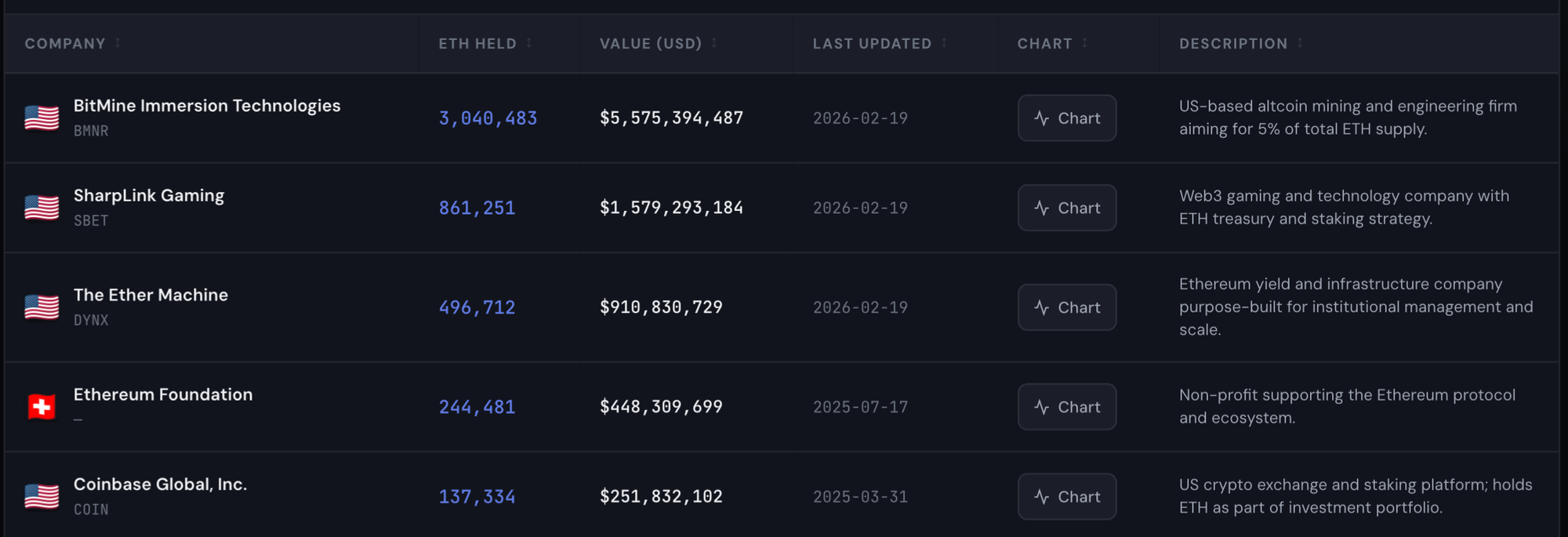
Lee has overseen BitMine's transition into a digital asset treasury company (DAT) following its pivot away from Bitcoin mining in 2025. The company has accumulated the largest corporate ETH treasury to date — 3,040,483 ETH, worth over $5.5 billion.
The runner-up in the Ethereum treasury race, SharpLink Gaming, holds less than a third of that — 861,251 ETH. Behind Strategy’s unmatched Bitcoin treasury, BitMine has become the second-largest corporate crypto treasury by asset value.
Lee has repeatedly made headlines with aggressive long-term price targets for the second-largest cryptocurrency. Previously, he suggested it could hit $12,000–$15,000 by the end of 2025, calling it "severely undervalued" at $3,000.
More recently, he argued that ether could eventually reach $250,000 if the network becomes a primary payment layer for AI agents and advanced computing systems.
Lee’s bull case: Why Ethereum could see exponential upside
Tokenization thesis
Lee believes Ethereum will become the dominant settlement layer for tokenized real-world assets — from real estate and bonds to AI computing infrastructure and even national energy reserves.
In June 2026, Lee set an ambitious target of $250,000 for ETH, roughly a 50-fold increase from the price levels at the time. This would value the network at roughly $30 trillion — larger than the US Treasury market ($29.4 trillion at press time).
Lee made the prediction during one of Ethereum's weakest periods of the year — ETH had just dipped below $2,000, pressured by heavy outflows from US spot ETFs. Lee viewed that pessimism as the signal itself:
"If you are bearish today, you are selling at the bottom. I can't emphasize enough, if you're bearish today, you are bearish at the bottom for Bitcoin and Ethereum."
AI infrastructure thesis
According to Lee, the machine-to-machine economy is key to this potential upside. He sees Ethereum as a "premier choice" for autonomous AI agents as they potentially account for an increasing share of internet activity — a neutral, instant settlement layer that operates independently of legacy payment rails.
In this hypothetical scenario, ether will be the default currency for automated computing power purchases, while RWA platforms will be layered on top of the base network. Combined with continued growth in stablecoins, Lee believes that could expand the network's value into the trillions of dollars.
Governance shift thesis
Another pillar of Lee's thesis is the staking-focused model adopted by BitMine itself.
According to Lee, DATs are gradually replacing the Ethereum Foundation as the network's primary long-term stewards. As of June 2026, BitMine and SharpLink controlled around 7% of Ethereum's circulating supply collectively, with Lee's firm approaching its 5% accumulation goal.
Meanwhile, the Ethereum Foundation holds roughly 100,000 ETH (just 0.1% of the total supply), after years of intentional divestment following its “Subtraction” philosophy.
These corporate players are also large-scale stakers, generating over $500 million in annualized staking rewards while helping secure the network. BitMine itself stakes most of its holdings through an in-house validator network.
Supercycle thesis
Lee argues that Wall Street tokenization and AI are driving a new growth cycle, potentially similar to the early days of Bitcoin. At the heart of that thesis is Ethereum's role as the infrastructure layer for RWAs, stablecoins, and institutional adoption.
That view has led Lee to argue that ETH could eventually reach $12,000–$60,000. He compares Ethereum's potential trajectory with Bitcoin's rise after he first recommended BTC as an investment to Fundstrat clients in 2017. In late 2025, Lee suggested that ETH had started on the same path.
Reiterating his thesis at Paris Blockchain Week in June 2026, he called current prices "future optionality at a discount," and urged patience through drawdowns and volatility.
A key part of Lee's valuation framework is ETH's historical price ratio against Bitcoin. Assuming BTC reaches its estimated fair value of $250,000 and the ETH/BTC ratio returns to its eight-year average of 0.0479, ETH would be worth around $12,000.
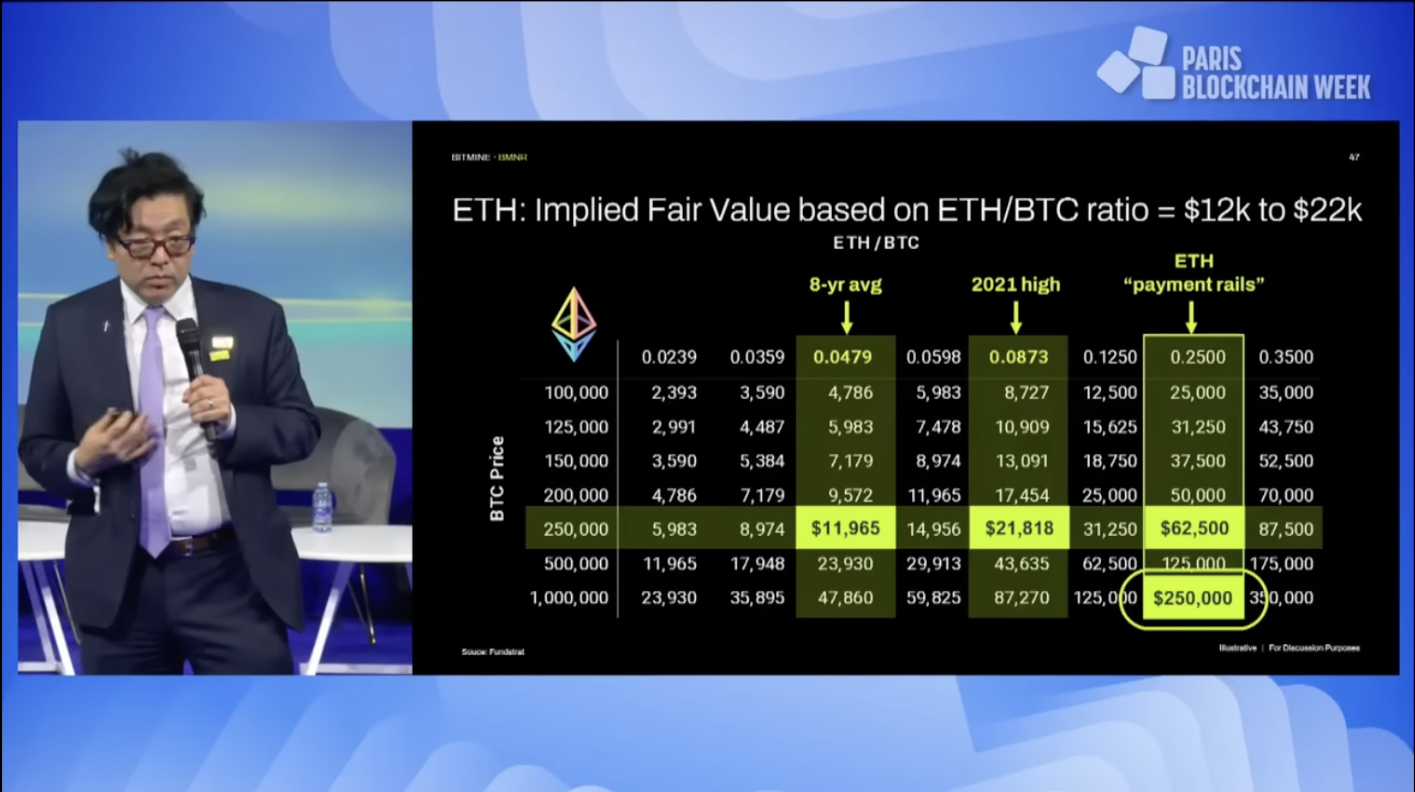
However, if ether returns to its 2021 peak ratio of 0.0873, this would give what Lee calls the "payment rails number"— roughly $62,000.
“If you look at the last crypto lows and make a composite of where Ethereum could be in roughly 3 years, that would be a 30x and that would take us to around $60,000.”
The bear case: Why Ethereum could keep falling
Structural flaws
10x Research argues Ethereum has structural problems that make it vulnerable. They have been bearish on it since at least October 2025, when they described it as the "easier short of this bear market." Back then, ETH was trading around $3,800, over 26% higher than current prices.
In particular, Markus Thielen argued that "very little value actually accrues to the Ethereum network" from stablecoins. The core argument is that economic gains from massive stablecoin volumes often go to the issuers rather than the network or toward increasing the value of ETH.
Competition is real
Ethereum faces rising competition from faster, cheaper Layer-1s. Newer chains offer lower fees and higher throughput. Key scaling upgrades like EIP-4844 empowered them to capture the vast majority of transaction volume. They offer advantages over the base layer across several key metrics:
- Transaction fees. While a standard L1 transaction fee can fluctuate, L2 median fees have plummeted by over 95%. For instance, networks like Base average roughly$0.05 per transaction, and Arbitrum One hovers around $0.09.
- Throughput and scalability. Due to its sequential execution design, Ethereum L1 faces a severe bottleneck during high-demand cycles. It natively handles only 15-30 transactions per second (TPS), far below Layer-2s like Arbitrum One with a peak capacity of up to 40,000 TPS.
- Confirmation speed. On Ethereum L1, users must wait for block times (12 to 15 seconds) and subsequent block confirmations to be certain their transaction went through. L2 "soft finality" happens in under 1 second, suiting fast-paced retail apps.
Overall, Layer 2s outshine Layer 1 primarily by serving as the high-speed execution engine for retail activity. As their scaling success has actively stripped transaction fees away from the mainnet, L1 pivots into a specialized settlement layer for institutions and rollups.
Underperformance versus Bitcoin
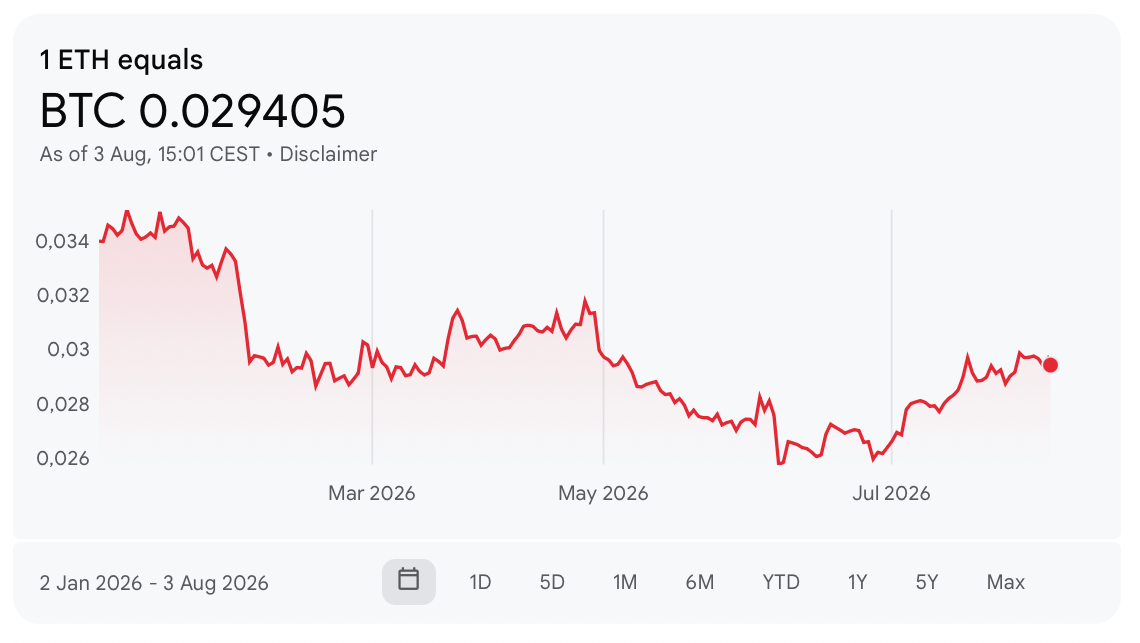
Ethereum significantly underperformed Bitcoin throughout the first half of 2026, causing the ETH/BTC ratio to slide from roughly 0.034 in January to a 10-month low of 0.027 in June. This gap reflects a multi-month trend where ETH consistently dipped harder on down days and lagged behind BTC's recoveries.
Ethereum's lower institutional liquidity depth explains why ETH suffers far worse during risk-off periods driven by macro or geopolitical headwinds. That said, a strong relief rally in July — driven by institutional shifts — saw ether gain 22% compared to Bitcoin's 9%, reclaiming a localized spot ratio of 0.0294.
Institutional skepticism
While Lee is bullish, some institutional observers remain more cautious. Internal Fundstrat reports have at times been more cautious than his public statements. And even BitMine — where Lee serves as executive chairman — has occasionally paused purchases despite his public optimism.
In contrast to Bitcoin's "digital gold" identity, Ethereum's valuation framework is less straightforward. Wall Street still struggles to establish concrete cash-flow metrics for Ethereum. As noted by Galaxy's research team, many investors still struggle to understand how ETH captures value as network activity grows.
Institutions are also concerned about revenue streams being siphoned off. A highly fragmented ecosystem of Layer-2 networks now handles the bulk of transaction activity, reducing value accrual to the base layer.
What both sides get right
Where Lee is right
Tokenization of real-world assets is no longer theoretical. Open World has already tokenized over $65 billion in premium crypto assets. By mid-2026, tokenized assets spanning AI supercomputing centers, energy grids, and real estate portfolios were reshaping how institutions deploy capital. Major partnerships are building national-scale RWA tokenization engines anchored to Ethereum.
Institutional adoption is real. Ethereum is becoming the default financial and data layer of Web3. As Lee puts it, current prices may well be "a discount to the future."
Where the bears are right
The market doesn't care about narratives. Ethereum is down more than 60% from its all-time high. It's down nearly 40% year-to-date, and has lost significant ground to Bitcoin over the past year.
Competition is real. Faster, cheaper Layer-1s are gaining traction. Ethereum's long-term dominance is no longer taken for granted, and the four-year cycle that worked for Bitcoin may not work for Ethereum.
Where all this leads us
Lee could be right about the long term — the tokenization of real-world assets and AI infrastructure are real trends. But even if his thesis proves correct, the path there is unlikely to be smooth. In the meantime, prices can remain under pressure or even fall further.
Lee may be early, and the bears may be right about the network's current challenges. The debate is not about whether Ethereum has potential — it is about whether that potential will translate into ETH value accrual fast enough to justify today's expectations.