Clapp Weekly: Bitcoin's resilience, CLARITY Act markup, Solana's Alpenglow test

BTC price
Bitcoin climbed back to $81k after taking a hit from a hotter-than-expected US inflation print Tuesday. The coin showed resilience, likely buoyed by aggressive dip-buying amid Middle East re-escalation that has lifted oil and the dollar. Bitcoin products led crypto fund inflows last week ($858 million total), alongside the largest weekly unwind of BTC short positions in months.
BTC slipped from a weekly top of nearly $82.5k on May 6, dove below the $80k mark two days later, rebounded, and gradually recovered to $81.5k. It zigzagged on May 11 and eventually fell below $80k the next day before bouncing back.
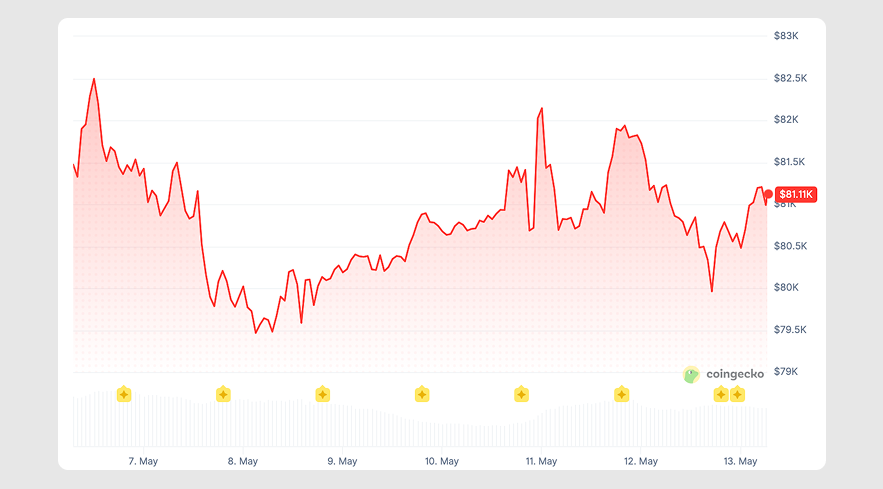
At press time, BTC is trading at $80,991.66, down 0.3% over the past 24 hours with a weekly loss of 0.4%.
ETH price
Ether is lagging Bitcoin, with traders eyeing crucial support at $2,250. A Grayscale report flagged rising net issuance due to low-cost staking. Proposals to slash staking rewards are being discussed to curb inflation and strengthen ETH’s store-of-value narrative. Meanwhile, derivatives metrics show recent DeFi hacks (like the KelpDAO exploit) haven't spooked traders.
ETH sold off after topping at $2.4k on May 6, following BTC's lead. The price found a floor at roughly $2,275 on May 8 and rose steadily before breaking past $2.3k on May 10 and reversing the next day. After bouncing off $2,263 on May 12, ETH is clawing back.
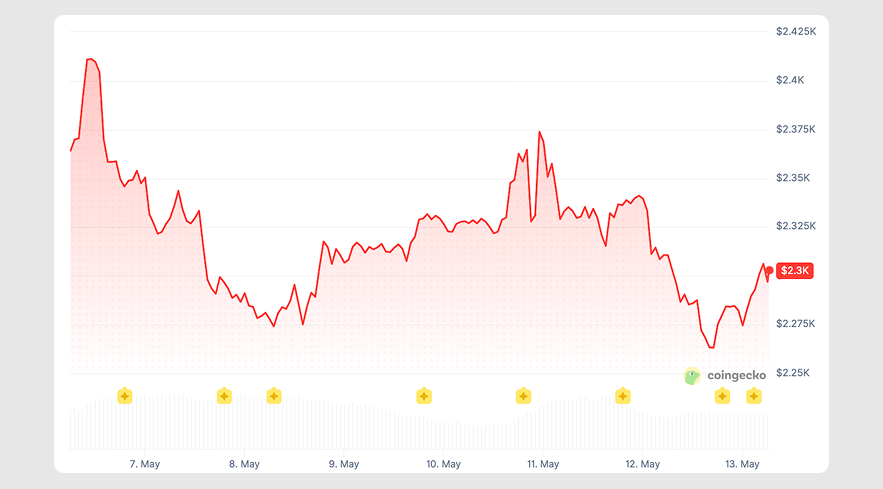
Trading at $2,297.55, ETH has shed 0.6% over the past 24 hours and 2.9% over the past 7 days.
Seven-day altcoin dynamics
The Fear and Greed Index slipped back into the Fear zone (42/100) after briefly poking into 'neutral' territory on May 13. While a hotter-than-expected CPI (Consumer Price Index) report for April sent oil prices higher, the impact on crypto was relatively muted. The DeFi and Computing sectors took the biggest hit, while most altcoins lagged behind.
CPI rattles traditional markets
The April CPI print mainly hit traditional markets, on edge over signs of any impact of surging oil prices from the Iran conflict. The odds of a rate cut in June and July are hovering below 5%, with just 11% for September on CME FedWatch.
Both headline and core CPI came in hot year-over-year. The headline index jumped 3.8% — the highest since a 4% rise in May 2023 — beating consensus estimates of 3.7%. Core CPI, which excludes food and energy, rose 3.8% (vs. 3.7% expected), and also beat the MoM prediction (0.4% vs. 0.3%).
News of the US and Iran rejecting mutual proposals to end the conflict dimmed hopes for a near-term resolution. With the Strait of Hormuz still effectively blocked to most traffic, soaring energy prices are adding fuel to inflation woes worldwide — Japan's 20-year bond yield hit the highest level since 1997.
XRP forges ahead
The five US-listed spot XRP funds pulled in $25.8 million in net inflows on May 11, their biggest daily haul since January 5. The token has also stormed to the top of South Korean crypto trading: XRP/KRW was the most active pair on Upbit and ranked second on Bithumb. However, XRP remains nearly 60% below its July 2025 peak despite a 9.5% 30-day run.
The fresh interest follows two Ripple milestones:
- Locking in a $200 million debt facility to support the expansion of Ripple Prime, the firm's multi-asset prime brokerage platform.
- Successful live cross-border redemption of tokenized US Treasuries on the XRP Ledger on May 6 — a pilot involving JPMorgan, Mastercard and Ondo Finance.
- Laying out a four-phase plan to make the XRP Ledger quantum-resistant by 2028.
Top weekly winners
- SIREN (+59.3%) is outperforming a flat broader market amid thin liquidity. There's no clear coin-specific catalyst, and the token seems to be ignoring heated controversy on social media over alleged rugs and cartel mechanics.
- VVV (+44.5%) reclaimed Q1 2025 levels after teaming up with StrikeRobot lit the fuse on speculative buying. The co-development partnership gives holders of both VVV and SR tokens a 1.2x points multiplier. Today, traders are booking profits.
- ONDO (+28.2%) made strides as Ondo expanded 35 tokenized assets to Hyperliquid's HyperEVM, bringing tokenized stocks and ETFs to a widely used and liquid trading venue. A dip on May 12 looked like a classic "buy the rumor, sell the news" move.
Top weekly losers
- PENGU (-13.7%) is under pressure from profit-taking after a strong monthly run fueled by sector rotation and project narratives. Pudgy Penguins' merchandise revenue ($40 million) has sparked questions about a disconnect between the business and the token price.
- MORPHO (-9.3%) cooled off after a rally sparked by a technical breakout, heavy buying on Binance, and a generally risk-on market. MORPHO is now the second-biggest lender behind Aave as its ETH-denominated TVL tripled over the past year to roughly 2.9 million ETH.
- HYPE (-8.6%) likely reflects broader pressure amid ongoing geopolitical tensions; a falling Altcoin Season Index shows exodus from higher-beta tokens. Investors seem to be 'buying the dip': a $3.02 million whale purchase points to underlying demand.
Cryptocurrency news
CLARITY Act text drops — and Saylor says it's a game-changer
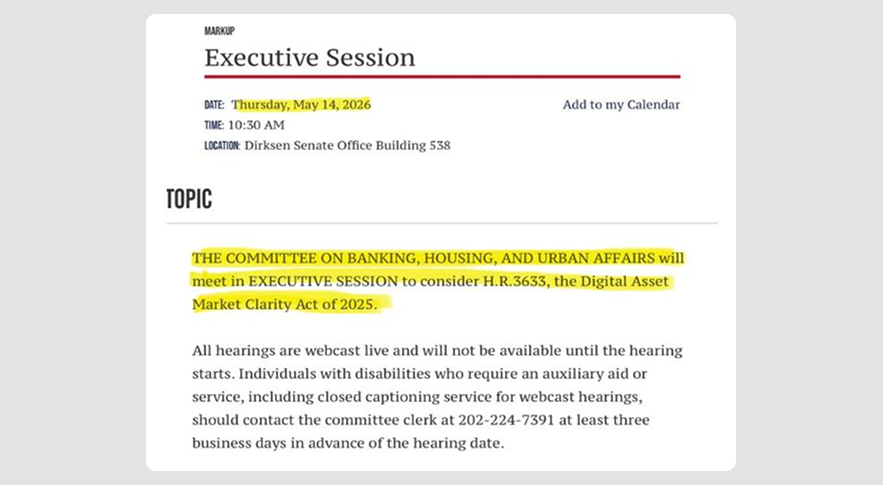
The wait is almost over. On Thursday, May 14, the Senate Banking Committee will finally hold its long-delayed markup hearing on the CLARITY Act — and the full 309-page text dropped late Tuesday.
After months of gridlock, lawmakers have put pen to paper. Now the crypto industry gets to see what all the negotiating was about.
What's in the bill
Stablecoin rewards survive — but with guardrails. The bill prohibits interest or yield payments for simply holding stablecoins. However, it carves out an exemption for "rewards or incentives based on bona fide activities or bona fide transactions."
Translation: you can earn rewards for trading, transacting, or staking. You can't earn interest for parking cash.
That compromise hasn't satisfied everyone. A coalition of banking trade groups, including the American Bankers Association and Bank Policy Institute, sent a last-minute letter arguing the language still opens the door for yield-like programs. But crypto insiders have largely accepted the tradeoff.
Beyond stablecoins
The bill also lays out definitions, disclosure requirements, and rulemaking for digital assets. It updates securities law to apply to crypto activities while applying insider trading bans and ethics provisions. Tokenized securities remain securities — but the SEC must study custody standards, consumer protection, and cross-border coordination.
On quantum computing, the bill creates a voluntary path for adopting NIST post-quantum cryptography standards. It's a forward-looking move that acknowledges the threat without mandating compliance.
Why Saylor is paying attention
Strategy's Michael Saylor framed the markup as more than another regulatory hurdle. He argued the CLARITY Act could help unlock a wider market for "digital capital, digital credit and digital equity" — potentially validating Bitcoin as a core capital markets asset.
For Strategy, that's directly relevant. The company has built its public-market identity around Bitcoin-backed corporate finance. Clearer rules could support broader adoption of MSTR and provide a stronger framework for STRC, its preferred shares.
What happens next
Thursday's hearing will feature debates and amendments. The Banking Committee must then reconcile its version with the Agriculture Committee's. From there, the bill needs floor time before Congress's Memorial Day recess on May 21.
Sen. Bernie Moreno (R-Ohio) has warned that if the CLARITY Act doesn't pass by May, it becomes much harder after the November midterms.
The markup doesn't mean the bill is close to becoming law. But after months of delays, Washington is finally moving. And the industry is watching.
Solana's biggest consensus overhaul yet: Alpenglow goes live for testing
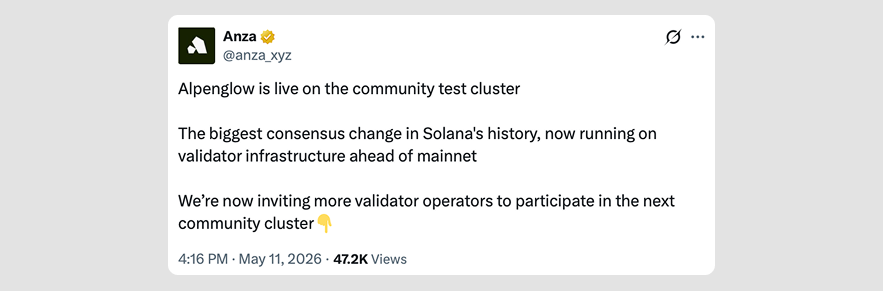
Solana is about to get a major facelift. Anza, a core developer team, announced Monday that Alpenglow — the biggest consensus overhaul in Solana's history — is now running on a community test cluster. Validator operators can finally test the software designed to move Solana away from its current Proof-of-History and TowerBFT system toward a faster, more efficient architecture.
If successful, the upgrade could dramatically reduce finality times and improve network responsiveness. This may translate into even faster transactions and near-instant settlement.
What's changing
Today, Solana relies on Proof-of-History, a cryptographic clock that timestamps transactions before validators even look at them. It's the secret sauce behind Solana's speed. But the design has also been linked to network instability and outages during periods of heavy demand.
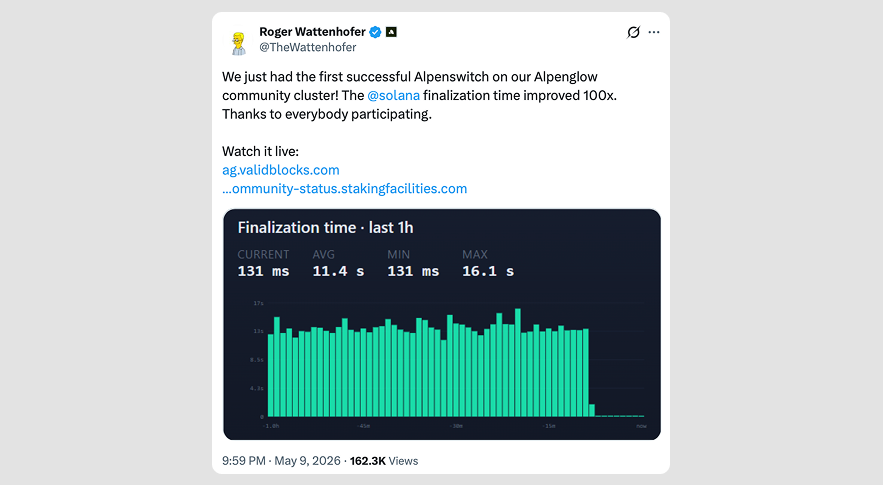
Alpenglow proposes replacing major chunks of that system with a redesigned framework. In simple terms, validators would be able to communicate and confirm blocks faster and more efficiently — potentially cutting transaction finality from several seconds to near real-time speeds.
"This is the biggest consensus change in Solana's history," Anza wrote on X. "Now running on validator infrastructure ahead of mainnet."
What "Alpenswitch" means
The test cluster milestone suggests validators can successfully perform what developers are informally calling "Alpenswitch" — transitioning nodes from Solana's existing process to Alpenglow in a live environment.
Solana co-founder Anatoly Yakovenko recently said at Consensus Miami 2026 that Alpenglow could reach mainnet as soon as next quarter if testing continues smoothly.
Alpenglow's significance for Solana and SOL
Solana has always been known for two things: blazing speed and occasional outages. The network has processed thousands of transactions per second for years, but critics have pointed to downtime during peak demand as proof the architecture has limits.
Alpenglow aims to close that gap. A more efficient consensus mechanism could mean fewer interruptions and more room to scale — without sacrificing the low fees that made Solana a haven for DEX traders and meme coin degens alike.
For SOL holders, the upgrade is a potential catalyst. Improved network reliability and faster finality could attract more developers and users, likely boosting demand for the coin over time. Traders will be watching mainnet progress closely — successful deployment could give SOL a leg up, while stumbles might trigger a sell-the-news reaction.
What's next
The test cluster is live, and validators are kicking the tires. If all goes well, mainnet could follow within months. And after years of debate over its design trade-offs, the team is finally rewriting the engine — while the car is still moving.