Clapp Weekly: BTC highest since Feb. 5, Goldman Sachs ETF, BitMine's $3.8B loss

BTC price
Bitcoin is hovering near $74K after tagging $75.9K on April 13 — its highest since the February 5 crash to $60K. Improving sentiment around the Iran conflict helped fuel a wave of short liquidations, accounting for most of the $687.5 million wiped out in 24 hours. Meanwhile, Strategy added $1 billion in BTC through its STRC preferred shares.
BTC slipped below $71K, recovered to around $73.5k on April 11, then pulled back again. After bouncing off a low of $70,821 two days later, it rallied sharply to a $75,482.48 peak on April 14. Since then, the price has been drifting lower.
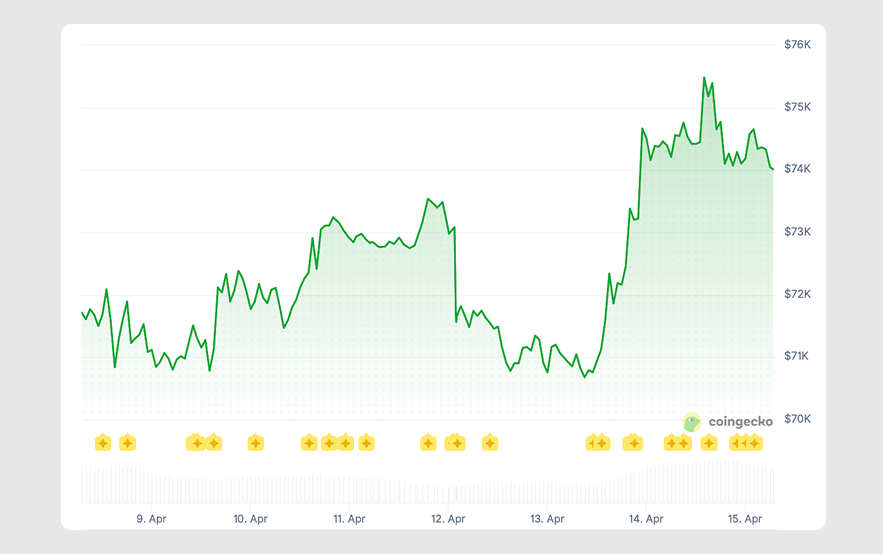
Changing hands at $74,064.67, BTC has shed 1.0% over the past 24 hours with a gain of 3.3% on the week.
ETH price
Ether is outperforming Bitcoin, pointing to a broader risk-on tone. The ETH/BTC ratio has climbed near 0.0313 — its highest since January — supported by strong on-chain activity and Q1 data. Roughly 284,000 new users joined the network, while stablecoin supply surpassed $180 billion. On April 12, Ethereum processed 3.62 million transactions, breaking the 3 million mark for the first time.
After losing $2,250 a week ago, ETH bottomed at $2,164.89 on April 9 before recovering above $2.3K, then pulling back on April 12. It rebounded from around $2,190 on April 13, peaked at $2,392.92 yesterday, and has since retreated.
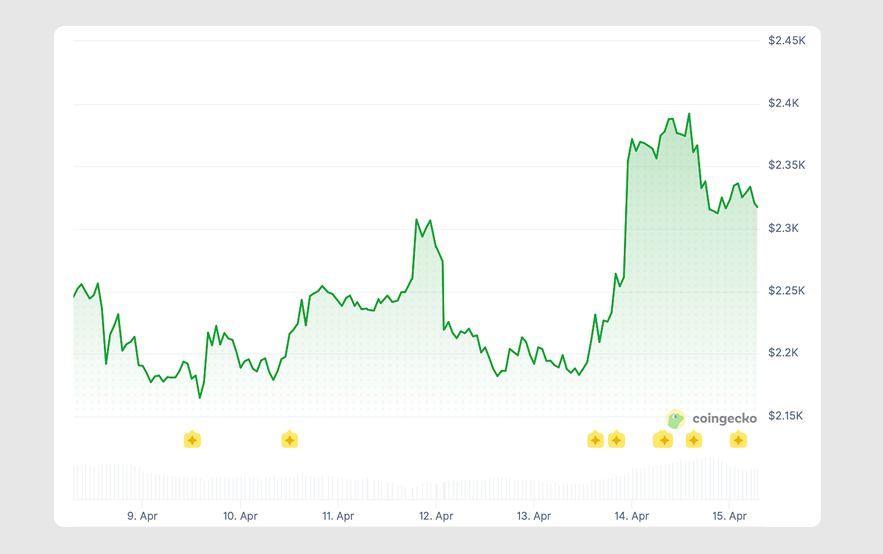
Currently at $2,328.04, ETH has lost 2.6% over the past 24 hours, but remains up 3.5% on the week.
Seven-day altcoin dynamics
Optimism around a tentative ceasefire involving the US and Iran weighed on oil prices and lifted risk assets. As major indices turned green, crypto-linked stocks like Circle (CRCL, +11%) and Sharplink (SBET, +10%) also moved higher.
Brent and WTI crude both dipped below $100 per barrel on Monday, April 13. Over the weekend, traders had braced for downside after stalled Iran talks, with President Trump warning of “complete decimation” if negotiations failed.
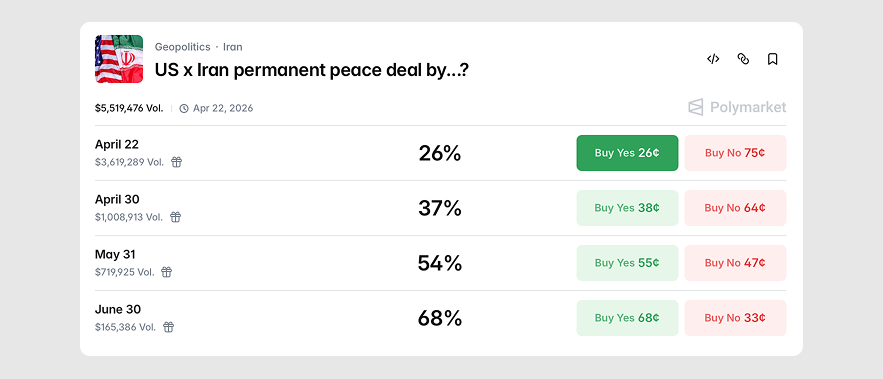
On Polymarket, the odds of the current ceasefire ending on April 21 — 14 days after President Trump announced it — have risen to 42%. However, 68% of bettors expect a permanent deal no sooner than June 30 — exactly when 92% say the entire US/Israel-Iran conflict will end.
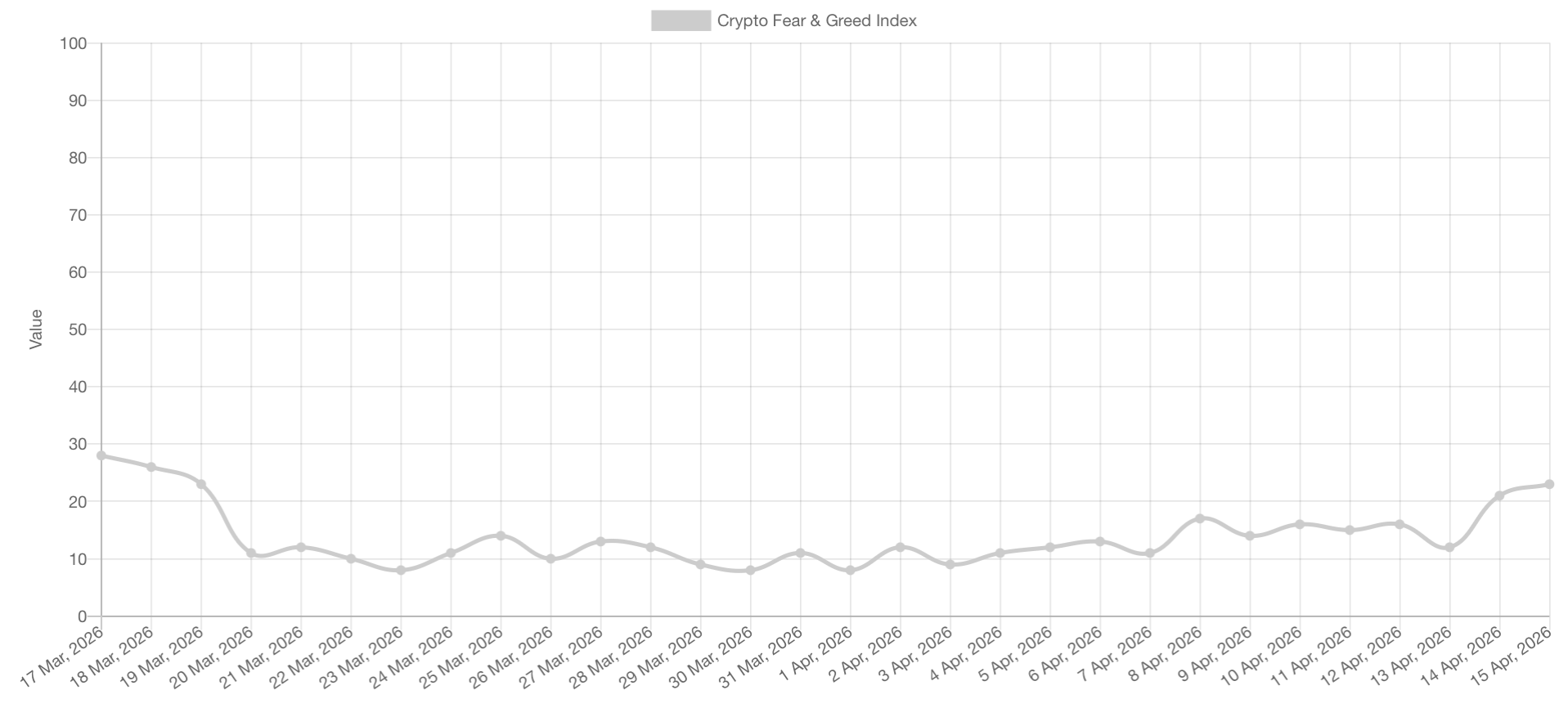
Easing oil prices and growing expectations of Federal Reserve rate cuts this year are supporting liquidity across risk markets. The Crypto Fear & Greed Index has exited “Extreme Fear” for the first time since March 19, hovering near 22/100.
Still, analysts say the latest rebound is largely driven by short covering in derivatives rather than strong spot demand. Spot volumes on crypto exchanges still linger close to multiyear lows.
Top weekly winners
- RAVE (+6,214.5%) skyrocketed after Binance and Coinbase listings sent daily volume up 60x in hours, sparking a violent short squeeze. A pre-pump transfer of 30.6 million RAVE to Bitget shortly before the surge raised manipulation concerns.
- DEXE (+56.9%) is riding capital rotation within DeFi, fueled by sector momentum, rising trading activity, and growing interest in social trading and DAO management tools.
- JST (+27.0%) is getting a lift from its TRON ecosystem integration, with Justin Sun calling it the "little TRX." The token powers JustLend DAO, where users supply assets, earn interest, and take out overcollateralized loans.
Top weekly losers
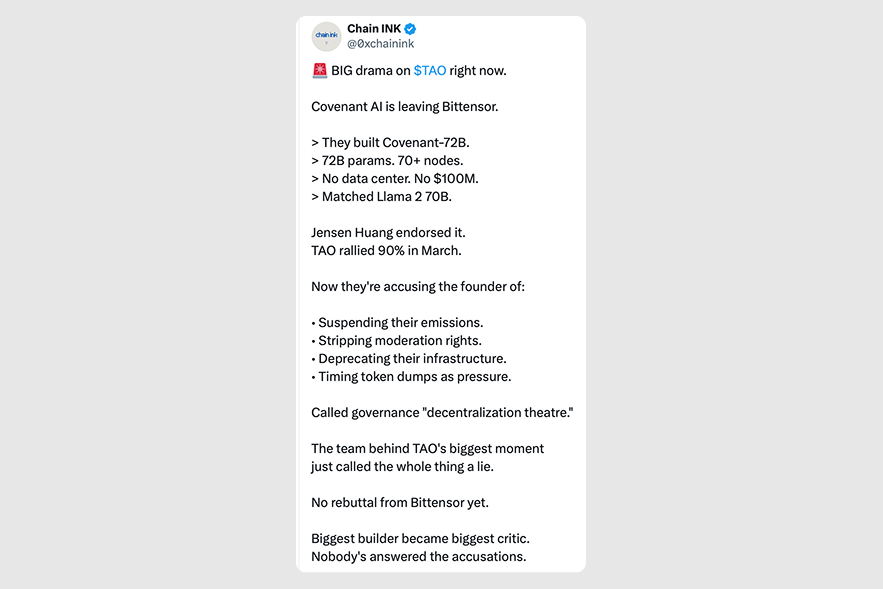
- TAO (-27.2%) is tumbling after Covenant AI — a prominent subnet developer — exited Friday, calling the project's governance "decentralisation theater." The news triggered massive long liquidations, with investors flocking to competitors like NEAR Protocol's NEAR.
- NIGHT (-18.2%) is sliding toward a critical all-time low in an apparent post-hype decline. With no strong structural support — ecosystem traction or real utility — the market is repricing the asset lower.
- DOT (-10.9%) is licking its wounds from a bridge hack. The attacker minted 1 billion DOT and dumped it all in a single transaction for 108.2 ETH ($237k). The team claimed only DOT on Ethereum was affected; the Polkadot core network remained secure.
Cryptocurrency news
Goldman Sachs enters Bitcoin ETF race — with an income twist
Goldman Sachs has filed an application with the SEC for a Bitcoin Premium Income ETF — one of its first direct pushes into crypto investing. The product won't just track Bitcoin's price. It will try to generate income by selling options on Bitcoin-linked funds.
The banking giant might be late to the Bitcoin ETF party, but it isn't showing up empty-handed. Its ETF does not simply copy what everyone else is doing, as it will offer a dividend stock version of Bitcoin exposure. Investors will get steady premiums in exchange for capping some upside in rallies.
Why now?
The filing lands less than a week after Morgan Stanley launched its own spot Bitcoin ETF, joining BlackRock and Fidelity in a rapidly crowding field. But Goldman is targeting a different audience.
"This could be a hard sell, given the volatility," said Morningstar ETF analyst Bryan Armour. Yet he acknowledged the income angle could appeal to investors who want Bitcoin exposure but can't stomach pure price swings.
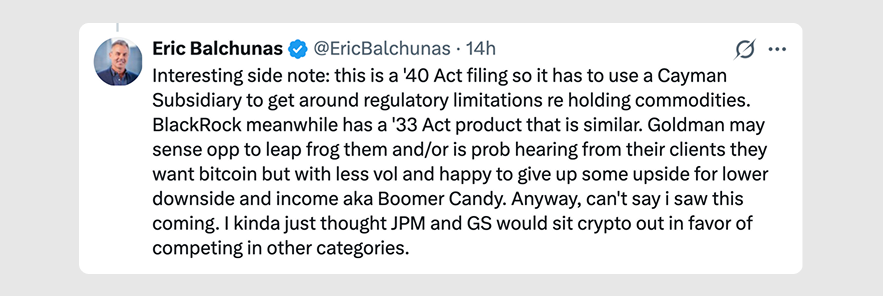
ETF analyst Eric Balchunas offered a simpler take: Goldman is hearing from clients who want Bitcoin with less volatility — and are happy to give up some upside for lower downside and regular income.
Catching up
Goldman has lagged rivals for years. CEO David Solomon has called himself an "observer" of Bitcoin, personally holding "very little, but some." He's been more enthusiastic about tokenization, calling it "super important" for future markets.
But the bank just completed a $2 billion acquisition of Innovator Capital Management, a pioneer in options-based ETFs. That deal now looks prescient.
The bigger picture
On April 7, Morgan Stanley became the first major US commercial bank to offer a spot Bitcoin ETF as its Bitcoin Trust (MSBT) launched on NYSE Arca with a management fee of just 0.14% — undercutting BlackRock's 0.25%. But Goldman's filing arrives as the crypto ETF market matures beyond plain spot products.
BlackRock has a similar income-focused fund in the works. Grayscale launched one last year. The competition is no longer just about fees. It's about who can package Bitcoin into products that behave like traditional income-generating assets.
Goldman may be late. But it's finally in the game — and it's playing a different position.
BitMine's $3.8B paper loss: The cost of betting big on Ethereum
Tom Lee's BitMine has become the Michael Saylor of Ethereum — but this week, that comparison came with a painful price tag.
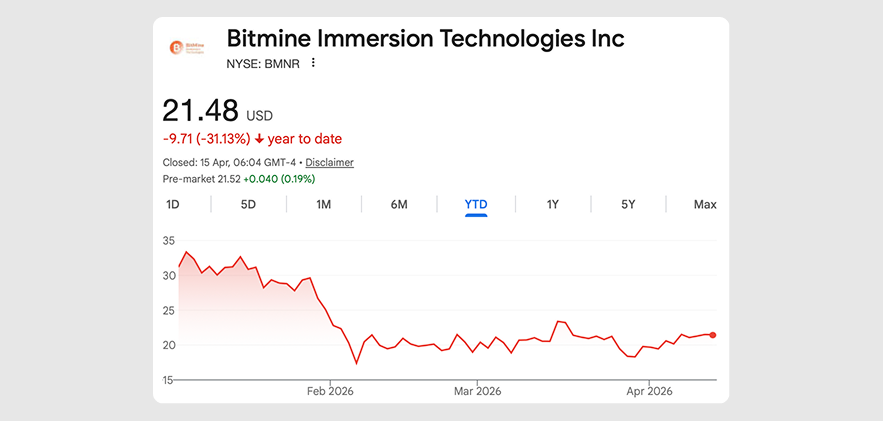
The New York-listed firm reported a staggering $3.82 billion quarterly net loss for the period ended February 28, driven almost entirely by unrealized markdowns on its massive ETH treasury. A year ago, its loss was just $1.16 million.
Yet BitMine hasn't sold a single coin. The loss is purely accounting noise under fair-value rules that require marking holdings to market each quarter. ETH fell hard during the period, generating a paper loss even though the position remains profitable on a cost basis.
The numbers are staggering
BitMine now holds 4.87 million ETH — roughly 4% of the entire circulating supply — at an average cost of $2,206 per token. At current prices, that stash is worth nearly $11.4 billion.
The company raised over $10 billion through stock sales in the past six months, more than doubling its share count from 232 million to 494 million. Nearly all of that cash went straight into Ethereum.
In the most recent week alone, BitMine snapped up 71,524 ETH — its fastest buying pace since December 2025. The firm is now 81% of the way toward its self-proclaimed "Alchemy of 5%" target: accumulating 5% of all circulating Ethereum.
The business underneath
Once a mining company, BitMine has reinvented itself. Self-mining revenue collapsed 86% year-over-year to just $219,000. Staking has taken over, generating $10.2 million of the company's $11 million in quarterly revenue.
BitMine recently launched MAVAN, its institutional-grade staking platform. With 3.3 million ETH already staked, the company projects annual staking rewards of $310 million at full deployment.
But the transformation isn't cheap. General and administrative expenses exploded from under $1 million a year ago to $75 million this quarter. The gap between operating costs and operating revenue is stark for a company whose core product is now holding a single token.
Lee's bottom call
Despite the loss, chairman Tom Lee struck an optimistic tone. "Ethereum is in the final stages of the 'mini-crypto winter,'" he said, pointing to structural tailwinds like Wall Street's growing embrace of blockchain technology.
Lee has previously predicted ETH could reach $12,000 to $22,000 if Bitcoin hits $250,000. In his most bullish scenario? $62,000.
But his timing has been off before. A previous call that Ethereum would bottom near $2,500 and rally to $9,000 by early 2026 missed the mark. Some investors are questioning his signals, even as they respect his conviction.
The concentration question
BitMine's growing hoard has raised eyebrows about Ethereum's decentralization. Lee pushes back, claiming even 10% ownership wouldn't threaten the network.
For now, the company keeps buying. The coming quarters will test whether staking revenue can offset the accounting volatility of holding $11 billion in a single digital asset — and whether Lee's bottom call finally lands.