Clapp Weekly: Bitcoin outruns gold, CBDC ban nears, X Money's DOGE wait

BTC price
As war rages in the Middle East, Bitcoin is outshining stocks, gold, and silver. The rally gained steam after Trump signaled the conflict could soon end: BTC reclaimed $71k on March 10, just ahead of February's CPI report. Meanwhile, spot ETF inflows stayed strong — $568 million last week following $787 million the week prior.
The BTC price peaked at $73,669.78 on March 4, slipped below $68k two days later, and bottomed at $65,962.94 on March 9 before rebounding. Following a high of almost $71,500 on March 10, BTC is hovering around the $70k mark.
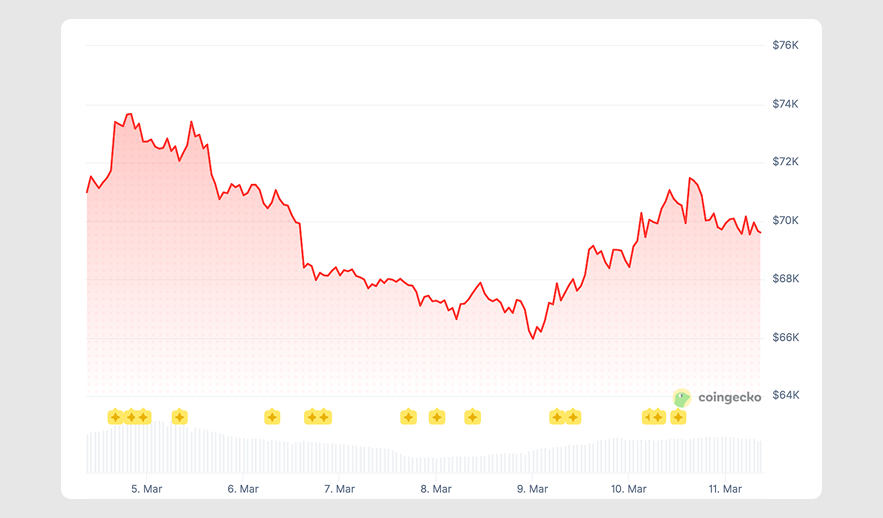
Currently at $69,549.90, BTC is down 1.8% over the past 24 hours with a 0.1% 7-day change.
ETH price
Ether is holding firm above $2k, buoyed by whale buying and accumulation that continue despite muted price action. Selling has been largely limited to ETF investors and retail traders — wallets holding 100-1k and 1k-10k ETH have collectively slashed their holdings by 200,000 ETH over the past week.
ETH tracked BTC's trajectory, nearly touching $2,180 on March 4 before declining. It fell below $2k on March 6, rebounded from roughly $1,930, and topped out at $2,018.71 on March 10. Since then, it's been trading lower.
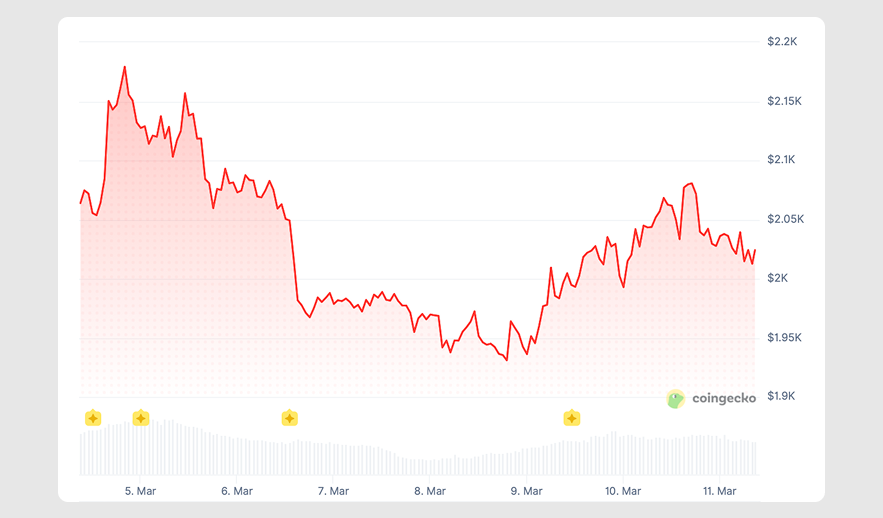
Currently at $2,011.61, ETH is down 2.4% over the past 24 hours with a 7-day gain of 0.3%.
Seven-day altcoin dynamics
Bitcoin-led momentum continues to dominate the recovering market. Altcoin prices are lagging far behind, with the Altcoin Season Index stalling at 35/100 — firmly in Bitcoin season territory.
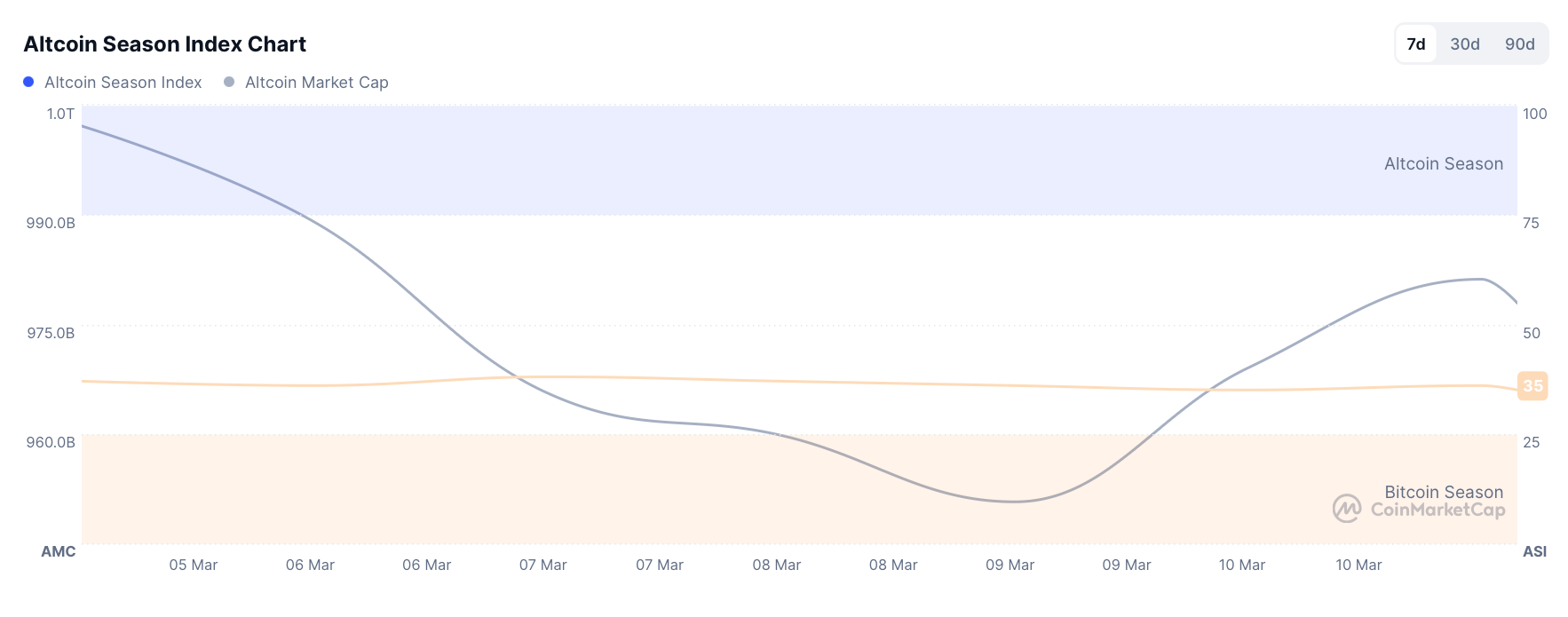
As investor appetite remains concentrated in the market’s pioneer, the Fear & Greed Index is locked in "Extreme Fear" (12/100) at press time after briefly dipping back to 7/100 on March 9.
Oil fears ease
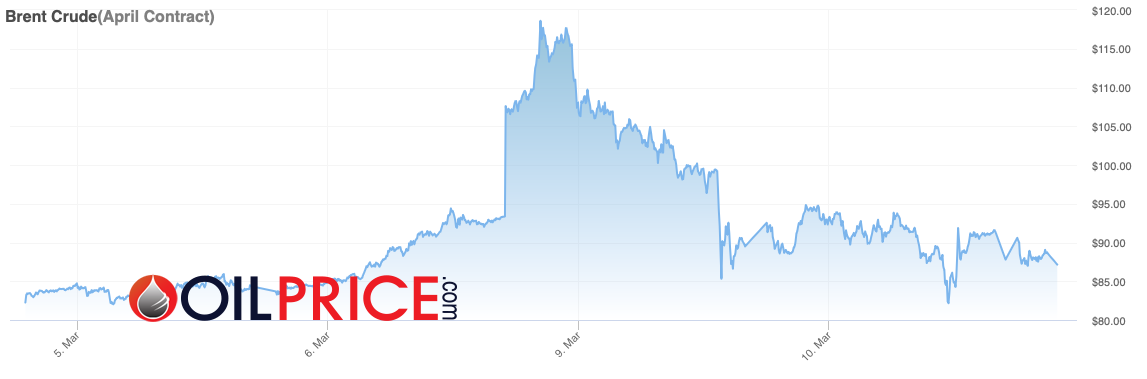
The March 10 recovery came as news from The International Energy Agency (IEA) eased fears of an oil supply shock amid the Iran war. The agency announced its member countries would soon discuss releasing emergency oil reserves.
Both Brent and WTI prices have dipped — currently trading at $87.40 and $83.40 per barrel, respectively. On Sunday, March 8, April contracts for both grades topped $100.
Inflation data ahead
Today's Consumer Price Index (CPI) report for February (March 11) arrives after a lower-than-expected January reading. Both headline and core are projected to stay the same on an annual basis (2.4% and 2.5% YoY, respectively).
The real macro spotlight, however, is the Personal Consumption Expenditures (PCE) index — the Fed's preferred inflation gauge. Due March 13, the January report will likely show no headline change from December (2.9% YoY), but the crucial core index could heat up to 3.1% YoY — the highest since March 2024 — as companies pass tariff costs to consumers.
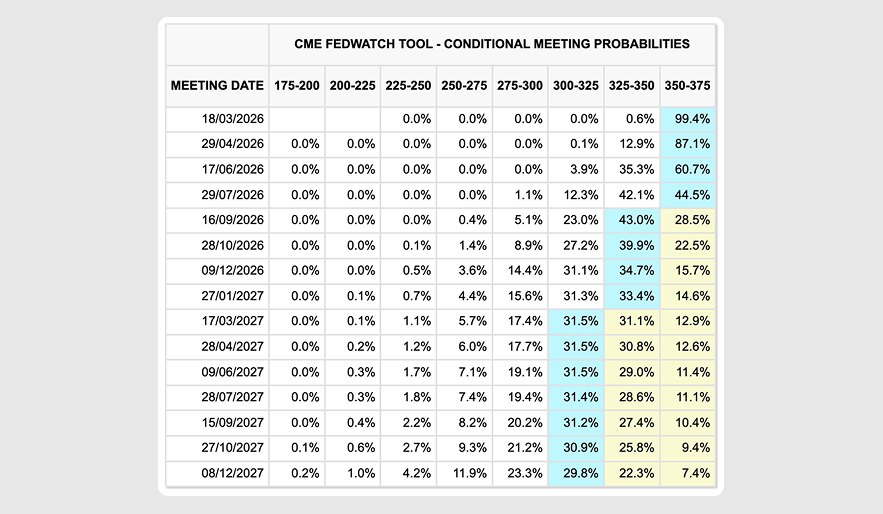
An upside surprise would reignite sticky inflation fears, potentially weighing on crypto prices ahead of next week's Fed meeting. The odds of a rate cut on March 18 have already slid below 1%.
Deutsche Bank economists suggest the Fed "will not be able to cut again until later this year" as "policymakers will need more clarity on inflation trends before cutting rates further, especially given that some of the downside risks to the labor market seem to be receding."
Weekly winners
- PI (+36.7%) is benefiting from positive social buzz ahead of the Pi Day event, commemorating the mathematical constant pi, amid whale buying and anticipation of major listings. The biggest whale bought 2.4 million PI worth over $525k on March 10 — after his weekend purchases totaled over $640k.
- OKB (+28.1%) soared after NYSE’s parent company Intercontinental Exchange (ICE) invested in the exchange at a $25 billion valuation. The amount reportedly reached $200 million, and ICE also secured a seat on OKX’s board of directors. The companies' collaboration could explore market structure, clearing, data, and institutional access to crypto.
- WBT (+13.2%) rocketed on March 4, a day ahead of its listing on the Kraken CEX that expanded access beyond the native WhiteBIT exchange. However, a massive, 81.5 million token unlock (approx. $4.45B) scheduled for March 13 could exert substantial downward pressure.
Weekly losers
- FIL (-15.1%) has slipped amid overall altcoin weakness, pressured by leveraged long liquidations, and whale shorting that sparked a cascade, amplified by high spot volume.
- XDC (-13.9%) is struggling to recover from a March 6 plunge, which coincided with BTC's dip. A recent Coinstats report also revealed minimal revenue generation over the past year, high execution risk, and low liquidity as the network faces competition from Solana and Ethereum L2s.
- TRUMP (-13.8%) plunged 96% from its all-time high as President Trump's approval ratings fell amid the ongoing war in the Middle East. In a recent NBC News poll, 41% of respondents supported his efforts regarding Iran.
Cryptocurrency news
Congress moves to kill the digital dollar — but what does it mean for crypto's big bill?
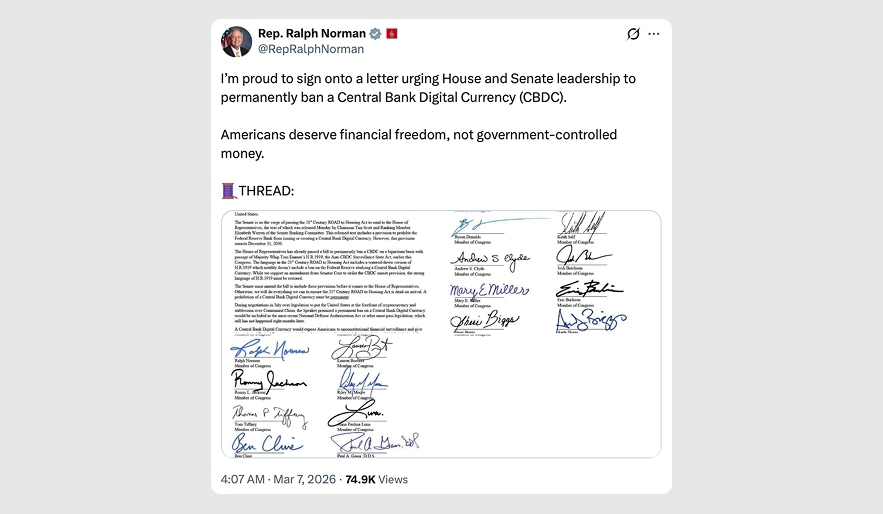
The digital dollar is officially on life support, and Congress may soon pull the plug for good. Last week, Senator Ted Cruz filed an amendment to the 21st Century ROAD to Housing Act that would permanently ban the Federal Reserve from issuing a central bank digital currency.
The move would make permanent a temporary ban currently set to expire in 2030. With the housing bill expected for a Senate vote as soon as this week, TD Cowen's Washington Research Group sees the writing on the wall.
"We expect a ban on a central bank cryptocurrency to be included in the housing bill that gets to the President's desk as soon as next month," wrote Jaret Seiberg, managing director at TD Cowen. "It is more likely that the ban is permanent than temporary."
Why now?
The push builds on last year's House passage of the Anti-CBDC Surveillance State Act, which prohibited the Fed from issuing a digital dollar directly to individuals. Cruz has long championed the cause, warning that a CBDC could let the government track every transaction.
Congressman Ralph Norman put it bluntly: "A permanent prohibition is the ONLY way to protect Americans' privacy and liberty."
The Fed, for its part, insists it has no plans to issue a digital dollar without congressional approval. But as Seiberg notes, "that could change over time based on who wins the White House in 2028 and who becomes Federal Reserve chair in 2030. It is why a ban is helpful."
Good for stablecoins, complicated for CLARITY
A permanent CBDC ban would remove the existential threat hanging over stablecoin issuers — no more worrying about the government launching its own competitor. That's broadly positive for Tether, Circle, and the rest of the ecosystem.
But it could also make passing the CLARITY Act harder.
Seiberg warns that lawmakers may now point to two crypto victories — the GENIUS Act and a permanent CBDC ban — and call it a day. "That is a lot of congressional focus on one industry," he notes. "We are not saying this closes the door on Clarity. It just joins the list of obstacles to action. And each new obstacle makes enactment a bit less likely."
Meanwhile, back at the negotiating table
The stablecoin yield debate continues to gum up the works. At an American Bankers Association summit this week, Senator Angela Alsobrooks signaled a compromise is taking shape — one where both sides will be "just a little bit unhappy."
The goal: guardrails that prevent deposit flight from banks while still allowing innovation. Senator Mike Rounds suggested rewards might be tied to account activity rather than balances, a middle ground JPMorgan's Jamie Dimon has signaled banks could accept.
With midterms approaching and the calendar tightening, every new variable — CBDC ban, yield fight, procedural hurdles — adds weight to an already heavy lift. Washington may be closer to killing the digital dollar. Whether it can also birth the CLARITY Act is another question entirely.
X Money arrives in April — but Dogecoin's role remains the million-dollar question
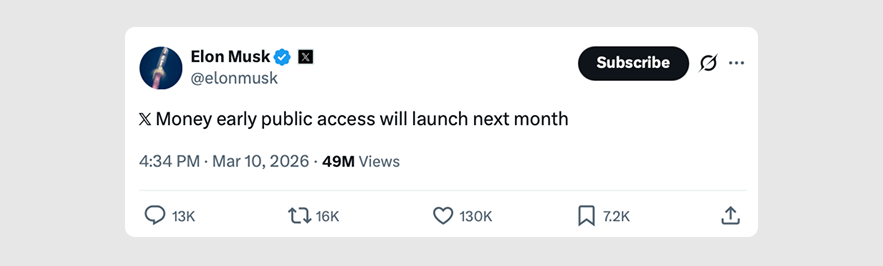
Elon Musk's long-awaited "everything app" is finally ready for its close-up. Early public access to X Money will launch next month, the billionaire confirmed Tuesday, marking a major milestone in his quest to transform the social media platform into a financial powerhouse.
The payments service, which has been quietly tested by early users including "Star Trek" actor William Shatner, will allow peer-to-peer transfers, direct deposits, yield on cash balances, and debit card purchases with cashback.
Shatner, invited by Musk to beta test the platform, is now auctioning off early access to support his Hollywood Charity Horse Show — for a $1,000 donation, users can skip the line and start making coffee purchases and transferring funds ahead of the public rollout.
But for the crypto community, one question looms larger than all others: where's Dogecoin?
Dogefather's favorite coin
Musk's history as Dogecoin's most famous booster is well-documented. He's called it his "favorite cryptocurrency," teased integrations, and sent the memecoin soaring with a single tweet more times than anyone can count. So when X Money finally neared launch, speculation ran wild that DOGE would be baked in from day one.
So far, that hasn't happened. The early beta screenshots show no obvious crypto integration — just familiar fintech features that rival Venmo, Cash App, and PayPal. X Product Lead Nikita Bier has emphasized that while users can now trade traditional equities and digital assets via "smart cashtags," X itself isn't acting as a brokerage or executing trades.
Yet the market is betting otherwise.
DOGE jumps 8% on speculation
Despite the absence of concrete details, Dogecoin surged more than 8% on March 10, climbing to $0.099 with trading volume up 36%. The derivatives market lit up too — DOGE futures open interest jumped across Binance, OKX, and Bybit, with some exchanges seeing double-digit percentage increases.
The reaction suggests traders are pricing in an eventual DOGE integration, even if it doesn't arrive in April. Musk recently reposted a third-party forecast of X Money's future features that included "crypto integration" alongside loans and money market accounts. For a community accustomed to reading between the lines of Musk's tweets, that's enough.
What's actually coming
Behind the speculation lies real infrastructure. X Payments has secured more than 40 money transmitter licenses across US states. Visa signed on as a partner in January 2025 for secure, instant account funding. The pieces are falling into place for a legitimate financial services play.
Whether crypto becomes part of that picture — and whether Dogecoin leads the charge — remains unconfirmed. But if history is any guide, betting against the Dogefather's favorite coin has rarely been a winning strategy.
For now, X Money prepares its April debut. The crypto world watches, wallets ready, waiting to see if the "everything app" finally includes the one thing its biggest fan has always loved.