Clapp Weekly: Gold takes the crown, BTC mining crisis, Tether's USAT

BTC price
Bitcoin has steadied after plunging from roughly $91,000 to $88,000 in a macro-driven sell-off. The price is locked in a slim range as traders await the Fed's rate decision today and Mag 7 earnings later this week. Analysts link the rebound to shrinking leverage and short-term stabilization, rather than genuine momentum.
The BTC price slid from nearly $90k to $87,653.05 on Wednesday, January 21, bounced back above $90k, and seesawed lower. After Friday's hike to $90,475.02 came a steep weekend plunge. Recovering from Monday's low of $86,319.2, BTC reached above $89.3k a few hours ago.
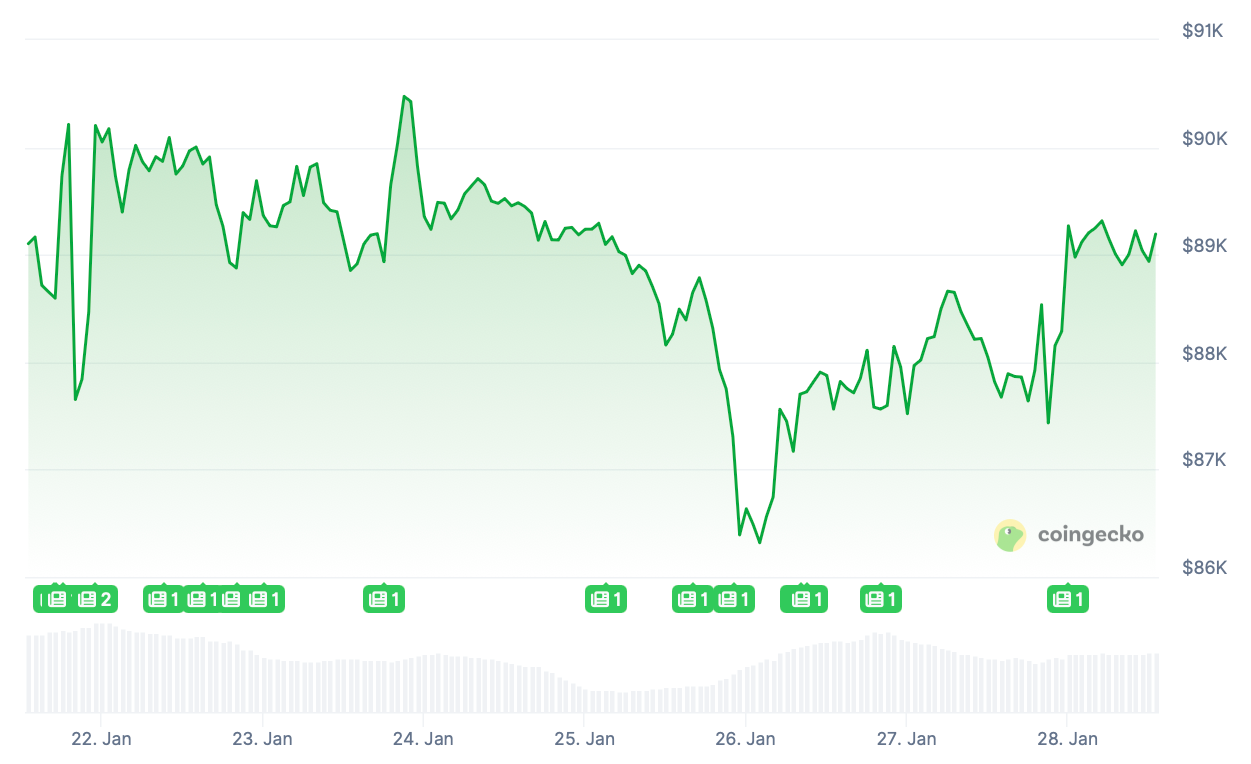
Currently at $89,178.79, BTC is up 1.6% over the past 24 hours with a +0.2% 7-day change.
ETH price
Ether is recovering from the $2,800 zone after the unveiling of ERC-8004 failed to spur momentum — likely as its benefits are not immediate. This new standard "allows AI agents to interact across organizations, ensuring credibility travels everywhere." Despite whales stepping in, sentiment is depressed — down 90% compared to the Pectra launch baseline.
Unlike BTC, ETH peaked higher after dipping to $2,898.09 on Wednesday, January 21. The same day brought a weekly high of $3,044.41 before a gradual descent to $2.95k and a steep plunge lower. The price bottomed at $2,818.87 on Monday, January 26, and has since been climbing.
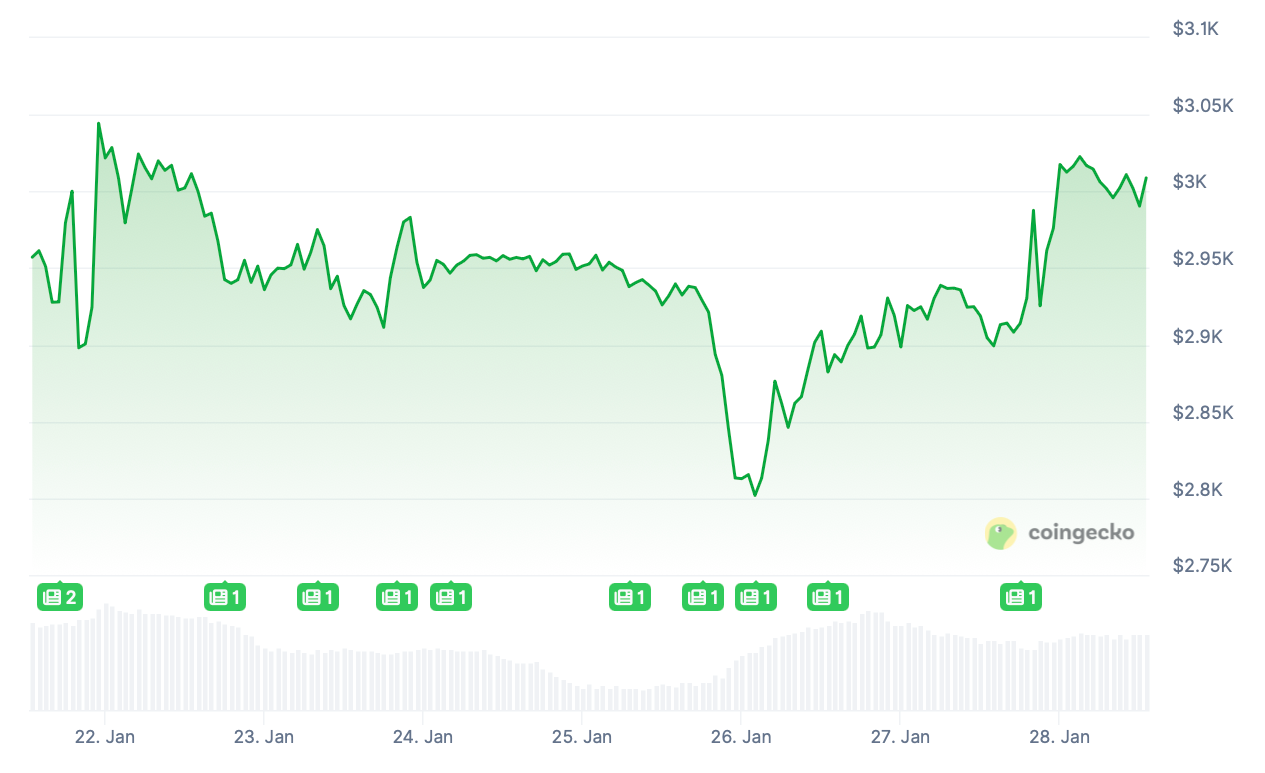
At press time, ETH is changing hands at $3,005.91, up 3.4% over the past 24 hours with a +1.4% weekly change.
Seven-day altcoin dynamics
Risk appetite remains muted, with the Fear & Greed Index still in the Fear zone (30/100). As Bitcoin sank under macro stress, investors began exiting crypto for fiat — stablecoin supply fell by about $2.24 billion over a 10-day period. Capital is flowing toward gold, supported by a weaker US dollar and record-setting global stocks.
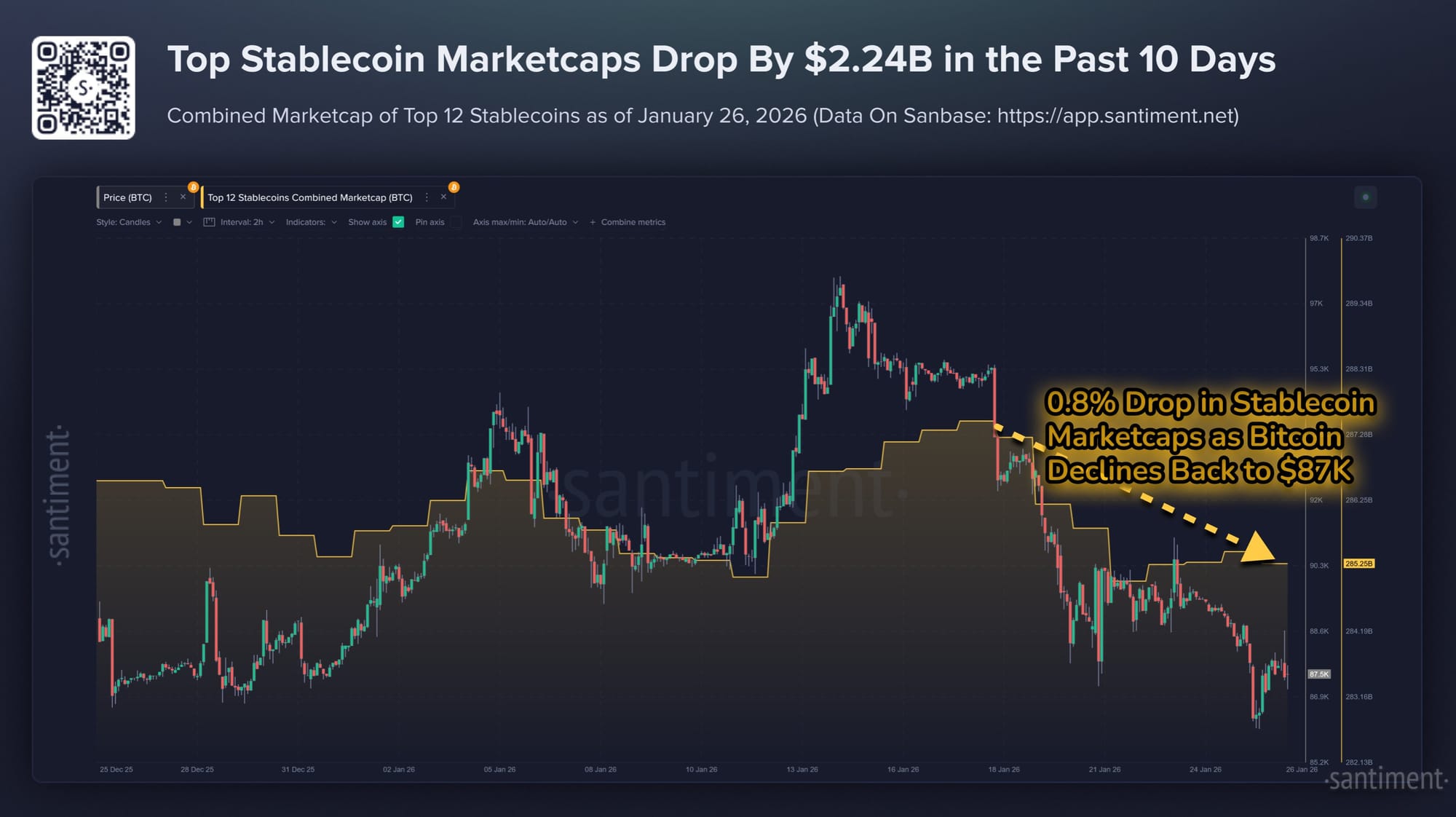
This shift is a classic flight to a more established safe haven, with gold hitting a new record high of $5,100 per ounce this week. While BTC is sidelined, “gold is backed by thousands of years of credibility and low volatility,” as noted by HashKey Group's senior researcher Tim Sun.
Bitwise CIO Matt Hougan sees gold's hike as a sign of deepening institutional distrust in fiat — a potential booster for crypto, particularly as demand for self-custody and censorship resistance grows. Yet the delay of the CLARITY Act could slow adoption.
"If the bill fails, I believe crypto will enter a “show me” period. That means it will have three years to make crypto indispensable to the everyday lives of regular Americans and the traditional financial industry. If it succeeds, regulations will take care of themselves. If it fails, there could be real challenges," he wrote.
Silver has also hit new highs, surging past $115 an ounce on Monday — and overtaking Bitcoin's gains since the 2017 cycle peak.
Fed rate decision: No cut in the cards
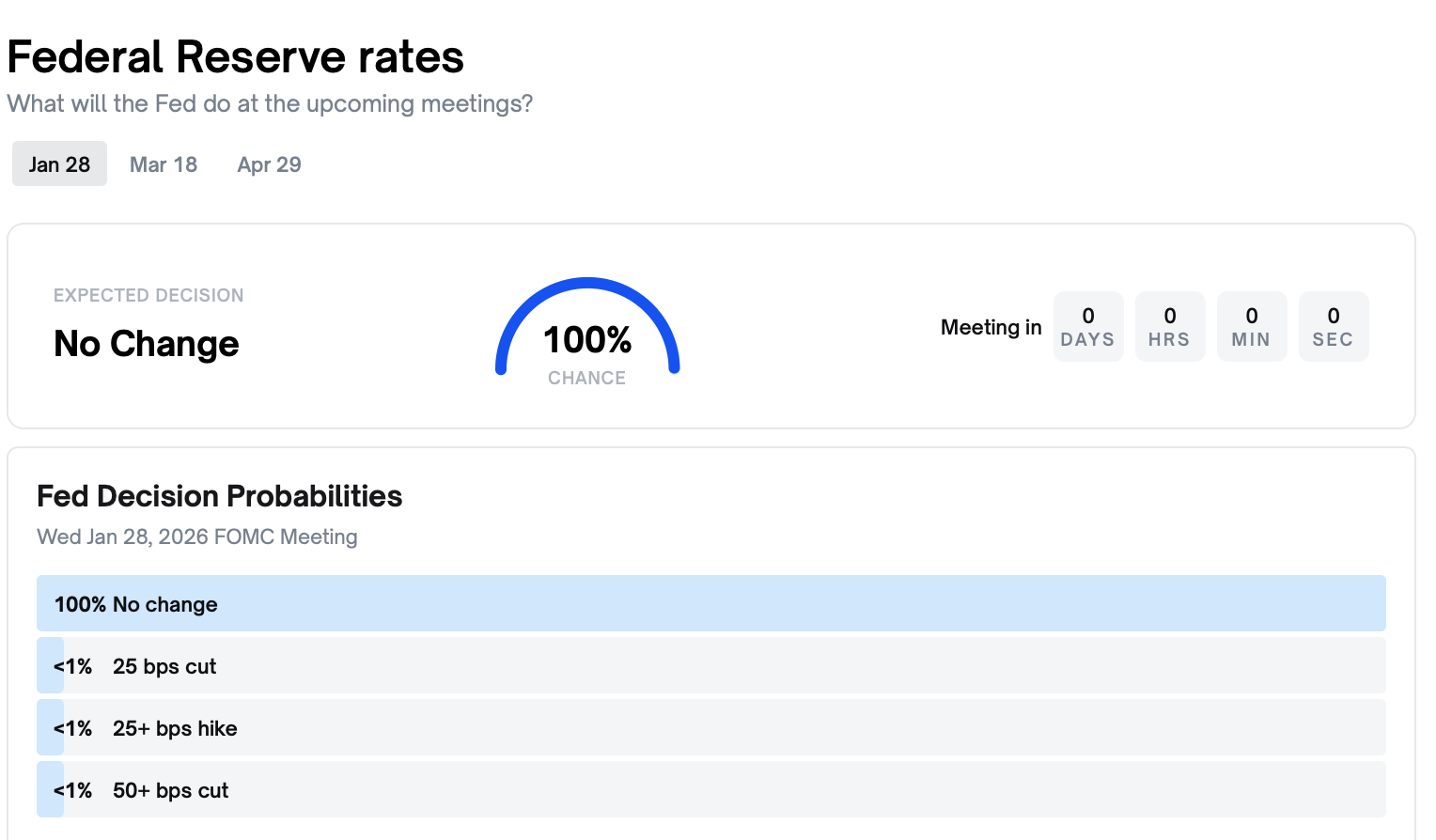
Based on market expectations and policymakers’ comments, the Fed is likely to keep its benchmark interest rate unchanged. CNBC projects near-term caution from the agency "as a series of cuts made last year work their way through the economy." Traders will focus on future guidance in Fed Chair Jerome Powell's post-meeting press conference.
Weekly winners
- RIVER (+109.9%) rallied on Tron founder Justin Sun's $8 million investment in the River project, which is designed to bridge stablecoins between chains. The founder’s commitment aims to help integrate River's satUSD into the Tron ecosystem. Yet leverage outweighing spot liquidity fuels wash trading allegations.
- HYPE (+57.4%) surged as the Hyperliquid exchange saw exploding commodities futures volumes — primarily for silver and gold. Silver became the third most active perp market on the platform. That spike is propelling token demand as a large share of trading fees from user-generated markets funds HYPE buybacks.
- PUMP (+31.2%) rebounded from Sunday's dip, though whale selling and exchange inflows suggest consolidation. The rally came despite a class action lawsuit filed against Pump.fun and the Solana Foundation alleging insider trading. While token launches have declined, recent buybacks support the price, and the outlook hinges on structural changes.
Weekly losers
- ICP (-12.5%) gave up most of its early-January gains despite a growing token burn rate. The AI sector market cap dropped over 8% amid the broader risk-off rotation — on January 27, 17 of the top 20 AI tokens were in the red (currently 12/20).
- POL (-11.6%) is challenged by fading on-chain demand after a spike in the second week of January, which triggered a record token burn.
- ARB (-8.9%) declined in a similar pattern to ICP and POL, while analysts maintain an optimistic outlook for the medium term.
Cryptocurrency news
Bitcoin's plunge triggers mining profitability crisis
With Bitcoin hovering around $87,900, the average cost to mine a single coin in the US has climbed to over $94,746. Data from the Cambridge Bitcoin Electricity Consumption Index (CBECI) reveals a brutal truth — any miner paying more than $0.10 per kWh for energy is likely operating at a loss.
This squeeze isn't confined to American shores; nations like China, Russia, and New Zealand also face costs perilously close to, or exceeding, the current BTC price.
Immediate reaction: strategic shifts and shutdowns
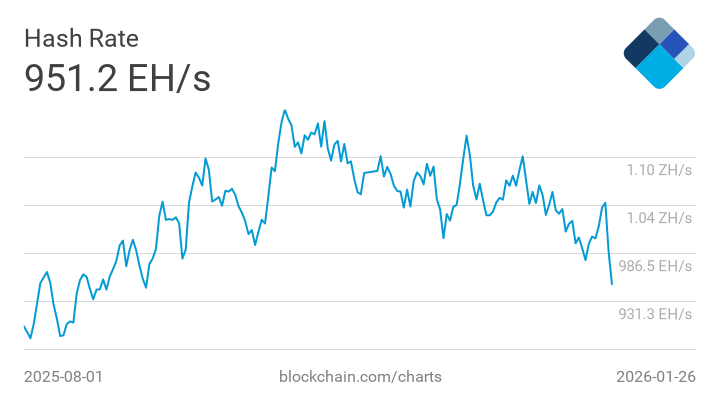
Major US mining firms are pivoting to AI data centers, while others are slashing operations. This has triggered a sharp drop in the global hashrate — the total computational power securing the Bitcoin network — as unprofitable machines go dark.
Bitcoin hashrate — the total computational power securing the blockchain — is down around 20% since mid-October, from around 1.2 zettahash per second (ZH/s) to 950 exahashes per second (EH/s).
Hidden bull signal?
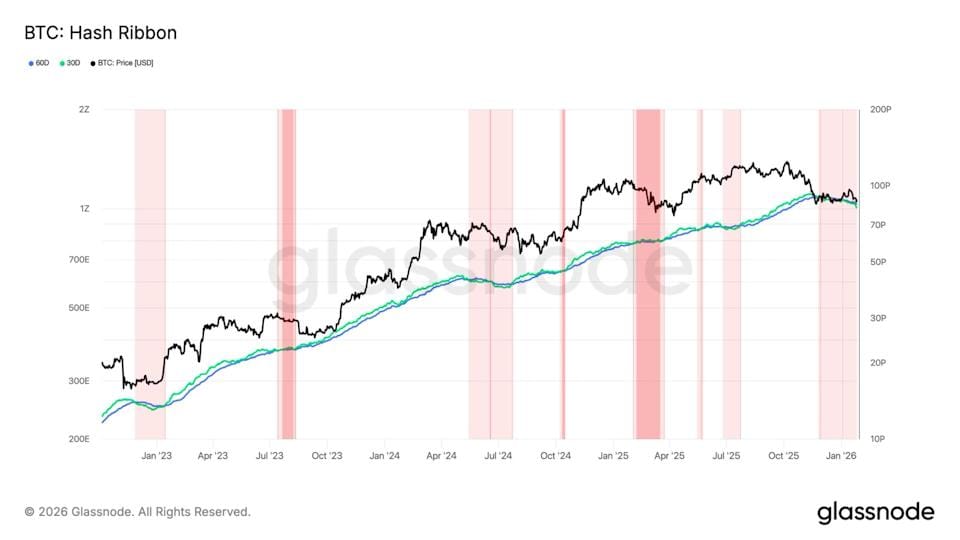
But within this crisis, a historically reliable metric is flashing a curious signal: the Hash Ribbons. This indicator tracks miner capitulation, precisely the kind of pain we're seeing now.
Historically, when the short-term hashrate average crosses back above the long-term average — signaling the worst of the shutdowns is over — it has often marked a major bottom for BTC's price. As noted by CoinDesk, we saw this play out before rallies in 2024 and post-FTX in 2022.
As a result, the next difficulty adjustment — a mechanism that keeps block production steady — could mark the largest drop since China's bitcoin mining ban in July 2021. Analysts project a decline of around 17%. This means the network's cryptographic puzzles will become easier to solve, allowing miners to secure blocks with less computational power.
Stark economics vs historical precedent
While soaring energy costs are forcing a painful industry shakeout, the ensuing miner capitulation may be quietly setting the stage for the next bullish phase. The question every crypto observer is asking now: will history rhyme once more?
Tether makes its "made in America" play
Tether, the titan behind the $1 trillion+ USDT, has officially stepped back onto US. soil. This week, the issuer has launched USAT, a new stablecoin that’s being billed as its first federally regulated, “Made in America” token.
For years, while USDT dominated the global crypto scene, its availability in the US was murky due to a lack of clear federal rules. That changed with last year’s GENIUS Act, which finally created a national framework for stablecoins. Tether is now playing directly by those new rules.
More than a rebranded USDT
USAT is built from the ground up to satisfy US regulators. It’s issued through the federally chartered Anchorage Digital Bank, with Cantor Fitzgerald — a heavyweight Wall Street name — acting as the custodian for its reserves. This is a stark contrast to USDT’s offshore structure and feels like a direct olive branch to the American financial establishment.
Leading the charge stateside is Bo Hines, a former White House crypto policy advisor who’s now CEO of Tether’s USAT unit. In a statement, Tether CEO Paolo Ardoino positioned USAT as the natural evolution of their mission:
“Tether has long demonstrated how digital dollars can deliver trust and transparency globally. USAT takes that to the next level with a product made for America.”
The token launched with a $10 million supply on Ethereum and is already listed on major platforms like Kraken, Crypto.com, and OKX.
USDC's new rival
US institutions have favored Circle’s USDC for years due to its transparency and local compliance. USAT is poised to compete on Circle’s home turf, leveraging Tether's enormous financial power for robust scaling. The issuer, boasting billions in reported quarterly profits, targets a $1 trillion market cap for the stablecoin within mere five years.
Rather than ask for a seat at the US table, Tether has built a whole new, regulation-friendly chair. This move could massively accelerate institutional adoption, giving TradFi a compliant, familiar on-ramp into digital dollars. The stablecoin wars just entered a whole new, highly regulated phase.