Clapp Weekly: Iran truce rally, Morgan Stanley's ETF edge, FDIC opens stablecoin floodgates

BTC price
Bitcoin dashed toward $72,000 following confirmation of a two‑week US–Iran ceasefire. The news triggered almost $600 million in leveraged liquidations — mostly short sellers getting squeezed— adding fuel to the fire. On April 6, just ahead of Trump's Iran deadline, Bitcoin ETFs posted their biggest inflow in six weeks, raking in $471 million.
The BTC price rolled from under $69k to roughly $66,045 on April 2, then traded around $66k for three straight days. Monday's push on April 6 took it to nearly $70k before a brief retreat, followed by yesterday's explosive rally to $71,975.62.
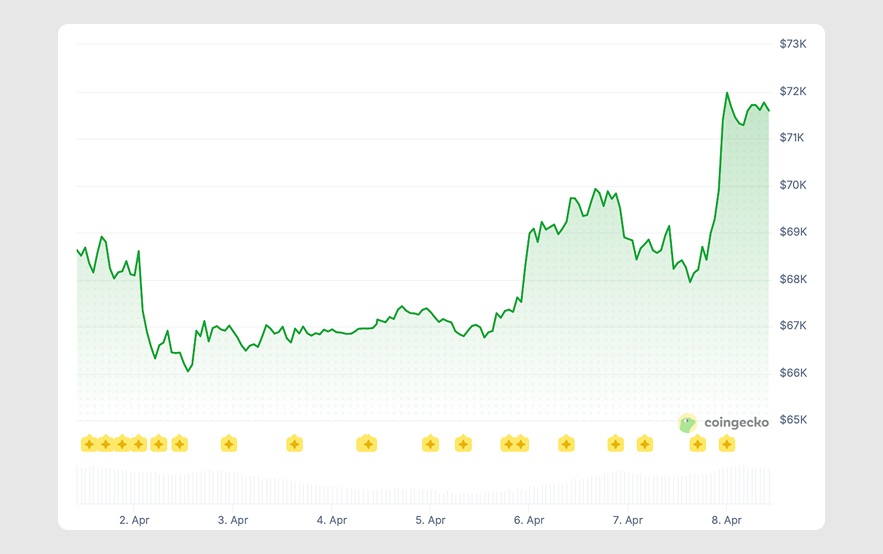
Currently trading at $71,684.45, BTC has gained 3.9% over the past 24 hours with a 4.4% 7-day gain.
ETH price
Ether has ripped past $2,200 despite volatile ETF flows. On April 6, US spot Ethereum funds pulled in $120 million in net inflows — only to give back half the next day. But whales are accumulating again, snapping up 230K ETH in the past week. Tom Lee's BitMine has also kicked in $150 million of ETH, pushing its stash closer to 4% of total supply.
Echoing BTC's swings, ETH slid from over $2,150 to $2,026.62 on April 2 and hugged the $2k level for days. Another dip followed on April 5, then a rally to $2,164.40 on Sunday, April 6. After a brief retreat, it surged to $2,255.81 earlier today.
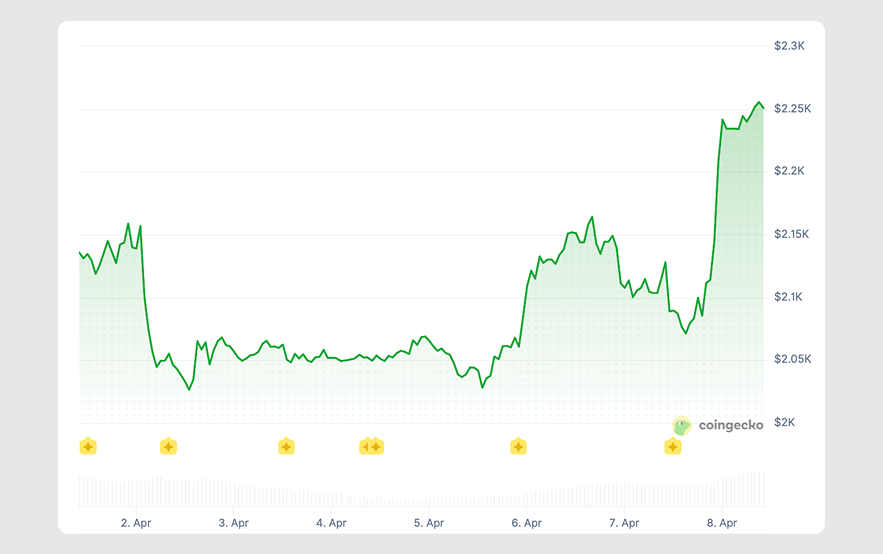
Changing hands at $2,252.81, ETH is up 6.3% over the past 24 hours with a 7-day change of 5.4%.
Seven-day altcoin dynamics
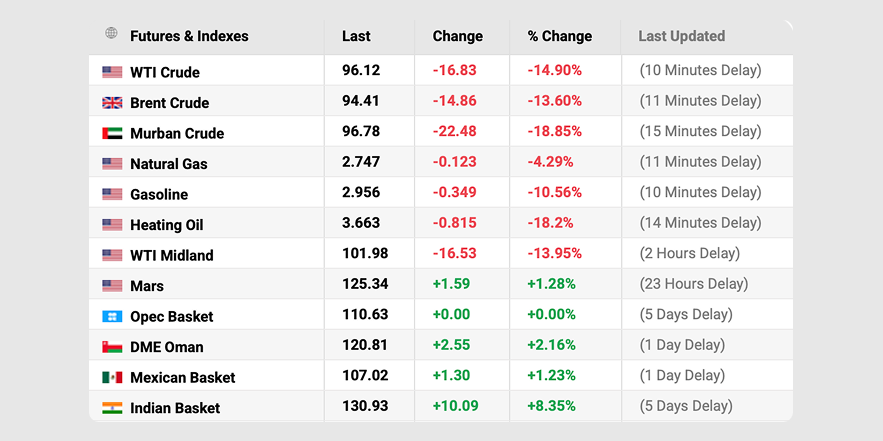
A two-week ceasefire in the Iran war, confirmed by Trump and Iranian officials, lifted risk assets on April 7. As crypto and US stock futures soared, oil prices declined by over 10% as fears eased over disruptions in Middle East energy supplies.
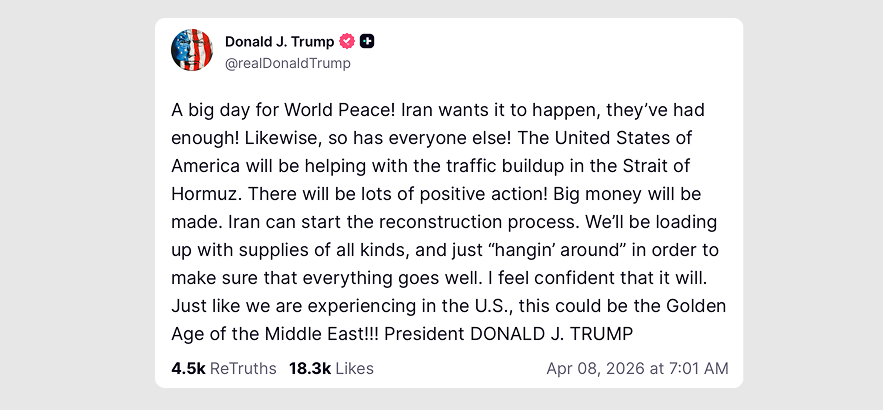
Taking to Truth Social just before his 8 p.m. ET deadline, Trump wrote:
"I agree to suspend the bombing and attack of Iran for a period of two weeks. This will be a double sided CEASEFIRE! The reason for doing so is that we have already met and exceeded all Military objectives, and are very far along with a definitive Agreement concerning Longterm PEACE with Iran, and PEACE in the Middle East."
Hours before, Trump had gone so far as to claim that "a whole civilization will die" unless Iran reopened the Strait of Hormuz. Uncertainty tied to the Iran war has kept risk assets under pressure for over a month, with oil rallies and inflation fears persistently capping Bitcoin's upside.
At press time, both Brent and WTI May contracts are trading slightly below $100 per barrel. An overwhelming majority of Polymarket bettors (84%) expect Trump to announce a complete end of military operations in Iran by June 30.
Altcoins still underperform Bitcoin
Altcoins have remained in a slump for a sustained period of time, with the CoinMarketCap Altcoin Index at 33. Recent CoinGecko analysis shows a divergence from past market patterns.
Due to the emergence of ETFs, altcoins have failed to outperform BTC following its ATH of $126k back in October. Fresh capital is mostly coming from institutions and “tends to stay concentrated in Bitcoin.”
Top weekly winners
- BCAP (+261.0%) is demonstrating a fake-looking "top gainer" move amid near-zero liquidity — it is even flagged as not actively tradable on major exchanges.
- ZEC (+32.0%) is following the broader bullish reversal that includes a privacy-coin and beta rebound; the 24-hour trading volume has surged 50% to $458.23 million.
- ALGO (+20.1%) gained fresh momentum after the Google Quantum AI paper confirmed its front-runner status in the field of quantum-computer resistance.
- RENDER (+17.1%) has followed Bitcoin's rally, also supported by rising global demand for AI computing resources on the Render Network; AI workloads now account for an estimated 35–40% of the total volume.
Top weekly losers
- NIGHT (-12.5%) slid on April 2, continuing its broader bearish trend year-to-date. The falling price ignored the use of validator nodes from Google, MoneyGram, Telegram, and Vodafone.
- UNI (-9.5%) is struggling to recover from its April 1 crash; analysts have described the latest downfall as a "classic liquidity sweep and forced liquidation event." The Drift Protocol hacker has also used Uniswap V3 to buy $2.46 million worth of ETH.
- RAIN (-7.2%) is feeling the pressure as traders position for a massive token unlock — on April 10, nearly 38 billion RAIN tokens are due to enter circulation.
Cryptocurrency news
Morgan Stanley debuts a new Bitcoin ETF with a killer advantage
BlackRock's IBIT is a Goliath of the Bitcoin ETF market, gobbling up over $63 billion since debut. Now, another investment banking giant has joined the ETF party: Morgan Stanley Bitcoin Trust (MSBT) debuted on NYSE Arca on Apr. 7.
Morgan Stanley has become the first major US commercial bank to offer a spot Bitcoin ETF. And while it's entering a crowded field, the firm isn't coming empty-handed. Morgan Stanley has something BlackRock doesn't — a captive audience.
The fee war continues
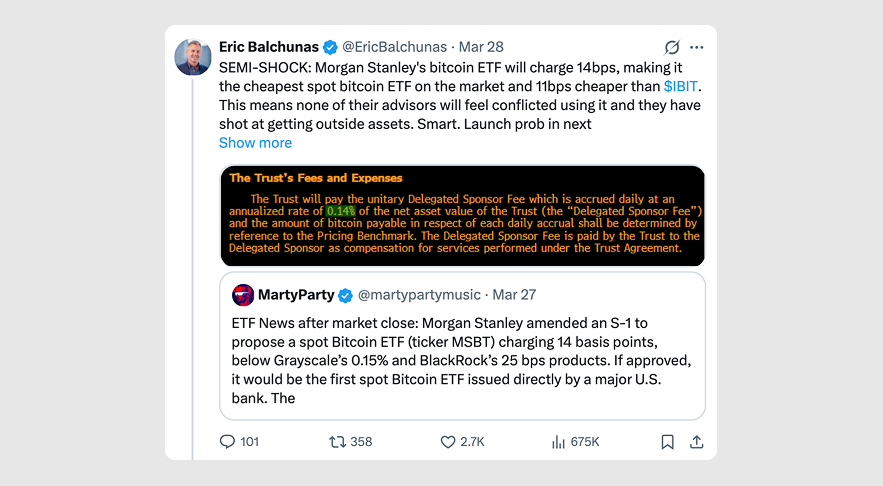
MSBT charges a management fee of just 0.14% — undercutting BlackRock's 0.25% and putting pressure on rivals to follow suit. VanEck currently charges zero under a fee waiver, but that expires in July. Grayscale's "Mini" product charges 0.15%. Morgan Stanley is right in the sweet spot.
But the real weapon is the distribution network.
16,000 advisors, trillions in assets
Bloomberg's Eric Balchunas put it bluntly: "What Morgan Stanley has going for it is a captive audience. It's got its own army of advisors." Roughly 16,000 financial advisors oversee trillions in client assets. If they start recommending MSBT, adoption could happen fast.
"Morgan Stanley is on another level" compared to Fidelity's advisory network, Balchunas said.
Last year, the firm's Global Investment Committee recommended allocating up to 4% of portfolios to crypto for "opportunistic growth." Now, with SEC approval secured, those allocations can actually happen.
Beyond Bitcoin
MSBT isn't Morgan Stanley's only crypto play. The bank has filed proposals for a staked Ether ETF and a Solana ETF. It's also pursuing a national trust banking charter to offer custody, trading, and staking services. Amy Oldenburg now leads the digital asset division.
Custody is handled by Coinbase and Bank of New York Mellon — institutional-grade infrastructure designed to keep regulators happy and advisors comfortable.
Schwab isn't far behind
Morgan Stanley isn't the only traditional finance giant gearing up for a crypto push.
Charles Schwab, the brokerage behemoth with nearly $12 trillion in client assets, plans to launch spot cryptocurrency trading for BTC and ETH in the first half of 2026. The firm has already opened a waitlist for what it calls a "Schwab Crypto" account, which will allow clients to buy and sell the coins directly alongside their stocks and bonds — all within the familiar interface.
Schwab already offers crypto-linked ETFs and Bitcoin futures, but direct trading is the logical next step. With its massive built-in client base, it could quickly become a formidable competitor to both crypto-native exchanges and other traditional finance entrants.
Stablecoin market just got a new set of rules — and Wall Street Is ready
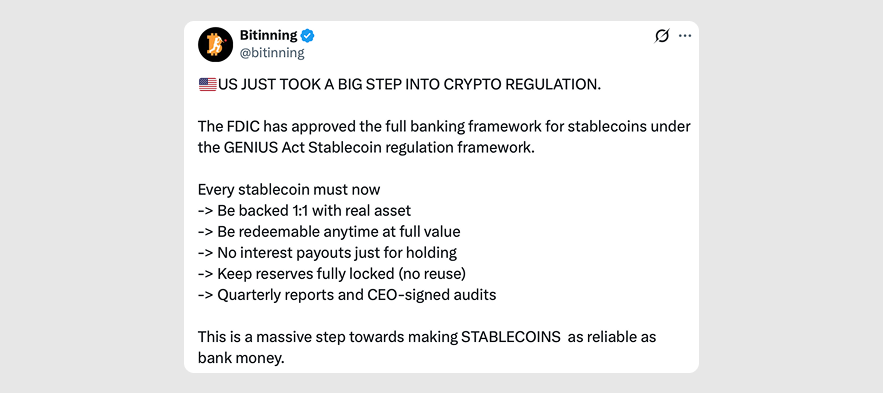
The FDIC approved new prudential standards for stablecoin issuers on Monday, firing the starting gun for Wall Street banks preparing to enter a market now worth over $323 billion. The vote advances the second phase of rulemaking under the GENIUS Act, signed into law by President Trump last July.
For years, stablecoins were crypto's backyard project. Tether and Circle dominated, while Wall Street watched from the sidelines. Not anymore. The country's largest lenders are already jockeying for position.
The dam broke last summer
When President Trump signed the GENIUS Act in July 2025, it created the first federal framework for payment stablecoins. The law was simple in hindsight: hold 1:1 reserves in dollars or Treasuries, submit to audits, get licensed. Issuers under $10 billion answer to states; bigger players face the OCC.
But the real game-changer was what the law didn't do. It carved stablecoins out of SEC and CFTC jurisdiction entirely. No more guessing whether a dollar token counts as a security. That clarity turned a regulatory minefield into a paved road.
Banks are already moving
Bank of America's Brian Moynihan didn't mince words when the law passed: "If they make that legal, we will go into that business." By January, he was warning that up to $6 trillion in deposits — a third of all US commercial bank money — could eventually shift into stablecoins if yields ever get approved.
JPMorgan isn't waiting. The bank has been running deposit tokens through its Kinexys platform since June 2025, recently putting dollar tokens on Coinbase's Base network. First major bank to operate on a public blockchain? That's a notable milestone.
Meanwhile, Bank of America, Citi, and Wells Fargo reportedly explored a joint stablecoin project as early as May 2025. Wells Fargo has piloted its own digital cash token for internal settlement.
The catch — no yield allowed
Here's where it gets weird. The FDIC's proposal explicitly bans stablecoin issuers from paying interest or yield, including through third-party arrangements. Your bank savings account earns interest. A bank-issued stablecoin? Not yet.
Moynihan's $6 trillion prediction assumed regulators would eventually flip that switch. For now, the switch stays off.
Why this matters
A 60-day comment period just started. Full implementation could take until early 2027. But the signal is already loud and clear: the regulatory gray zone that protected Tether and Circle's dominance is gone.
Banks bring institutional credibility, compliance teams, and built-in customer bases. They also bring something crypto natives struggle with: trust from traditional investors.
The stablecoin market just got a lot more crowded. And Wall Street isn't asking for permission anymore.