Clapp Weekly: Macro tug-of-war, Washington's BTC move, Robinhood Chain debut

BTC price
Bitcoin reclaimed the $64.8k level in its strongest session in weeks as cooler US inflation reduced the odds of a July Fed rate hike. The rally followed a pullback toward $63k over the weekend, when renewed US-Iran strikes revived risk-off sentiment. Spot ETF flows, which had just turned positive, also weakened, with July 13 outflows reaching $424.66 million — nearly five times the previous session’s inflows.
The BTC price bottomed at $61.6k on July 8 and steadily climbed toward $64.5k on July 10 before stabilizing around the $64k level. It then slid back to $61,858.79 on July 13 and rebounded the following day. After hitting a weekly high of $64,976.84, BTC pulled back slightly but held its gains.
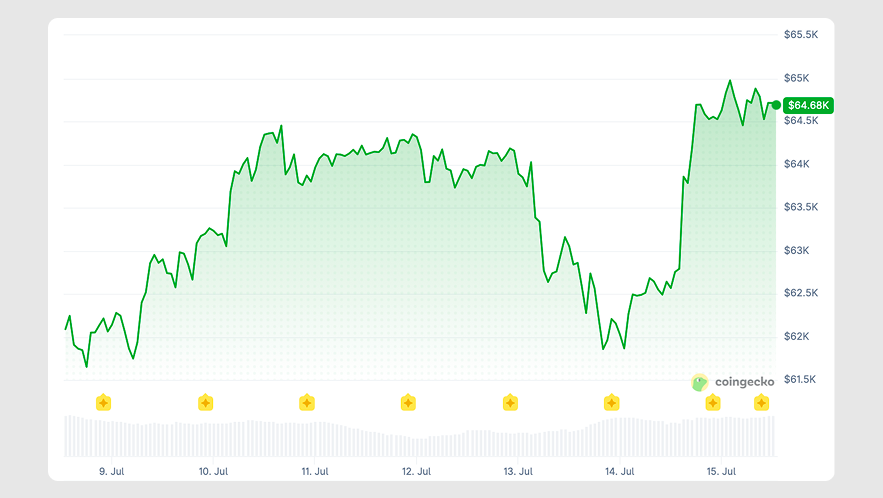
At $64,692.07, BTC is up 3.2% over the past 24 hours with a weekly gain of 2.7%.
ETH price
Ether jumped 7% on Tuesday following the US CPI report, despite muted participation from both whales and retail traders. The newly launched Robinhood Chain, a layer-2 network focused on tokenized real-world assets, could emerge as Ethereum’s biggest onboarding catalyst yet. Meanwhile, BitMine added another $49 million worth of ETH to its treasury last week, bringing its holdings close to 4.8% of circulating supply.
ETH recovered from a July 8 low of $1,721.51, tracking BTC's broader rebound, and climbed to $1,825 on July 11 before drifting lower. It briefly reclaimed the level two days later before sliding to $1,753.40 and recovering again. The coin then surged to a weekly peak of $1,885.95 today before easing back slightly.
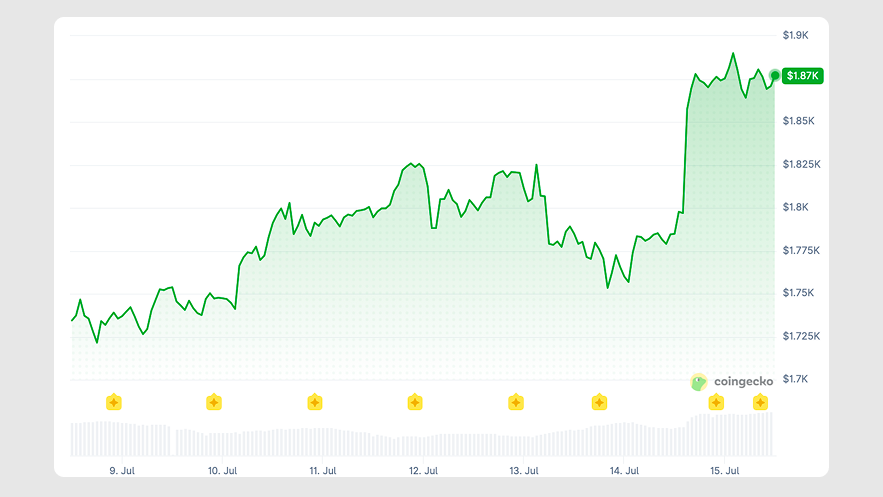
At $1,876.84, ETH has gained 5.0% over the past 24 hours and 6.5% over the past seven days.
Seven-day altcoin dynamics
The latest flare-up in US-Iran hostilities revived concerns over shipping through the Strait of Hormuz, a critical oil chokepoint. September Brent crude and August WTI climbed back to $85.90 and $80.15, respectively, adding fresh inflation pressure and narrowing the room for Fed easing. Extreme Fear persists, though sentiment improved slightly over the week, with the index rising from 20 to 25.
Energy-driven shocks have remained a headwind for Bitcoin since US-Iran tensions first escalated in late February. The market is now caught in a tug-of-war between macro relief and geopolitical risk, with the latest US CPI report reshaping expectations around the Fed’s next move.
CPI cools fears, but Warsh stays cautious
Core Consumer Price Index (CPI), which excludes food and energy, was unchanged in June despite economists expecting an increase. CNBC attributed the slowdown to falling energy and services costs. The energy index dropped 5.7% in June — its biggest monthly decline since April 2020 — although it remains up 15.7% year over year.
Headline inflation also recorded its sharpest monthly decline in more than six years, slowing to 3.5% year over year versus the 3.8% forecast, and falling 0.4% month over month against expectations for a 0.1% decline. The implied odds of a Fed rate hike this month fell sharply, dropping from 43% to 13%.
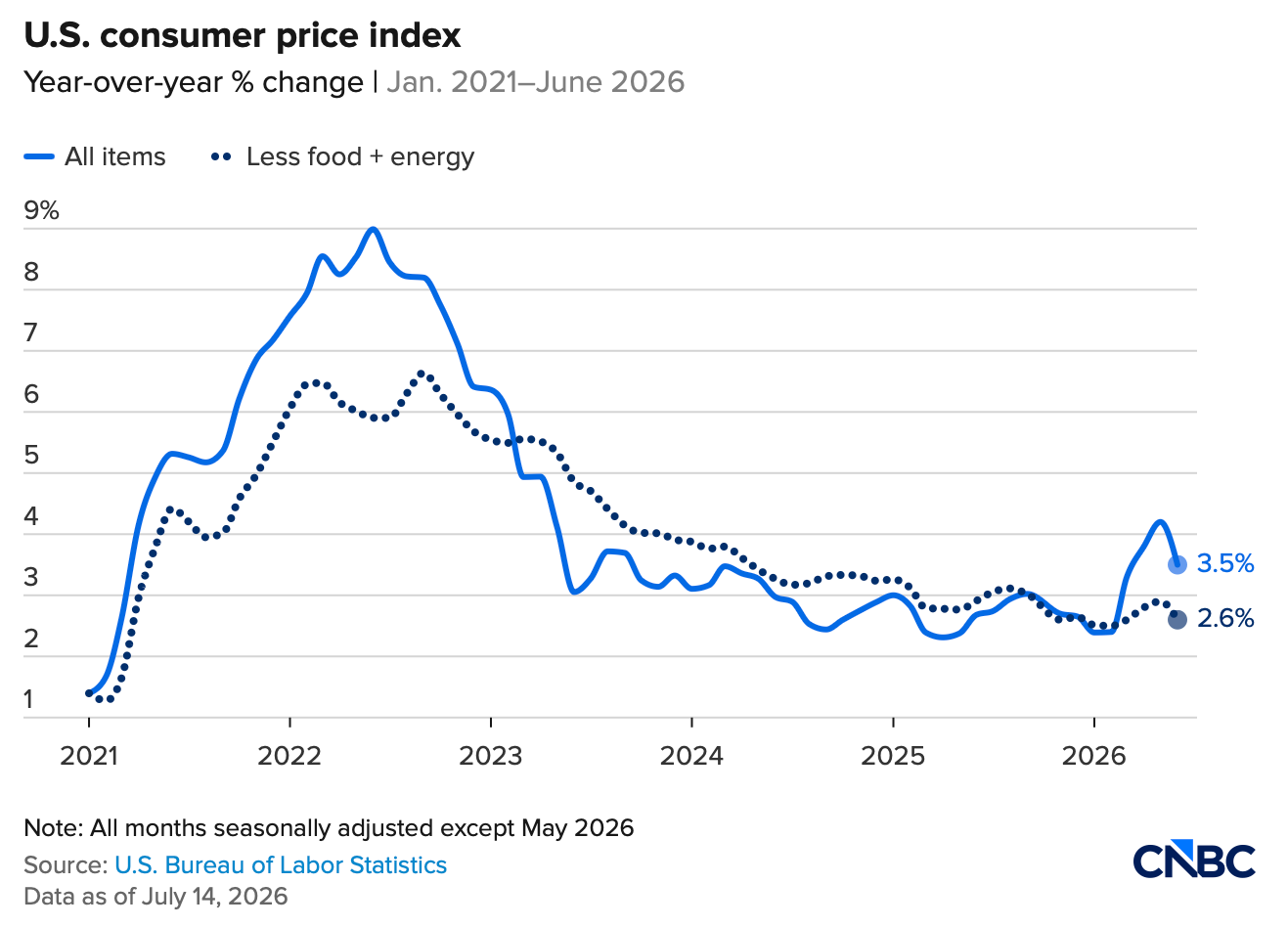
According to Navy Federal Credit Union chief economist Heather Long, “this takes the pressure off the Federal Reserve and allows the central bank to wait and see what happens.” However, analysts warn the relief could prove temporary given renewed US-Iran tensions. During Congressional testimony, Fed Chair Kevin Warsh said:
“There might be some that look at this morning’s data and say, ‘Oh, mission accomplished, everything is swell.’ That is not my view.”
Analysts are now turning their attention to the September FOMC meeting (September 15-16) for further policy signals.
Korean stocks hint at AI hype cooling
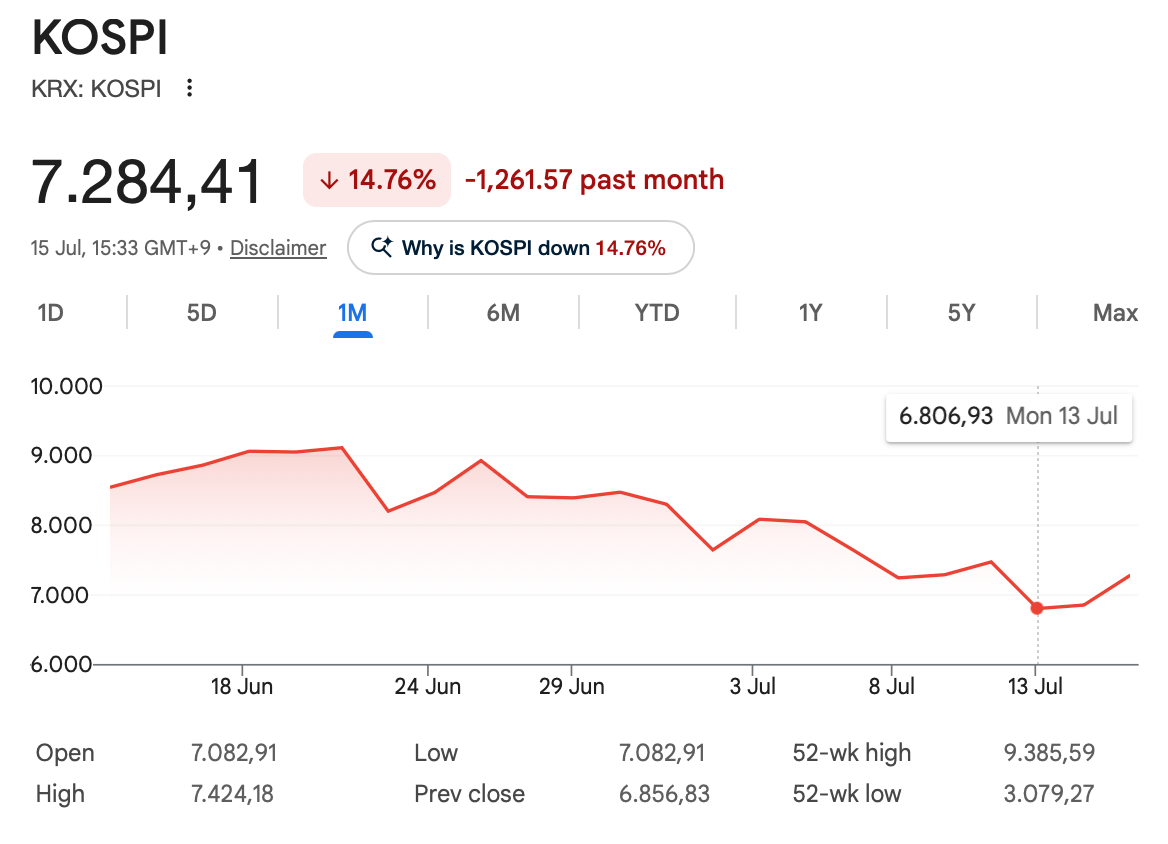
South Korea’s KOSPI — heavily weighted toward Samsung and SK Hynix — has technically entered bear market territory. Similar to the S&P 500 in the US, the index is now more than 20% below its June peak as retail investors search for alternative sources of returns. The correction reflects stretched valuations, elevated retail leverage, and growing doubts over the pace of AI infrastructure spending.
The stock sell-off coincided with a surge in crypto activity on Upbit, South Korea’s largest exchange. Trading volume jumped 1,318% within 24 hours to $4.2 billion, with XRP alone outpacing Bitcoin in volume.
However, part of the move was driven by forced selling, as 1.2 million leveraged accounts faced margin calls. Major altcoins including XRP, ADA, and SOL remain in negative territory at press time.
Top weekly winners
- DEXE (+41.3%) surged on a combination of growing on-chain activity, whale accumulation, and a structural short squeeze. Buying pressure was further amplified by staking activity and DAO treasury locks, though the lack of a clearly defined hard cap continues to raise concerns among traders.
- ADI (+19.9%) soared after the ADI Foundation announced a $50 million strategic investment on July 13. The capital will support enterprise adoption and sovereign digital infrastructure, strengthening demand for the token’s real-world utility narrative.
- ARB (+19.2%) rallied on a sharp increase in network activity and revenue following the launch of Robinhood Chain, which is built on Arbitrum’s infrastructure. A technical breakout and broader market short squeeze added further momentum to the move.
Top weekly losers
- PI (-25.1%) plunged to a new all-time low of $0.07059 on July 14, 2026, down 97.5% from its 2025 peak, as token unlocks and mainnet migration pressures weighed on sentiment. Upcoming unlocks will release another 127 million tokens over the next 30 days, adding to the selling pressure.
- M (-12.4%) tracked a broader pullback across high-risk memecoins, while traders also took profits after its July 14 rally, when the token gained more than 20%. Given M’s history of extreme volatility and concentrated ownership, even limited selling pressure can trigger outsized moves in thin liquidity conditions.
- AERO (-8.7%) declined as a high-beta DeFi token caught in the broader risk-off move, driven by macro uncertainty and derivatives liquidations, with no AERO-specific catalyst identified. The token also faces dilution pressure, as gauge emissions require sustained fee generation to absorb expanding supply.
Cryptocurrency news
US government moves $288M in seized crypto — sale or custody?
The US government just moved $288 million in seized Bitcoin and ether onto Coinbase Prime. And the internet immediately asked: are they selling?
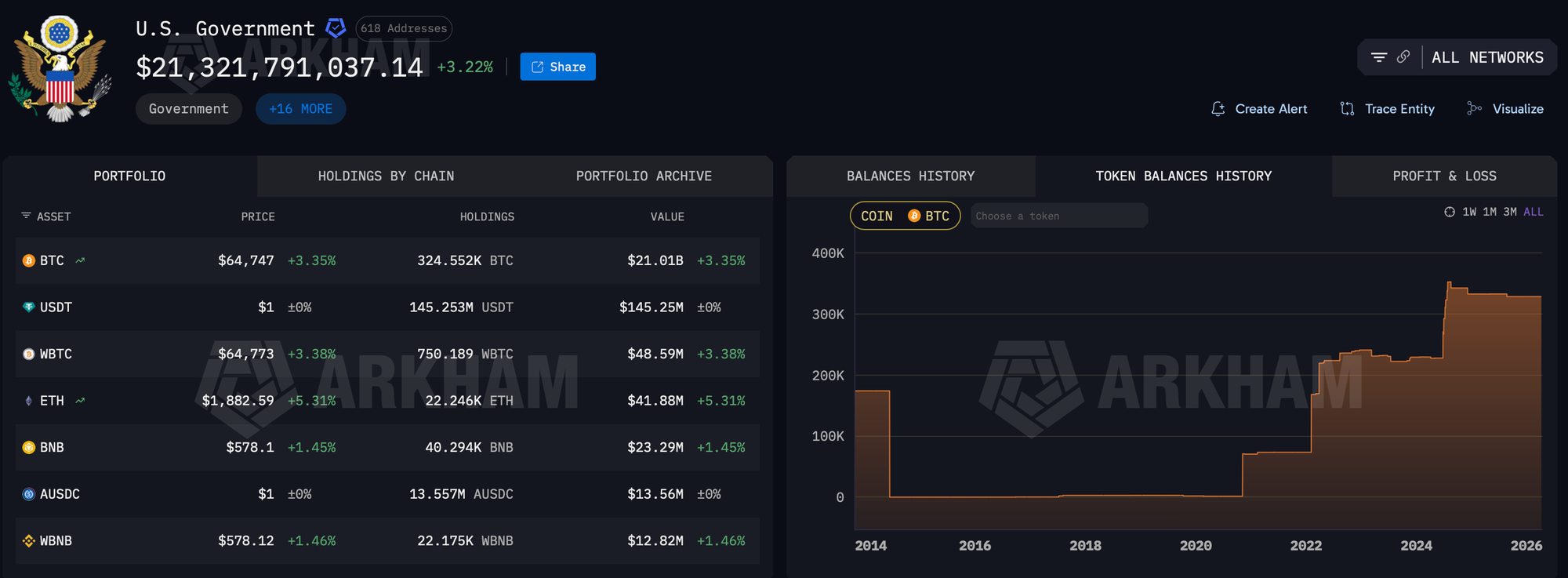
On Monday, on-chain tracker Arkham flagged transfers of around 3,800 BTC ($235 million) and 30,000 ETH ($53 million) to the exchange's institutional platform. The Bitcoin came from funds seized from dark-web dealer Ryan Farace ("Xanaxman") and the defunct exchange BTC-e. The Ethereum was tied to a money-laundering case involving Oracle employee Brian Krewson.
Custody or cashing out?
The government has offered no public explanation. Large holders typically keep coins in cold storage, so moving them to an exchange draws scrutiny.
"It's not yet clear whether the inflows are in preparation for a sale or simply for the consolidation and custody of seized assets," Tim Sun, Senior Researcher at HashKey, told Decrypt.
The US Marshals Service selected Coinbase Prime in 2024 to custody and trade forfeited digital assets. So the transfers could simply be administrative — moving assets into managed custody rather than preparing for a dump.
The never-sell rule
The timing is awkward. President Trump's March 2025 executive order created a Strategic Bitcoin Reserve and declared that government Bitcoin deposited into it "shall not be sold."
But Sun notes that only Bitcoin that has "completed the final forfeiture process" can be moved into the reserve. The coins moved Monday came from active criminal cases and are handled separately.
Ethereum sits outside the rule entirely. It falls under a separate Digital Asset Stockpile, giving the government "greater freedom of disposal," Sun said.
The scrutiny is sharpened by how unsettled the reserve remains. Bills to codify it with a 20-year holding rule have stalled in Congress. The Treasury and Commerce departments are still contesting who controls the assets.
A rounding error
The government still holds roughly $20.6 billion in crypto, including 324,552 BTC. Against that pile, the $288 million move is little more than a rounding error.
Whether it's a sale or just custody shuffling, the market is watching. In crypto, where trust is scarce, any government move this size raises eyebrows — even if the answer is ultimately mundane.
Robinhood Chain goes live — and Ethereum is its key beneficiary
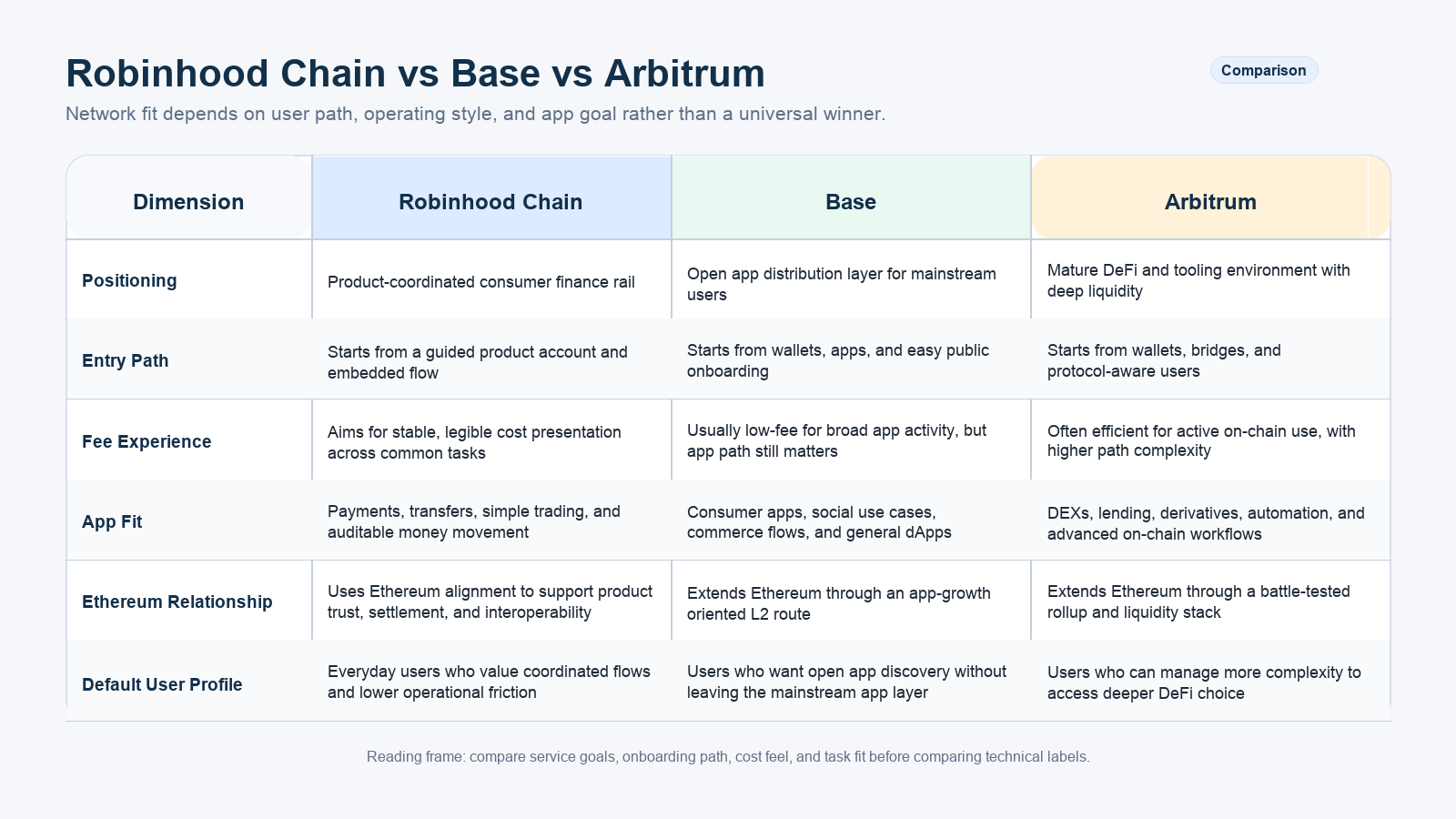
Robinhood has built a blockchain. The trading app launched the Robinhood Chain on July 1, an Ethereum Layer-2 that lets its 28 million users trade tokenized US stocks 24/7 across more than 120 countries. Built on Arbitrum's tech, it's the first real bridge between on-chain activity and the value of ARB — with 10% of net protocol fees routed back to the Arbitrum ecosystem.
By July 13, Robinhood Chain pulled in $135 million of value across 800,000 addresses. However, that volume came mostly from speculative memecoin trading. At press time, memecoins like CASHCAT and stablecoins dominate activity, while real-world assets account for only about $12.8 million on the chain.
The critics, however, focused on one number: Robinhood Chain users generated roughly $843,000 in transaction fees, while the network paid only about $1,600 to Ethereum for settlement. That's a 527x gap.
Ethereum's onboarding engine
Ethereum's long-term thesis has never relied exclusively on maximizing transaction fees. The network increasingly functions as a secure settlement layer supporting a growing ecosystem of Layer-2s that compete to attract users, developers, and assets.
Robinhood Chain could onboard millions of mainstream investors to Ethereum-based finance for the first time. They won't need to understand bridges, wallets, or gas fees. They'll just buy tokenized Apple or Nvidia shares, and suddenly they're holding assets that live on a blockchain.
That kind of user acquisition may ultimately prove more valuable than a temporary spike in Layer-1 revenue.
AI agents are the real story
Robinhood opened its stock trading platform to AI agents in late May. Crypto, options, and futures are next. In its first week alone, the new chain saw 2,100 AI agents generate $77 million in volume and earn builders $1.3 million.
Extending the same framework to tokenized equities would create the possibility of agents transacting in the largest and most liquid financial assets without human help.
Looking ahead
Once users are comfortable managing assets onchain, the broader Ethereum ecosystem becomes significantly more accessible. Tokenized stocks could eventually serve as collateral in lending protocols, trade on decentralized exchanges, or interact with stablecoins.
A user who joins Robinhood Chain to buy shares of Apple may later discover decentralized borrowing, perpetual futures, or tokenized Treasuries.
The debate shouldn't be about how much Robinhood Chain pays Ethereum today. The real question is whether it can onboard millions of traditional investors into onchain finance.