From Hormuz to Hyperliquid: How crypto traders are betting on oil

Since the US-Iran conflict sent shockwaves through global energy markets, crude oil has become one of the world's most volatile assets. Crypto traders responded by piling into on-chain derivatives, turning geopolitical headlines into round-the-clock opportunities.
While tokenized spot oil remains a work in progress, DeFi markets already let investors speculate on prices without touching a futures exchange. Here's how it works — and where the technology is headed.
TL;DR
- Oil became one of the world's most volatile macro trades after the US-Iran conflict disrupted supplies through the Strait of Hormuz, sending Brent crude above $120 before retreating.
- Crypto traders can already speculate on oil prices through decentralized perpetual futures, gaining 24/7 exposure without trading traditional commodity futures.
- Tokenized oil remains in its infancy, but projects such as WTIC, LITRO, and OilXCoin are working to bring physical crude and energy reserves onto public blockchains.
- On-chain oil could unlock fractional ownership, instant settlement, and broader market access, making one of the world's largest commodity markets more accessible to both retail and institutional investors.
- Institutional interest is growing, suggesting that tokenized energy assets may become a meaningful part of the broader real-world asset (RWA) ecosystem over the coming years.
Iran vs oil
Oil is the world's most important commodity — the backbone of global energy markets and one of the clearest barometers of inflation, geopolitics, and economic growth. Global crude prices are primarily measured against two benchmark grades: Brent crude, the international reference, and West Texas Intermediate (WTI), the leading benchmark for US oil.
On February 28, 2026, coordinated US-Israeli military strikes hit Iranian infrastructure. In response, Iran officially closed the Strait of Hormuz, a maritime choke point that handles roughly 20% of global oil supplies.
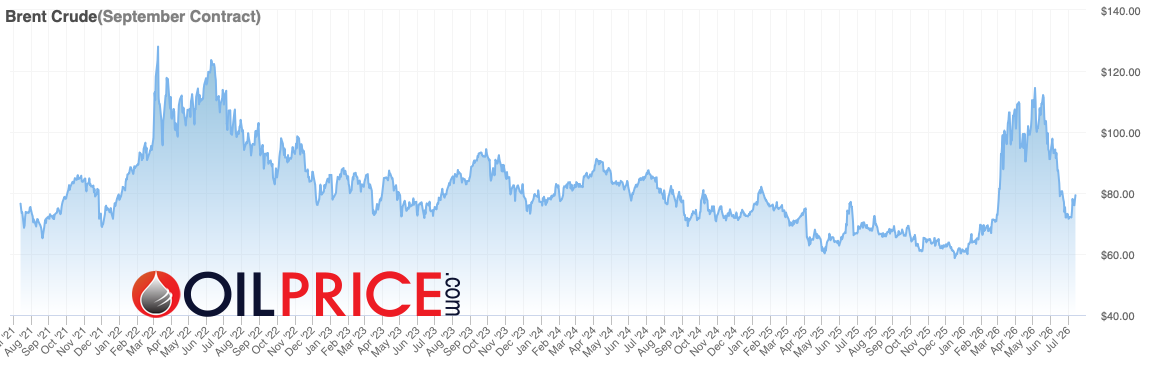
As a result, Brent crude oil prices surged from a pre-war baseline of $72 to a peak near $120 per barrel, before the market adjusted. The market unfolded in four distinct phases.
1. Initial shock (late February-mid-March)
The initial strikes were treated as a minor logistical disruption, with Brent climbing from $72 to $76 per barrel. With the closure of the Strait of Hormuz in early March, prices spiked to $80-82 per barrel.
The closure caused a massive supply deficit of 10-14 million barrels per day. Between May 4 and 9, Brent breached the $100 mark and rocketed to an intraday high of $119.50 per barrel, the highest since the Great Financial Crisis. However, this wasn't the peak yet.
2. Peak and extreme volatility (mid-March-April)
On March 10, as the White House announced that military objectives were nearing completion, Brent shed roughly 6% in a single day. Yet, prices remained highly volatile, seesawing between $100 and $115 per barrel.
The rally temporarily paused when G7 Nations announced coordinated strategic petroleum reserve leases. Yet, on April 30, infrastructure anxieties renewed, and Brent hit its 52-week peak of $120.88 per barrel.
3. Ceasefire and market deflation (May-June)
High costs caused global demand to plunge, even though US retail gasoline remained elevated at roughly 50% above pre-war levels. As a result, prices began to retreat gradually.
The interim peace deal and ceasefire in mid-june helped bring Brent down to $71.59 per barrel by the end of the month. The war risk premium shrank rapidly as limited traffic flowed again through the Strait of Hormuz. Energy markets largely concluded that the conflict had entered a de-escalation phase.
4. Renewal of hostilities (July)
The truce proved fragile. On July 7-8, the US resumed strikes after Iran allegedly attacked three tankers in the Strait of Hormuz, and revoked sanctions waivers. In response, Tehran targeted 85 US military installations in Bahrain and Kuwait.
Trump has declared the interim peace deal “over,” while almost 1 billion barrels of global petroleum reserves are depleted as of July 12. China's large-volume import is still halted, while mothballed refineries remain offline. Behind-the-scenes diplomatic talks continue.
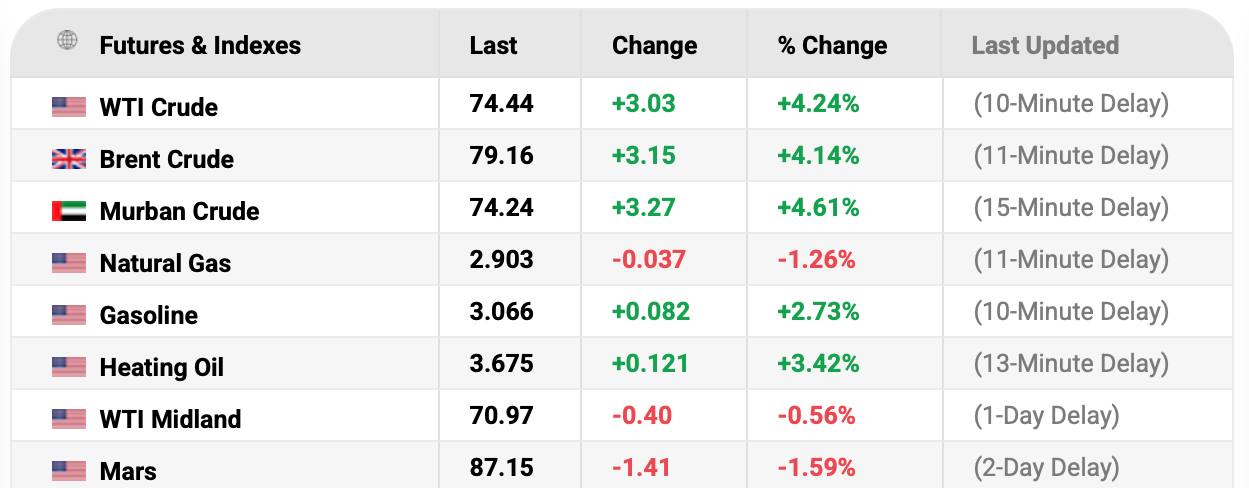
Brent immediately spiked over 5% in a single session to $78.02 per barrel. Overall, the market appears to have balanced out tanker traffic fears against resilient global supplies. As of this writing, September Brent and August WTI contracts are trading at $79.16 and $74.41, respectively.
Why crypto traders care
Every escalation in the Middle East now sends ripples far beyond traditional energy markets. Oil has become one of the world's most actively traded macro themes, and crypto is no exception. Instead of opening futures accounts or trading on legacy commodity exchanges, investors can now speculate on crude directly through decentralized perpetual markets that operate 24/7.
Oil trading in DeFi: Perpetual contracts
Perpetual futures, or Perpetual swaps, are derivatives, which means their value is derived from the underlying oil, but trading happens separately on a dedicated market. Until tokenized spot oil becomes available, crypto-native exposure remains concentrated in these instruments.
Perp traders go long or short on the future price of physical oil without an expiry date. Leverage allows them to control positions far larger than their initial capital, magnifying both gains and losses.
No physical barrels ever change hands. The funding rate mechanism ensures the price tracks the true market price of the oil closely.
- If it rises above the spot price, the funding rate turns positive, forcing long-holders (buyers) to make periodic payments to short-sellers.
- If it falls below the spot price, the funding rate turns negative, meaning short sellers pay long holders.
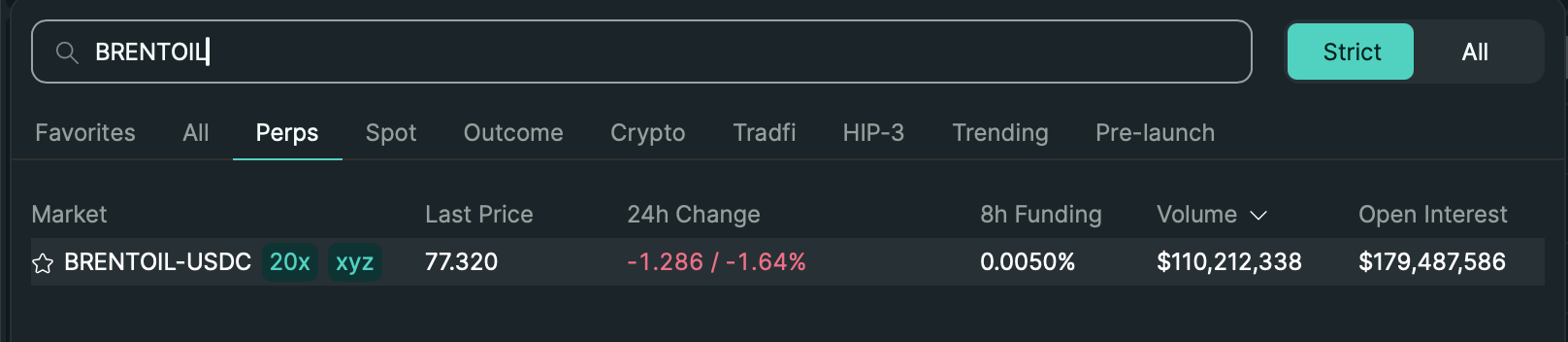
Thanks to DeFi markets, perpetuals can be traded 24/7. Hyperliquid expanded to RWA futures with the Hyperliquid Improvement Proposal-3 (HIP), which allows users to deploy perpetuals with a 1 million HYPE token deposit.
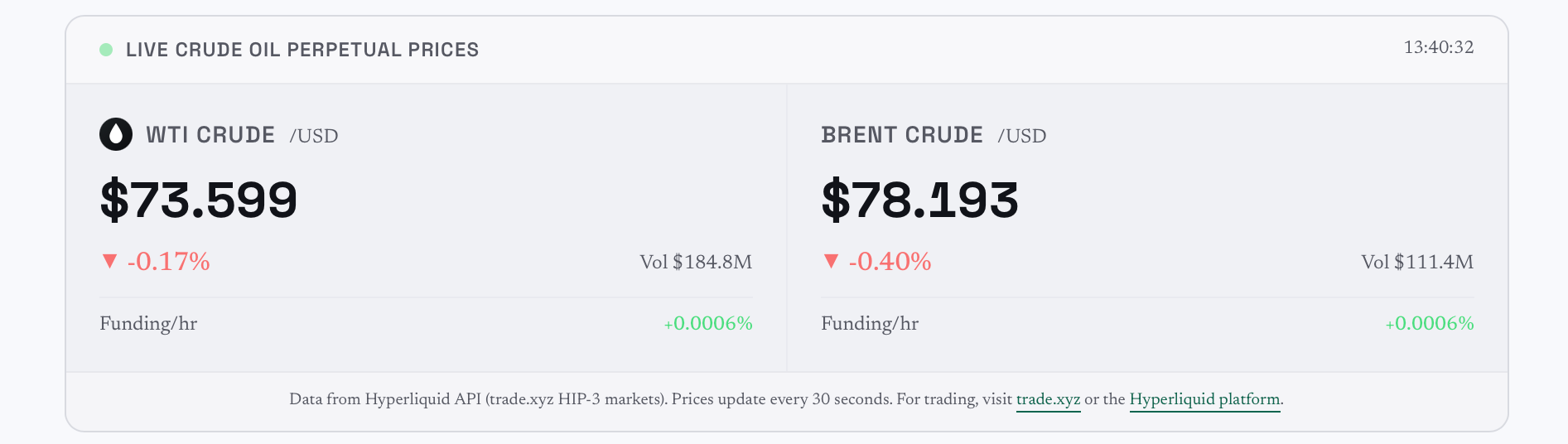
BRENTOIL (Brent crude) is a cash-settled perpetual futures contract, with USDC margin providing up to 20x leverage. CL (WTI crude) uses the same margin pool, providing exposure to the US benchmark.
Because they trade around the clock, on-chain perpetual markets often price in geopolitical developments before traditional commodity exchanges reopen. Perpetual trading is particularly attractive in a highly fluid situation like the current US-Iran crisis, which moves oil prices due to the closure of the Strait of Hormuz.
Oil as RWA: Work in progress
In the past few years, Real World Assets (RWA) have made headlines, with government bonds, stocks, real estate notes, and gold successfully put on chain. Yet beyond gold, commodity-based RWAs — including oil — remain largely untapped. For ordinary investors, “owning a barrel of oil” is nearly impossible.
Multiple projects are working on bringing oil barrels onto the blockchain as a Real-World Asset (RWA). This may involve tokenizing physical crude, refined products, or energy infrastructure, so they can be traded as digital tokens. Tokenization could open one of the world's least accessible commodity markets to a much broader range of investors.
It brings three crucial benefits to this historically opaque and rigid market:
- Fractional ownership. Investors and logistics companies can buy fractions of a barrel (e.g., down to 1/1,000th of a barrel) to hedge fuel costs — without expensive futures accounts or large capital.
- Real-time settlement. Replacing paper-heavy contracts with on-chain assets eliminates the traditional multi-day settlement cycle (T+2 or T+3). T+0 (instant) settlement mitigates the "geopolitical lag" during global crises, which also means banks don't have to bake an “uncertainty premium” into every trade.
- Diversification. Tokenized oil is tied to inflation and energy security rather than crypto-specific cycles. This gives investors a low-correlation, inflation-hedging asset.
WTIC
Fully liquid, institutional-scale tokenized oil markets have yet to emerge. At present, the Energy Substantiation startup is leading the charge to put a barrel on a blockchain. The firm has rolled out WTIC, a token designed to allow oil to move as freely as digital money.
Each token will represent one barrel of oil, giving investors 24/7 price exposure. Its value is backed 1:1 by the price of physical West Texas intermediate crude, priced through reverse Dutch auctions.
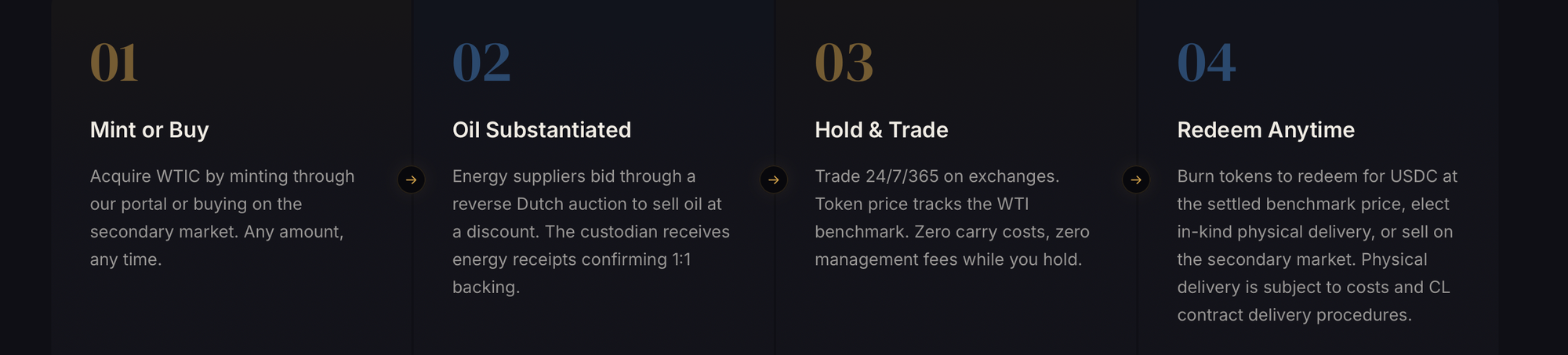
That underlying oil is treated as a spot commodity. This means holders will redeem it at the daily spot closing price, taking advantage of lighter regulation.
The upcoming debut on LMAX should resolve the current liquidity problem — as of early July, WTIC’s on-chain value hovers near $80,000.
LITRO
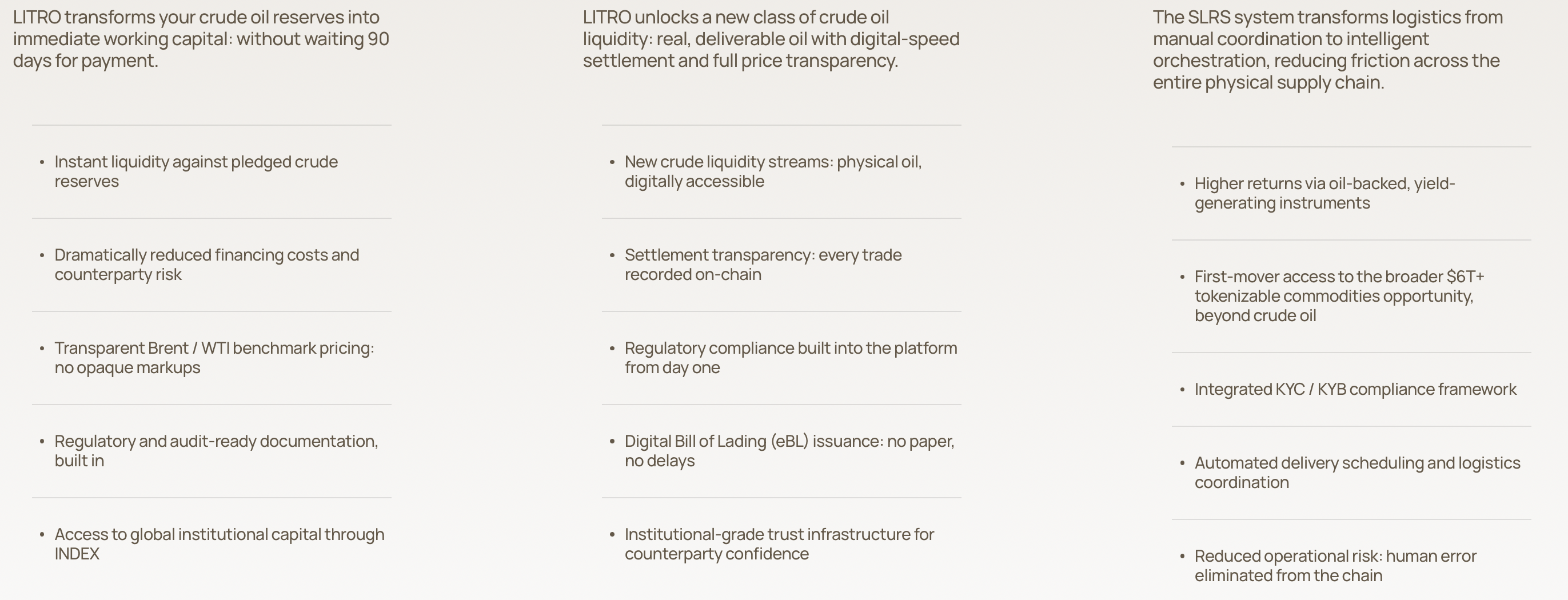
Another RWA project currently in development, LITRO, is also working on a token with a 1:1 peg to physical oil reserves. However, unlike WTIC, it is priced against the Brent benchmark. It is also focused on the actual delivery of the commodity, eliminating weeks of manual coordination.
All crude oil reserves pledged by producers are verified by an independent auditor. The issuer — INDEX — uses an AI-powered Smart Routing Logistics system to match buyers to optimal terminals and vessels. The system provides immutable proof of delivery, with real-time IoT vessel tracking across the entire supply chain.
Aside from redeeming for physical crude oil, holders can also settle in US dollars or roll the position forward.
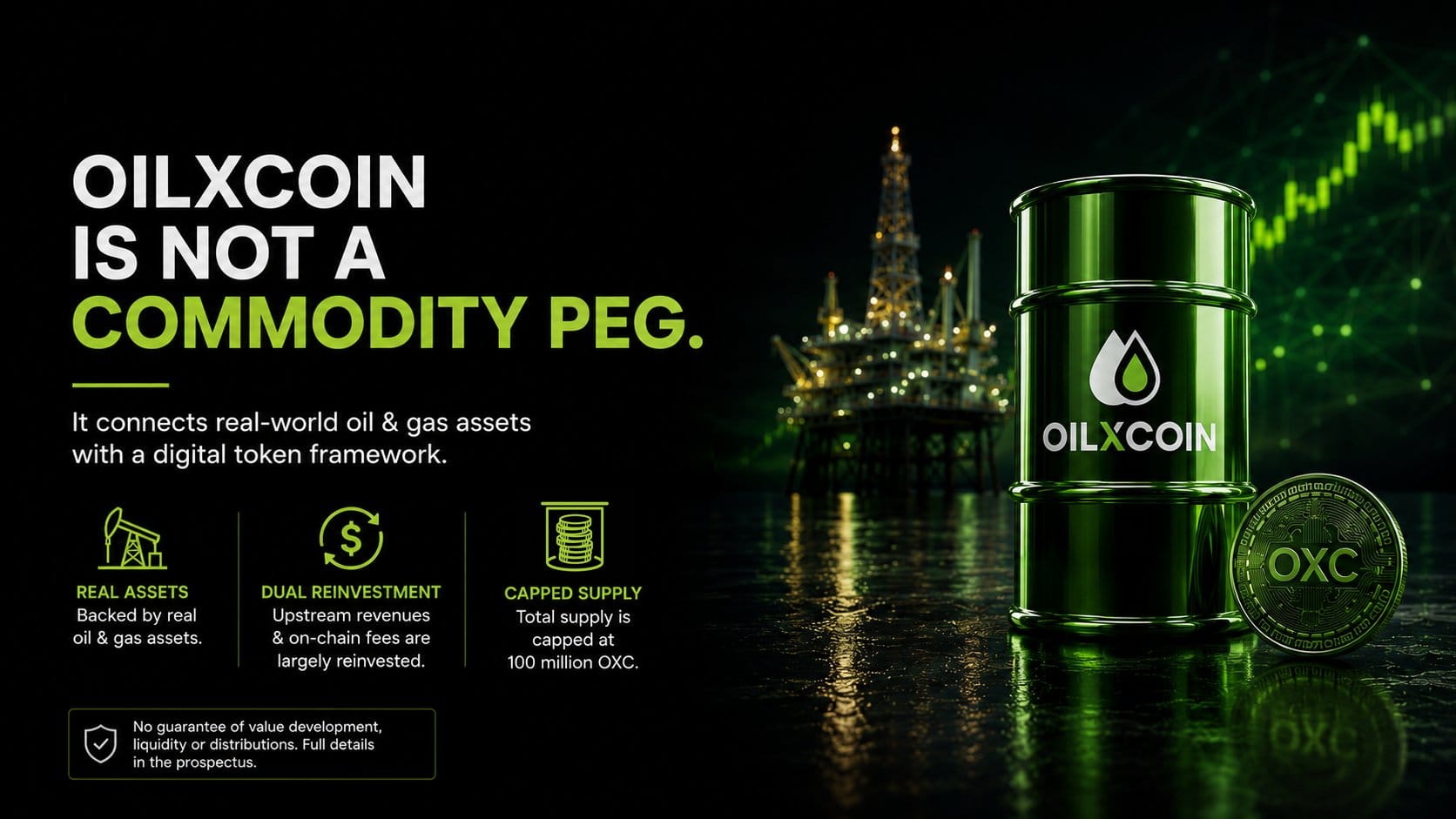
OilXCoin
The OilXCoin security token (OXC) is "anchored in natural gas and oil reserves and their upstream value chains." A security token regulated by Liechtenstein's Financial Market Authority (FMA), it powers a dual-income model rooted in both the upstream business and 0.75% crypto transaction fees.
After securing an EU/EEA prospectus approval, OilXCoin now trades on regulated brokerage platforms Archax and Assetera. Its value is linked to independently verified Gas-in-Place (GIP) and Oil-in-Place (OIP) reserves, providing a degree of insulation from broader crypto market downturns. Furthermore, revenue is continually reinvested in production infrastructure and further reserves.
Institutional RWA deals
Tokenization is moving beyond retail experiments. In mid-2025, Feniix Energy purchased a $75 million Latin American oil and gas facility using stablecoins and tokenized debt and equity through Global Settlement's RWA platform, GSX Protocol. A fully tokenized capital stack was used to acquire operational real estate.
Deals like this suggest tokenization is evolving beyond proof-of-concept projects toward financing real-world industrial assets.
Wrapping up
Oil has long been one of the world's most important financial assets, yet it remains one of the least accessible for ordinary investors. While DeFi perpetuals have brought 24/7 speculation on crude prices to crypto, true tokenized ownership of oil is still in its early stages.
If current projects succeed, they could reshape how energy assets are traded, settled, and financed. Yet regulatory hurdles, liquidity constraints, and the operational complexity of linking digital tokens to physical barrels remain significant challenges.
Even so, the recent surge in geopolitical volatility has highlighted the value of faster, more accessible commodity markets — making oil one of the next frontiers for blockchain-based finance.