Clapp Weekly: Middle East chaos, Bitcoin's war defiance, Trump vs. banks

TL;DR
- War headlines shook markets — but Bitcoin didn’t break.
- ETF inflows signal institutional accumulation despite retail fear.
- Rising oil threatens rate-cut hopes, complicating the macro backdrop.
- Altcoins continue to capitulate as liquidity thins.
- Trump escalates the crypto policy fight, pressuring banks over stablecoin rules.
BTC price
Bitcoin reclaimed $70k after dipping to $63k over the weekend as the US and Israel launched coordinated air strikes on Iran. While traders generally lean bearish, this rebound is propelled by institutional demand and short covering. Spot ETFs have drawn around $1.45 billion in net inflows over the past five trading days.
The BTC price surged from under $65k to roughly $69,340 last Wednesday, February 25, and declined gradually until bottoming at nearly $63,177 on Sunday, March 1. Recovering swiftly the next day, BTC came close to $69,500 before resuming its surge earlier today.
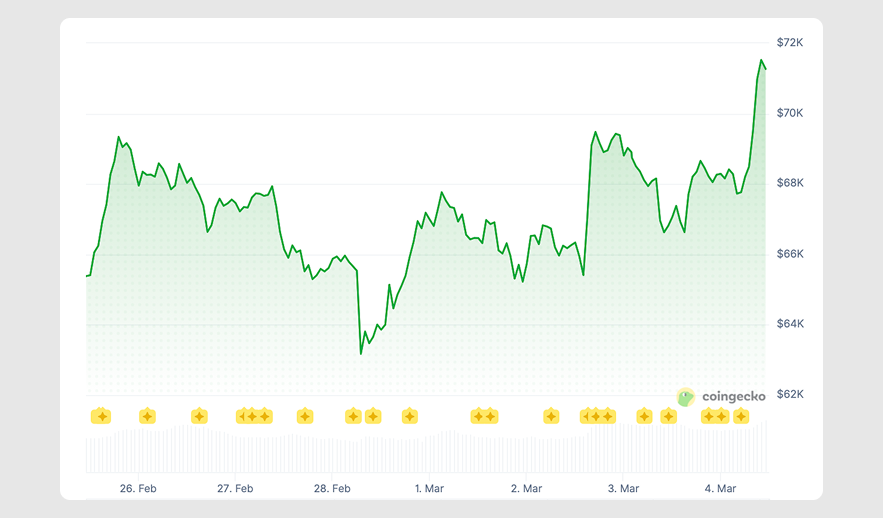
Currently at $71,276.10, BTC is up 6.5% over the past 24 hours with a gain of 9.1% over the past 7 days.
ETH price
Ether has struggled to cling to $2k as macro pressure hinders recovery from the dramatic late-January breakdown. Yet large investors appear to be preferring yield generation over selling into market rallies. Around 3.4 million ETH is waiting to enter Ethereum's validator set — one of the longest staking queues since the network adopted proof-of-stake.
Tracking BTC, ETH bounced from $1,884.95 on February 25 and approached $2,100 the following day. After a multi-day pullback, it fell to $1,866.40 on March 1, briefly reclaimed $2k, and later peaked near $2,065 before attempting another recovery today.
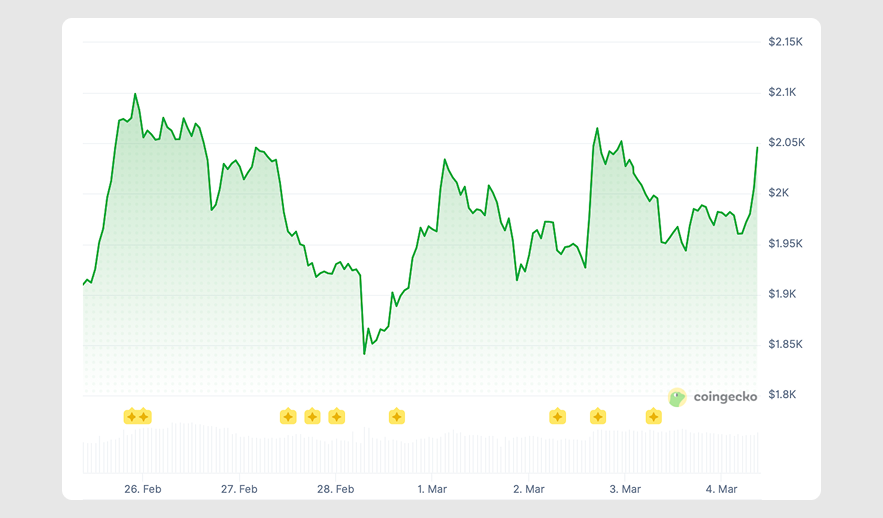
At press time, ETH is trading at $2,073.33, with a 24-hour loss of 5.8% and a 7-day gain of 8.5%.
Seven-day altcoin dynamics
The Fear & Greed Index has teetered between 10 and 14 over the past week, reflecting extreme fear amid the renewed Middle East turmoil. Spiking oil prices and sinking stocks accompanied crypto's broad downslide after the swift weekend bounce.
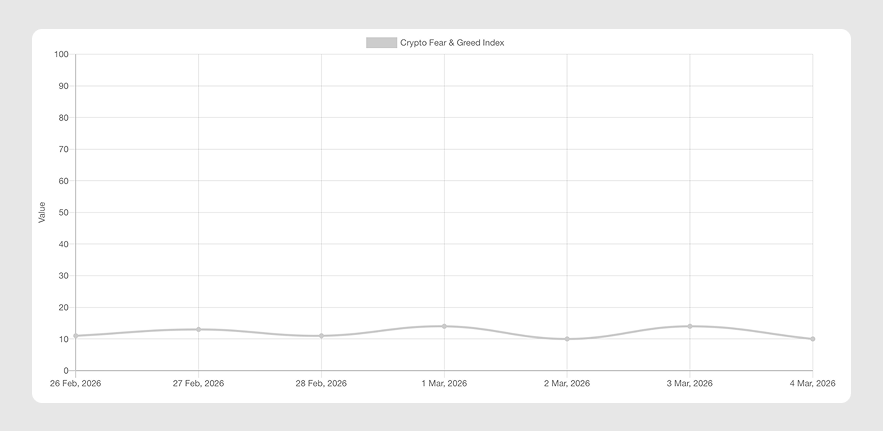
Higher energy prices amid the US-Israel strikes on Iran — and retaliatory attacks on Gulf nations — are fueling inflation fears that might prompt the Fed to delay rate cuts.
Altcoin capitulation
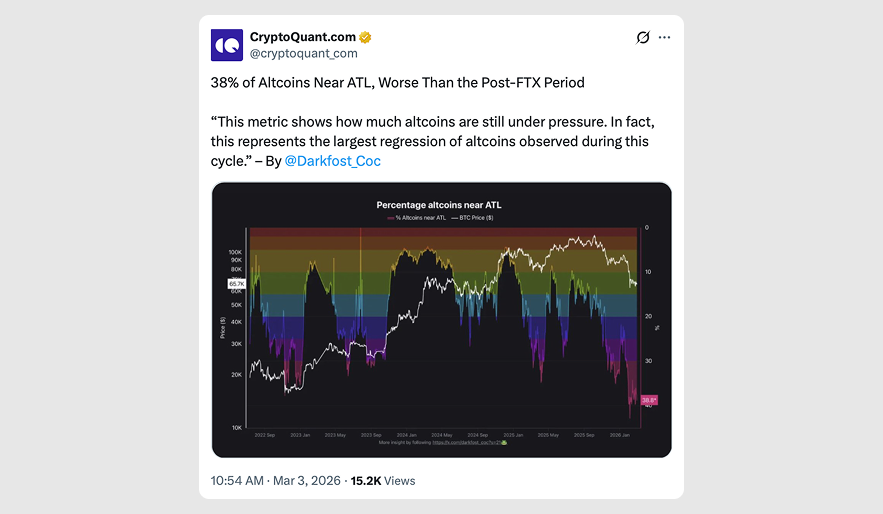
According to CryptoQuant, 38% of altcoins were trading close to their all-time lows on Tuesday, March 3, caving in under persistent structural pressure. This drawdown was deeper than during the post-FTX meltdown.
Analysts point to a widening dispersion between large-cap and small-cap assets, alongside weak liquidity conditions and highly selective risk appetite.
Higher oil triggers broad selloff
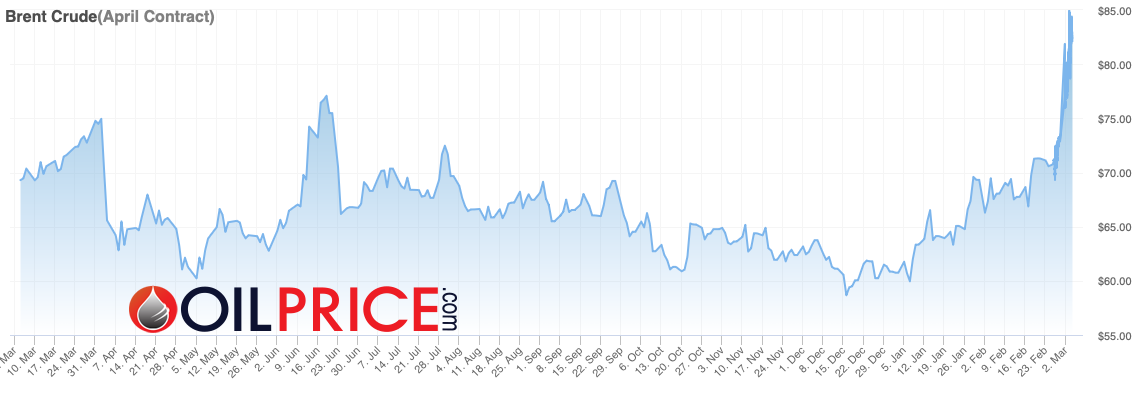
As TradFi markets reopened, Brent crude prices soared beyond $80 per barrel for the first time since January 2025. This marked the biggest daily upswing since the start of the Russia-Ukraine war.
Gold surged toward $5,400 an ounce, while both Asian equities and US equity futures slipped. However, the Nasdaq Composite, the S&P 500, and the Dow Jones recovered relatively quickly within the day.
Investors are weighing the prospect of a prolonged military conflict, trying to determine whether Iran’s remaining leadership will move quickly to strike a deal with the Trump administration (more on this below).
Weekly winners
- NEAR (+40.8%) charted the most impressive gains following NEARCON 2026, where the team presented its vision for AI-native infrastructure. It also launched the Near.com "super app" that blends a private framework for AI agents with decentralized identity.
- JUP (+22.0%) skyrocketed on significant institutional backing — a $35 million institutional investment from ParaFi Capital. The blockchain and digital asset firm provided the first external capital raise for the Solana DeFi platform.
- DOT (+19.9%) rallied on last week's spot ETF filing by Grayscale Investments. Nasdaq filed a formal request with the SEC to list shares of the Grayscale Polkadot Trust — after rival 21Shares filed to register its own 21Shares Polkadot Trust.
Weekly losers
- HASH (-20.7%) has been sinking since Sunday, March 1, aligned with the broader trend triggered by the Middle East conflict.
- PEPE (-15.6%) has also followed the broader market downslide, which likely prompted a rotation away from highly speculative assets.
- ATOM (-12.7%) is struggling as its TVL falls alongside negative funding rates; fewer participants are depositing or interacting with ATOM-based protocols.
Cryptocurrency news
War, whiskey, and Bitcoin: Why analysts see a strange kind of catalyst in Iran
Conventional wisdom says war is bad for risk assets. Sell first, ask questions later. But as the US and Israel's coordinated strikes on Iran sent oil soaring and stocks stumbling, a different narrative quietly took shape in crypto circles: what if conflict actually fuels Bitcoin?
The narrative shift
Analysts at the London Crypto Club see the confirmed death of Ayatollah Ali Khamenei not as a market negative, but as a "narrative catalyst" the industry has been waiting for. In their view, Bitcoin's recent weakness had little to do with geopolitics and everything to do with a typical cyclical correction — first liquidity tightening, then an AI-driven rotation out of tech stocks.
The fundamentals remain unchanged.
They lay out two scenarios.
- In a prolonged war, expect an "extreme risk-off" environment where investors flee to hard assets. Counterintuitively, Bitcoin may join gold as a beneficiary — not despite the chaos, but because of it.
- In a swift resolution, a "peace premium" emerges, and Bitcoin rides the euphoria higher.
Either way, the analysts argue, the Fed will eventually inject more liquidity to finance military operations. More money printing, more fuel for scarce assets.
History doesn't rhyme, it prints
Arthur Hayes, BitMEX's founder, pulls the lens back further. Decades of data show US military campaigns lead to increased federal spending and, invariably, Fed rate cuts. What looks like destruction in the moment becomes monetary fuel over time.
- During the 1990 Gulf War, Fed officials cited “heightened uncertainties” that had “greatly complicated the formulation of an effective monetary policy.” As the year drew to a close, the Fed had cut rates to revive market confidence and relieve economic strain.
- Shortly after the September 11 terror attacks in 2001, Fed chair Alan Greenspan called an emergency meeting. His 50-basis-point cut proposal was quickly accepted, and markets stabilised.
Strait of Hormuz in focus
In retaliation for the US-Israel strikes, Iran has de facto closed the Strait of Hormuz, a crucial passage for one-fifth of the world’s oil. Jake Ostroviskis, head of OTC at Wintermute, says “the oil move matters more for crypto than the geopolitics itself,” and if the price of Brent hits $100, it might still hurt crypto traders and digital asset treasuries.
“If Brent stays above $80 for more than a few sessions, the re-inflation narrative hardens and the March rate cut that was already a long shot becomes impossible.”
Markets had already priced in no change to the US interest rate in March, according to CME FedWatch (2.7%). For April and June, the odds stand at just over 12% and 39%.
However, rising inflation expectations could potentially benefit Bitcoin. Even if investors initially flee to cash, the relative appeal of scarce assets like Bitcoin might rise, provided deposit interest rates remain unchanged. Stephen Coltman, head of macro at 21Shares, explained:
“If rates are 3% but expected inflation is 5%, then you will look for alternatives to cash because otherwise your money will be losing value over time in real purchasing power terms.”
The institutional signal
Meanwhile, as retail panicked, something else happened.
Spot Bitcoin ETFs recorded $458 million in net inflows on Monday — the largest single-day move in weeks. BlackRock's IBIT alone absorbed $263 million. Not a single ETF posted an outflow that day. Seven funds went green.
This follows a week that reversed January and February’s $1.8 billion in outflows into $787 million in net inflows. What looked like cooling institutional appetite now reads differently: coordinated accumulation.
Rachael Lucas, analyst at BTC Markets, points to the concentration in IBIT as a tell. "Coordinated buying among large allocators such as pension funds and endowments," she suggests.
What it adds up to
So which is it — a market spooked by war or one quietly positioning for its aftermath? The data suggests both. Retail sells the headline; institutions buy the dip. The Fed prints; Bitcoin responds.
Trump vs. banks: Crypto's Washington showdown heats up
Just when it seemed the CLARITY Act was stuck in legislative quicksand, President Trump just lit a match.
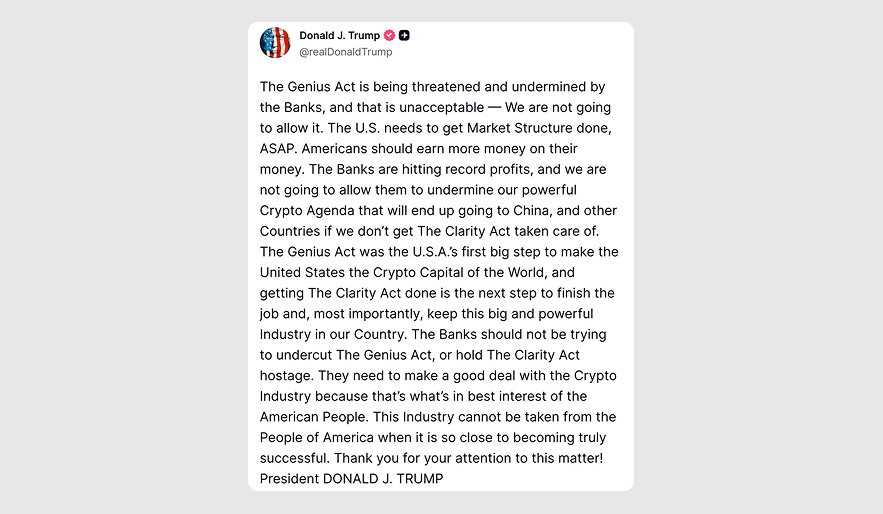
In a blunt Truth Social post Tuesday, Trump accused major banks of "threatening and undermining" the GENIUS Act — the stablecoin law already on the books — and holding the broader market structure bill "hostage." His message was unmistakable: pick a side, and soon.
What's the fight about?
At its core, this is a battle over stablecoin yield and who gets to offer it.
Crypto firms want to preserve the ability to reward users who hold stablecoins. Banks, led publicly by JPMorgan CEO Jamie Dimon, argue that if crypto platforms pay yield without the same regulatory framework, they'll pull deposits out of the traditional system and destabilize banking.
"If you want to be a bank, become a bank," Dimon said Monday, crystallizing Wall Street's position.
But Trump isn't buying it. His post framed the standoff as banks protecting their profits at the expense of American consumers and innovation. Let the fight stall too long, he warned, and the industry will simply migrate overseas.
Where things stand
The GENIUS Act — creating the first federal framework for stablecoin issuers — is already law, signed last summer. Regulators are now implementing it; the OCC released proposed rules last week outlining how banks can issue payment stablecoins under federal supervision.
The CLARITY Act is the missing piece. It would finally define which assets fall under SEC versus CFTC jurisdiction, resolving a question that's haunted the industry for years. The House passed it with bipartisan support. The Senate? Stalled.
Coinbase withdrew support after amendments threatened stablecoin rewards. Banking lobbyists sent red-line text requesting changes. The White House hosted meetings. Nothing moved.
Now Trump has drawn a line in the sand.
What happens next?
Senator Cynthia Lummis amplified Trump's message: "America can't afford to wait. Congress must move quickly."
But with midterms approaching and both sides dug in, the window is narrowing. Industry participants warn that without a resolution soon, the chances of passing the CLARITY Act this year could evaporate.
For now, crypto watches Washington with a mix of hope and exhaustion. The President has taken a side. Whether that's enough to break the logjam — or just deepen the trench — remains to be seen.