SpaceX pre-IPO to post-IPO: Tokenized exposure, ETFs & what's next

As SpaceX races toward what could become the largest IPO in history, investors are scrambling for early exposure. Weeks before the stock begins trading on Nasdaq, retail traders already have multiple ways to bet on the company's future — from private-market funds and tokenized products to pre-IPO futures and synthetic derivatives.
Not all of these vehicles are created equal. Some track SpaceX's valuation directly, while others offer only indirect or synthetic exposure without ownership rights, voting power, or dividends.
Here's how the growing market for SpaceX-linked products works — and what may happen when the company finally goes public.
TL;DR
- SpaceX's upcoming IPO is expected to be one of the largest public listings in history, with a projected valuation approaching $2 trillion.
- Retail investors can already gain exposure through private-market funds, tokenized products, pre-IPO futures, and secondary-share platforms.
- Most tokenized and synthetic products do not provide actual ownership, voting rights, or dividend claims on SpaceX shares.
- Several ETFs and private-market funds already hold SpaceX stock, offering indirect exposure through traditional financial markets.
- The IPO could influence crypto markets by competing for speculative capital while also strengthening the case for corporate Bitcoin adoption.
Dissecting SpaceX IPO hype
Elon Musk's SpaceX publicly filed its S-1 registration statement on May 20, 2026. The company is expected to hold its initial public offering (IPO) on Nasdaq on June 12, 2026 (ticker: SPCX), with the company's valuation currently approaching $2 trillion.
SpaceX's IPO debut differs from traditional corporate listings in several ways:
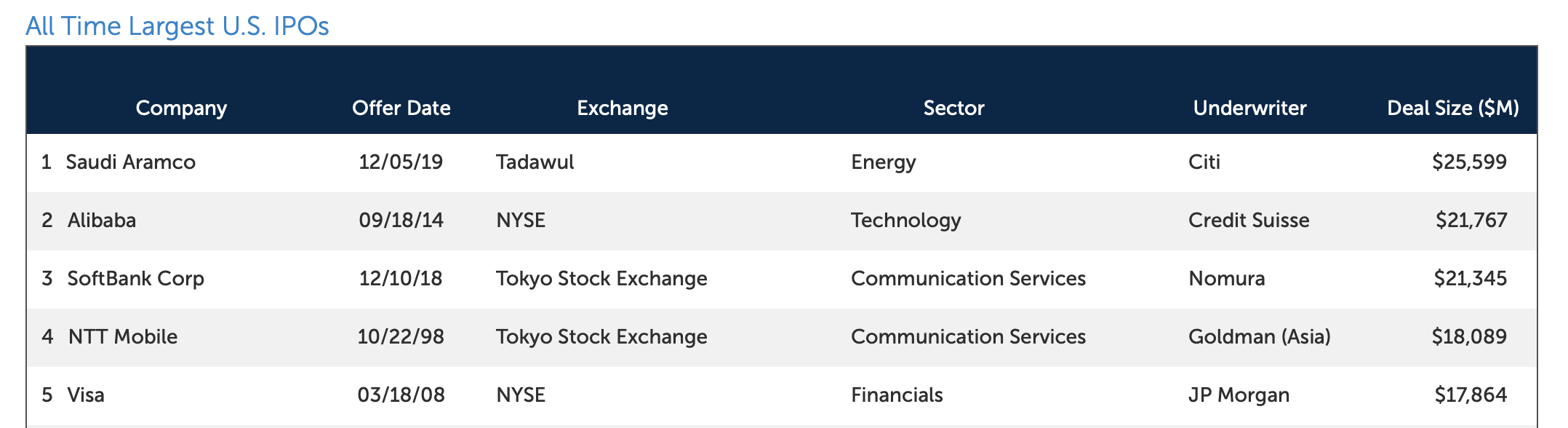
- The capital target — up to $75 billion — would easily make it the largest IPO in stock market history. That's more than double what Saudi Aramco raised in 2019 ($25.6 billion initially, $29.4 billion after selling additional shares).
- The insider share lockup is unconventional. Shares will be released gradually — some as soon as after Q2 earnings — bypassing the traditional 6-month single block. Moreover, Elon Musk's shares will be excluded from these early unlocks.
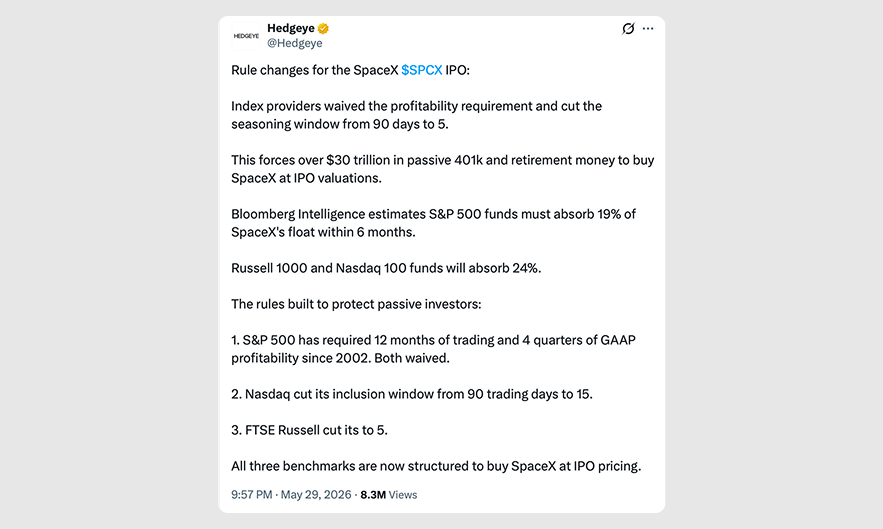
- SpaceX will leverage a rare fast-track exception. Nasdaq has compressed its inclusion window and waived the 10% minimum float rule. SpaceX will enter the benchmark index just 15 trading days after going public.
- Elon Musk will hold special, highly-weighted voting shares, ensuring he keeps ironclad control over SpaceX's strategic direction.
- Valuation is largely driven by investor expectations ("vibe") around future growth opportunities, including Starlink, launch services, AI infrastructure, and science-fiction goals like Mars colonization.
Why does it matter for crypto?
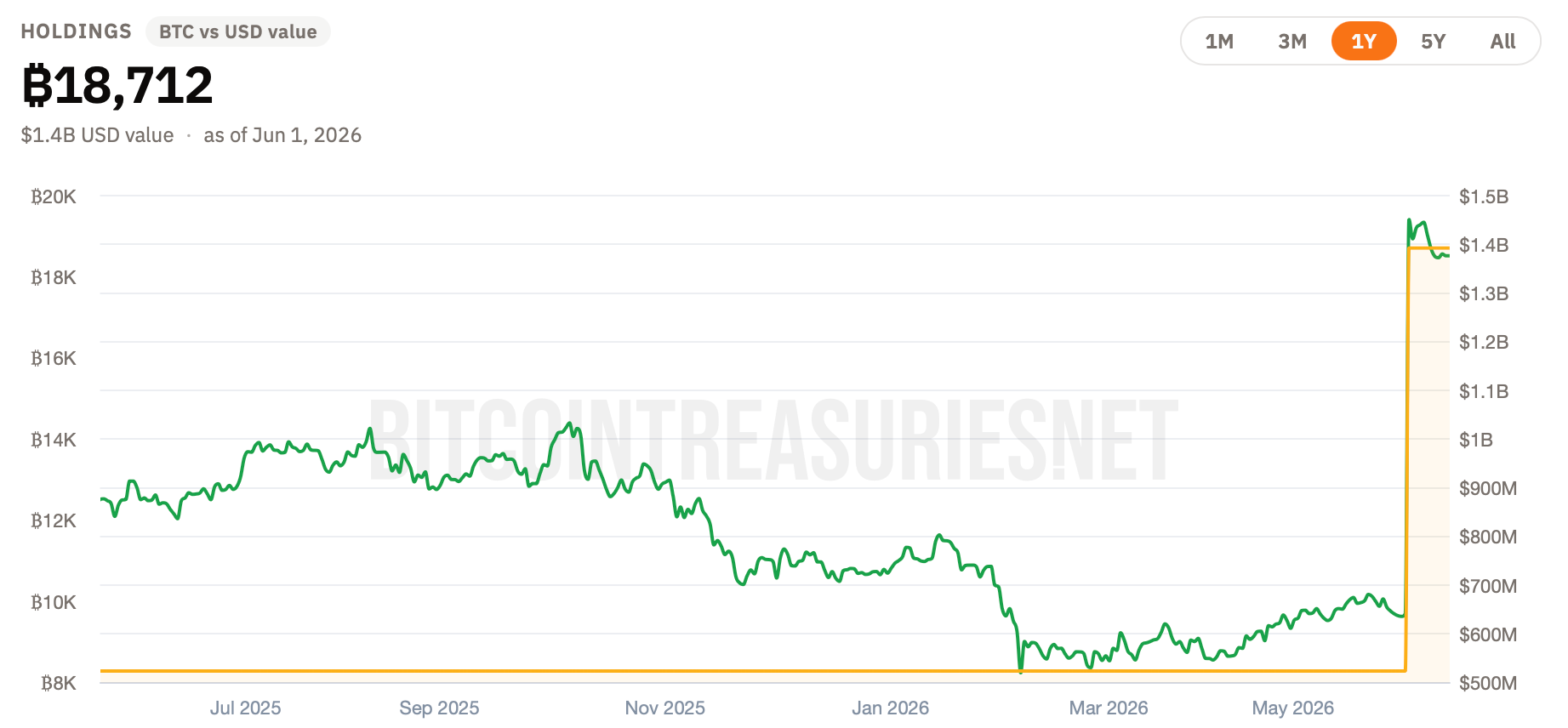
As of June 1, 2026, SpaceX is the third-biggest private corporate holder of Bitcoin, with 18,712 BTC (over $1.4 billion) on its balance sheet. In addition, Tesla –another company led by Elon Musk – is also a noteworthy Bitcoin holder (11,509 BTC worth roughly $836 million).
SpaceX's public success might prompt other tech giants to add Bitcoin to their corporate treasuries. While not a "Magnificent Seven" company, SpaceX's projected $1.75 trillion valuation gives it comparable size and weight — potentially enough to inspire sustained crypto buying by companies across the sector.
Dogecoin — once Elon Musk's darling — could also get a boost. The SpaceX CEO has been a high-profile DOGE supporter, and any social media post linked with SpaceX could send its price soaring. Musk previously suggested DOGE might become the first interplanetary currency, and that future moon missions might be paid for entirely with it.
How tokenized SpaceX shares work
Until it goes public, SpaceX (Space Exploration Technologies Corp.) remains a privately held company. This means its shares aren't available on stock exchanges like the NYSE or Nasdaq, nor through traditional brokerage accounts.
Private SpaceX shares are only accessible to accredited investors through secondary pre-IPO marketplaces like EquityZen, Forge Global, or Hiive. The rest have turned to decentralized derivatives platforms like Hyperliquid to trade derivatives and price the company ahead of its listing.
Parts of the crypto ecosystem are actively capitalizing on the hype. Users can already gain indirect exposure to SpaceX's private value, future performance, and IPO outcome. These digital products take different shapes, from tokenized exposure to IPO futures. Prominent public market vehicles include:
- Special Purpose Vehicles, AKA feeder funds (SPVs): Pool capital from multiple investors into an entity (e.g., private broker or secondary market) created to purchase shares on their behalf.
- Tokenized exposure (PreStocks SpaceX): Sell blockchain-based tokens that let everyday traders speculate on SpaceX's implied market value.
- Tokenized debt-style product (Bitget preSPAX): Offers a digital token following SpaceX post-listing economic performance with synthetic exposure.
- RWA pre-IPO token (BingX SpaceX RWA): Provides platform-defined exposure to SpaceX-linked real-world assets.
- Pre-IPO perpetual futures (OKX SPACEX/USDT): Provides USDT-settled derivative price exposure.
- Private-company funds (Private Shares Fund PRIVX): Offers fund shares with exposure; SpaceX represents the largest position in the portfolio (~19.3% of net assets), in combination with xAI, which it recently acquired.
- Listed private-market funds (Destiny Tech100 DXYZ): Buying its stock translates to indirect exposure; the largest and most significant holding in its portfolio is SpaceX (over 16%).
Unlike real shares, tokenized exposure does not typically provide legal ownership, voting rights, or dividends. It also does not require SpaceX approval or a relationship and gives no information rights, while liquidity depends on the issuing platform.
ETF shortcut to SpaceX
Investors hunting for SpaceX exposure have flooded into the ETF space. Six space-themed ETFs have launched in the past three months alone, including Van Eck's WARP, Global X's ORBX, and Roundhill's MARS. Tema ETFs' Space Innovators ETF (NASA), launched on March 30, blew past $2.6 billion by the end of May.
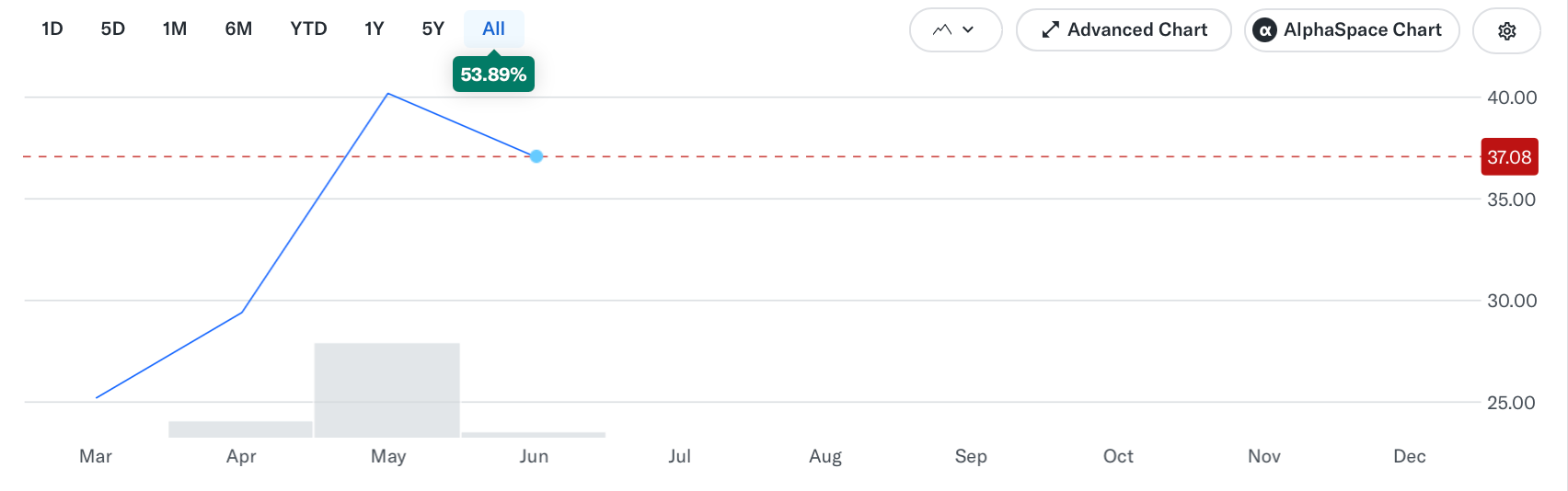
NASA already holds privately traded SpaceX shares directly — one of the few retail-accessible vehicles that does, with SpaceX currently representing around 7.5% of the fund. Ron Baron's First Principles fund (RONB) holds SpaceX too, and the ERShares Private-Public Crossover ETF (XOVR) owns shares worth nearly $300 million.
Those ETFs aren't created equal: some hold pure-play space names; others mix in defense contractors or even Amazon.
Is SpaceX IPO a threat to crypto?
Aside from potentially inspiring corporate crypto buys, the upcoming IPO also poses a unique challenge. High retail allocation means it targets the same high-risk capital that typically flows into crypto.
'Liquidity drain' ahead?
Given the massive $75 billion target raise at a $1.75 trillion valuation, this IPO could pull immense capital out of the broader tech and risk-asset sectors. That reallocation could pressure Bitcoin and major altcoins, testing how decoupled crypto truly is from traditional finance. The potential 'liquidity drain' is already making headlines.
Meanwhile, OpenAI is targeting a Q4 listing at a roughly $1 trillion valuation. Anthropic's reported October debut could pull in over $60 billion. With all three giants hitting the public market on schedule, they would attract nearly $240 billion through year-end. According to PitchBook, that figure would exceed every venture-backed US IPO combined since 2000.
Challenge to 'Bitcoin proxy' narrative
SpaceX's BTC stash accounts for a mere 0.03% of its $2 trillion valuation. Nonetheless, it might offer a more diversified and attractive exposure vehicle than companies built around holding the asset (for example, Michael Saylor's Strategy or The Block).
The stock would mix direct exposure to space tech, AI compute capabilities, and a major BTC treasury — a potential magnet for investors that previously flocked to dedicated crypto-holding firms or ETFs.
Wrapping up
Between tokenized products, pre-IPO derivatives, private-market funds, and ETFs, investors have built an ecosystem to speculate on SpaceX's future well before its shares hit Nasdaq. The result is a blurring line between traditional finance, private markets, and digital assets.
Whether the listing ultimately pulls liquidity away from crypto markets or deepens institutional interest remains to be seen. Either way, SpaceX's public debut will be closely watched by investors on both Wall Street and the crypto side.