Clapp Weekly: Middle East see-saw, CFTC task force, stablecoins in crosshairs

BTC price
Bitcoin steadied above $71k after a 15-point Iran peace plan pushed oil back below $100. The coin had slipped toward $69k amid a broader Monday pullback in risk assets. With $14 billion in options — 40% of all open interest — set to expire on Deribit this Friday, market makers could lift the price toward the "max pain" level of $75k to limit payouts.
BTC crashed from $74k on March 18 to under $69.5k the next day, struggled to reclaim $71k, and drifted lower over the weekend. A Monday reversal from $67,684.18 sent it to $71,453.40, followed by more see-sawing. After dipping below $69.2k on March 24, the coin has since reclaimed $71k.
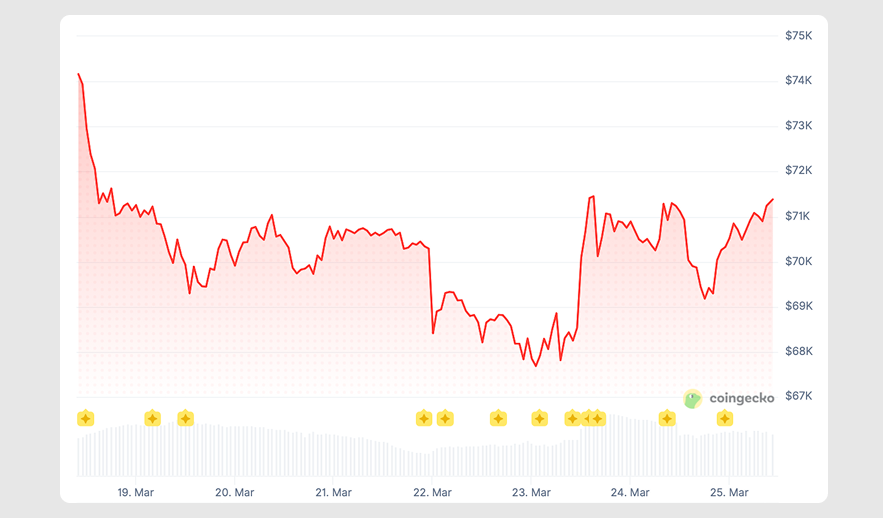
Currently changing hands at $71,181.22, BTC is down 0.1% over the past 24 hours with a 3.7% weekly loss.
ETH price
Ether is consolidating above $2.1k after its Monday rally stalled at $2,200. The price sprang back on Iran optimism and BitMine's latest move: adding 65,341 ETH to its treasury, now worth $10.17 billion. Meanwhile, the network faces deep existential questions over dramatic roadmap shifts amid scaling, quantum, and AI pressures — all while spot ether ETFs suffer a five-day losing streak.
ETH sank from over $2.3k to $2.2k on March 18, edged lower the next day, and stabilized near $2,150. The fall resumed over the weekend, culminating at $2,035.78 on Monday, March 23. A rebound pushed ETH back toward $2.2k, but holding firm remains a struggle.
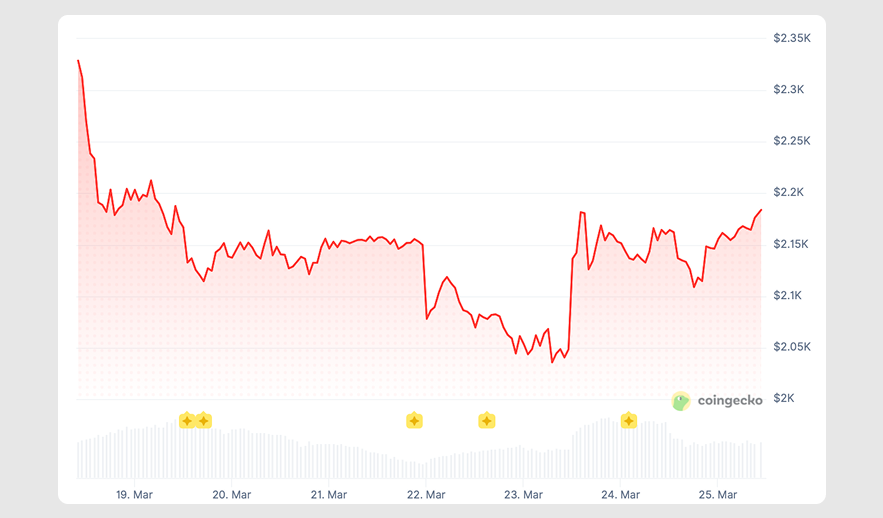
Currently at $2,180.56, the coin is up 1.0% over the past 24 hours with a loss of 6.2% over the past 7 days.
Seven-day altcoin dynamics
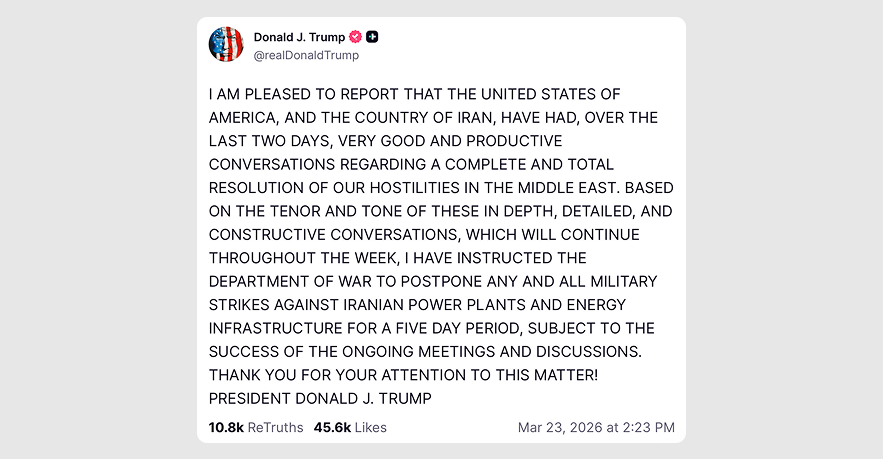
News of a five-day pause on US strikes against Iran's power plants lifted Bitcoin, sparking a broad relief rally on March 23. President Trump's post mentioning "good and productive conversations" with Tehran sent oil prices tumbling over 13%.
However, Iranian officials subsequently denied any talks with the US. As volatility returned, oil surged back over $100 a barrel. Crypto liquidations — over half of them from short positions — totaled over $670 million over a 24-hour period. Then came another turnaround: news of a US-drafted 15-point Iran peace plan.
At press time, the Fear and Greed Index remains locked in the "Extreme Fear" zone (15/100).
AI surge on de-escalation hopes
Conflict-related volatility delivered double-digit gains for AI altcoins, buoyed by last week's Nvidia GTC conference. Bittensor's TAO, Artificial Superintelligence Alliance (FET), and Render (RENDER) led the rally.
The AI run was also propelled by a short squeeze, which spread "hardest into higher-beta names where positioning was already most compressed," as noted by Derek Lim, head of research at Caladan.
No Fed cuts this year sour sentiment
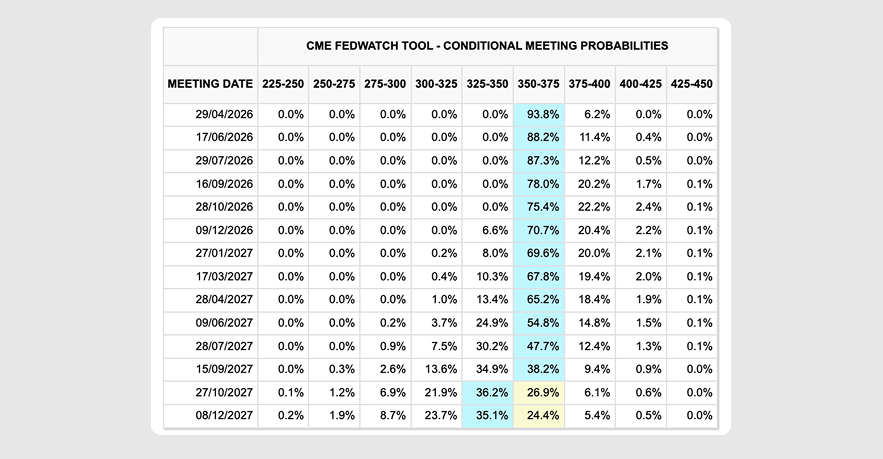
The prospect of Fed interest rate cuts this year is fading due to the ongoing war in Iran. Wall Street analysts are even bracing for a rate hike, citing soaring gas prices and the rising cost of borrowing. According to ABC News, the cost of mortgages, auto loans, and business credit has all been climbing since February 28.
If materialized, a rate hike would mark a sharp turnaround — earlier this year, discussions focused on the frequency of expected cuts, not whether they were possible at all. An overwhelming majority of Polymarket users expect no change in April (95%), June (87%), and July (78%).
CME FedWatch also shows no change is likely until mid-2027.
Top weekly winners
- SIREN (+129.7%) keeps leading gains despite crashing 67% overnight; a parabolic 238% rally on March 22 sent it to an all-time high of $3.61, extending a broader run sparked by renewed interest in AI and the launch of perpetual futures.
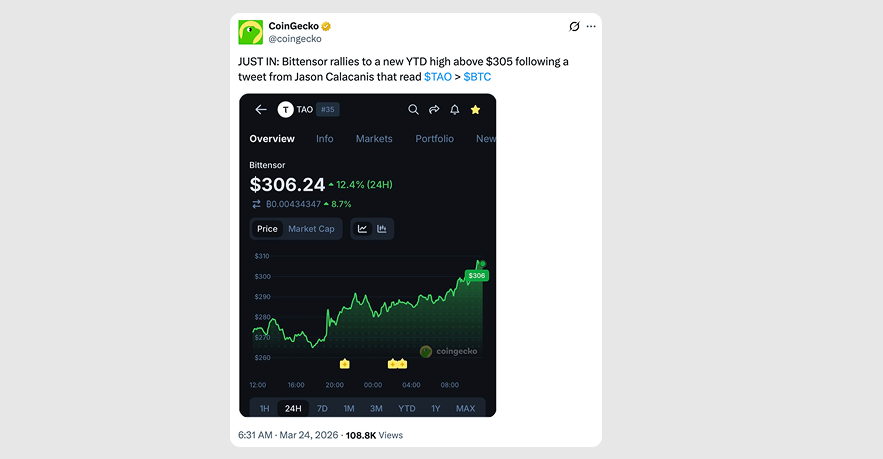
- TAO (+22.5%) skyrocketed after an X post from veteran angel investor Jason Calacanis stated $TAO > $BTC. Speaking on a podcast, he also suggested a 200x rally was possible in 5-10 years, labeling Bittensor as a long-term AI infrastructure bet.
- PI (+8.3%) sprang back on March 20 after the rollout of Token Launchpad on testnet. The reversal from a macro-driven tailspin defied the next day's token unlock, development delays, and declining social buzz.
Top weekly losers
- WLD (-19.7%) has struggled since the Worldcoin team reportedly sold $38 million worth of tokens in an OTC deal, receiving 35M USDC. This transaction — one of the biggest token shifts in months — raised questions about investor sentiment, treasury strategy, and the potential for further transfers.
- ENA (-19.3%) tumbled on heavy selling outweighing positive developments like the upcoming Season 5 rewards program. The decline also ignored a 43 million ENA withdrawal from exchanges — moving assets into self-custody is a bullish sign that often drives upswings.
- ZEC (-14.9%) is regaining retail interest as the broader market edged higher on news of a potential de-escalation in the Middle East; a buildup in ZEC futures suggests bullish anticipation.
Cryptocurrency news
CFTC's new task force: Welcome mat for crypto, AI, and prediction markets
First, the SEC drew its lines. Now, the CFTC is rolling out the welcome mat.
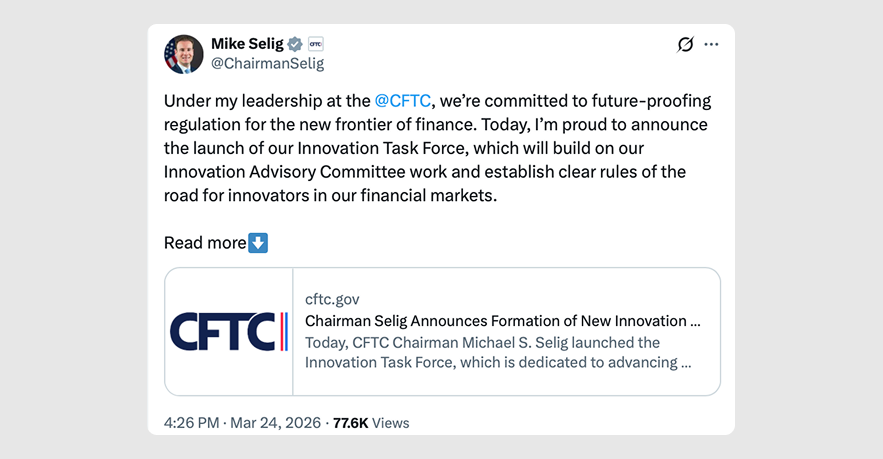
In a move signaling a new era of regulatory clarity, the Commodity Futures Trading Commission unveiled its Innovation Task Force this week — a dedicated unit tasked with building clear frameworks for crypto, artificial intelligence, autonomous systems, and prediction markets.
"We can foster responsible innovation at home and ensure American market participants are not left on the sidelines," CFTC Chairman Michael Selig said in announcing the initiative.
What it will do
Led by Selig's senior advisor Michael Passalacqua, the task force will coordinate closely with the SEC and its own Crypto Task Force — a striking contrast to the turf wars that defined the previous administration. The goal is simple: give builders a clear set of rules instead of forcing them to navigate regulatory quicksand.
The move follows a historic memorandum of understanding between the SEC and CFTC earlier this month, formalizing their commitment to harmonize crypto oversight. That agreement, paired with joint guidance clarifying which digital assets qualify as securities, has fundamentally reset the regulatory landscape in a matter of weeks.
Prediction markets in focus
The task force arrives amid intensifying scrutiny of prediction markets — platforms like Kalshi and Polymarket that let users bet on everything from elections to sports outcomes.
The CFTC has been busy. It recently published guidance for registered exchanges on event contracts and is actively seeking public comment on whether new rules are needed.
The agency has also made clear it won't cede jurisdiction easily. When states like Arizona and Nevada moved to block Kalshi under local gaming laws, Selig's response was blunt: "See you in court."
Meanwhile, both Kalshi and Polymarket took proactive steps this week to tighten insider trading policies. Kalshi added preemptive screening for politicians and sports figures; Polymarket enhanced its market integrity terms.
Beyond prediction markets
The task force's mandate extends further. A major ruling last week gave self-custodial wallet Phantom the ability to offer users derivatives access without registering as a broker — a significant win for decentralized finance.
And the CFTC's Innovation Advisory Committee, packed with executives from Nasdaq, Kalshi, and other major players, will feed directly into the task force's work.
What it means
For years, crypto builders complained the US lacked clear rules. Now, in rapid succession, both the SEC and CFTC have delivered — first with a joint token taxonomy, now with the CFTC's dedicated innovation unit.
The regulatory fog is lifting. The question is whether builders will respond.
Stablecoin rewards in the crosshairs: Circle plunges 20% on CLARITY Act draft
The crypto market got a wake-up call this week, and it came not from the Fed or war headlines, but from a draft bill making its way through Congress.
Circle shares cratered 20% on Tuesday — the stock's worst day ever — after the latest version of the Digital Asset Market Clarity Act raised the prospect of strict limits on stablecoin rewards. Coinbase, which shares revenue from USDC, dropped nearly 10% in sympathy.
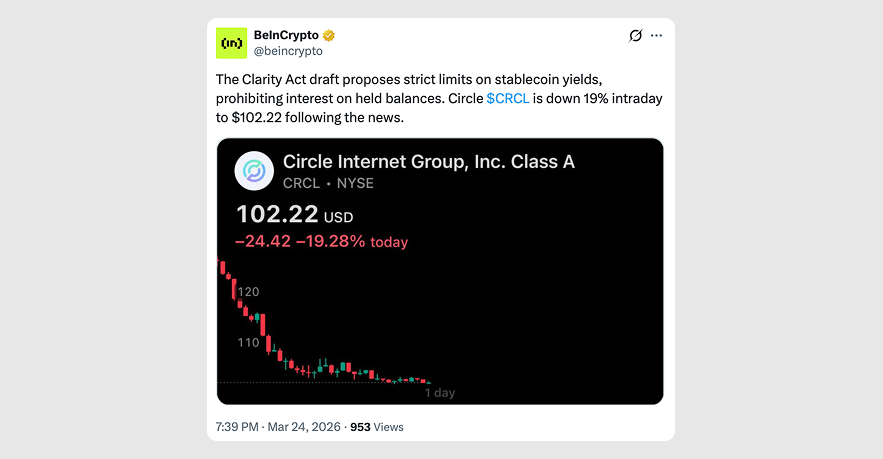
At the heart of the sell-off: language that would ban stablecoin issuers from paying yield to users simply for holding the assets. The draft also targets anything "economically equivalent to interest," effectively cutting off the pass-through model that has fueled stablecoin adoption.
Eliminating a powerful incentive?
Earning yield on stablecoins — whether through onchain lending or platform incentives — has been a key part of the pitch to investors. For Circle's USDC, those rewards have turned a simple payment token into something closer to a savings vehicle.
Mizuho analyst Dan Dolev put it bluntly: a potential ban would "reduce the use case for Circle in the near-term, while not paying rewards would reduce the long-term attractiveness of holding USDC."
The debate pits the crypto industry against traditional banks, which have argued that stablecoin rewards could siphon deposits out of the banking system. The GENIUS Act, passed last year, already barred issuers from paying yield directly. But crypto firms found workarounds, using reserve income to fund rewards through partners like Coinbase.
The new draft closes that loophole. It would allow "activity-based rewards" — for using stablecoins in payments, trading, or lending — but not for simply holding them.
Not as bad as it looks?
Despite the sharp drop, analysts are urging calm. Circle shares were up 170% since early February before Tuesday's plunge, leaving the stock vulnerable to any negative headline.
Owen Lau of Clear Street noted that "it looks like an overreaction, but the market tends to shoot first and ask questions later." Ryan Rasmussen of Bitwise agreed, saying "there will be workarounds," such as loyalty programs that could replicate similar incentives.
"With that in mind, Circle's long-term outlook has never been better," Rasmussen said. "They hold a 30% share of a market projected to grow 10x over the next four years."
What's next
According to Politico, Senators Thom Tillis and Angela Alsobrooks reached a compromise on stablecoin rewards late last week. However, the crypto industry got its first look at the actual language this week during a closed-door review in Washington.
The bill still needs to pass a markup in the Senate Banking Committee, now expected in late April. If it advances, the Clarity Act would finally give the industry a comprehensive market structure framework—but possibly at the cost of one of its most powerful user incentives.
For now, the market has spoken. And it didn't like what it heard.