CLARITY Act explained: Crypto’s make-or-break moment?

The CLARITY Act aims to bridge the regulatory gap between crypto and TradFi, giving businesses codified rules and supercharging investor confidence in digital assets. Here is a look at the biggest effort to forge a clear US rulebook for crypto markets.
Purpose of CLARITY Act
The existing US frameworks were created for traditional finance (TradFi); they must be tailored to the new blockchain reality. This mismatch breeds uncertainty for regulators, institutions, and individual users — and the CLARITY Act is meant to tackle it. Ultimately, the industry needs lasting guidelines to power its continued growth without malpractice.
For businesses: regulatory clarity
Businesses crave a clear framework to build products legally. Companies are often stumped about what is allowed and choose to serve customers outside of the US to play it safe. The CLARITY Act aims to chart a clear pathway so they can build in the US with confidence.
For investors: market integrity & clear risk criteria
The disconnect between TradFi and crypto standards fuels unease for professional investors — even the difference between a digital commodity and a digital security is murky. Furthermore, blockchain technology enables novel, previously unimaginable types of financial interactions.
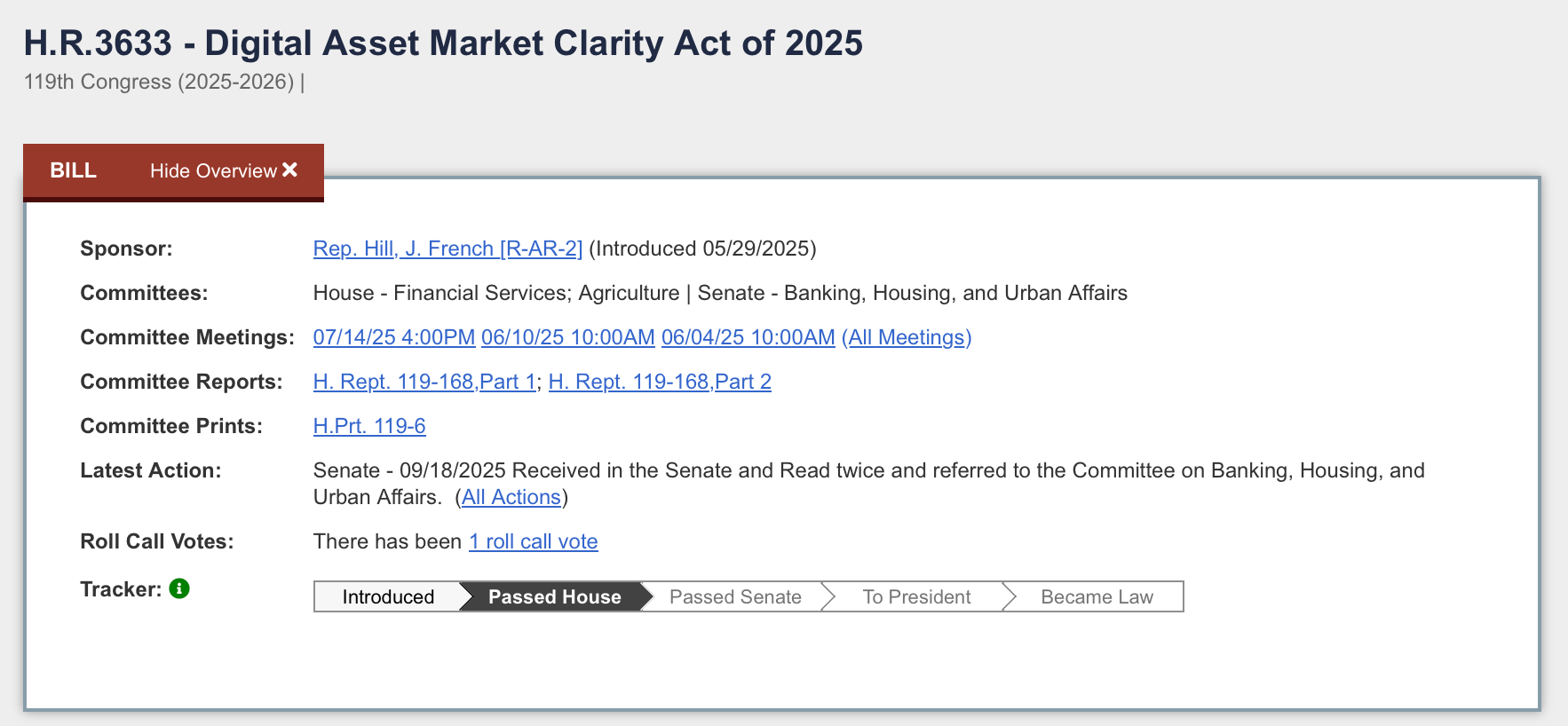
For regulators: durable laws for new technology
The CLARITY Act will set in stone rules to define which regulators police what, how trading platforms must operate to be compliant, and what disclosures are required when issuing, selling, or trading tokens.
Furthermore, while the current administration is viewed as pro-crypto, the rules should not swing on which officials are in charge. Long-term confidence is impossible without guardrails that endure across administrations and political landscapes, ensuring a lower chance of reversals.
So, what does CLARITY Act apply to?
If passed, this “market structure” bill will govern trading platform operations and disclosures for specific tokens. In this regard, it mostly targets stablecoins, altcoins, and businesses, as Bitcoin has significant historical precedent in the country. Major unresolved clashes around the CLARITY Act go far beyond the pioneering coin:
- Issuer-style disclosure requirements
- Stablecoin yield provision
- DeFi intermediary boundaries
The initial scope has ballooned into a broad negotiation about detailed crypto sector components. However, the bill does not dictate which crypto assets appear in ETFs.
CLARITY Act evolution and progress
In 2025, the House passed an initial framework that would make token classification more consistent, clarify platform registration pathways, and demystify disclosure requirements for token issuers. At its core, it carved out a separation of authority between two regulators:
- The CFTC (Commodity Futures Trading Commission) gained more responsibility for policing spot markets for digital commodities.
- The SEC (Securities and Exchange Commission) solidified its role over securities and investment contracts.
Since then, the scope of the bill has exploded. In mid-January 2026, the Senate Banking Committee released a full 278-page draft of the base text, including a slew of amendments (100+ proposed).
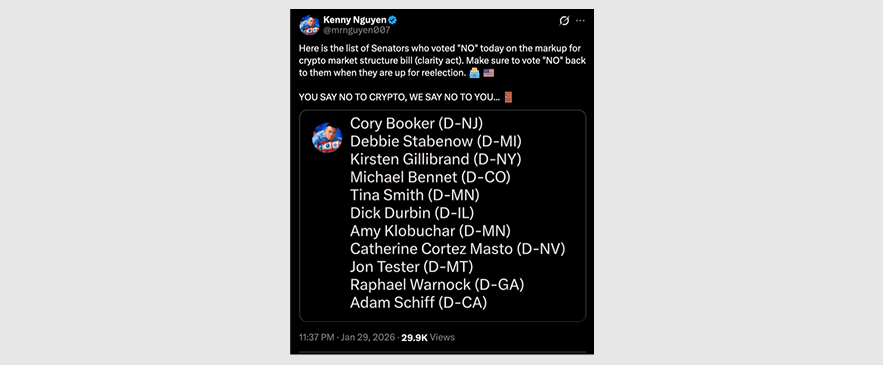
Yet, industry friction prompted the Committee to postpone its planned markup vote. The biggest flashpoints are amendments concerning stablecoin yield and tokenization — critics say they hand an advantage to banks and TradFi at the expense of crypto.
That said, CoinShares’ Matthew Kimmell is bullish on legislation passing in 2026:
“Crypto legislation has faced turbulence before, with last summer’s GENIUS Act (a stablecoin-focused law) as the prime example that even controversial bills can clear major hurdles when industry and government leadership decide a deal must get done.”
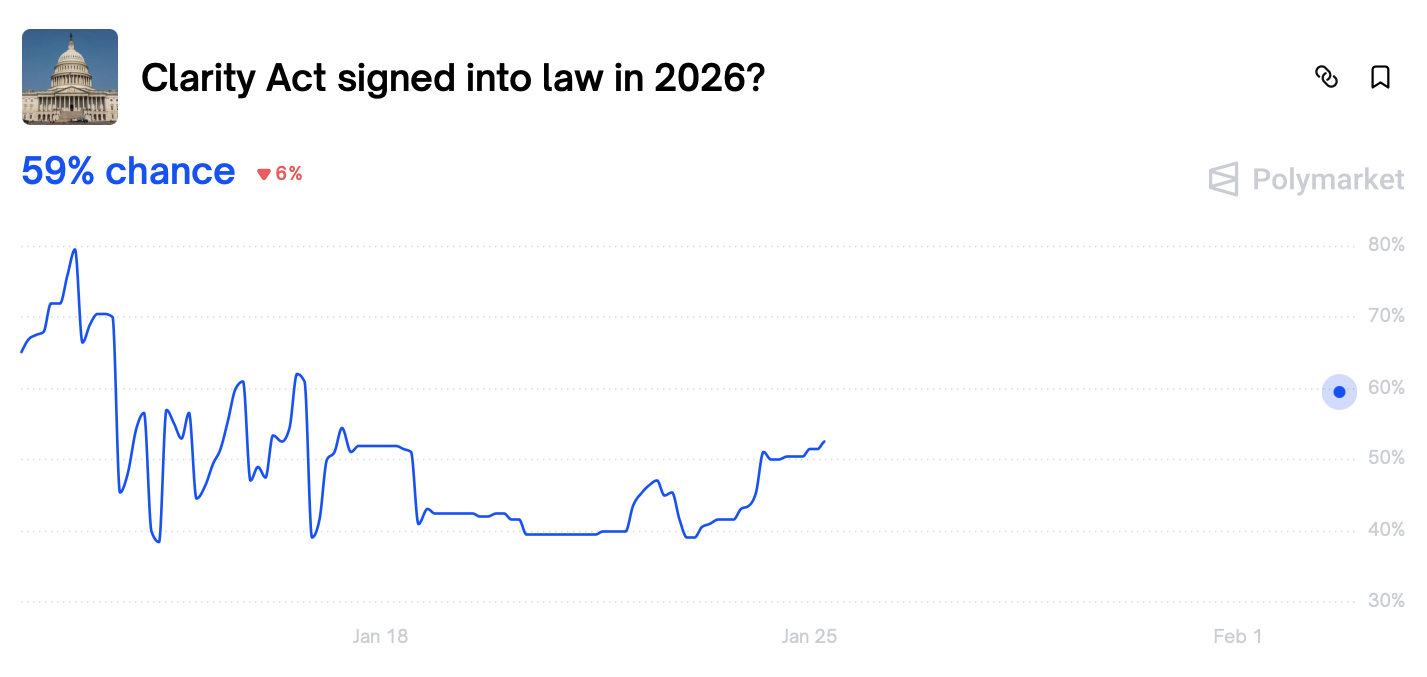
Most Polymarket users (59%) currently agree.
Both policymakers and industry leaders appear keen to pass a market structure law — it remains the top crypto priority. The biggest hurdle is a lack of calendar time in Congress due to the mid-term elections in November. Beyond August, policymakers’ schedules will be jammed.
Criticism of CLARITY Act
Crypto industry leaders, including Coinbase (which has withdrawn its support), are particularly rattled by provisions concerning decentralized finance, the SEC's authorities, and stablecoin yield. Here is why.
Critics argue the proposed guidelines would stifle innovation, complicating token launches and decentralized operations for startups. Moreover, some provisions could pressure blockchains to become permissioned products, betraying the very ethos of crypto.
However, opposition is not unanimous. Voices from numerous crypto companies and organizations have shared statements in support of the bill and the markup hearing.
DeFi controversies
The provisions for DeFi had not been revealed before the release of the current draft on January 21, 2026. The AML and KYC rules were particularly jarring to the industry.
In particular, the current version proposes stretching the scope of the Bank Secrecy Act to specific DeFi operations — so running decentralized platforms would require centralized management for operations and compliance.
In addition, the draft suggests tasking the US Treasury Department with the ability to sanction and otherwise restrict interactions between self-hosted wallets and exchanges, according to a CoinDesk source. Critics of these “sweeping” provisions include Blockchain Association CEO Summer Mersinger.
Stablecoin reward restrictions
In public discussions, the most heated point concerns yield on stablecoin holdings. Some of the amendments, championed by the banking lobby, bar platforms from directly offering such rewards — except as part of user activities like staking and lending. Yet, according to insiders, the bill could outlaw yields of any sort on stablecoin deposits.
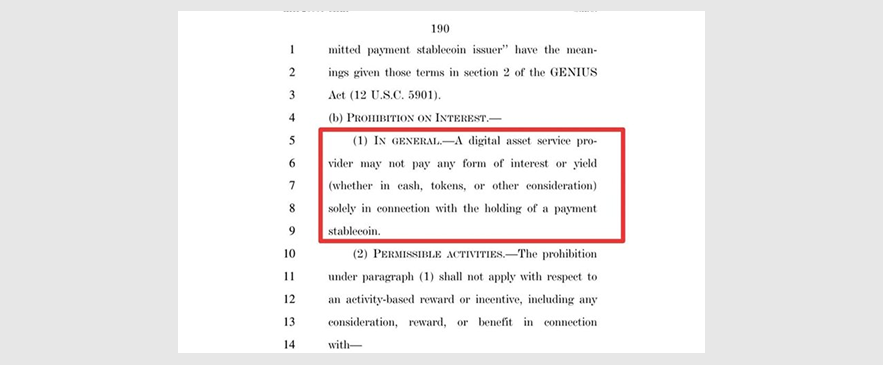
Currently, stablecoin companies do not have to follow similar rules to banks, which must secure backing from the Federal Deposit Insurance Corporation and accept intensive disclosures and government supervision. Essentially, treating stablecoin deposits on par with bank deposits would restrict issuers and exchanges' ability to offer rewards.
Securities restrictions
The CLARITY Act also hands the SEC the authority to enforce disclosures and restrictions on the sale of "network tokens" or "ancillary assets. " These assets are defined as any tokens whose value depends on "the entrepreneurial or managerial efforts" of the developers — an Ancillary Asset Originator (the original issuer or creator) or a related person.
The SEC is to define when "network tokens" fall within its remit. Thus, it could oversee every token launch, requiring that projects persuade the agency that their tokens are not securities. Some critics also say the bill would hamstring the SEC and the CFTC's flexibility in creating exemptions.
Fork in the road
The CLARITY Act remains the clearest path to a durable US crypto rulebook. Its postponement proves that the question of "how crypto should be regulated" is far from simple. Despite the drive for codified rules, the process has exposed a clash of competing visions over what constitutes a fair framework. Now, the debate is about the soul of the industry’s future in America.
The ultimate hurdle now is legislative will: whether lawmakers can hammer out a final compromise and race it across the finish line before the political window slams shut. The coming months will decide if America gets a rulebook or remains stuck in regulatory gridlock.
If the bill regains momentum by March and secures bipartisan backing, it could become a powerful market catalyst. It would materially reduce the limbo for builders and regulators, boost investor confidence in US oversight, and finally pave a compliant path for mainstream offerings.