Crypto's hidden infrastructure: How DePINs are rewiring the world

Do you need extra computing power, storage, or energy? Renting those resources from a corporation is the old way. Blockchain-based systems are dismantling familiar centralized models with a fresh approach to supplying and tapping into real-world resources. Anyone can hop in — no contracts or approvals needed.
What are DePINs?
DePIN (Decentralized Physical Infrastructure Networks) let everyday people contribute and access physical or digital resources, from wireless coverage to computer storage.
They replace corporations with a crowd-powered network that offers crypto rewards for contributors. This is infrastructure, built by the many and open to all. DePINs operate on three layers: hardware contributed by users, middleware tracking usage data, and a blockchain that hands out rewards.
DePINs fall into two categories based on whether their resources are location-dependent or interchangeable:
- Physical Resource Networks (PRNs) offer resources locked to a specific place — think connectivity, mobility, energy, or mapping. Examples: Hivemapper (mapping) and Helium (wireless coverage).
- Digital Resource Networks (DRNs) offer swappable resources — those you can tap into from anywhere in the world — such as computing power, bandwidth, and storage. Think: Filecoin (storage) and Render Network (GPU compute).
In short: PRNs depend on location, DRNs don’t.
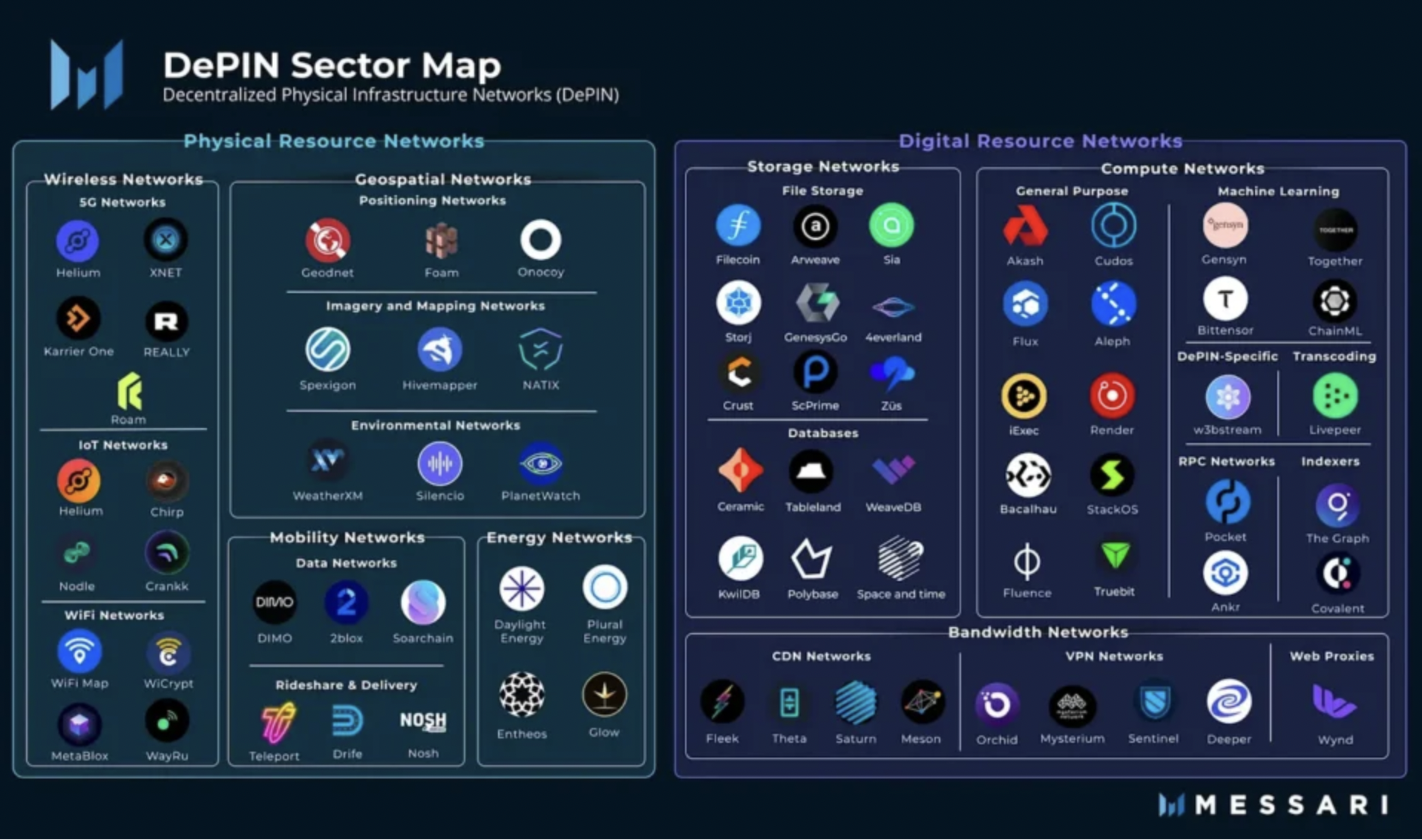
Many centralized services harness the crowd to run networks of resources serving millions. Take Uber — drivers chip in cars and services, serving customers and getting paid. Meanwhile, all access, pricing, and data stay locked in the app provider's hands.
DePINs flip this script, applying blockchain philosophy to infrastructure provision. A decentralized protocol orchestrates contributions, keeps score, and auto-distributes rewards — no gatekeepers or steep entry barriers. Anyone can jump in as a provider or consumer.
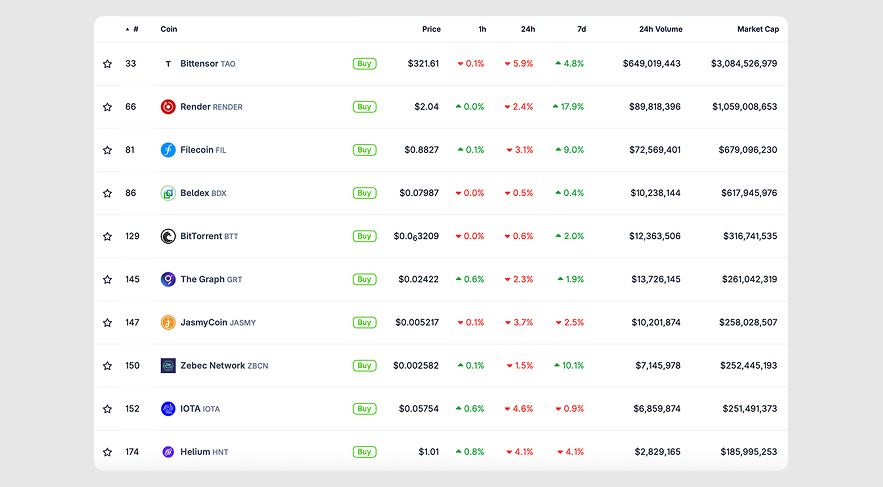
Since the term popped up in 2022, the sector has exploded. At press time, the DePIN category on CoinGecko lists 246 tokens, topped by Bittensor (TAO) and Render (RENDER).
How does a DePIN work?
Here's a peek at the three interlocking layers forming the core of any DePIN.
Layer 1: Hardware
Private providers offer up their idle physical gear — from a GPU cluster or an internet router to a solar panel — to cash in through automatic rewards. Think Bitcoin miners expending computing power to verify transactions — there's no cap on how many can join in.
Layer 2: Middleware
This is how those physical resources plug into the blockchain for resource distribution and rewards. Middleware gathers activity data for every piece of hardware and funnels it to the network.
Layer 3: Blockchain
The blockchain acts as an administrator and payment system with a built-in pricing model. Upon receiving the activity data, it parcels out demand across providers and calculates rewards by contribution, which are then paid out in cryptocurrency. Users are charged for each service they use.
Example: Render Network
The Render Network is a decentralized GPU computing marketplace built for 3D rendering and AI tasks. Artists starved for rendering power get matched with users who have idle GPU capacity. This happens on autopilot: artists or designers submit jobs, and distributed nodes process them using RENDER tokens for payment.
As of April 2026, an estimated 35–40% of total network volume is pulled by AI workloads. The blockchain-based, peer-to-peer model delivers faster and cheaper rendering compared to traditional farms.
- Job submission: Creators upload 3D scenes or rendering jobs (e.g., Blender, Cinema 4D) to the network via plugins or a web portal.
- Matchmaking: The network's algorithm auto-matches these jobs with available GPU providers based on needs like GPU model, speed, and cost.
- Job distribution & processing: The rendering workload is spread across multiple, independent nodes (node operators) globally for high-performance rendering.
- Verification: A trustless system checks that the rendered output is accurate and complete before the final project is released.
- Payment & incentives: Once verified, the creator pays the GPU providers in RENDER.
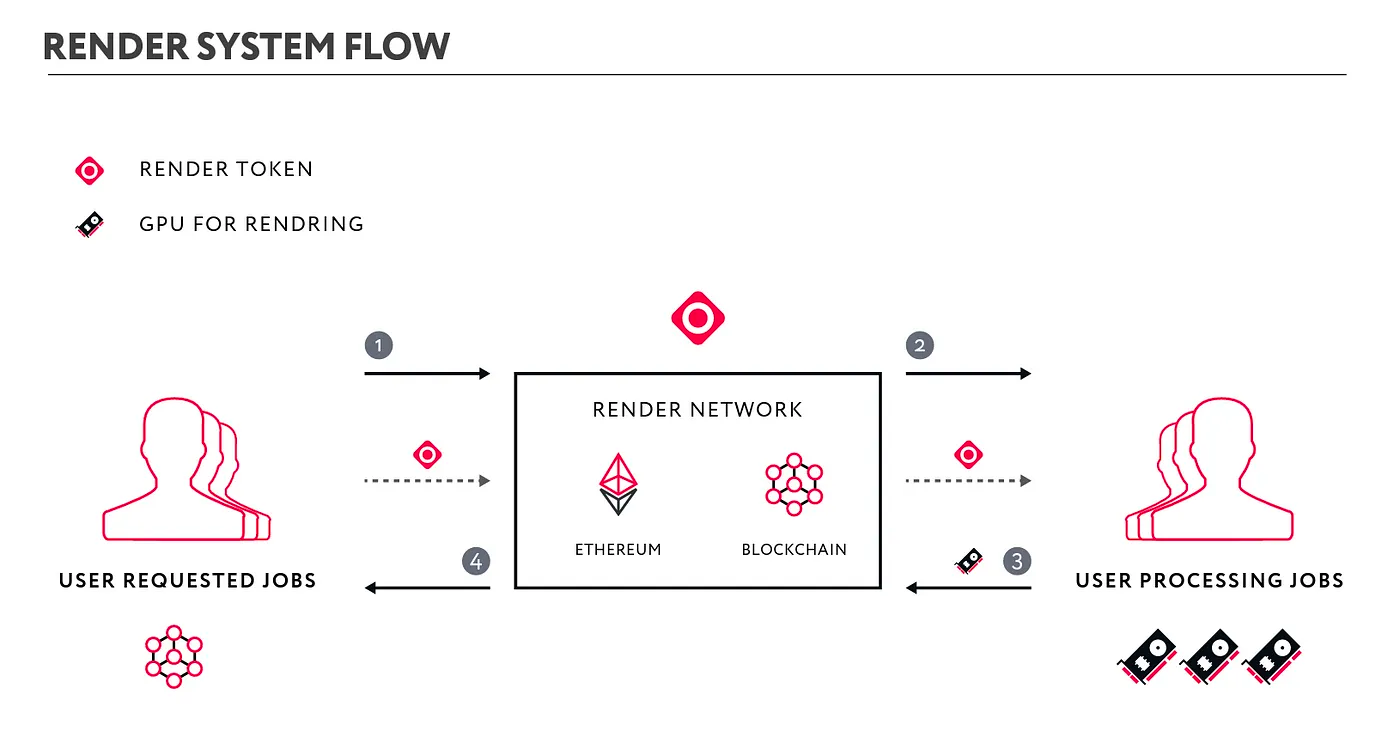
The native cryptocurrency, Render, was originally an ERC-20 asset (RNDR), so users had to stick with Ethereum-compatible addresses to hold and move them. In 2023, the community voted to migrate to Solana to escape high gas fees and transaction delays. Hence, the "new" Render (RENDER) now runs on Solana addresses.
The RENDER tokenomics uses a "burn-and-mint" model: tokens are burned to pay for work, and new ones are minted to reward operators.
Other use cases
Participants pitch in their resources in exchange for crypto rewards. It boils down to three main buckets:
- Sharing of idle resources. Users can lend out computational power or extra energy from solar panels across a network. Think of it as Airbnb for hardware.
- Building and running infrastructure. Some networks pay users to roll out new infrastructure and keep it running. Examples: charging stations for electric cars or relay towers for wireless networks.
- Rendering services or tackling tasks. Users can earn tokens for network heavy lifting like computation or data digging.
DePIN building hub peaq identifies four arenas where members can support devices and machines: land, sea, sky, and space. The possibilities are sprawling, including:
- P2P electric car charging
- Ridesharing and renting electric bikes and scooters
- Wind and solar energy swapping
- Delivery of food and goods
- Selling fitness tracker data
- Community-owned robo-restaurants and robo-cafes
Top 5 DePIN projects by market cap (April 2026)
Beyond Render, several other DePINs have climbed the ranks. Here are the five biggest players right now, based on market cap.
1. Bittensor (TAO) — $3.08 billion
Bittensor is a decentralized brain for machine learning — a hub for AI models from around the world that rewards the most useful ones with TAO tokens. It functions as a crowd-sourced neural network: users plug in and get paid for contributing computing power or high-quality data.
2. Render (RENDER) — $1.06 billion (see above)
3. Filecoin (FIL) — $679 million
Filecoin is a decentralized storage network — think Airbnb for hard drive space. Users rent out their spare storage capacity, and anyone can store files on the network for a fraction of what centralized providers charge. Miners earn FIL tokens for hosting data and proving it's kept safe.
4. Beldex (BDX) — $618 million
Beldex is a privacy-focused DePIN building a full suite of decentralized applications. Its arsenal includes a private messenger, a tracker-free browser, and an anonymous VPN. The network runs on Masternodes that relay traffic and validate transactions, earning BDX rewards for keeping things private.
5. BitTorrent (BTT) — $317 million
Yes, that BitTorrent. The peer-to-peer file sharing giant has morphed into a DePIN where users earn BTT tokens for seeding files and lending bandwidth. The network now tackles decentralized storage and live streaming, turning the old protocol into a rewards-powered ecosystem.
DePIN flywheel
The graphic below illustrates the engine behind DePINs. Within them, token rewards, transaction fees, network growth, and incentives are all tangled together.
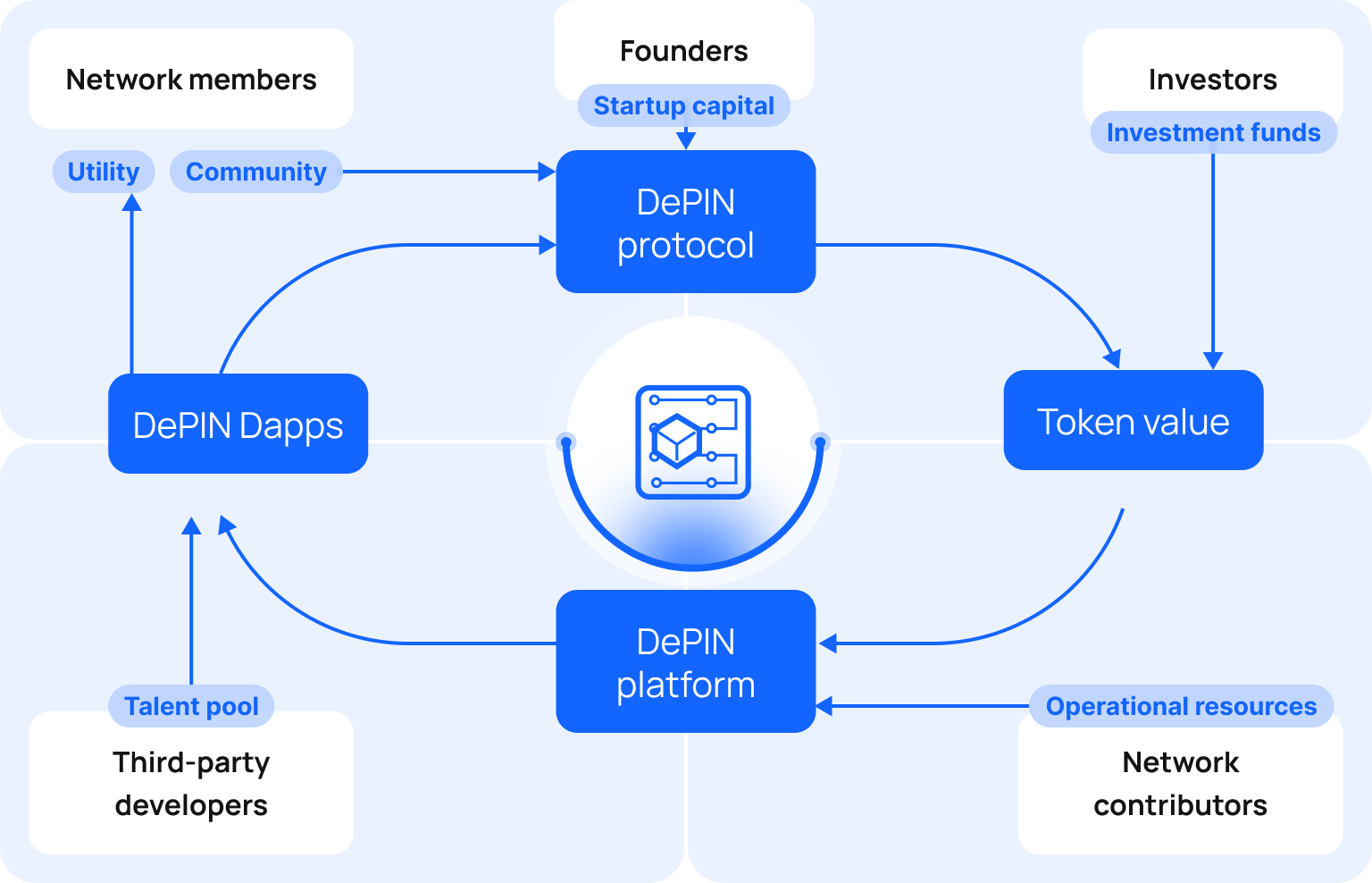
- Token rewards nudge service providers (supply-side participants) to spin up and roll out infrastructure.
- Transaction fees (from end users tapping the services) fuel the ecosystem.
- As the network swells, more end users, developers, product builders, and service providers pile in.
- As the community expands, so do token rewards for service providers — with the token price hitched to network usage.
Biggest advantages of DePINs
- Scalable access. DePIN networks can flex in any direction along with demand, onboarding or dropping providers as needed. In centralized systems, this means upgrading the hardware.
- Cost efficiency. Users can tap resources more cheaply than from a centralized entity. Plus, since the infrastructure is owned by everyday people, platform overhead is generally lower.
- Democratic access. DePINs are permissionless — contributors and users can jump in without contracts, approvals, or any membership hassles.
- Incentives. Token rewards can turn into active or passive income streams for providers who put their idle resources to work.
- Decentralization. DePIN architecture eliminates single points of failure, much like DAOs. Control is spread across providers.
Existing challenges
DePINs aren't all smooth sailing. Like any blockchain project, they're vulnerable to smart contract bugs and hacks. Getting started can be a headache — they're complex and demand serious technical know-how to set up and keep running.
And there's the token problem: the crypto rewards you earn can swing wildly in value, throwing the whole ecosystem into flux.
- Complexity. Non-crypto-natives may find DePINs overwhelming.
- Provider density. The pool of available providers at early stages can be thin.
- Fluctuating profitability. Contributors cover their own hardware and operating costs. Profitability also depends on network growth and token value, so early-stage networks may struggle to offer attractive rewards.
- Centralized influence. Although DePINs are decentralized by design, some reward systems could still let large providers amass influence.
- Regulatory uncertainty. DePINs operate in a hybrid landscape that blends traditional infrastructure regulations with crypto-asset compliance, complicating operations across jurisdictions.
Wrapping up
DePINs are rewriting the rules of how physical infrastructure gets built and accessed. Instead of trusting a handful of corporations, the crowd now pools resources — from GPUs to wireless hotspots — and gets paid for it. The sector has snowballed from a niche idea in 2022 to over 200 tokens with a collective market cap of $9.6 billion.
But it's not all smooth sailing. Complexity, provider density, and rollercoaster profitability remain hurdles. Still, DePINs are here to stay, and they're turning the infrastructure game on its head.