Clapp Weekly: CLARITY vote collapses, crypto sells off, Fed decision ahead

BTC price
Bitcoin sharply gave back Monday's gains after the Senate rejected the CLARITY Act, ending a brief rally fueled by regulatory optimism. BTC had climbed above $79k despite concerns about an AI slowdown weighing on AI-related stocks. US spot Bitcoin ETFs returned to positive flows on Tuesday, pulling in $160.04 million after a four-day outflow streak that drained roughly $460 million. The broader range remains intact, with BTC trading between $60,000 and $80,000 since May, down roughly 35% over the past year.
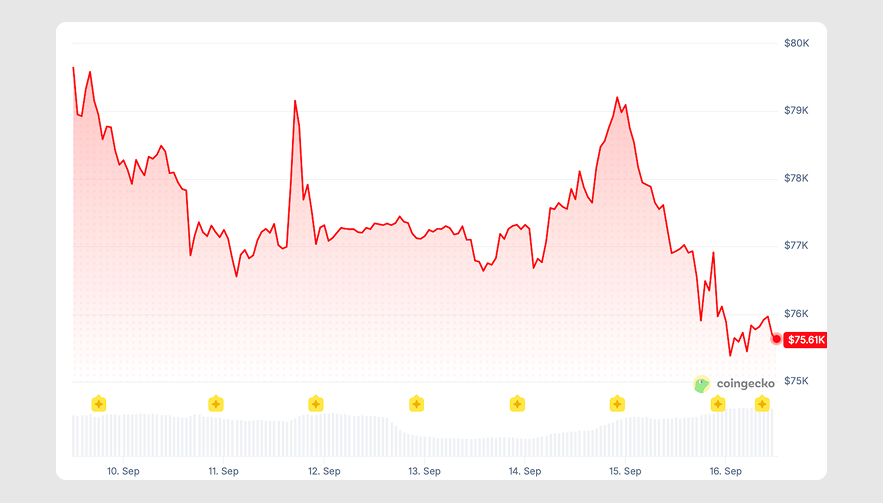
BTC fell from nearly $79.7k to $76.5k on September 10, then briefly bounced to $79,157 the next day. It reversed again and hovered around $77k through the weekend before climbing to a higher high of $79,286.67 on Monday — only to collapse sharply afterward.
At press time, BTC is changing hands at $75,444.77, down 1.8% over the past 24 hours and 4.3% over the past 7 days.
ETH price
Ether slipped below $2.4k, tracking Bitcoin's sharp retreat. Yet beneath the near-term pressure, whales, trading desks, and institutional buyers are still active. BlackRock withdrew 11.69k ETH (roughly $28.3 million) from Coinbase Prime, while BitMine is 98% of the way toward its goal of holding 5% of total supply after purchasing another $68 million worth of ETH. Spot ETF flows have been mixed, with a $141.47 million outflow yesterday following two positive sessions that brought in $337 million combined.
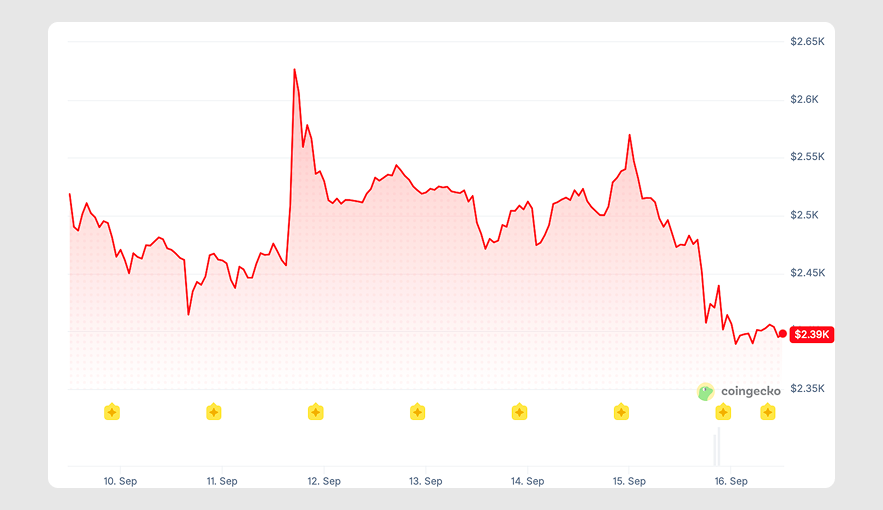
ETH dropped from $2.5k toward $2.4k on September 10 before surging to $2,626.56 the next day and retreating soon after. It lost its grip on $2.5k over the weekend and managed to reach only $2,569.90 on Tuesday, September 15, before selling pressure intensified.
ETH is changing hands at $2,392.89 at press time, down 3.2% over the past 24 hours and 4.2% over the past 7 days.
Seven-day altcoin dynamics
The CLARITY Act's failure in a Senate procedural vote triggered roughly $571 million in long liquidations across exchanges, the highest tally since August 22. Ether positions absorbed the heaviest damage alongside Bitcoin, as analysts had expected ETH and DeFi tokens to outperform had the Senate voted yes.
Earlier this week, reports that President Trump had accepted the bill's ethics restrictions sent Bitcoin from roughly $77,000 to nearly $80,000 on Monday, as markets read the move as clearing the last obstacle ahead of the decisive vote. When the bill failed, major tokens sold off across the board.
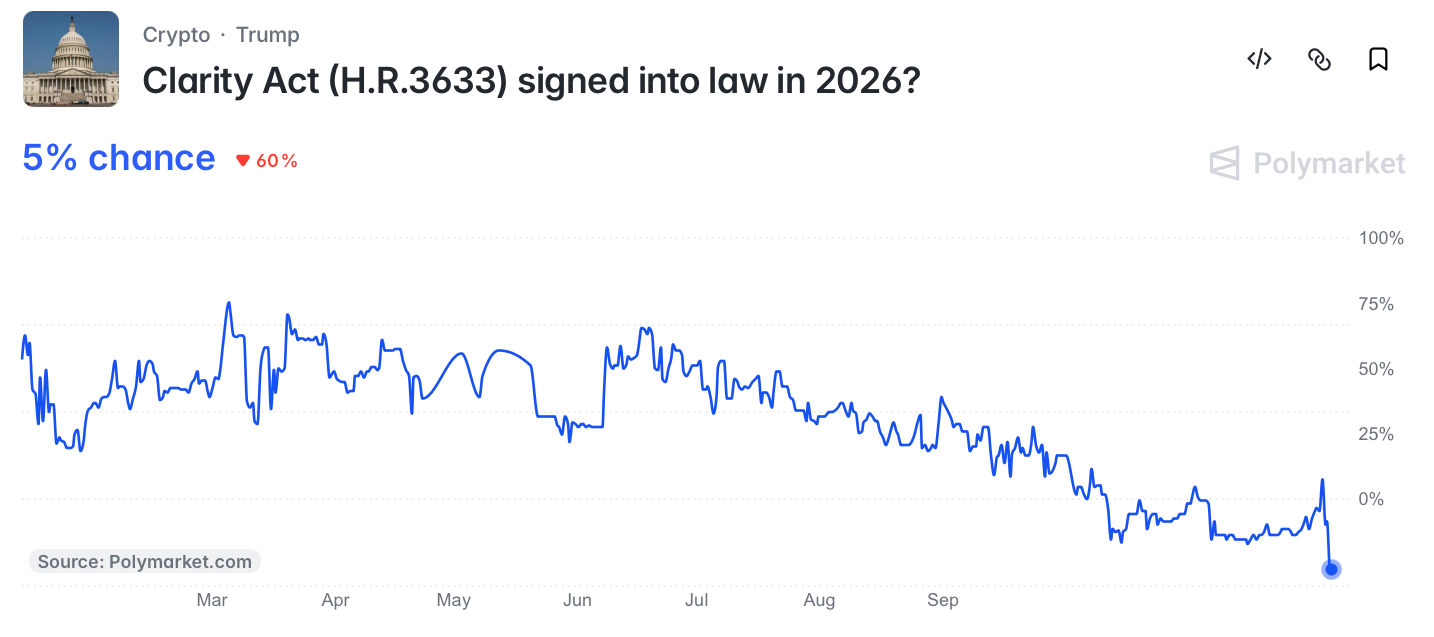
Yet, as Decrypt noted, the outcome had largely been priced in, making the plunge "orderly rather than a rush for the exits." On Polymarket, the odds of the CLARITY Act becoming law in 2026 halved to 17% by Tuesday morning after Republicans rejected a Democratic counteroffer. They now stand at just 5%.
The total crypto market cap has shed 2.47% over the past 24 hours, falling to $2.67 trillion, while the Fear and Greed Index plunged to Neutral (51) from yesterday's Greed reading of 69.
XRP tumbles as CLARITY hopes fade
XRP led losses among major tokens. The legislation would have permanently enshrined its status as a digital commodity in federal law, and with Ripple's business model heavily focused on institutional cross-border payments, compliance, and enterprise software, XRP was expected to be one of the key corporate beneficiaries.
Earlier this week: Crypto ignores AI slowdown calls
Earlier in the week, regulatory optimism overpowered renewed AI fears. Crypto's Monday rally came even as calls to pump the brakes on AI development sank Nvidia, Intel, and related stocks. Many of the warnings came from insiders, including Anthropic CEO Dario Amodei, who published an essay arguing for a deliberate pause in the pace of model capability improvements. Within a day, OpenAI's Sam Altman and xAI owner Elon Musk both publicly agreed.

Top weekly winners
- BTW (+58.2%) rallied on the back of staking and reward campaigns, including the September Staking Program and Binance Wallet Booster Season 5. However, potential sell pressure from one wallet controlling ~73% of the supply could overwhelm the token’s thin liquidity.
- JST (+9.9%) surged after the TRON ecosystem’s integration with MetaMask, which explicitly includes JustLend DAO and its token set. Accompanying media reports highlighted JustLend DAO’s role as TRON’s primary lending platform.
- XMR (+2.1%) revisited its January highs, boosted by August’s THORChain 3.20 upgrade, which added infrastructure for native cross-chain swaps. A technical breakout added fuel alongside a broader CPI-related rally last Friday. However, the CLARITY Act’s failure dashed hopes of a digital-commodity classification, pulling the token sharply lower the day after.
Top weekly losers
- PUMP (-22.4%) lost ground amid app suspensions, rising competition, and broader market weakness. The temporary removal of the Pump.fun iOS app from Apple’s App Store in the US and India triggered panic and a sharp sell-off, while rival launchpads such as StonkFun and Pons drew away user attention and trading volume.
- WLD (-21.3%) pulled back after an early-September rally fueled by AI hype and the launch of perpetual futures trading on Kalshi.
- DOT (-20.7%) came under pressure from profit-taking after a rally that coincided with a governance vote on launching dotUSD, a native stablecoin backed by DOT. The broader risk-off move added to the selling pressure.
Cryptocurrency news
Clarity Act dies in Senate: 49-50 vote deals blow to crypto's biggest policy goal
On Tuesday, the Digital Asset Market Clarity Act failed to clear the Senate's 60-vote threshold, falling 49-50 in a procedural vote that didn't even secure a simple majority. Multiple Republicans joined Democrats in voting no, sealing the bill's fate.
It was the furthest the market structure legislation had ever progressed — over 600 pages of compromise, months of negotiation, and hundreds of millions spent on lobbying. And it still wasn't enough.
What killed it
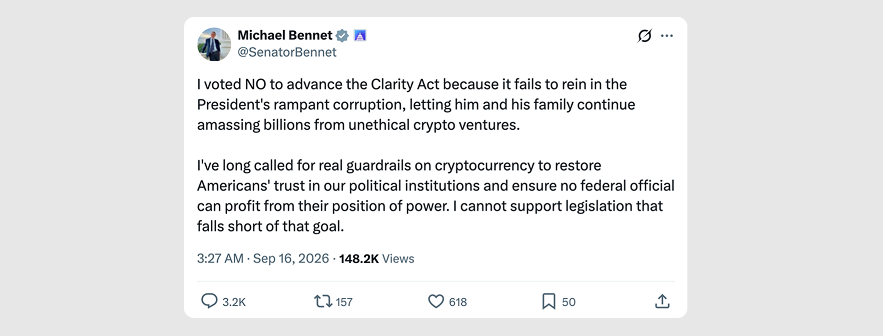
Two issues proved insurmountable. First, ethics provisions aimed at curtailing senior government officials — including President Trump — from maintaining crypto business ties. Democrats argued the restrictions didn't go far enough; Republicans balked at the scope. Second, the closer the vote crept to the November midterms, the harder it became to find bipartisan ground.
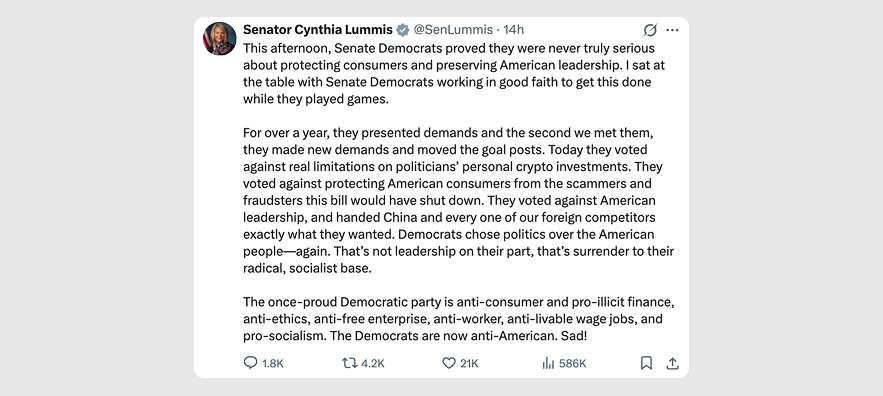
Every Democrat voted against the bill, depriving it of bipartisan support. Senator Cynthia Lummis, the bill's leading Republican negotiator, summed this up bluntly:
“The bill is dead. This was a purely political move on the part of the Democrats.”
In her final plea on the floor, Lummis urged colleagues to not only join the 21st Century economy, but lead it. However, they didn't listen.
As noted by Politico, Trump’s ability to profit from his family’s crypto businesses, reported to have earned him over $1.4 billion in income last year, remains the key hurdle. Democrats also insisted on changing a few other sections, partly to address prosecutors' concerns about their authority to go after illicit finance.
What now
The industry will pivot to the SEC and CFTC, which are already advancing their own rules. The SEC's proposed Regulation Crypto Assets offers a path for projects to raise capital without immediate securities registration. Chair Atkins made it clear the SEC was not waiting on Congress.
"With or without that legislation, this Administration will deliver for American investors and technological innovators," Atkins said, according to the SEC transcript. "Promises were made, and they will be kept."
But as Atkins himself admitted, agency rules can be undone by the next administration. Only legislation provides durability.
The SEC has three rulemaking tracks running in parallel. Aside from Regulation Crypto, it is preparing to give transfer agent rules the first meaningful revision in around four decades — a prerequisite for institutional adoption of tokenized securities. In addition, the staff is developing a proposal that would enable investment advisers to self-custody crypto in cases where a qualified third-party custodian does not yet exist.
Industry reacts
The response was measured, if disappointed. Ripple CEO Brad Garlinghouse said it "stung":
"This was an opportunity bigger than Ripple or one company — we did this for the industry, for consumers, and to cement the US's position as the crypto capital of the world."
Others pointed to Europe, where MiCA has provided a clear rulebook since December 2024. Cardano Foundation CEO Frederik Gregaard suggested builders "can't afford to wait around for the US to get its act together."
Some struck a more defiant tone, while Strategy's take was simple: "Bitcoin has had legal and regulatory clarity in the US for years."
For now, the industry waits — again — while Washington's window closes.
Fed set to hike for first time since 2023 — crypto is bracing for impact
Markets are pricing in a 93% chance of a quarter-point Fed rate hike on September 16 — a giant leap from 69.4% on Friday. This move would raise the fed funds rate for the first time since July 2023, when Jerome Powell's agency concluded the most aggressive and rapid monetary tightening cycle since the early 1980s.
This time, it's Kevin Warsh's turn. However, some market observers suspect this decision could spark a series of hikes, given the inflation pressures fueled by rising oil prices. Bond markets are also anticipating further hikes.
Why now
Inflation has remained above the Fed's 2% target for more than five years. The US-Iran war has added fresh energy-driven price pressures, with Brent crude holding above $100 a barrel since September 9. August CPI came in at 3.4% annually, well above target, albeit in line with estimates. The monthly gain in the core index (0.3% ) also came 0.1 percentage point higher than expected.
As Warsh said at Jackson Hole in August:
"We must be confident that underlying inflation is moving to our objective, clearly and at sufficient speed. Otherwise, we have work to do. That's our job . . . our mandate . . . and our charge to keep."
The crypto angle
Bitcoin slipped below $77,000 on Tuesday ahead of the decision, down 3.3% in 24 hours.
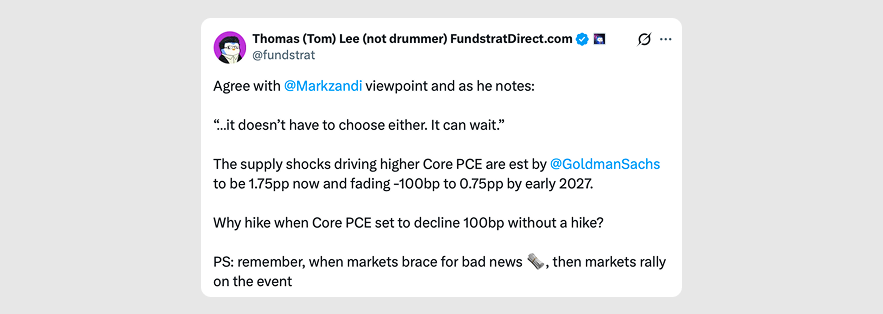
Not everyone thinks a hike is wise. BitMine's Tom Lee called it a "policy error," arguing that much of the remaining inflation comes from supply shocks that are already fading. "Why hike when Core PCE is set to decline 100 bp without a hike?" he asked.
MNFund's Michael van de Poppe doesn't expect a hike and would buy any further dip. He sees Bitcoin at range lows after consolidation, with a reclaim of $78,000 potentially opening a move toward $90,000–$92,000.
What matters more
The hike itself may be less important than what comes next. Markets will scrutinize the dot plot for clues on whether this is a one-and-done move or the start of a series.
Bond markets are already voting for the latter. The 10-year Treasury yield briefly breached 5% this week, and mortgage rates have climbed above 7%. A hawkish message from Warsh could help calm yields or spook risk assets further.
Long: Watch Treasury, not the Fed
Not everyone is fixated on Wednesday's rate decision. Custodia Bank CEO Caitlin Long argues the more consequential power shift is happening at Treasury. She points to the GENIUS Act, the 2025 law that governs dollar-pegged stablecoins and takes effect January 18, 2027, as the clearest sign. Treasury and the Office of the Comptroller of the Currency have already published proposed rules, while the Fed has stayed quiet. Long said:
"There's no question Treasury is taking a lot more power from the Fed."
Treasury has also asserted authority over which foreign stablecoins can access US markets — a gatekeeping role that didn't traditionally sit with the department. Long expects that leverage to accelerate a shift toward tokenized deposits, bank-issued dollars that move over blockchain rails, at the expense of stablecoins broadly.
US banking groups raised similar deposit-flight concerns when the GENIUS Act first passed. For crypto markets, the Fed's rate call settles Wednesday's question. Who actually writes the rules for the digital dollar looks like a fight that stretches well into 2027.