Revolving credit line vs loan: You pay interest only on what you draw

Crypto credit lines borrow a familiar mechanism from traditional finance and turn it into a real advantage — a revolving limit that replenishes as you repay. That's the headline benefit, but it's not the only one; lower effective interest costs come along with it too.
Fixed-term loans are familiar for a reason: apply, get the money, pay it back on a schedule. That works fine if you know exactly how much you'll need and when. Credit lines remove that constraint entirely, which is what makes them the more flexible option for a lot of crypto borrowing.
Here's the actual difference, why it matters for what you end up paying, and how to figure out which one fits your situation.
TL;DR
- A loan gives you a lump sum. You borrow the full amount and start paying interest on all of it immediately.
- A credit line gives you a limit. You draw only what you need, when you need it, and pay interest only on what you've actually drawn.
- Unused credit costs nothing. The portion of a credit line you haven't drawn doesn't accrue interest.
- Credit lines are renewable. As you repay, your available credit replenishes — a loan is one-and-done.
- The right choice depends on your needs. One-time expense? A loan. Ongoing flexibility? A credit line.
How a loan works: Lump-sum interest from day one
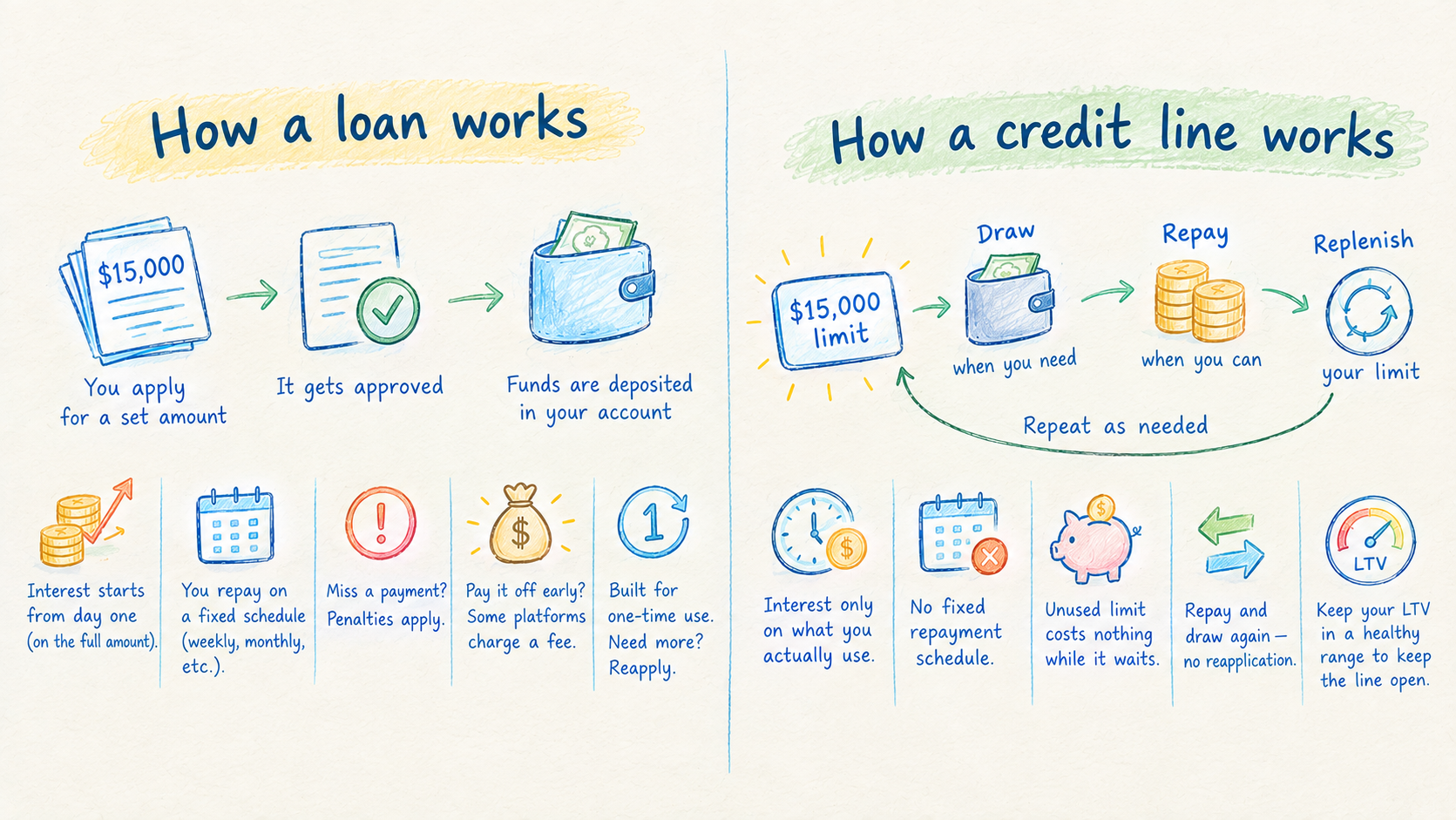
A fixed-term loan is straightforward. Say you ask for $15,000. The platform approves it and deposits that lump sum into your account, and from there:
- Interest accrues on the entire loan from day one, whether you spend it immediately or let it sit untouched for a month.
- You repay on a fixed schedule — weekly, monthly, whatever the terms specify.
- Missing a payment triggers penalties.
- Paying it off early sometimes triggers a fee too, depending on the platform.
- It's built to be used once. Need more later, and you're reapplying from scratch.
All of that adds up to a genuinely rigid product. You're locked into a repayment schedule, a fixed maturity date, and potential charges on both ends — for paying late and sometimes for paying early. And unless you put the entire lump sum to work right away, you're effectively paying interest on money that's just sitting there.
This fits borrowers with a specific expense and a timeline they're comfortable following — buying a car, renovating a home, covering an emergency medical bill. Where it falls short is flexibility: if your needs or your ability to repay shift, the loan itself can't adapt.
Credit lines: Interest accrues on what's drawn
A credit line opens up a pre-set borrowing limit you can draw from, repay, and draw from again. That turns a $15,000 approval into a genuinely revolving line, rather than a one-time lump sum.
It's the same basic mechanism behind fiat credit cards and lines of credit — but crypto credit lines go a step further by dropping the fixed repayment schedule entirely.
On-demand drawing
You draw only what you need, when you need it. Delaying a draw costs you nothing — $2,000 drawn next week accumulates fewer days of interest than $2,000 drawn today. Whatever you haven't drawn just sits there as available credit, costing nothing while it waits.
No schedules
Repayment happens on your own terms, with no fixed schedule. Pay back what you want, when you want, and your available credit replenishes as you go — repay $2,000, and you can draw that same $2,000 again.
Usage-based interest
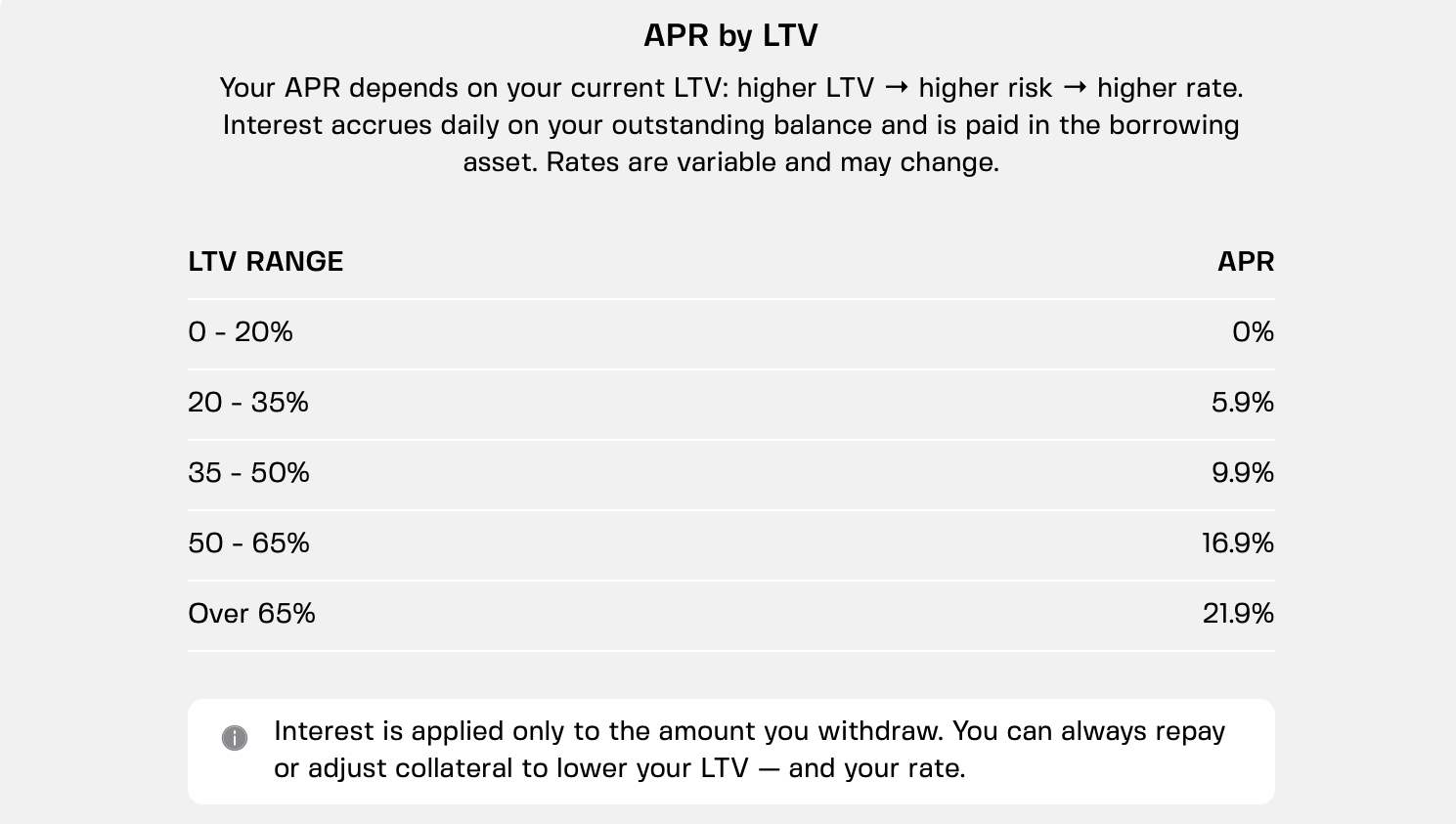
Interest only accrues on the portion you've actually withdrawn, not your total available credit limit. If the lender approves a $10,000 limit and you only withdraw $500, you pay interest only on those $500 — and even less as you repay. What's more, you may qualify for 0% interest if your LTV is low enough, depending on the lender.
You get a limit, use what you need, repay when it's convenient, and interest only ever applies to the balance you're actually carrying. The one ongoing requirement is keeping your LTV within an acceptable range to keep the line open.
Doing the math
Say you need $15,000 for a small business project, but you're not spending it all at once — $9,000 upfront, another $3,000 three months later, and a final $3,000 three months after that.
With a loan:
- You borrow $15,000 upfront and start paying interest on the full amount immediately, even though most of it sits unused for months.
- At 6% APR over 12 months, that's about $900 in interest.
With a credit line:
- You draw $9,000 at the start, held for the full 12 months.
- You draw another $3,000 at month three, held for 9 months.
- You draw a final $3,000 at month six, held for 6 months.
- At 6% APR, that works out to roughly $765 in interest — about $135 less than the loan.
And that's only assuming the borrower never repays anything until the end of the term (which is possible if their LTV never crosses the liquidation threshold).
In practice, credit lines usually save more than that, because every repayment immediately shrinks the balance you're paying interest on. Repay $4,000 partway through the year on the same $15,000 line, and the interest bill drops to roughly $705 — about $60 more in savings than the no-repayment version, without changing anything else about the borrowing pattern.
The savings come entirely from not paying interest on money you haven't drawn yet, and the more you stage your borrowing over time, the bigger that gap gets.
What about the unused portion?
With a loan, you pay interest on the full amount whether you use all of it or not. With a credit line, whatever's unused is genuinely free.
Say you open a $10,000 credit line and draw $2,000. Your interest is calculated on that $2,000 — not the full $10,000. The remaining $8,000 sits there, available, costing nothing.
This holds regardless of your rate tier: unused credit doesn't accrue interest on any revolving product, full stop. What a low-LTV 0% APR tier adds on top of that is a further discount on the portion you have drawn — so on a platform offering that structure, staying conservative on LTV means even your active balance can cost nothing, not just the unused part.
That combination is what makes a credit line genuinely different from a loan: you can keep liquidity on standby without paying a cent for the privilege until you actually put it to use.
Where loans and credit lines are alike
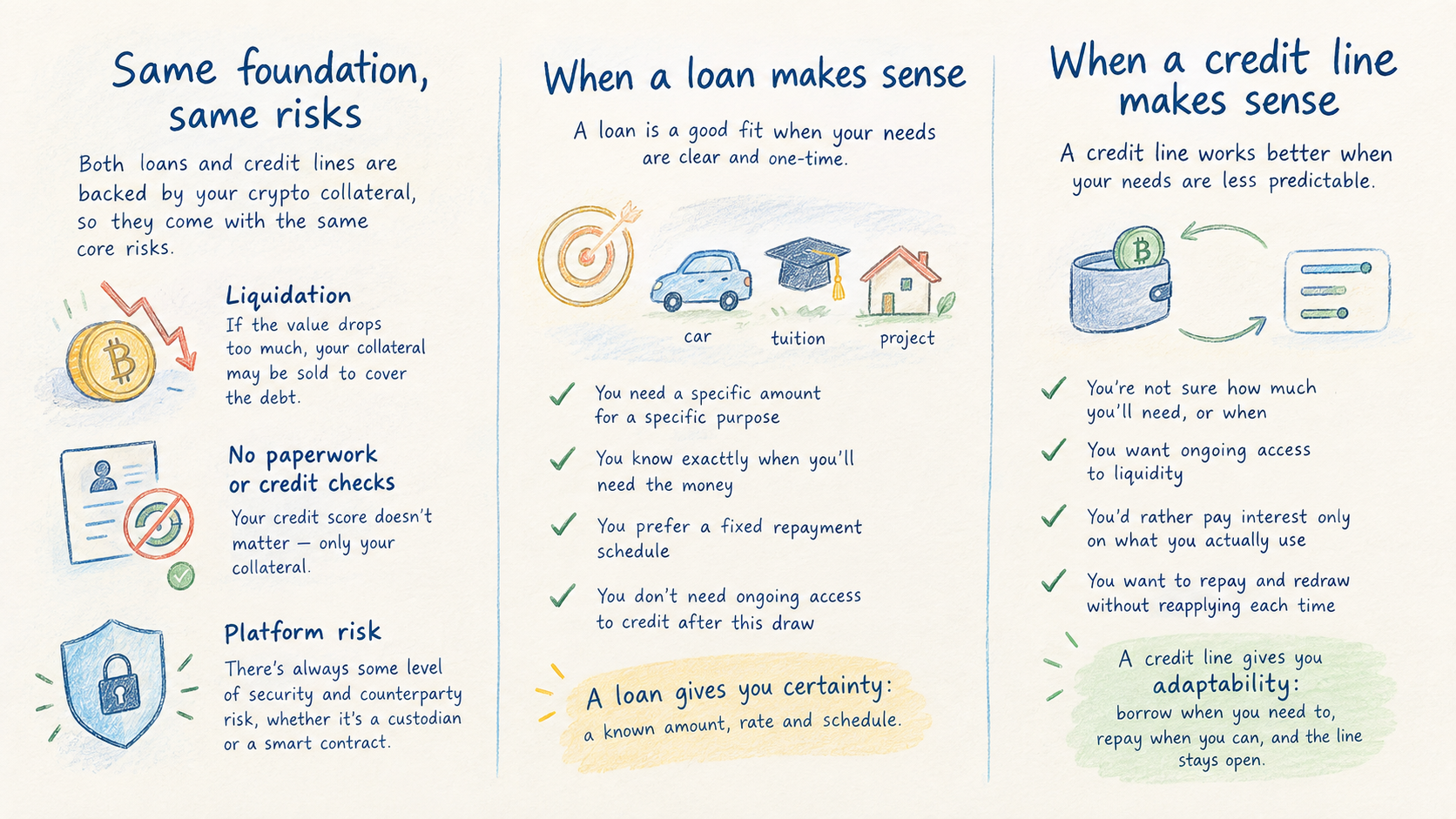
Both products share the same underlying risks, since both are backed by crypto collateral:
- Liquidation. If your collateral's value drops significantly, the platform may automatically sell a portion of it to cover what you owe. This happens without notice in DeFi, while CeFi lenders may (though don't have to) send warning alerts. Learn more in our guide to liquidation alerts.
- No paperwork or credit checks. Your FICO score means nothing to crypto lenders; the key requirement for eligibility is sufficient collateral. This makes crypto credit more accessible on this front than most TradFi products, particularly for younger borrowers or anyone without an established credit score — though it still requires owning crypto to put up as collateral in the first place.
- Platform risk. Whether you're dealing with a custodial lender or a DeFi smart contract, there's some level of security and counterparty risk involved either way.
The case for a crypto loan
Loans are built for a narrower use case. They typically give certainty: a known amount, a known rate, a known schedule — though some platforms do offer LTV-tiered pricing on fixed-term loans, too.
- You need a specific amount for a specific, known purpose — a car, tuition, a one-time project
- You already know exactly when you'll need the money
- You'd rather have a fixed repayment schedule than figure one out yourself
- You don't need ongoing access to credit beyond this one draw
If your situation fits that shape, a loan works fine as-is.
The case for a crypto credit line
A credit line gives adaptability — you're not locked into a fixed amount or schedule. Draw in full or in portions, repay when convenient, and the line stays open for whenever you need it next (as long as you stay within the platform's LTV limits).
It's the better fit when your needs are harder to pin down in advance:
- You're not sure exactly how much you'll need, or exactly when
- You want ongoing access to liquidity rather than a single lump sum
- You'd rather pay interest only on what you actually use
- You want to repay and redraw without reapplying every time
How Clapp handles credit lines
Clapp's revolving credit lines are priced on LTV. You draw only what you need, your unused credit sits ready in the background, and interest only applies to what you've drawn.
Keep your LTV at 20% or below, and your APR on that drawn balance is 0% — meaning the line costs you nothing until you actually use it, and even then, only once you cross that threshold. As you repay, your available credit replenishes automatically, with no fixed schedule and no reapplication process. The line simply stays open.
You can also add, remove, or swap collateral as your portfolio shifts, so the line adapts alongside you rather than locking you into whatever collateral mix you started with.

The collateral backing your line isn't locked to a single asset, either. Clapp supports multi-collateral pools, so you can mix stablecoins, BTC, ETH, and other supported assets together, then rebalance as your situation changes. For instance, swapping out volatile assets for stablecoins could lower your LTV, while swapping the other way raises it in exchange for more market exposure.
Bottom line: Certainty vs flexibility
A loan hands you a lump sum. A credit line hands you a limit. Both have a real place, depending on what you're actually trying to do.
Loans suit situations where you already know exactly what you need — fixed certainty, fixed schedule, interest on the full amount, but no ambiguity about what you're signing up for. Credit lines suit situations where flexibility matters more than certainty — draw what you need, when you need it, pay only for what you use, and leave the rest sitting there at no cost.
For most ongoing borrowing needs, the credit line model tends to make more sense: no interest on money you haven't touched, no fixed schedule boxing you in, and no reapplying every time liquidity comes up again. Pay for what you use, keep the rest available — that's the whole mechanism in one line.
Frequently asked questions
Do I pay interest on the full credit line or only what I draw?
Only what you draw. The unused portion doesn't accrue interest at all — that's the core difference from a loan, which charges interest on the full amount starting day one.
What happens if I don't use my credit line at all?
Nothing. No draw means no interest. On platforms with LTV-based pricing, keeping your LTV at 20% or below can also mean 0% APR on any balance you do carry — either way, an unused line just stays available.
Can I repay and re-borrow from a credit line?
Yes. As you repay, your available credit replenishes, and you can draw again whenever you need to — no reapplication, no new approval process.
Is a credit line better than a loan?
It depends on what you actually need. A specific amount for a specific purpose fits a loan fine. Ongoing access to liquidity, where you'd rather pay interest only on what you use, fits a credit line better.
What's the catch with a credit line?
The main risk is the same one that comes with any crypto-backed borrowing: if your collateral drops in value and your LTV climbs, you could face a margin call or liquidation. That risk exists with loans too — a credit line just gives you more room to actively manage it.
Does a credit line affect my credit score?
No. Crypto credit lines don't run traditional credit checks and don't report to credit bureaus. Your collateral is what actually matters here, not your credit history.