Are crypto-to-crypto swaps taxable in the EU?

Suppose you bought €10,000 worth of Bitcoin in 2024. The price has since doubled, but instead of taking profits in fiat, you swap it for USDT — no conversion to euros, the money just moves to a different wallet.
So did you just create a tax bill?
In some EU countries, yes. In others, not necessarily. That's what makes crypto taxation so confusing: the EU has introduced common reporting rules, but it hasn't introduced one universal rule for taxing crypto gains.
Here's when a swap actually creates a taxable event, how the gain gets calculated, and what the DAC8 directive changes for users.
TL;DR
- There's no single EU-wide tax rule for crypto-to-crypto swaps. Member States apply their own domestic tax rules.
- A swap can be taxable even when no fiat changes hands. In countries that treat the swap as a disposal, exchanging BTC for ETH can crystallize a gain.
- Some EU countries defer taxation until crypto is converted to fiat or otherwise realized under their national rules.
- DAC8 doesn't decide whether you owe tax — it increases reporting and information exchange around crypto transactions.
- From 2026, EU crypto users should assume their transactions are increasingly visible to tax authorities.
- Don't confuse "not taxable" with "not reportable." They're separate questions.
What counts as a “swap”?
A crypto-to-crypto swap is exchanging one crypto-asset for another — BTC → ETH, ETH → USDC, USDC → SOL, and so on. Whether euros ever enter the picture is beside the point.
The real question is whether your country treats giving up one crypto-asset in exchange for another as a disposal.
If it does, receiving a different crypto asset instead of cash doesn't shield you from tax. In several EU countries, swapping one token for another is treated as selling the first asset and buying a new one.
Germany is a clear example. Crypto-to-crypto swaps count as a private disposal transaction (private Veräußerungsgeschäft) under Section 23 of the German Income Tax Act. The gain is tax-free if you held the asset for more than a year — otherwise, personal income tax of up to 45% applies.
Germany also offers a tax-free exemption limit (Freigrenze) of €1,000 per calendar year, which makes it one of Europe's more investor-friendly regimes for patient HODLers.
“I didn't cash out” is not the same thing as “I didn't realize a gain”
To a tax authority, these are two separate events. Trading BTC for ETH doesn't cash you out to fiat — but your local law may still treat that trade as a BTC sale, meaning you realize a gain or loss the moment it happens.
- Cashing out means selling an asset and receiving actual government currency, like euros or dollars, into your account.
- Realizing a gain means triggering a tax event by selling, trading, or exchanging an asset for something else, whether or not cash is involved.
This isn't unique to crypto, either — trading one piece of real estate for another can trigger a realization event under similar logic, even with zero cash changing hands.
Why there isn't one EU answer
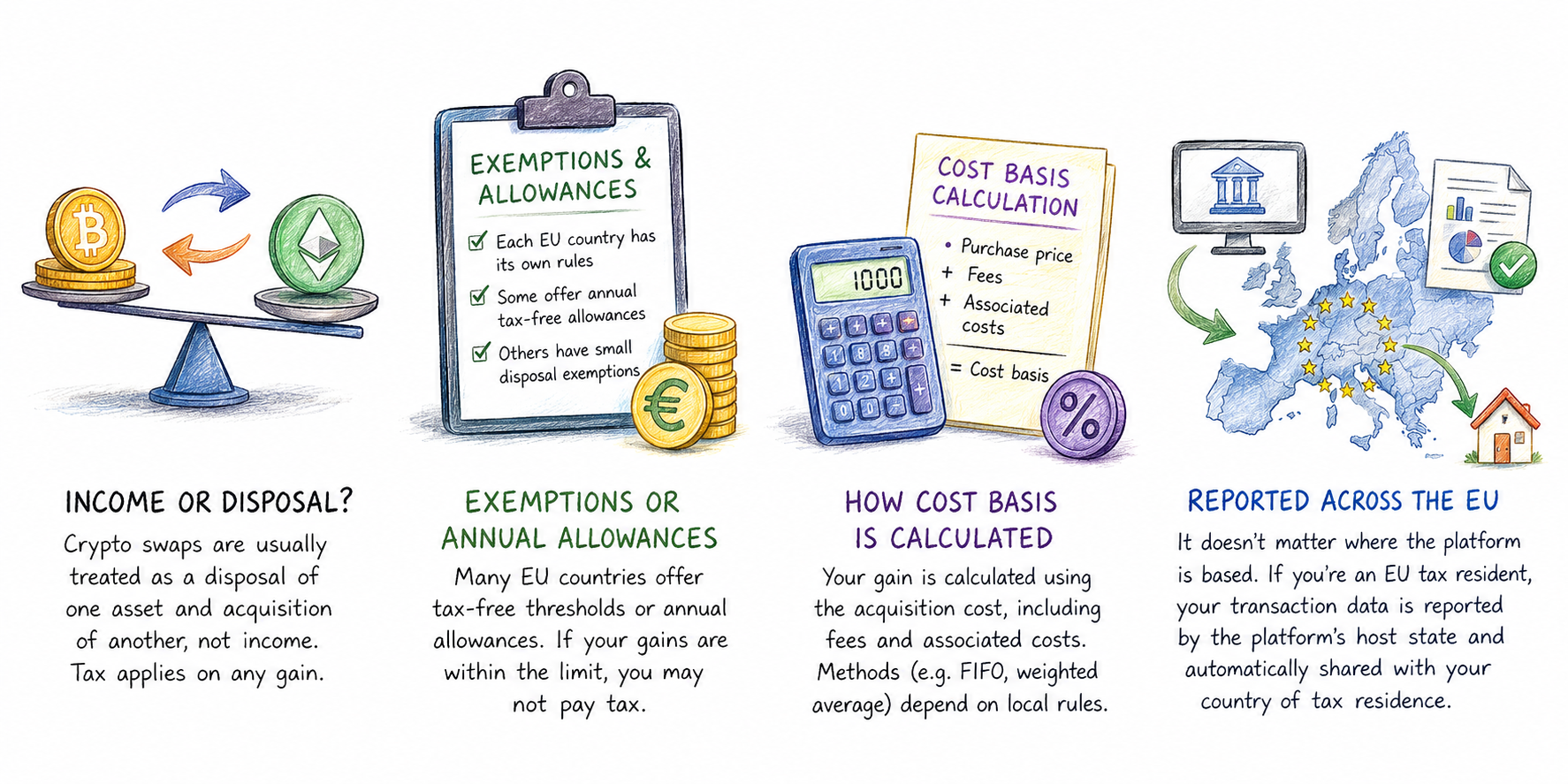
The EU has harmonized reporting, not personal crypto taxation. The European Commission itself has noted that Member States have taken different approaches — some treat crypto-to-crypto exchanges as taxable disposals, others tax gains later, once crypto is converted to fiat.
Countries where swapping can trigger a taxable gain
In most EU countries, including Italy and Cyprus, exchanging Asset A for Asset B is treated as disposing of Asset A. Every crypto-to-crypto trade counts as an immediate taxable disposal, with gains or losses calculated at the exact timestamp of the exchange.
You don't need to sell into euros for the gain to be realized — buy 1 BTC for €80,000, swap it for ETH when it's worth €86,000, and that €6,000 gain can become taxable right there.
Countries where crypto-to-crypto swaps can be tax deferred
Some jurisdictions don't treat the swap itself as the taxable moment — the tax point arises later, often when crypto is exchanged for fiat.
In Austria, swapping one cryptocurrency for another is tax-neutral and tax-deferred rather than a taxable realization. Under the Ökosoziale Steuerreform, which applies to assets purchased after March 1, 2021, exchanging Bitcoin for another token or a qualifying stablecoin isn't a taxable event.
France's tax law explicitly excludes standard crypto-to-crypto swaps from counting as taxable disposals — taxation is effectively deferred until you convert back into euros or use the crypto to pay for goods and services.
Portugal follows a similar approach: conversion back to fiat is what triggers tax, and like Germany, it offers a tax-free exemption for long-term gains held over 365 days.
Being non-taxable doesn't make these swaps invisible, though. Even in these countries, Crypto-Asset Service Providers (CASPs) automatically track and report user transaction histories under EU-wide frameworks like DAC8.
Countries with more complicated rules
Not every jurisdiction fits neatly into "taxable" or "deferred." Treatment can shift depending on:
- Whether you're a private investor or running a business
- How long you held the asset
- Whether you're swapping into a stablecoin
- Whether the crypto counts as income rather than a disposed investment
- Applicable exemptions or annual allowances
- How acquisition cost gets calculated
This isn't limited to exchanges based in your own country, either. If you live in one EU state but use a platform registered in another, your transaction data still gets reported to that host state and automatically forwarded to your country of tax residence.
The stablecoin question: does BTC → USDC count as “cashing out”?
USDC may be stable in value, but it's still a digital asset, and routing a trade through a stablecoin doesn't automatically make it tax-neutral.
As covered above, you don't need to touch euros for a disposal to occur — so if your jurisdiction treats crypto-to-crypto exchanges as disposals, swapping BTC → USDC can be treated the same as swapping BTC → EUR for tax purposes.
How the gain gets calculated
Say you bought BTC for €10,000, then later exchanged it for ETH when the BTC was worth €15,000. If your country treats the swap as a disposal, the gain is broadly:
€15,000 disposal value − €10,000 acquisition cost = €5,000 gain
The tricky part is everything real tax calculations layer on top of that simple formula — fees, multiple purchases at different prices, different cost-basis methods, and rules for identifying exactly which units were disposed of.
The blockchain can tell you precisely what you swapped. It can't tell you how your tax authority wants that gain calculated.
What changes with DAC8?
DAC8 came into force on January 1, 2026. EU Member States must now collect information through reporting CASPs and exchange it between tax authorities, with the first reporting year being 2026 and reports due in 2027.
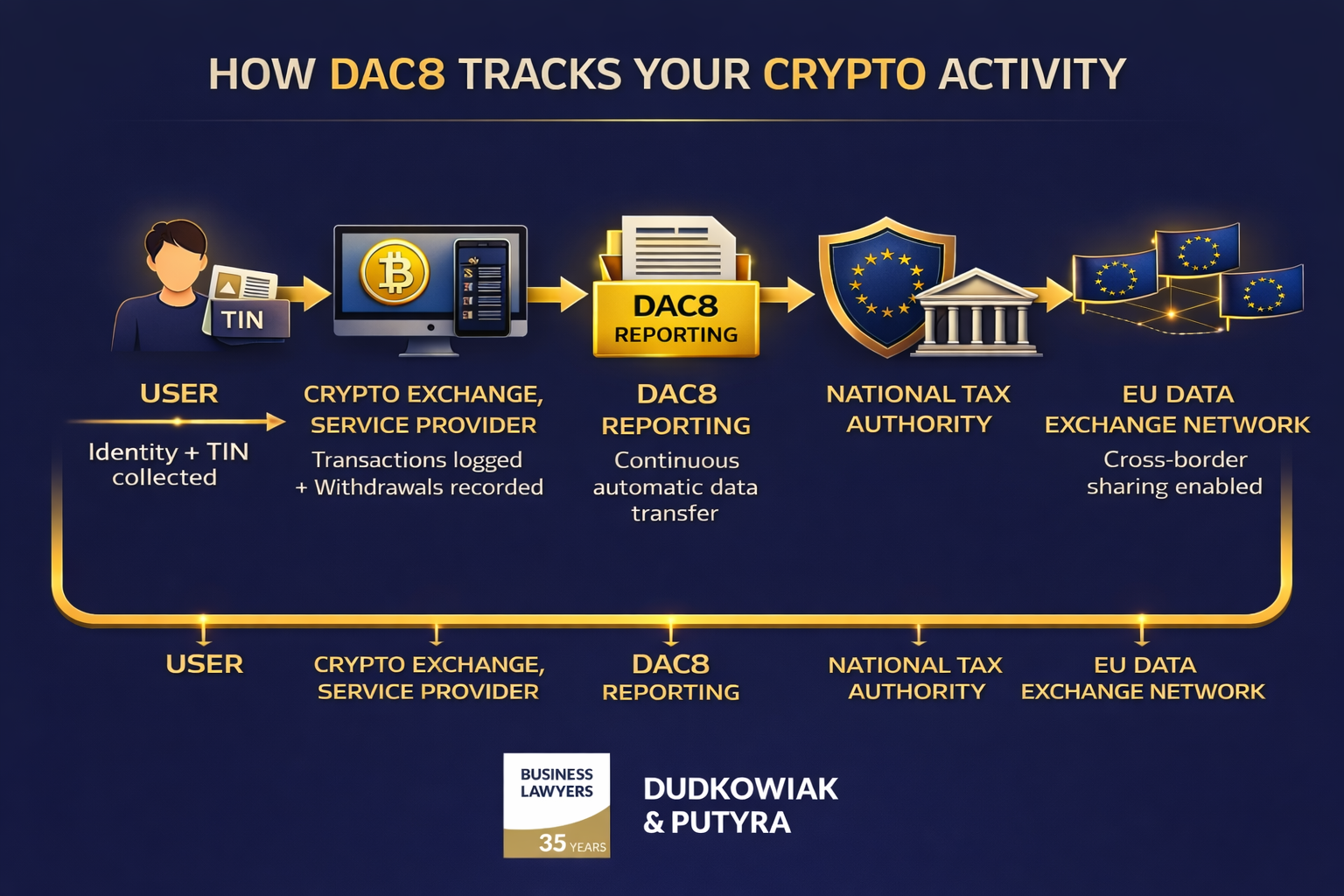
Crypto-to-crypto exchanges fall explicitly within that reporting framework.
Separately, the OECD's CARF framework — which covers EU states like France, Germany, and Austria — distinguishes crypto-to-crypto exchanges from crypto-to-fiat transactions and requires reporting on both sides of a trade.
“But it's on-chain. How would they know?”
The old assumption that crypto activity stays invisible no longer holds. For transactions handled by reporting CASPs, DAC8 builds a framework for collecting and sharing that data with tax authorities.
That doesn't mean regulators automatically get a full history of every wallet transaction you've ever made, but platforms do continuously collect user identification (name, address, Member State of residence, Tax Identification Number), along with records of crypto-to-fiat transactions, crypto-to-crypto trades, retail payments, and transfers to self-custody.
Platforms report this data to national authorities annually, and it's then shared automatically across the EU.
It's worth keeping three separate questions apart here.
- Taxability asks whether your country's tax law says you owe tax on the transaction.
- Reporting asks whether a service provider is required to report that transaction's information at all.
- Record keeping asks whether you personally can prove what you paid for the asset and what happened to it afterward.
These three don't always move together — a transaction can be reportable without being taxable, and being unable to prove your cost basis is a problem regardless of what the transaction's tax status turns out to be.
The real headache: Keeping track of swaps
Picture a chain like BTC → ETH → USDC → SOL → BTC over six months. If every disposal is taxable in your jurisdiction, you've potentially created several separate tax events, even though you never withdrew a single euro to your bank account.
That's why records matter more than most people expect. At minimum, track:
- Date and time
- Asset sold
- Amount
- Asset received
- Value at the time of the transaction
- Acquisition cost
- Transaction fees
- Wallet or exchange used
Don't wait until tax season to try to reconstruct six months of swaps from memory — by then, the exact values and timestamps are usually long gone. Exporting your transaction history as you go is the more reliable habit.
Clapp, for example, lets you pull your full transaction history from Statements in your profile in a format compatible with Koinly, CoinLedger, and CoinTracker, so the raw data is ready before you ever need to file.
What about swapping on a DEX?
Decentralized exchanges aren't reporting CASPs, and DAC8 doesn't apply to self-custodied DEX transactions in the same way. But that doesn't change the underlying tax question.
What matters, from a tax perspective, is often what happened economically — not whether you clicked "Swap" on a centralized exchange or interacted directly with a smart contract. If you disposed of one asset and acquired another, your country's tax rules may still apply regardless of where the trade took place.
How to stay on the safe side
- Know your tax residence. That's the starting point for everything else.
- Check the treatment of crypto-to-crypto exchanges specifically. A guide that only covers crypto-to-fiat sales won't answer the question you actually have.
- Keep records of every swap, especially acquisition cost and market value at the time of exchange.
- Track stablecoin transactions too. "It's basically cash" isn't necessarily how tax law sees it.
- Don't confuse exchange reporting with taxation. DAC8 changes transparency; it doesn't create one EU-wide capital-gains rule.
The biggest crypto tax myth
It's a mistake to assume nothing is taxable until you cash out to euros — that's only true in some countries, under some circumstances.
A BTC-to-ETH swap can be a taxable disposal in one Member State and fully tax-deferred in another. And from 2026 onward, the transaction can fall within the EU's new reporting framework regardless of whether it ends up creating any tax liability at all.
So don't just ask "did I cash out?" Ask two separate questions instead: did I dispose of a crypto asset under my country's tax rules, and is this transaction reportable? Those aren't the same question, and increasingly, you need an answer to both.
Frequently asked questions
Is swapping Bitcoin for Ethereum taxable in the EU?
There's no single EU-wide answer. It depends entirely on the tax rules of your Member State.
Is swapping Bitcoin for USDC taxable?
It can be. In jurisdictions that treat crypto-to-crypto exchanges as disposals, converting BTC into a stablecoin can still trigger a taxable gain.
Does DAC8 mean I'll automatically pay tax on every crypto swap?
No. DAC8 concerns reporting and information exchange. Whether a transaction is taxable remains a matter of domestic tax law.
Do I have to report crypto-to-crypto swaps if I didn't make a profit?
Reporting and taxation are separate questions. A transaction can be reportable even if it didn't result in a taxable gain.
Does using a DEX mean DAC8 doesn't apply?
Not necessarily. DAC8's reporting obligations focus on Reporting Crypto-Asset Service Providers, and whether it applies depends on the parties and services involved — it shouldn't be treated as a blanket exemption for every self-custodied transaction.
How can I know whether my swaps are taxable?
Start with your country of tax residence and its specific crypto tax rules. Keep complete transaction records regardless, since the tax treatment can hinge on the details of each individual swap.