Cold wallet vs custodial: At what portfolio size does it matter?

"Not your keys, not your coins" is the mantra for self-custody advocates, but offline storage isn't the answer for everyone.
If you have $100 in crypto, a $150 cold wallet doesn't make sense. If you have $100,000, leaving it all on an exchange starts to feel irresponsible.
Each option has real merits and real risks. The question worth answering isn't which one is better — it's when the trade-off actually starts to matter for you.
TL;DR
- Cold wallets give you full control and no platform risk, but you're solely responsible for your seed phrase. Lose it and your funds are gone for good.
- Custodial wallets give you convenience — password resets, customer support, recovery options — in exchange for trusting a third party.
- The right choice comes down to portfolio size and risk tolerance. Under $5,000, an exchange is generally fine. At $50,000+, cold storage should be the default.
- Human error is a bigger risk than exchange hacks for most people. Between 2.3 and 3.7 million Bitcoin are permanently lost due to lost keys or seed phrases.
- A hybrid approach works best for most people — the bulk of holdings in cold storage, a working balance on a reputable exchange for active trading
How wallets and custody options compare
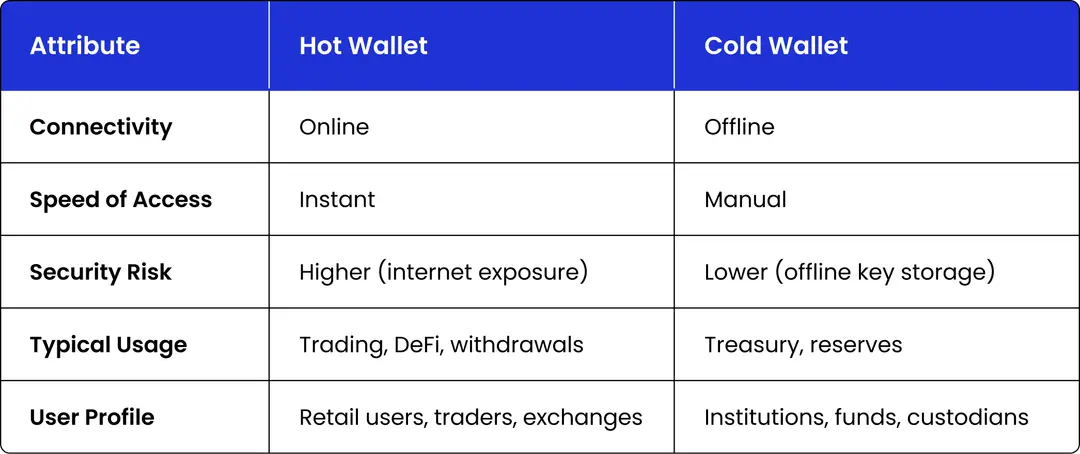
Cold wallets are the clearest form of self-custody, but "hot" wallets don't only exist on exchanges. The hot/cold split is really about internet connectivity and where your private keys are stored — custody is a separate question entirely, and the two get mixed up constantly.
- Hot wallets are software applications that store your private keys on your phone, computer, or browser, and only work while connected to the internet. Examples: MetaMask, Trust Wallet, exchange balances.
- Cold wallets are physical hardware devices that store your private keys completely offline. Examples: Ledger, Trezor.
Hot wallets are fast and convenient, which makes them ideal for daily trading, spending, or using DeFi apps — but that convenience comes with exposure to hacking, malware, and phishing.
Cold wallets solve that by staying offline entirely, which is exactly what makes them attractive for larger holdings. The trade-off is friction: you have to physically connect the device to sign every single transfer, which makes cold wallets impractical for anything you're using regularly.
Custodial vs self-custodial
A wallet where you hold the private keys — cold or hot — is self-custodial, meaning you have full control over your funds. That's different from a custodial wallet, where a third party like an exchange or lending platform controls your assets and typically limits transaction amounts until you complete ID verification.
This is why all cold wallets are self-custodial, but hot wallets can go either way. Keeping funds in Trust Wallet is self-custody. Leaving them on Binance hands control to the exchange.
So does cold storage actually beat keeping a balance on an exchange? It depends on which risk you're more willing to live with.
Comparing the actual risk
The exchange risk (custodial)
Leaving crypto on an exchange means trusting the platform. If it gets hacked, freezes withdrawals, or goes bankrupt, your funds could be stuck or gone.
In 2022, FTX users lost billions when the exchange collapsed. Funds were frozen for months, and many customers are still being repaid. Founder Sam-Bankman Fried was convicted of fraud and sentenced to 25 years in federal prison.
That said, exchange security has come a long way. Top-tier platforms now run institutional-grade infrastructure — 95–99.5% of assets held in cold storage, multi-party computation (MPC) wallets, and insurance funds to cover losses. Major CEXs also publish proof-of-reserves reports on a regular basis.
The self-custody risk (cold wallet)
Holding your own keys eliminates platform risk entirely — no exchange can freeze your funds or lose them in a breach. But you're trading platform risk for personal risk.
Lose your seed phrase, and there's no "forgot password" button. According to Chainalysis, between 2.3 and 3.7 million Bitcoin are permanently lost, most of it due to user error rather than exchange hacks.
Cold wallets aren't infallible either: The Coldcard case
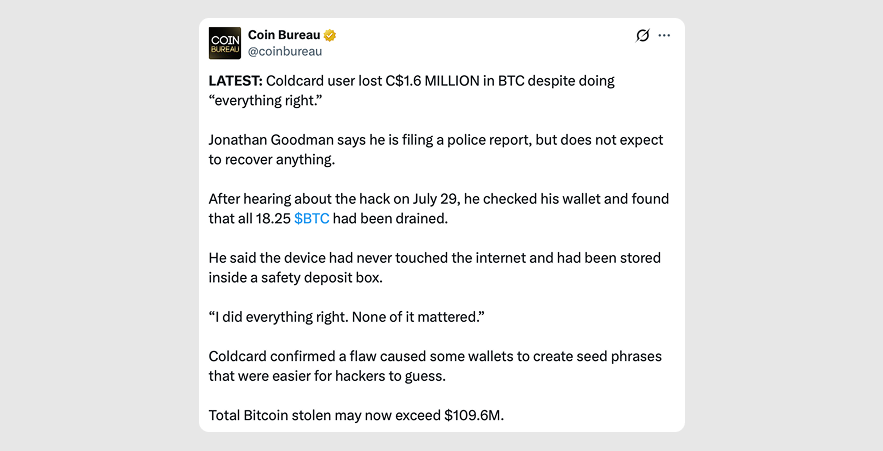
Cold wallet hacks are rarer than CEX or DEX breaches, but attackers are getting more sophisticated. In late July 2026, the Coldcard hack became the largest hardware wallet exploit of the year so far.
A years-old firmware bug had weakened key strength from 128 bits down to as little as 40 on some devices — meaning that when users thought they were generating a random key, that key was roughly three times more guessable than they realized. Attackers didn't even need physical access to exploit it.
Roughly 1,816 BTC, worth around $116 million, was drained from more than 5,200 addresses across four separate waves. The provider's software patch didn't fully fix the underlying problem — anyone who generated a seed on a Coldcard since March 2021 was still considered at risk and was urged to migrate to a new one.
At what portfolio size does it matter?
There's no single number that works for everyone, but here are a few rules of thumb.
- Consider a cold wallet when your crypto holdings exceed the cost of the device. A hardware wallet typically costs $50–$150. If you have $500–$1,000 in crypto, the security investment starts to make sense. Below that, a reputable exchange or a free software wallet is a reasonable choice.
- Move to cold storage when you're holding assets you don't plan to trade. If you're not touching your crypto for months or years, there's no reason to leave it on an exchange. The risk of platform failure, account freezes, or hacks is unnecessary when you don't need quick access.
- If you're an active trader, keep working funds on an exchange or hot wallet. Convenience matters when you're moving funds regularly. Just keep your long-term holdings separate.
For many people, the switch becomes obvious somewhere between $500 and $5,000. That's when the cost of the device feels negligible compared to what you're protecting. Below that, a free software wallet or a reputable exchange is fine. Above that, the security benefit starts to outweigh the inconvenience.
The real question is about your time horizon. If you're holding long-term, move to cold storage regardless of the amount. If you're trading actively, keep funds accessible. The amount matters, but the purpose matters more.
The human error factor
This is the part that's easy to overlook — most people brace for hackers and forget to brace for themselves.
Your seed/ recovery phrase is a single point of failure. It needs to be stored offline, kept in more than one secure location, and never shared with anyone. Most catastrophic self-custody losses don't come from a sophisticated attack — they trace back to a seed phrase that was lost, damaged, or exposed.
The practical fix is to start small. Experiment with $100–500 in self-custody before moving anything significant over. Learn how it actually works before you trust your life savings to a hardware wallet.
Cold wallet basics
A hardware wallet is a physical device that generates and stores private keys inside a secure element on the device itself. The keys never leave it. Even if your computer is compromised, an attacker can't extract your keys or alter transaction details without physically holding the device.
What to look for
- A secure element chip — prevents key extraction even with physical access to the device
- On-device transaction display — lets you verify the recipient and amount before confirming
- Open-source firmware — allows independent security researchers to audit the code
- Direct manufacturer purchase — avoids the risk of a tampered device from a third-party reseller
What it costs
Hardware wallets typically run $50 to $250.
The hybrid approach: The middle ground
Most experienced holders don't pick one option and stick with it exclusively — they use both, deliberately.
The logic is that different funds have different jobs. Money you might need to move or trade on short notice belongs somewhere fast and liquid. Money you intend to hold long-term belongs in cold storage, out of reach of both hackers and your own impulses.
A common split is roughly 70% in cold self-custody and 30% on a platform or in a hot wallet for active trading.
Take Sarah, who holds $100,000: she keeps $80,000 in cold storage and $20,000 on an exchange for trading. If that exchange gets hacked, her core holdings are untouched — she's balanced security against accessibility instead of maximizing one at the expense of the other.
You can keep a custodial balance for active trading and savings while moving long-term holdings into cold storage. The two approaches aren't in competition — they're built to complement each other.
Bottom line: No hard rule
The portfolio size where self-custody becomes worth the hassle depends on your own risk tolerance and technical comfort.
Under $5,000, an exchange is generally fine. Over $50,000, cold storage should be your default. Between those two points, a hybrid approach makes sense.
Self-custody removes counterparty risk and replaces it with personal responsibility — neither is strictly the correct answer for everyone. A beginner with a small balance can reasonably start on a reputable exchange while learning the ropes. A long-term holder with meaningful sums has a strong case for moving to cold self-custody.
The goal is matching the method to the amount, the time horizon, and how much responsibility you're actually comfortable carrying — and making that choice on purpose, rather than by default.
Frequently asked questions
1. At what portfolio size should I get a hardware wallet?
There's no single number. A common rule of thumb is when the cost of the device (usually $50–$150) feels negligible compared to what you're protecting. For some, that's $500. For others, it's $5,000. The more important question is your time horizon — if you're holding long-term, cold storage makes sense regardless of the amount.
2. Is a cold wallet 100% safe?
No. Cold wallets eliminate platform risk, but they introduce personal responsibility. Lose your seed phrase and your funds are gone forever. Hardware wallets can also have firmware vulnerabilities — the Coldcard hack in July 2026 drained over $116 million from thousands of wallets. No solution is perfect. Choose the risk you're more comfortable managing
3. Is it safe to keep crypto on an exchange long-term?
Exchanges are more secure than they used to be — top-tier platforms keep 95-99.5% of assets in cold storage. But if you're not touching your crypto for months or years, leaving it on an exchange means accepting platform risk for zero benefit. Move long-term holdings to cold storage.
4. Is it worth moving crypto to a cold wallet for small amounts?
If you have $100 in crypto, a $100 hardware wallet doesn't make sense. The cost outweighs the benefit. For smaller balances, a reputable exchange or a free software wallet is a reasonable choice. The threshold is personal, but the device cost relative to your holdings is a useful guide.
5. What's the difference between a hot wallet and a cold wallet?
A hot wallet is connected to the internet — convenient for frequent use, but more vulnerable to attacks. A cold wallet stores keys completely offline, significantly reducing hacking risk, but is less convenient for daily transactions. The choice depends on how you use your crypto.
6. What's the hybrid approach?
Most experienced holders don't choose one or the other exclusively. They keep the bulk of their holdings in cold storage for long-term security and a smaller balance on an exchange or hot wallet for active trading. Different funds have different jobs — match the method to the purpose.