Bitcoin's four-year cycle is changing — but is it dead?

Bitcoin has long been associated with a market cycle centered around its scheduled halving events. For more than a decade, this pattern has shaped investor expectations, trading strategies, and market narratives. But recent market behavior, however, has led many to question whether it is beginning to break down.
Anatomy of Bitcoin's four-year cycle
This theory suggests that a standard cycle starts with an accumulation phase and ends with a crash after reaching a peak. Each cycle's defining moment is the Bitcoin halving, a quadrennial event that is crucial to the coin's supply mechanics and scarcity.
Every 210,000 blocks, roughly every four years, a halving slashes the mining reward paid for adding a new block to the blockchain by 50%. Since 2009, that reward has shrunk from 50 BTC to 3.125 BTC. This process is expected to continue until Bitcoin reaches its maximum supply of 21 million coins around the year 2140.
Through halvings, Bitcoin creator Satoshi Nakamoto embedded a scarcity mechanism that underpins Bitcoin's "store of value" proposition. Like gold, Bitcoin becomes progressively harder to produce over time. Gold production slows as high-quality deposits become scarcer, while halvings shrink Bitcoin's new supply.
Historically, each halving has been followed by a strong Bitcoin bull market, reinforcing the idea that shrinking supply supports higher prices over time.
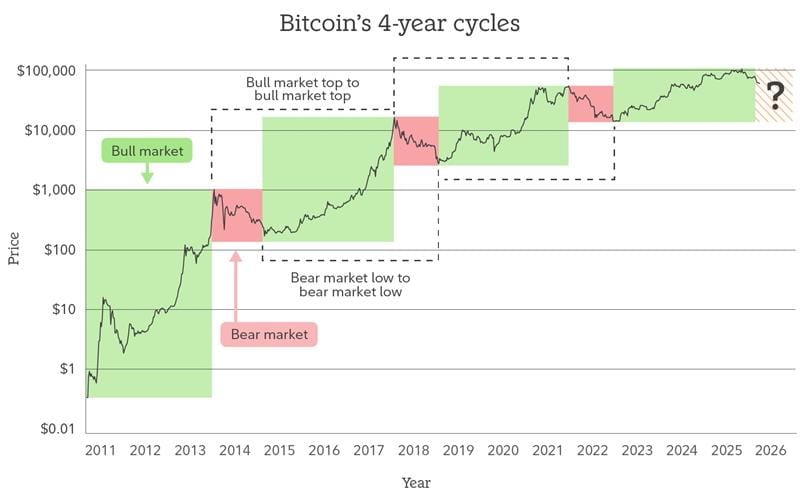
How a typical cycle unfolds
Accumulation (1–1.5 years)
Following a price crash, long-term investors begin buying more BTC at a perceived discount. Modest volatility and on-chain activity accompany neutral to negative sentiment. Gradually, the price begins to recover.
New bull market (1–1.5 years)
Traders anticipate the next Bitcoin halving, which will decrease future supply. As sentiment evolves from neutral to optimistic, liquidity returns, media coverage picks up, and prices climb further.
Historically, post-halving months have often marked the most explosive phase of the bull market, with price gains accelerating as new capital enters the ecosystem. The retail crowd, wary during the accumulation phase, begins pouring money into the market. New all-time highs prompt high-risk investors to boost leverage in pursuit of further gains.
Bear market (about 1 year)
Amid a dramatic market correction, leverage is flushed out, and many participants capitulate, locking in losses to preserve what capital they can. Sentiment flips negative, altcoin prices sink, and eventually a market bottom forms. Meanwhile, development continues in the background as innovation quietly marches forward.
What drives Bitcoin cycles?
No single factor explains Bitcoin's recurring market cycles. Instead, they are generally viewed as the product of three forces working together: programmed scarcity, investor psychology, and broader liquidity conditions.
Scarcity mechanism
The ratio between an asset's existing supply and annual new supply defines its scarcity. Known as the Stock-to-Flow (S2F) ratio, this model applies to traditional commodities like gold and silver. It also works for Bitcoin, which has a hard-coded limit of 21 million coins (fixed total supply) and mining rewards distributed on a fixed schedule.
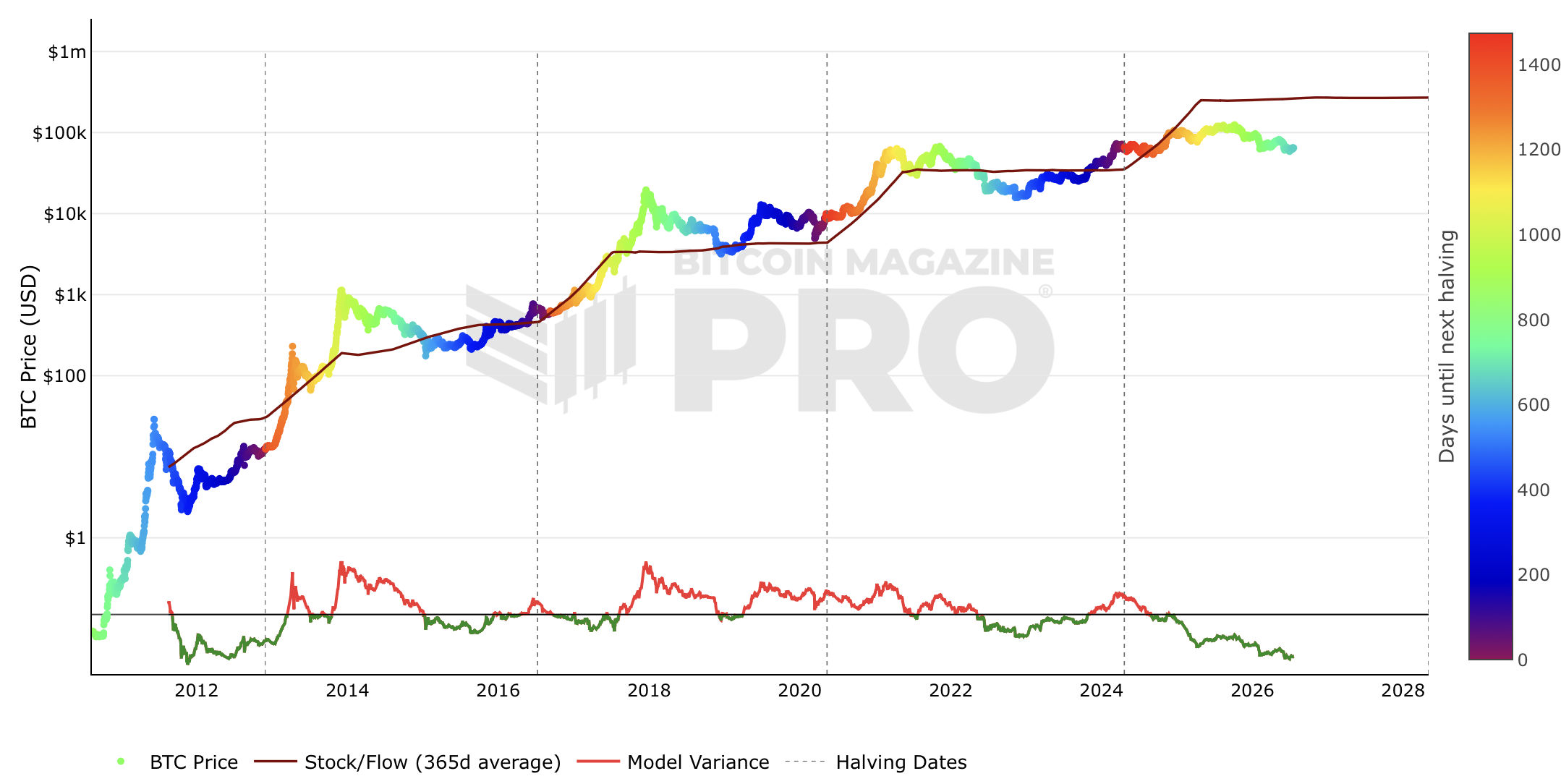
Every halving roughly doubles Bitcoin's S2F ratio by cutting the rate of new issuance in half. The current ratio of approximately 116 is roughly twice that of gold, making Bitcoin significantly more scarce under this model.
In theory, if demand remains constant while new supply keeps shrinking, prices should gradually rise. It is because of this digital scarcity that Bitcoin is often called "digital gold" and used as a hedge against inflation in traditional financial markets.
Expectations and herd behavior
Unlike commodities such as gold, Bitcoin derives much of its value from market expectations about its future utility and scarcity. This explains its heightened sensitivity to factors like halving anticipation, narratives, and rumors.
Bitcoin's post-halving rallies have become something of a self-fulfilling prophecy: as the cycle has repeated itself multiple times, investors are more likely to trade BTC according to that historical playbook. This is a classic example of herd behavior.
Broader liquidity trends
Some market observers also link Bitcoin's performance to changes in global liquidity, money supply, and Federal Reserve policy. US dollar liquidity and monetary conditions in major economies — particularly China — are thought to have a particularly strong impact. For instance, BitMEX founder Arthur Hayes links Bitcoin's three major bull-market peaks to traditional finance drivers:
- In 2013, BTC officially crossed the $1,000 threshold for the first time ($1,156), fueled by money printing after the 2008 financial crisis.
- In 2017, BTC surged to nearly $20,000 as the Japanese yen devalued against the dollar.
- In 2021, BTC soared to an all-time high of $67,549 amid post-COVID money printing.
Not all analysts agree with Hayes' interpretation, however. His explanation for the 2017 rally remains particularly controversial. While Bitcoin did rise almost 19x that year — from about $1,000 to nearly $19,800 — the surge was mainly driven by speculative demand, growing public interest, the ICO boom, and growing adoption. Meanwhile, the yen experienced only a modest devaluation, incomparable to Bitcoin's surge.
The Fed factor
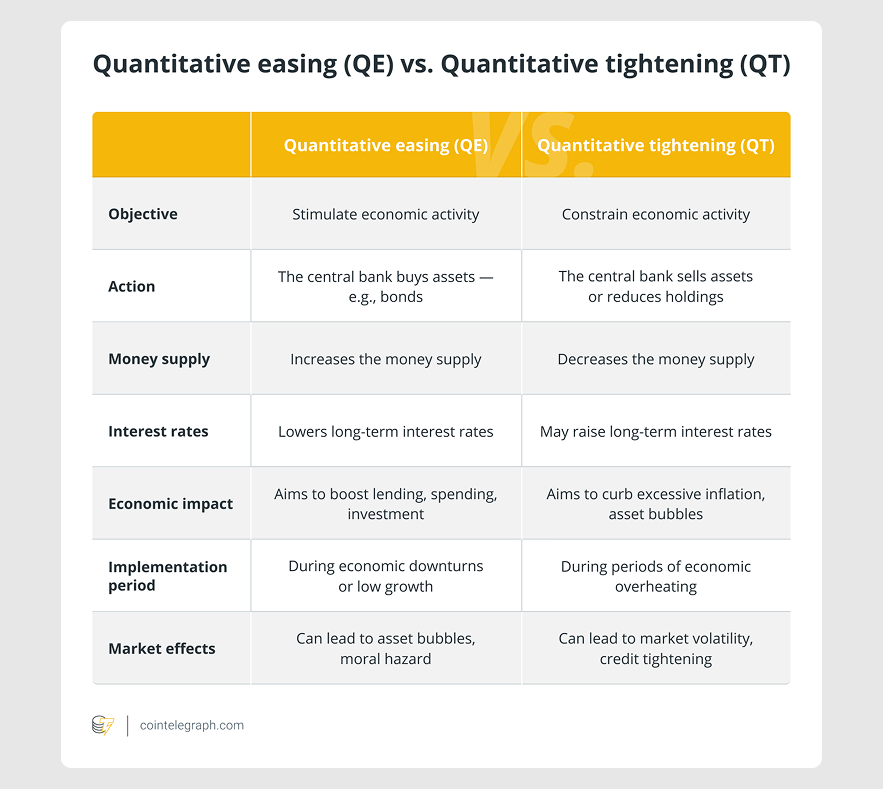
The Federal Reserve implements a range of policies to manage liquidity. The following measures support risk assets by injecting liquidity:
- Quantitative easing (QE) — buying longer-term Treasury securities and mortgage-backed securities to inject liquidity into the financial system.
- Lowering the federal funds rate — as banks charge each other less for overnight loans, the cost of borrowing for consumers and businesses falls, stimulating economic activity.
Other measures aim to curb inflation by restricting liquidity, reducing the amount of capital available for risk assets:
- Quantitative tightening (QT) — reducing the number of assets held on the Fed's balance sheet.
- Raising the federal funds rate — making borrowing more expensive for consumers and businesses.
Bitcoin's correlation with equities turned positive in 2020, partly due to institutional adoption, portfolio integration, and the advent of spot Bitcoin ETFs. This has led some commentators to argue that future Bitcoin cycles may diverge from the historical four-year pattern.
What is changing the Bitcoin cycle?
Today, it is increasingly common to hear that Bitcoin's four-year cycle is no longer relevant. The main argument is the rapid institutionalization of the market through spot Bitcoin ETFs, corporate treasury companies, pension funds, hedge funds, and other large investors.
- A more stable holder base. Unlike retail traders, institutions typically allocate capital on fixed schedules, use leverage more conservatively, and follow disciplined risk-management strategies. As a result, their growing presence may gradually dampen volatility, making the traditional boom-and-bust cycle less pronounced.
- Bitcoin has also matured considerably, evolving from a niche speculative asset into an increasingly institutional financial asset. Macroeconomic forces — including Federal Reserve policy, global liquidity conditions, and geopolitical shocks — now exert a much greater influence on price action than they did during previous cycles.
- Macroeconomic forces matter more than ever. While halvings still occur every four years, central bank decisions (e.g., interest-rate decisions and fiscal stimulus) and global risk sentiment follow no such schedule, making Bitcoin increasingly responsive to external forces.
- Each successive halving delivers a smaller absolute supply shock. The first halving reduced the block reward from 50 BTC to 25 BTC, while the most recent cut it from 6.25 BTC to 3.125 BTC. Although the percentage reduction remains the same, the number of newly issued coins removed from circulation becomes progressively smaller with each cycle.
So, are the four-year cycles over?
Taken together, these changes suggest that Bitcoin is evolving from a niche, retail-driven asset into a more mature financial instrument. The four-year cycle may not be disappearing — it may simply be becoming less dominant.
That view has become increasingly common among institutional researchers. Fidelity Digital Assets, for example, argues that Bitcoin's growing integration into traditional finance — through spot ETFs, corporate treasuries, and broader regulatory acceptance — is likely to make future market cycles less pronounced than in Bitcoin's early years.
At the same time, Fidelity cautions that it is too early to declare the four-year cycle dead. Bitcoin's sharp correction following its 2025 all-time high shows that boom-and-bust dynamics remain part of the market, even if they are becoming less predictable.
Many analysts argue it is premature to declare the four-year cycle dead. Halvings still reduce the pace of new Bitcoin issuance, and supply shocks continue to interact with investor psychology and liquidity conditions. Rather than disappearing altogether, the cycle may simply be becoming less predictable as Bitcoin matures.