Clapp Weekly: CPI drags BTC to $72.8K, Grayscale’s Zcash bet, ETH as store of value

BTC price
Bitcoin plunged to $72,839 on Tuesday, its lowest level since August 20, after a hotter-than-expected US inflation report. Fading institutional demand added to the pressure: US-listed spot Bitcoin ETFs recorded four straight days of outflows, totaling over $1.1 billion.
A highly leveraged derivatives market, flagged by K33 Research, raises the risk of sharp moves in either direction. Nearly $200 million worth of futures positions was liquidated in the past 24 hours, mostly longs ($168.35 million).
BTC rose toward $80.5k on November 4 but sank below $76k the next day and stayed in a narrow range under that mark until Sunday, when the slide resumed. The price dropped below $74k, bounced slightly, then hit a low of $72,839.90 yesterday before reversing again.
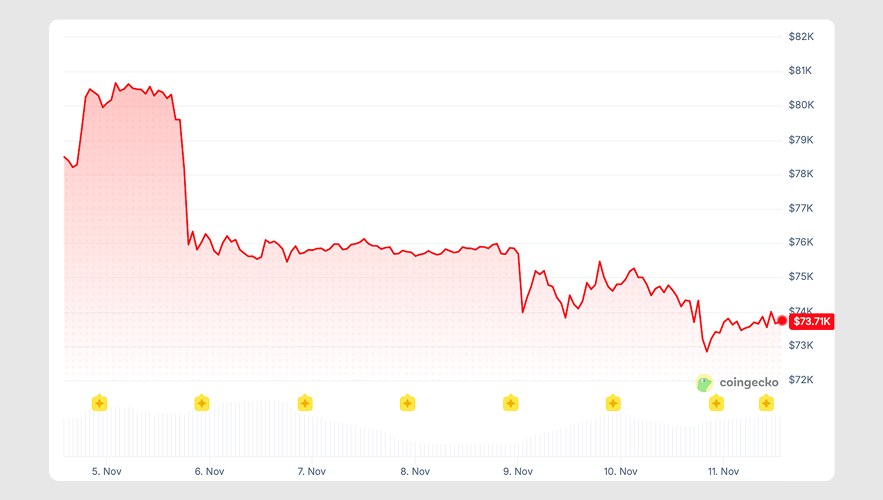
At press time, BTC is trading at $73,627.00, down 1.0% over 24 hours and 5.6% over the week.
ETH price
Ether is hovering around the $2k mark, pressured by shifting expectations for US monetary policy, declining risk appetite across the board, and institutional capital outflows. Spot ETFs have bled capital continuously since October 26, with November 4 the only exception (+$53.02M). The drop pushed 24-hour liquidations to $254 million, driven by $186.54 million in longs.
Last Saturday, Bitmine reported holding 6,070,092 ETH, or 4.97% of all ETH, after buying 9,587 ETH more. A day later, Vitalik Buterin announced a strategic shift from “ETH as fee-burning token” to “ETH as store of value” (more below).
ETH held $2.4k for just two days, then plunged toward $2.2k on November 6 and moved sideways there until Monday. It then sank to nearly $2k and struggled to recover, and yesterday’s attempt faded with a drop to $2,016.83 and a weak rebound.
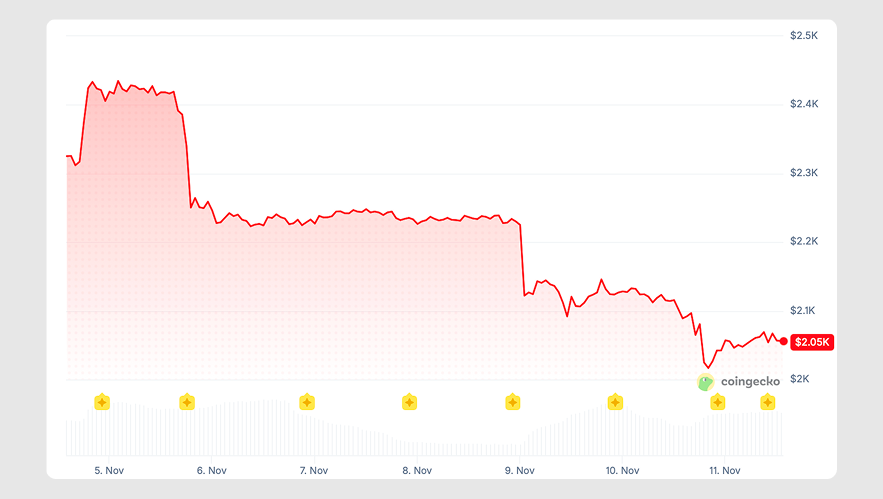
Currently, ETH is trading at $2,052.20, down 2.3% over the past 24 hours and 10.6% over the past 7 days.
Seven-day market dynamics
A brief crypto rally around November 4 reversed when Bitcoin began to sink, dragging most altcoins down. Large investors also pulled money out of crypto, and XRP fell harder than the other majors. Sentiment slid deeper into Fear at 29/100, a sharp change from last week’s Neutral reading of 50/100.
AI cryptocurrencies saw sharp volatility and sell-offs after news of an espionage-linked scandal involving Nvidia CEO Jensen Huang. According to CoinGecko, the sector shed 7.2% over the past week, while Nvidia stock erased all of its 2026 gains and was down 11.3% year to date at press time.
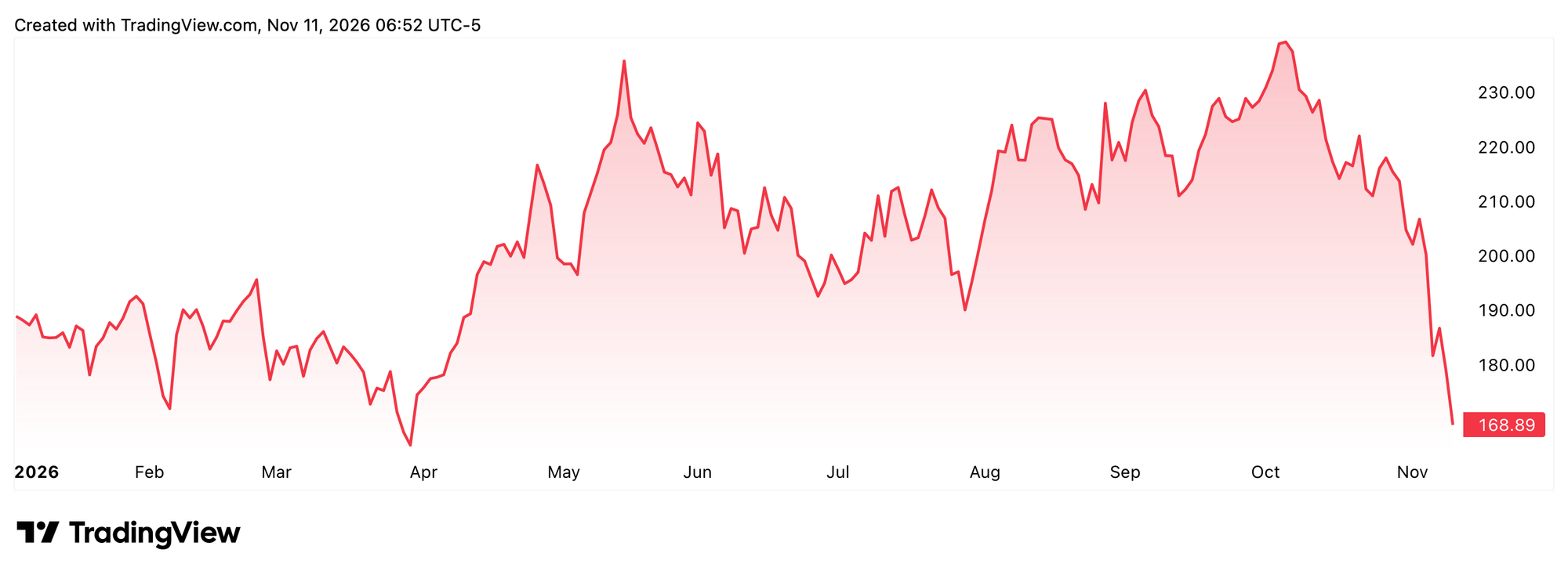
Nvidia is the sector’s main bellwether, so investors in decentralized AI networks and onchain derivatives reacted immediately to the governance and geopolitical risks now hanging over the chipmaker.
Inflation heats up, shakes markets
A hotter-than-expected October US CPI (Consumer Price Index) report sent crypto prices lower Tuesday. The index rose 0.4%, above the forecast 0.3%, while core CPI, which excludes food and energy costs, grew 0.3% against expectations of 0.2%. The year-over-year rate wasn’t released because there was no October 2025 report due to the government shutdown at the time.
Traders moved to price in more aggressive Fed rate hikes. Stocks initially shrugged off the disappointing numbers but have since turned lower.
Inflation edged down a bit in October after September’s high reading, but it still beat forecasts and remains well above the Federal Reserve’s 2% target. The print raised concerns about the rate outlook. A December hike appears locked in, with nearly 87% of traders expecting a 25-basis-point rise. Fed Governor Chris Waller, however, suggested a 50-basis-point move might be appropriate, adding that a smaller increase could put the Fed’s credibility at risk.
Hotter CPI figures are weighing on risk appetite, while expectations of further tightening are supporting the US dollar (USD) and US Treasuries. The 10-year Treasury yield is sharply higher, hovering around 5%, up from 4.82% on November 6. The more Fed-sensitive 2-year yield has returned to 4.74% for the first time since October 28.
Oil pressure eases
Oil offered some relief for markets. Brent dipped below $100 on November 5 and fell to roughly $89 yesterday, its lowest since August, before rebounding. At press time, the January contract is trading at $91.91, while WTI has plunged to $86.22. The decline followed President Trump’s claim that the Iran war is “effectively over” and that Israel and Gulf allies are well protected from Iran. Speaking at a White House briefing, he said:
“At this point, taking the military action doesn’t seem to be a very necessary thing – but we’re locked and loaded, ready to go for any reason.”
Top weekly winners
- BTW (+23.2%) reversed its decline on November 10, soaring above $1.25. There was no project news aside from the distribution of tokenized Nvidia stocks, announced November 8. The price had previously fallen roughly 12%-13% around November 9-10, following a wider crypto sell-off.
- INJ (+16.4%) soared after Canary Capital launched INJC, the first US spot-style ETF for INJ with built-in staking. The fund aims to stake at least 90% of holdings under normal circumstances, giving institutions, banks and brokerages exposure through standard portfolios.
- ETHFI (+13.4%) gained without major project-specific news, aside from refunding of bank deposit fees for select customers. Analysts link the rise to altcoin sector rotation, momentum spilling into AI- and DeFi-themed tokens, and short liquidations.
Top weekly losers
- RAIN (-34.9%) tumbled through the week, extending its multi-month bearish trend amid the broader sell-off.
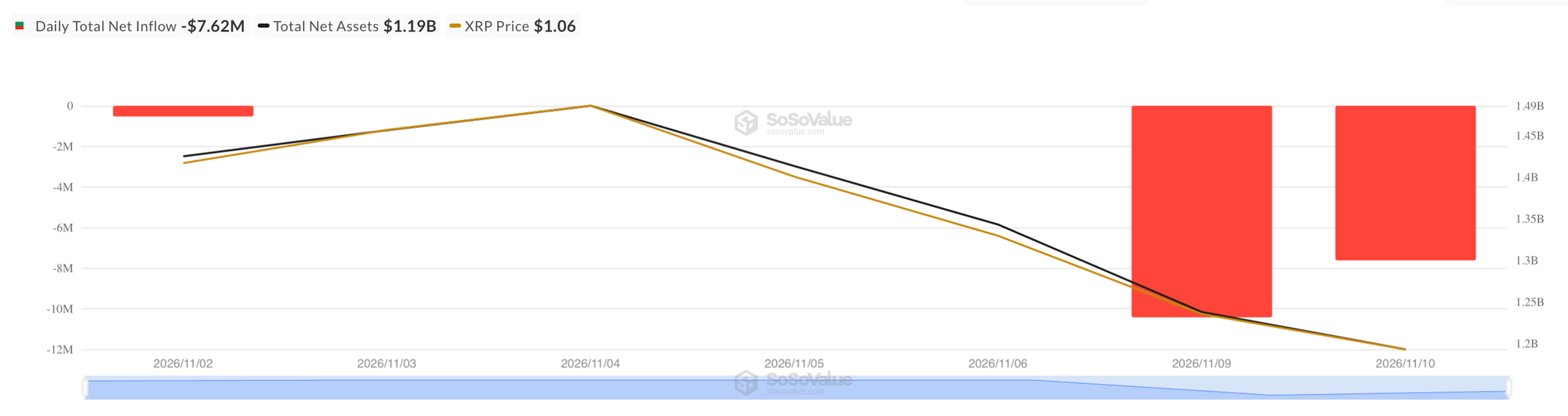
- XRP (-16.3%) sank as ETFs stalled, with zero net inflows from November 3 to 6, so there was no fresh buying to lift the price. The funds then lost $18 million over the next two days, cutting off one of XRP’s few regular sources of demand.
- WLD (-15.4%) is facing heavy whale selling and exchange deposits, along with a continuing technical downtrend since late October. Trading flows and liquidity were also affected by the Binance hack. The exchange re-enabled withdrawals for WLD on November 6.
Cryptocurrency news
Grayscale is betting $1 million on Zcash, even as the price slides
Asset manager Grayscale announced Tuesday it will direct $1 million to nonprofits and initiatives supporting the Zcash ecosystem. The first $400,000 has already been awarded in four equal grants of $100,000 each: the Zcash Foundation, policy group Pretty Good Policy for Zcash, Swiss-based Shielded Labs, and Project Tachyon, a scaling effort led by one of Zcash’s co-founders.
The funding comes from fees on The Zcash ETF (ZCSH). Grayscale says it intends to r it collects for up to the fund’s first year into Zcash development, marketing, and education. The commitment is voluntary, paid from Grayscale’s own funds, and can be changed or ended at any time.
The marketing blitz
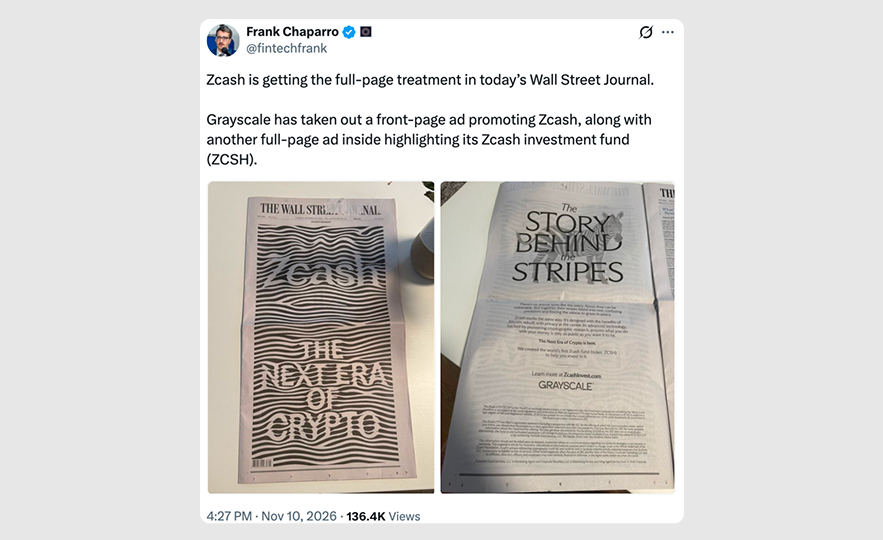
“We believe Zcash will help define the next era of crypto,” said Steve Vanourny, Grayscale’s head of index. The company isn’t stopping at grants. It launched Zcash Invest, an educational platform, alongside a national ad campaign called "Zcash: The Next Era of Crypto." The campaign kicked off Tuesday with a Wall Street Journal wrap, a full front-page takeover featuring a zebra motif drawn from the Zcash community.
Ads will run across print, outdoor, digital, streaming, and social channels. The messaging leans on a simple thesis: as more economic activity moves onchain and AI makes analysis easier, financial privacy becomes essential.
Ads will run across print, outdoor, digital, streaming, and social channels. The messaging leans on a simple thesis: as more economic activity moves onchain and AI makes analysis easier, financial privacy becomes essential.
The awkward timing
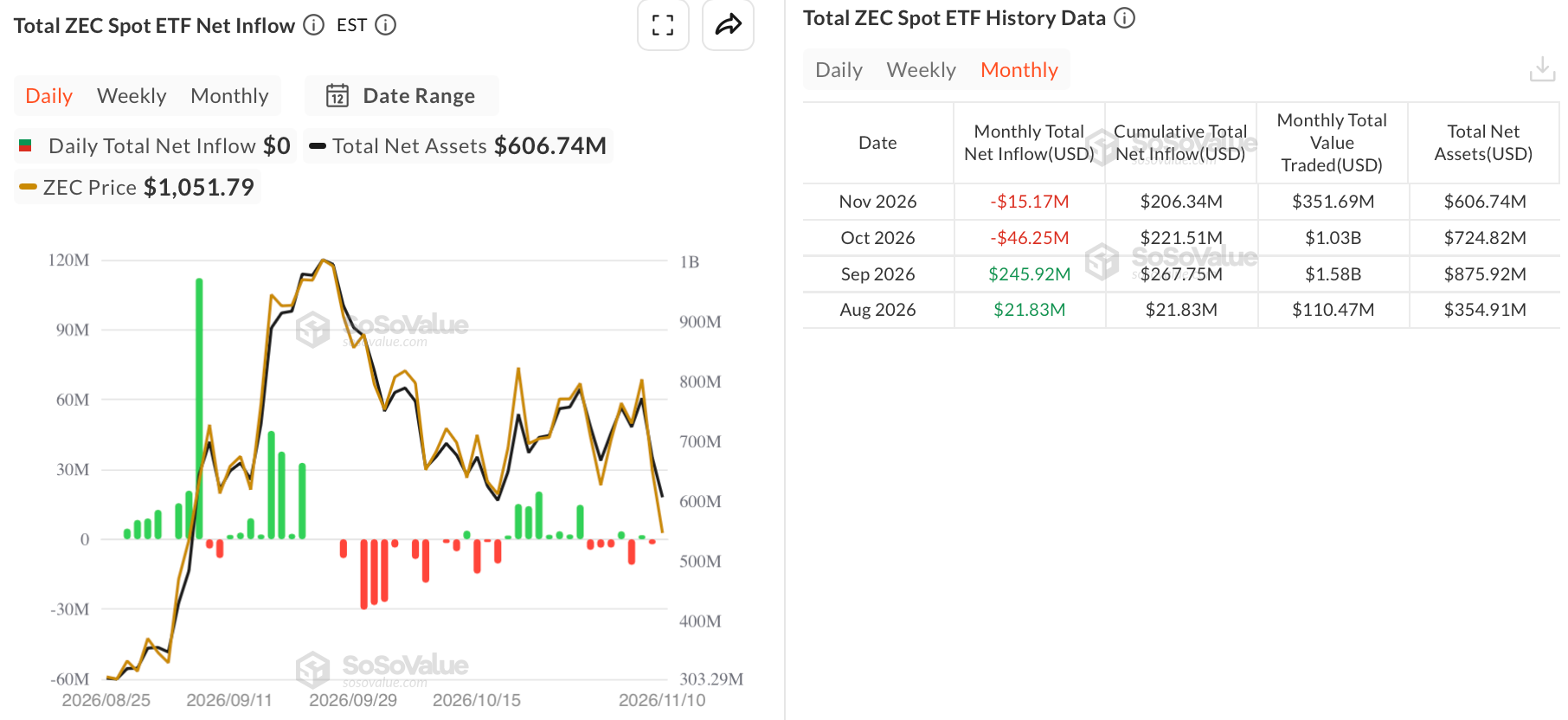
The campaign lands during a rough stretch. ZEC has fallen 13.7% over 24 hours to about $988. It’s down roughly 23% over 30 days and well off its October highs above $1,500, though still up about 103% from a year ago.
The ETF itself is bleeding. ZCSH has seen more than $15 million in net outflows so far in November, following $46.25 million in October. Shares are down around 12% to $27.25. Perpetual futures open interest sits at about $2.3 billion, a leverage build-up that has burned Zcash before.
The bigger picture
For now, Grayscale is spending money to educate the market about a coin that’s falling, but its push is a long-term bet on privacy as a category. The Zcash ETF listed in August, after a critical flaw in the network’s shielded pool sent ZEC down 50% in the spring. A fix arrived in July. The fund later split its shares to make them more accessible.
Competition is also coming. The Winklevoss twins have a Zcash ETF in the works, and Europe already has its first Zcash ETP.
Vitalik just rewrote Ethereum's pitch. Will the market buy it?
For years, the Ethereum faithful had a rallying cry: ultrasound money. The idea was simple: as network usage grew, fees would burn more ETH, supply would shrink, and price would follow. Vitalik Buterin just told them to stop believing it.
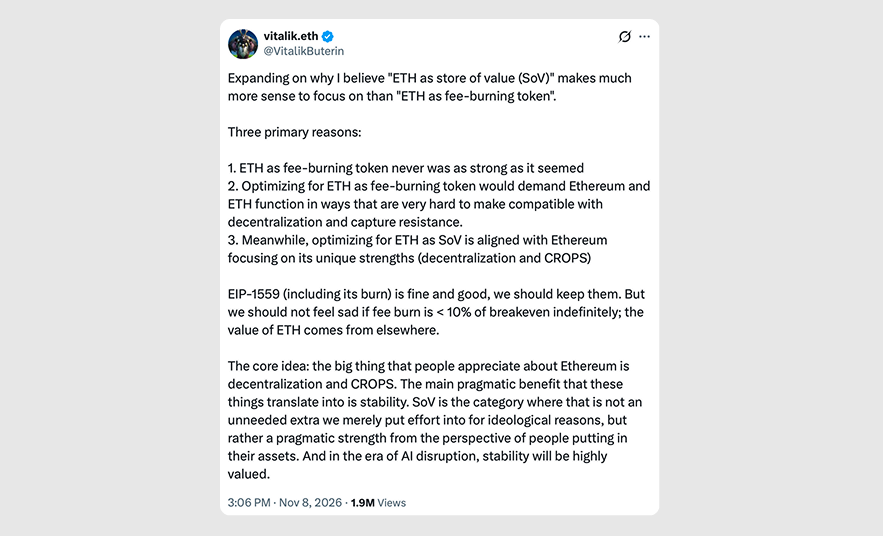
In a thread posted Sunday, Buterin argued that ETH should be framed as a store of value rather than a token whose price is supposedly underpinned by transaction fees being destroyed. The “ultrasound money” narrative became gospel during the 2021 bull run, when EIP-1559 began incinerating a slice of every transaction.
For years, the Ethereum faithful had a rallying cry: ultrasound money. The idea was simple — as network usage grew, fees would burn more ETH, supply would shrink, and price would follow. Vitalik Buterin just told them to stop believing it.
Buterin's verdict: it was always weaker than advertised
The burns that drove the narrative mostly came from activity inside crypto itself, he explained: lending loops, trading churn, and one memorable day when a digital land sale torched roughly $180 million in fees. None of that was external demand. When prices fall, that activity evaporates with it.
His own numbers make the case. Ethereum destroyed about 1.48 million ETH in 2022. This year, the figure sits near 19,200, a rounding error by comparison. Rollups siphoned activity off the mainnet, and settlement there costs users almost nothing.
So what replaces it?
Stability, in Buterin’s telling. Decentralization, resistance to censorship, and security, qualities he says will matter more as AI reshapes the threat landscape.
He’s also candid about the tradeoff. Engineering ETH to burn more fees would mean engineering Ethereum to be congested and expensive. That’s the behavior of a profit-maximizing company, not neutral infrastructure. “In the era of AI disruption, stability will be highly valued,” he wrote.
The reception
Allies are already building the new narrative. Ethlabs’ Binji Pande calls ETH a more future-proof store of value than Bitcoin, pointing to quantum preparedness and eleven years of market history. Julian Ma argues Ethereum’s security culture makes it a programmable store of value as AI pressures cryptography.
Skeptics note the obvious: store of value is Bitcoin’s turf, and BTC holds it with a hard cap, deeper institutional plumbing, and a corporate treasury bid Ethereum is only beginning to assemble. Zcash is also muscling into the privacy-focused store-of-value niche.
Enso’s Connor Howe agreed with Buterin but added a jab: the Ethereum Foundation “needs to start to actually listen” to builders on its network. “I think it took too long to say it.”