Clapp Weekly: Midterm whipsaw, Binance hack, DTCC puts $30 trillion onchain

BTC price
Bitcoin is recovering from a dip to $76.2k, though ETF outflows, uncertainty over what the midterm results mean for crypto, and the fallout from the Binance hack are still weighing on the market. US spot Bitcoin ETFs shed $399 million on Monday, their second straight day of outflows. BlackRock’s IBIT alone saw its largest daily outflow since June, at $405 million.
The withdrawals fit a wider cooling in institutional demand: October ended with $515.03 million in net outflows, snapping a three-month run of positive monthly inflows. A sustained recovery will depend partly on that demand coming back.
BTC climbed to nearly $81.7k on October 29, then dropped to $76.6k the next day and couldn’t hold above $78.5k. It crept back over the weekend and touched $78,556.55 on Monday before slipping again, then bounced from around $76.2k.
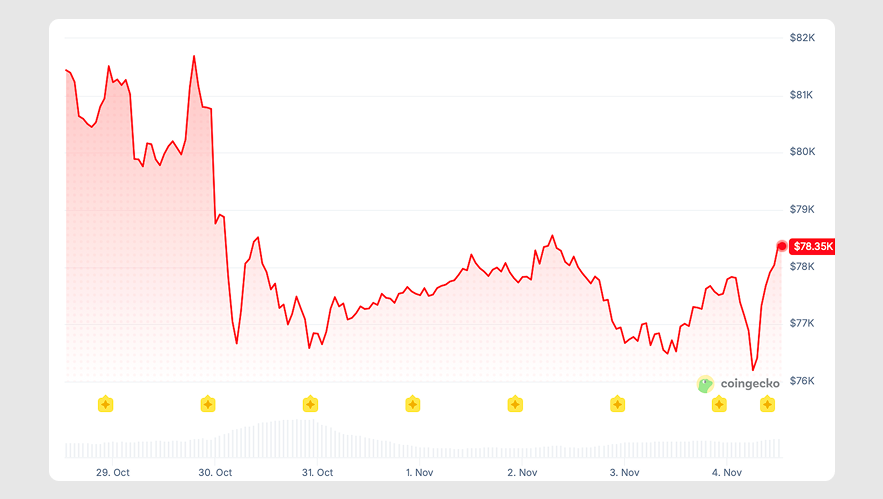
At the time of writing, BTC trades at $78,350.66, up 2.5% in 24 hours but down 3.4% on the week.
ETH price
Ether is trading below $2.3k after another recovery attempt failed to gain traction following its October 30 drop to around $2.2k. On Monday, spot Ethereum ETFs recorded their sixth consecutive day of outflows, losing $139.80 million. The funds shed a combined $1.61 billion in October.
Nearly 559,000 ETH left exchanges between October 28 and November 2, and more than half of that came right after the Binance incident, which drained approximately 200,630 ETH. BitMine bought another 5,000 ETH, putting it roughly 99% of the way to its goal of holding 5% of all circulating ETH.
The price followed Bitcoin lower during the Binance sell-off, sliding from around $2.3k to below $2.2k on October 30. It recovered through Monday and briefly pushed above $2.3k before pulling back. After another failed attempt to extend the gains, ETH rebounded from $2,246.
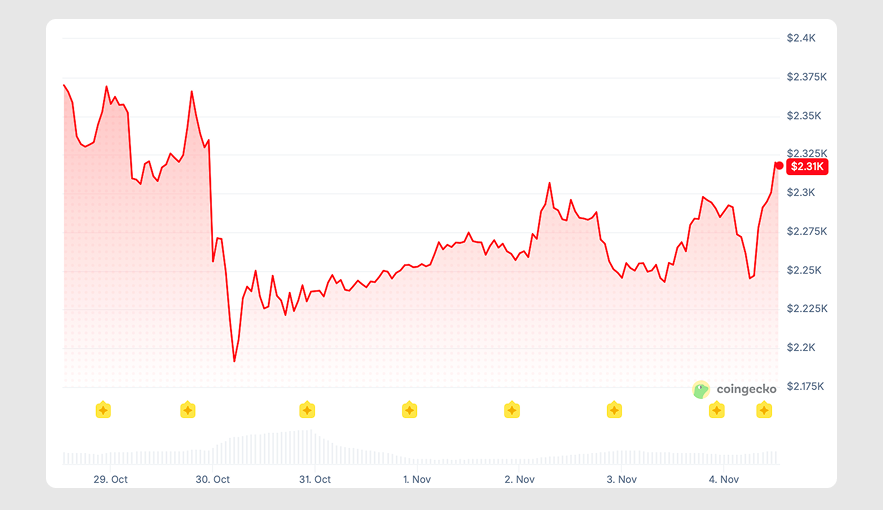
At the time of writing, ETH trades at $2,319.37, up 2.9% in 24 hours but down 2.1% over seven days.
Seven-day market dynamics
The $6.39 billion Binance hack pushed the Fear & Greed Index back into Fear territory on October 29, reversing last week’s Neutral reading. It now stands at 34/100. With Bitcoin near $76,900, the altcoin market is mixed. ZEC leads gains among the top 10 cryptocurrencies, rising 12.6% over the past 24 hours, while the privacy coin sector is up 9.5%.
XRP has been another outlier among major tokens, even though it was the first asset targeted in the Binance attack. Five wallets were drained in about four minutes, according to reports. Developments involving RLUSD also drew attention to the XRP Ledger.
On November 2, hours before Binance began reopening XRP and RLUSD withdrawals, Ripple minted 110.57 million RLUSD on the XRP Ledger in a single transaction. Large mints can reflect demand from exchanges or institutional clients, but the transaction alone doesn’t confirm what it was for.
Brent futures hold above $100
Markets are waiting for the next move in the US-Iran conflict. Brent has rebounded to $104 a barrel and WTI sits just above $96 at the time of writing, as traders shift their focus from the midterms back to the Middle East. Both benchmarks fell sharply on Tuesday after reports that Iran had signalled openness to negotiations on issues it had previously considered non-negotiable. President Trump said Tehran wanted “to make a deal and that could happen.” Brent price dynamics over the past week. Source: oilprice.com
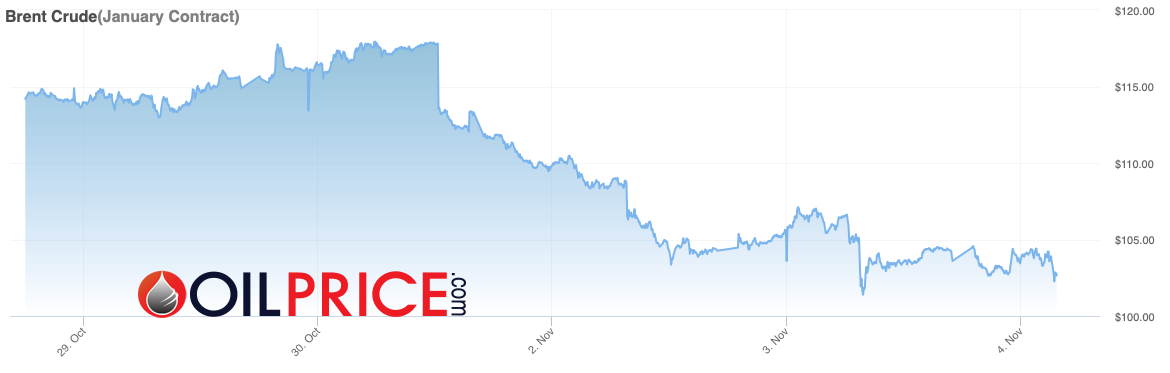
On October 30, Brent approached $118 a barrel, a six-month high, after Iran’s Revolutionary Guard claimed that three tankers had exploded in the Strait of Hormuz and a fourth vessel had struck a mine. Separately, Iran-backed Houthis claimed six attacks on Saudi airports and oil facilities, including the Ras Tanura refinery.
Traders assess midterm results
Bitcoin’s sell-off eased as investors weighed the midterm results and what they could mean for the crypto industry.On November 3, Democrats won control of the Senate and the House of Representatives. Expectations of a divided government weighed on the US dollar against all its Group-of-10 peers.
For crypto, the outcome carries its own risks. Markets worry about delays to the CLARITY Act, opposition to crypto-friendly nominees and a possible return to tougher scrutiny of digital asset firms. Bloomberg notes that the wider macro implications remain unclear. A political stalemate could limit fiscal stimulus and weigh on speculative assets, though lower Treasury yields might offer some support.
Bitcoin rally ahead?
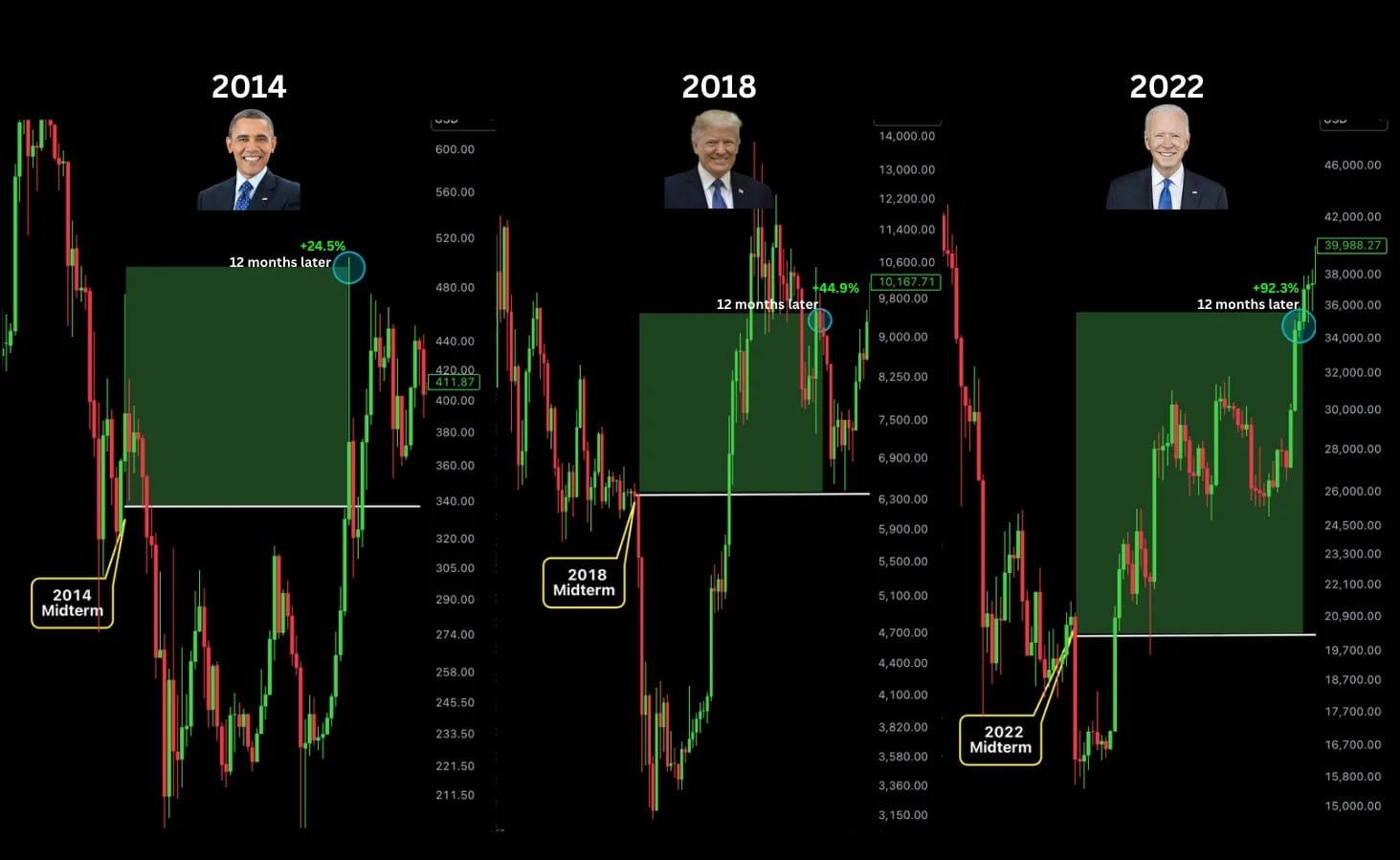
Bitcoin has dropped ahead of each of the five US midterm elections since 2010, according to CoinPedia, including falls of more than 48% in 2014, 37% in 2018 and 16% in 2022. BTC also lost 7.32% in October 2026. If history repeats, traders may be looking past the pre-election weakness: Binance Research puts Bitcoin’s average gain across the three previously recorded midterm years at 54%.
Top weekly winners
- LIT (+8.1%) surged after founder Vladimir Novakovski announced that Lighter plans to apply for two licenses from the Commodity Futures Trading Commission (CFTC) in November 2026. Trading in Turkey’s 30 largest stocks launched on the DEX, which gave it another lift.
- STX (+7.3%) rallied after BitGo added Bitcoin staking through Stacks to its qualified custody offering. To earn rewards, eligible institutions must pair their BTC with STX worth 5% of their Bitcoin position and commit to roughly six-month bonds funded by Stacks miners.
- ZRO (+6.4%) bounced after LayerZero announced a new partnership and integration with Loon Finance. LayerZero’s OFT standard will bring cross-chain functionality to CADC, Loon’s Canadian dollar-backed stablecoin. Recurring buybacks and anticipation around the Atlas trading system may have added support.
Top weekly losers
- BTW (-44.8%) fell on broader market weakness, token unlocks, subdued spot demand and thinning liquidity. On November 2, 101.63 million BTW tokens, worth roughly $110 million, entered circulation, adding to the available supply.
- M (-21.5%) declined as traders took profits following its October 28 peak of $1.14. The memecoin stays prone to sharp swings, with thin trading volume, concentrated insider ownership and unwinding leveraged positions adding to the volatility.
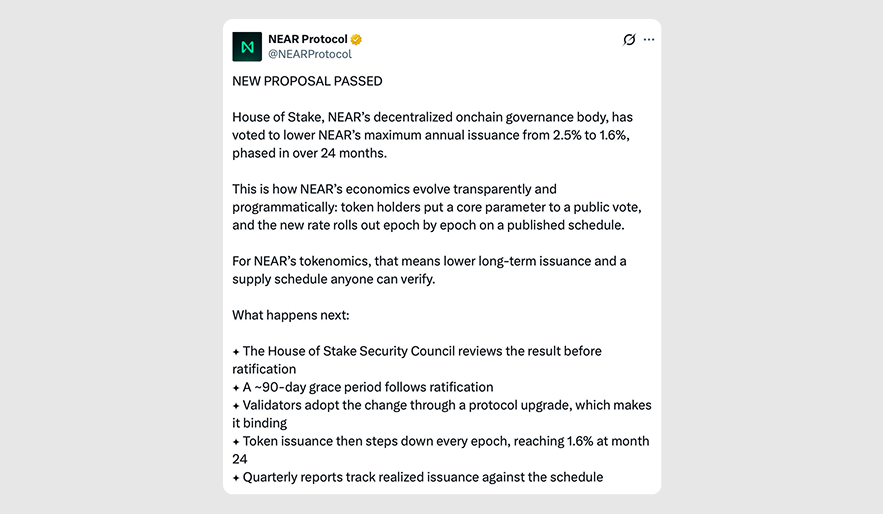
- NEAR (-18.5%) fell in a sell-the-news move after the protocol’s House of Stake approved a proposal to reduce annual token issuance from 2.5% to 1.6% over 24 months. The change could support NEAR’s long-term token economics, but it also cuts future staking rewards. Broader weakness across crypto, AI-related assets and tech stocks added to the pressure.
Cryptocurrency news
Binance's $6.3 billion hack started with a fake job interview
Binance revealed Tuesday that North Korea-linked attackers had spent months infiltrating the exchange before launching an attack on October 29 that reportedly affected around $6.3 billion in assets. The FBI has attributed the operation to the TraderTraitor group, while Pyongyang denies involvement.
The way in was a software engineer. In September, someone posing as a project director contacted him through a legitimate job platform. A fake HR representative ran a video interview and shared a social media account full of personal photos to build trust. A second interview, with a purported CEO, ended with the engineer downloading a coding assignment onto his work computer. The file contained malware that evaded endpoint security.
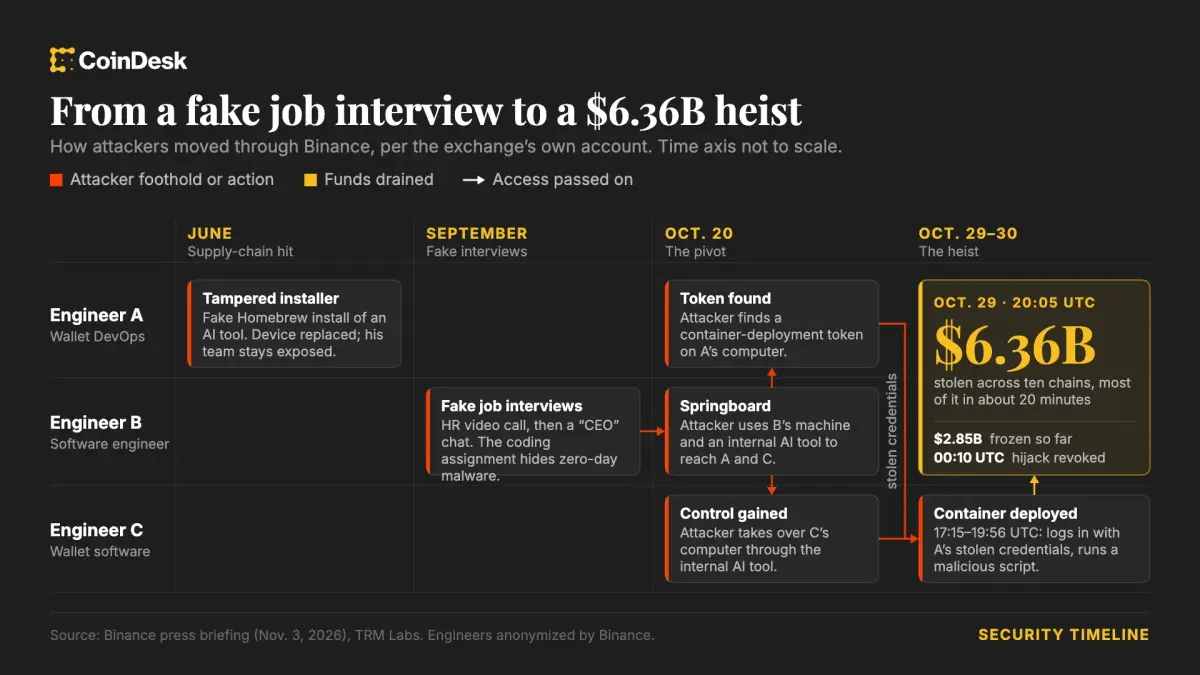
Separately, a second engineer had installed a tampered Homebrew package in June while looking for an AI tool. Binance detected the compromise and replaced the device, but the wallet team stayed exposed.
On October 20, attackers used the compromised machine and an internal AI tool to access two wallet engineers' computers. Nine days later, they deployed a malicious script, and funds began leaving at 20:05 UTC.
Why containment took hours
The attackers used Ethereum’s EIP-7702 feature to gain execution rights over a hot wallet. Because Binance’s hot wallets run on multiparty computation (MPC), the response was harder than revoking a single private key, and containment didn’t come until 00:10 UTC the following day.
CEO Richard Teng said about $2.85 billion had been frozen and roughly 98% of affected tokens replenished using company funds. He insisted users would not be affected.
The fallout
Customers withdrew $10.97 billion over 46 hours, while net outflows reached $5.28 billion. Withdrawal pressure peaked on November 1, when $936 million more left the exchange than entered in a single hour. By November 3, hourly deposits had finally exceeded withdrawals, which Teng described as a sign of stabilization.
The response
In his first interview since the hack, former Binance CEO Changpeng Zhao called for an industry security alliance to share lessons, conduct cross-audits and freeze stolen funds faster. “The speed of hacking is going to pick up because of AI capabilities,” he said. “The only way to fight a monster is to kind of become that monster.” He added that the threat was “definitely at the national security level” and banks were even more vulnerable.
South Korean President Lee Jae Myung has also called for a “powerful cybersecurity czar” to coordinate defenses across government and private industry, warning that AI is making attackers more sophisticated. The Korea Times reported that the National Intelligence Service has already ordered security checks at over 2,100 government bodies and public institutions, while the science ministry is inspecting around 170 private-sector infrastructure facilities.
Binance says it blocked 57 suspected North Korea-linked attempts this year. It is now bringing in independent experts to review the incident and find security gaps.
DTCC just put $30 trillion of Wall Street's plumbing onchain
On October 28, the Depository Trust & Clearing Corporation (DTCC) launched its tokenization service on the Canton Network and its own private Besu blockchain. At launch, 34 securities qualify, including large-cap Russell 1000 stocks, ETFs and US Treasury bills, notes and bonds. Together they represent roughly $30 trillion in market value.
DTCC subsidiaries handle clearing, settlement and custody for much of the US securities market, with more than $114 trillion in securities held at its depository. Bringing tokenization into that infrastructure gives the technology a route into established financial markets.
Blockchain comes to Wall Street’s back office
Each token is backed one-for-one by securities held at the Depository Trust Company (DTC). Participating firms can convert eligible holdings into tokenized form during business hours, with a target processing time of 15 minutes or less. Once tokenized, the assets can move between registered wallets around the clock, subject to compliance requirements.
Official ownership records stay with DTC, which sets the service apart from synthetic tokens that merely track a stock’s price. These tokenized securities represent the underlying assets and their associated rights and entitlements.
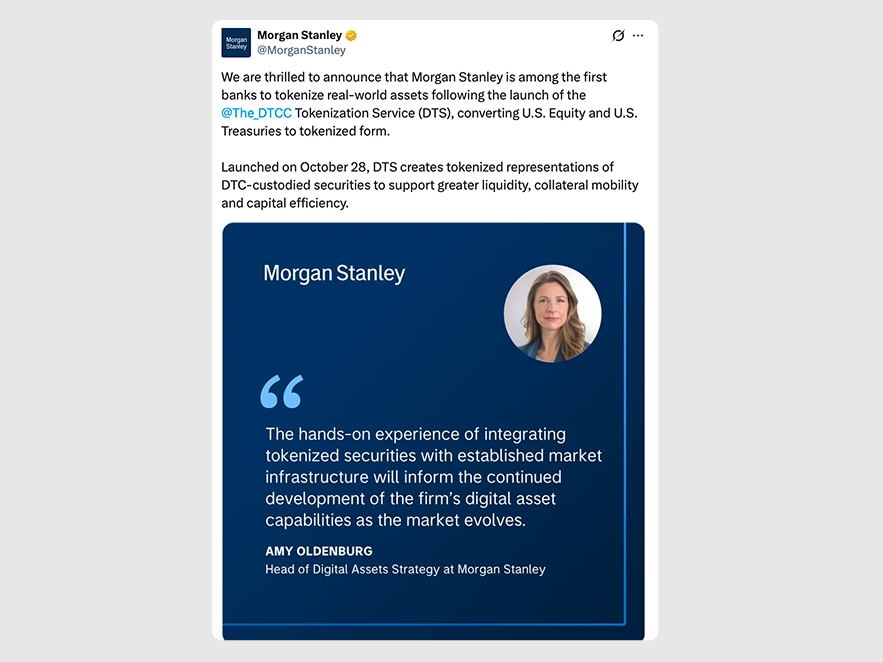
Twenty participants have signed on, including Bank of America, Barclays, Citi, Fidelity, JPMorgan, Morgan Stanley, Citadel Securities, State Street and UBS. Morgan Stanley confirmed it is among the first to tokenize real-world assets through the service, converting stocks and Treasuries. More firms are expected to join on a rolling basis.
Putting tokenized Treasuries to work
One early use case came from Société Générale, which accepted $10 million in DTCC-tokenized Treasuries as collateral on Canton. The assets were plugged into the bank’s existing collateral and back-office systems, following a plan first outlined in May. SocGen says it intends to expand the range of eligible securities and explore onchain repo financing.
Why the choice of blockchain matters
Canton gets an institutional boost from being one of the two networks supporting the initial service. But the service also runs on a private Besu chain, so the launch doesn’t automatically translate into demand for Canton’s CC token. How activity splits between the two environments will be worth watching.
What's next
DTCC's roadmap includes Stellar and Circle's Arc next year, along with digital cash settlement tools. Citi projects that tokenized securities could become a $5.5 trillion market by 2030.
The launch moves blockchain out of isolated pilot projects and into the infrastructure that supports securities markets. DTCC CEO Frank La Salla said: “By extending DTC’s resiliency, governance and operational standards into digital markets, we are establishing the foundation for responsible institutional adoption at scale.”