Crypto after the midterms: What a Democratic Congress means for the industry

Democrats won both the House and the Senate in the November 3 midterms, ending the unified Republican control that gave the crypto industry its friendliest Washington in years. The CLARITY Act, the industry’s top legislative priority, had already stalled in the Senate, and it will meet a very different Congress when the new members are sworn in January 2027.
Committee gavels will pass to Democrats, who are already discussing consumer protection and ethics rules for officials with crypto ties. The SEC and CFTC can keep writing rules in the meantime, and the sections below look at what that leaves in place.
TL;DR
- Democrats won the House and Senate in the November 3 midterms and will control the crypto-relevant committees once the new Congress is seated in January 2027.
- The CLARITY Act was already stalled in the Senate, and ethics rules tied to Trump’s crypto income are the main sticking point.
- New scrutiny is likely to focus on consumer protection and officials’ conflicts of interest, plus DeFi. Stablecoin payments and tokenization look better placed.
- Crypto PACs spent more than $170 million on the midterms, and some of their preferred candidates lost, including Jon Husted in Ohio.
- The SEC and CFTC can keep their rulemaking going, but guidance is easier to reverse than formal rules.
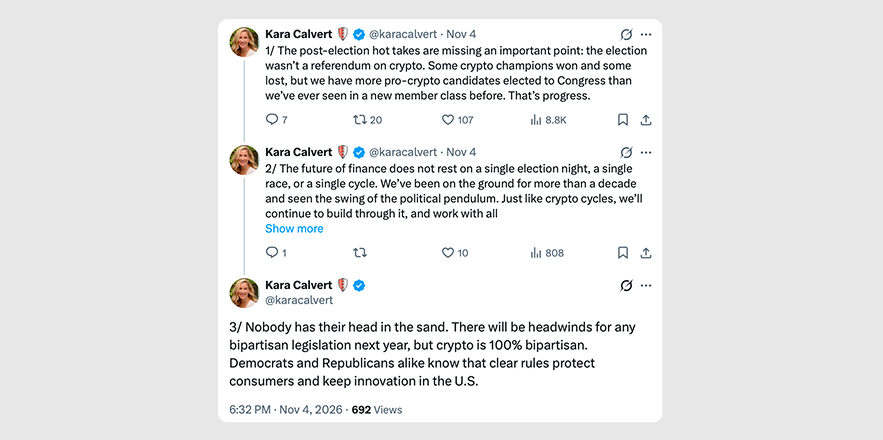
- Support for crypto still crosses party lines, so the industry will need to build ties with moderate Democrats.
Democrats sweep the midterms
The crypto industry spent heavily to shape the 2026 US midterm elections, hoping to secure a Congress willing to advance its legislative agenda. Unified Republican leadership used to provide a more favorable political environment, with the GENIUS Act enacted and the broader CLARITY Act passing out of the House in 2025.
Democrats gained a sweeping victory in the November 3 midterms, winning control of both the House and the Senate.The party flipped seven Senate seats in both solidly Republican states and battlegrounds, over 40 House seats (final tallies are still settling), five governorships and 12 state legislative chambers. AP described the result as a “widespread repudiation” of President Trump and the Republican Party.
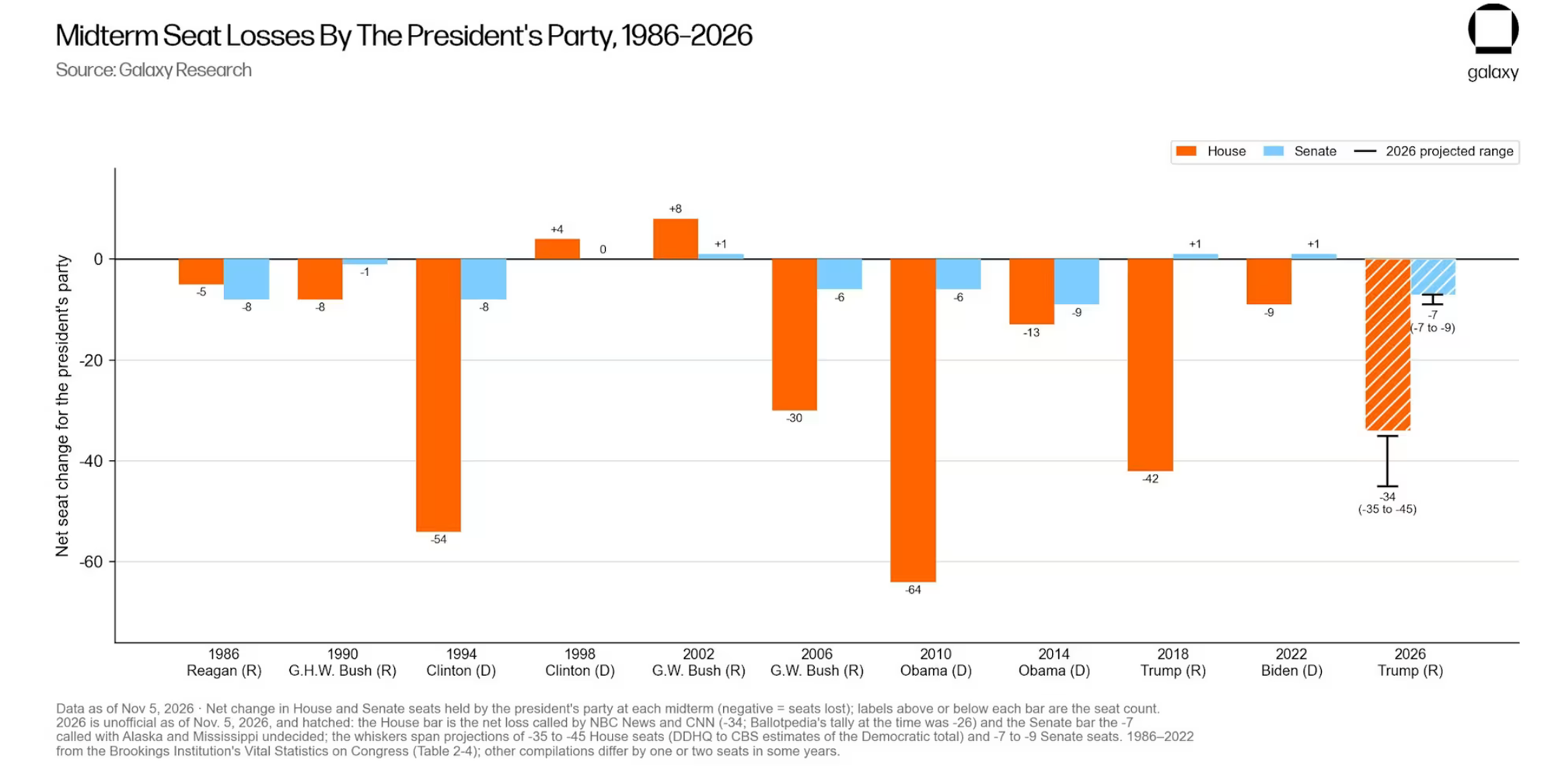
The result is a political setback for the administration and a new test for the crypto industry. The most notable congressional loss for crypto advocates was in Ohio, where Jon Husted (R) lost to former Senator Sherrod Brown (D). Crypto political action committees had reportedly spent $40 million supporting Husted and $24 million opposing Brown, the former Senate Banking Committee chair viewed as critical of crypto.
Other notable losses included:
- Bryan Steil (R-WI), head of the House Financial Services digital assets subcommittee
- Zach Nunn (R-IA)
- Ann Wagner (R-MO)
- Bill Huizenga (R-MI)
- Mike Lawler (R-NY)
Washington has entered the lame-duck period, with the outgoing Republican Congress still in office. Divided government typically constrains a president’s policy agenda, as it did for George W. Bush and Barack Obama after their parties lost Congress.
What changed in Washington?
The new Congress will take office in January 2027, which leaves outgoing lawmakers time to act. President Trump retains executive powers, and federal regulators appointed under him remain in place. Trump can also nominate commissioners for the Securities and Exchange Commission (SEC) and Commodity Futures Trading Commission (CFTC), subject to Senate confirmation.
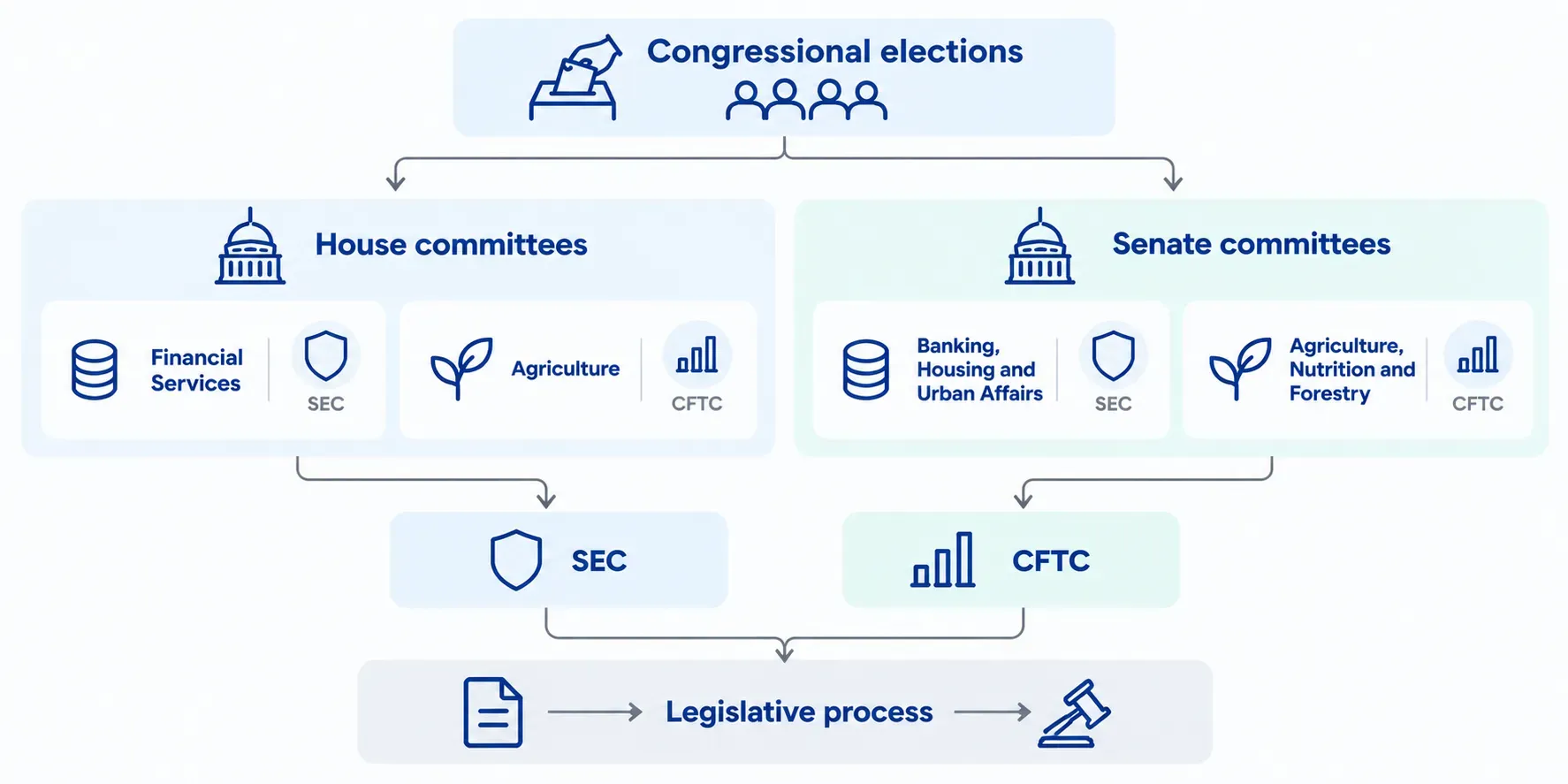
Once sworn in, Democrats will control the legislative agenda and lead congressional committees. Four of them oversee crucial parts of crypto policy, including securities regulation, commodities markets, stablecoins and financial services:
- Senate Banking Committee
- Senate Agriculture Committee
- House Financial Services Committee
- House Agriculture Committee
New committee chairs can decide which bills receive hearings, amendments and votes. The regulatory system hasn’t been handed to Democrats, though. Congress can investigate the administration and influence legislation, but it cannot simply reverse every executive or regulatory decision.
According to CNBC Make It, the key question is whether lawmakers can agree on lasting rules for the crypto industry, and how those rules could affect everyday investors. Crypto proponents fear the focus might shift from advancing digital asset legislation to ramping up oversight.
Is the CLARITY Act in trouble?
The Digital Asset Market Clarity Act (CLARITY Act) is the clearest example of what the election could change. The bill, passed by the House in 2025, aims to establish a clearer division of regulatory responsibilities between the SEC and CFTC. Although some Democratic lawmakers previously supported crypto market-structure legislation, the environment has changed.
The CLARITY Act stalled in the Senate even before the midterms. In September 2026, a procedural vote to advance it failed, with 49 senators voting in favor and 50 against cloture. Clashes between banks and crypto over stablecoin rewards slowed the talks, and they ultimately broke down over Donald Trump’s own crypto wealth. His 2025 financial report revealed $1.4 billion in income linked to World Liberty Financial and his TRUMP memecoin.
Sen. Angela Alsobrooks, D-Md., who was involved in both the GENIUS Act and CLARITY Act negotiations, said it was impossible for a Democratic-controlled Congress to prioritize the stalled bill. She also explained that while some Democrats were willing to get it passed, Republican leadership was done negotiating, and expecting a change during the lame-duck period was not realistic.
The ethics issue remains the biggest bone of contention. With Democrats now controlling both chambers, the existing version faces an even more difficult path, with a key choice between abandonment and a revised bipartisan proposal with stronger safeguards. Possible revisions include:
- Stronger investor protections
- Greater SEC oversight
- Stronger anti-money-laundering provisions
- Restrictions addressing conflicts of interest
What Democrats could target
Ethics probes of crypto businesses tied to elected officials are only one possible focus. According to CoinDesk, DeFi and centralized exchanges may face more stringent oversight. Meanwhile, growing stablecoin payments businesses and Wall Street’s plans to tokenize stocks, bonds and funds could have better odds of weathering Democrats’ midterm sweep.
Peter Curley, head of global regulatory affairs at tokenization firm Ondo Finance, expects more congressional questioning for the SEC and the CFTC on tokenized securities, but sees little reason for the entire segment to grind to a halt. He noted:
“The agencies have already made substantial progress without new legislation, and we expect that work to continue, particularly in tokenized securities and derivatives markets where established regulatory frameworks already exist.”
The following are possibilities, not confirmed legislative proposals. Some are already being discussed by Democratic lawmakers, particularly consumer protection and ethics provisions.
Consumer protection
- Exchange disclosures and transparency
- Custody and segregation of customer assets
- Proof-of-reserves and withdrawal protections
- Market manipulation and conflicts of interest
DeFi oversight
- The share of responsibility that developers, protocol operators and intermediaries should carry
- AML and compliance requirements for certain DeFi services
- Where regulators draw the line between software development and operating a financial service
Political conflicts of interest
- Limits on public officials profiting from crypto ventures while shaping digital asset policy
- Ethics and disclosure requirements
The crypto industry's $170 million political gamble
According to Fortune, crypto companies and political action committees (PACs) spent more than $170 million across over 100 midterm races. In the Ohio Senate race alone, PACs reportedly spent over $60 million supporting Husted and opposing Brown. Crypto PAC Fairshake, funded mainly by Coinbase, Ripple and the venture capital firm Andreessen Horowitz, had ended September with over $95 million left in the bank. Together with its affiliates, it spent about $150.8 million on the midterms through October 20.
Fairshake isn’t stepping back. Spokesperson Geoff Vetter told The Block:
“Fairshake played a meaningful role in winning competitive races across the country in 2026 and we will do it again in 2028. Newly elected and current members will have a choice: protect consumers and American jobs or fight progress. We will be watching and ’28 is a new map.”
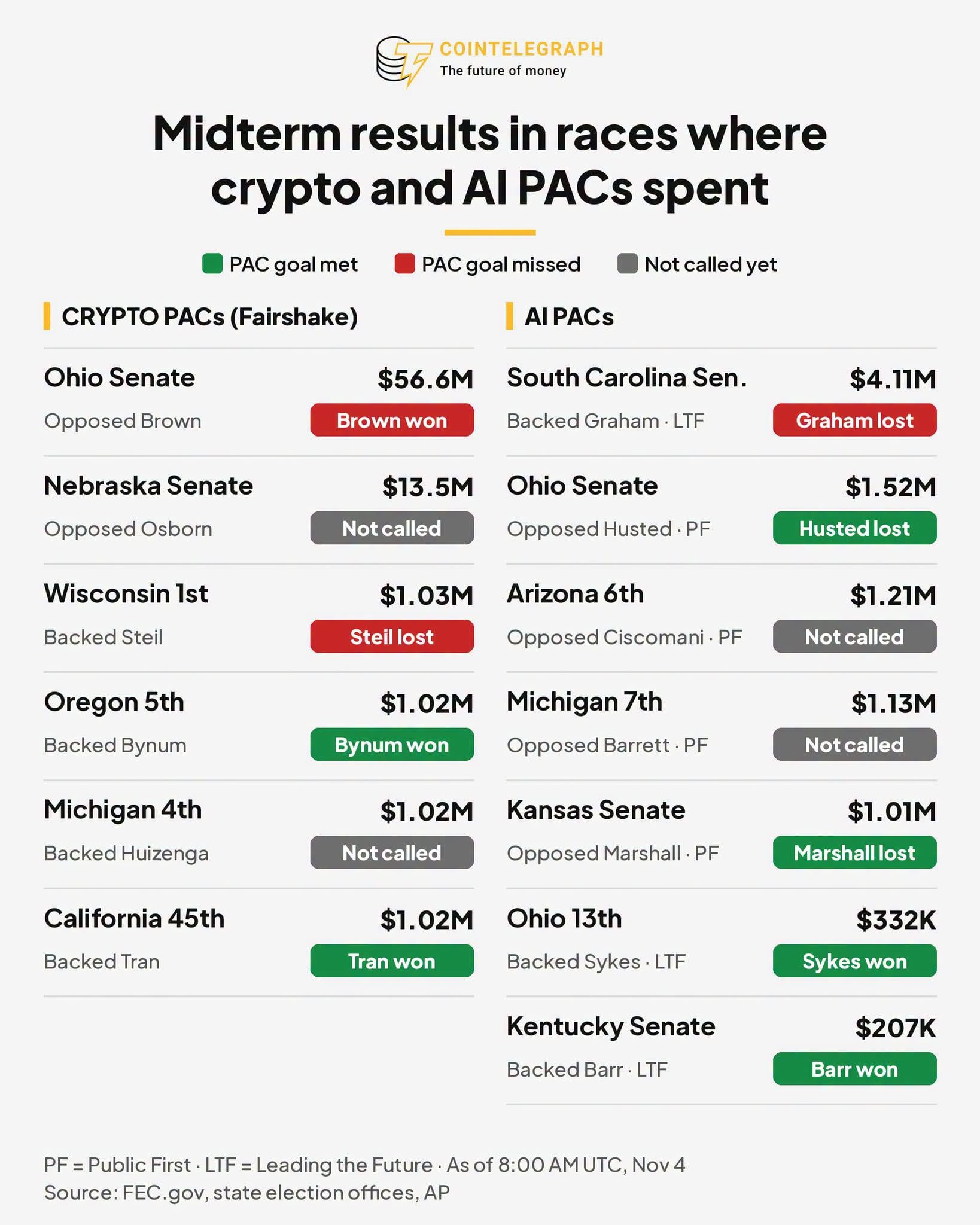
PAC spending was not exclusively about supporting Republicans. Some crypto advocates tried to build bipartisan support, recognizing that regulatory policy can outlast any one administration. Even so, some of the candidates they backed lost. Crypto-backed groups may now need to recalibrate toward bipartisan outreach and build relationships with the new congressional leadership.
The result also raises doubts about whether campaign contributions buy lasting influence when control of Congress changes. Some industry insiders feel the money spent on individual races like Husted vs. Brown could have been better spent lobbying lawmakers on the CLARITY Act.
Crypto support crosses party lines
Industry advocates say crypto has supporters on both sides of the aisle. More than 70 House Democrats previously backed the CLARITY Act, and some Democratic lawmakers want innovation and regulatory clarity but with stronger consumer protections and limits on conflicts of interest.
As results rolled in, crypto advocacy group Stand With Crypto counted 19 pro-crypto senators and 226 pro-crypto House members, against eight anti-crypto senators and 106 in the House.
Still, a Democratic sweep means more oversight, as The Block explains, and there is “close to no chance of the crypto industry getting legislation it wants on the table.” Industry participants may now need to engage more actively with moderate Democrats rather than relying primarily on Republican allies. The task now is to negotiate which rules should govern crypto and who should enforce them.
What happens to the SEC, CFTC and existing crypto rules?
A change in congressional majorities doesn’t reverse the regulatory changes already underway, and the Trump administration can still appoint commissioners and pursue its regulatory agenda.
Both agencies might face a durability test after spending much of 2026 developing rules without comprehensive legislation, filling the gaps left by Congress after the CLARITY Act stalled. The SEC introduced:
- A five-year exemption for venues trading tokenized securities, allowing them to list and trade tokenized securities without registering as an exchange (covered in our earlier piece on tokenized stocks)
- A proposal for Regulation Crypto Assets, aimed at creating a tailored offering regime for certain investment contracts involving crypto, including a $5 million “startup exemption” and a $75 million “fundraising exemption”
- A proposal to bring blockchain tech into transfer-agent rules, which would address a gap for companies tokenizing stocks. Currently, onchain data can show who owns the token, but the legal shareholder record sits elsewhere
The CFTC has moved on perpetual futures, a crypto-style derivative that lets traders bet on prices without an expiration date, and contracts on individual equities began trading on CFTC-registered exchanges on November 3.
Democrats’ victory now raises questions about how much of that agenda regulators can finalize before Trump’s term ends. Lawmakers can press the agencies through hearings, investigations, legislation and budget oversight.
If future agency leadership or legislation changes direction, regulatory uncertainty could grow. Yet it is easier to reverse guidance or informal policy positions than formal agency rules. Existing initiatives like stablecoin implementation and institutional tokenization may continue even if broader market-structure legislation stalls.
Road ahead: crypto's bipartisan test
The midterms have made comprehensive crypto legislation harder to pass. The CLARITY Act was already stuck in the Senate, and some Democrats want stronger consumer protections and ethics rules before they back it. Consumer safeguards and conflicts of interest are the likeliest areas of scrutiny once the new Congress is seated in January 2027, along with DeFi oversight.
Existing progress stays in place for now. The SEC’s tokenization exemption and stablecoin implementation can move forward without new legislation, and more than 70 House Democrats have already backed the CLARITY Act. The industry’s job in 2027 is to rebuild its lobbying around moderate Democrats as well as its Republican allies.