Clapp Weekly: Fed uncertainty, Clarity Act on ice, Morgan Stanley's ETF offensive

BTC price
Bitcoin is edging higher after dipping following the latest US-Iran strikes, adding to tensions across the Middle East. Previously, the coin largely shrugged off one of the worst stretches for Asian equity markets. Falling trading volume reflects traders' caution ahead of today's Fed rate decision. The ETF recovery has also stalled: after three consecutive weeks of inflows, US-listed spot Bitcoin funds have recorded $61.40 million in net outflows since Monday.
BTC slipped from $66k on July 23 and rebounded from below $64k the next day, gradually climbing back above the level before a July 27 push sent it to roughly $65.4k. A sharp sell-off followed, with the price bottoming at $63,108.02 on July 28. Since then, the coin has staged a modest recovery.
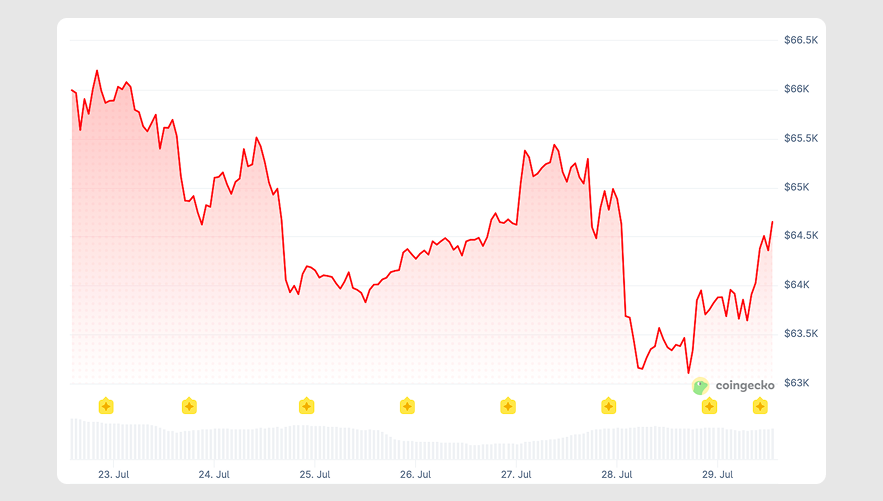
Currently, BTC is changing hands at $64,592.67, up 2.0% over the past 24 hours but still down 2.0% over the past seven days.
ETH price
Ether is hovering near $1,900 as sentiment stabilises ahead of the Fed decision. On-chain data shows investors moving ETH on-chain near break-even prices after the recovery earlier in July — possibly as they look to cut losses. Ethereum ETFs continue to outpace Bitcoin ETFs, attracting more than $318 million since July 3, per SoSoValue data. Buying pressure remains intact, while Morgan Stanley's newly launched Ethereum ETF adds to signs of strong institutional demand.
ETH has outperformed BTC, rebounding strongly after its initial plunge. It sank below $1.95k on July 22, briefly hovered around $1.8k the next day, then rebounded sharply to a seven-day high of $1,966.98. After pulling back, the coin recovered and is now holding above the $1.9k level.
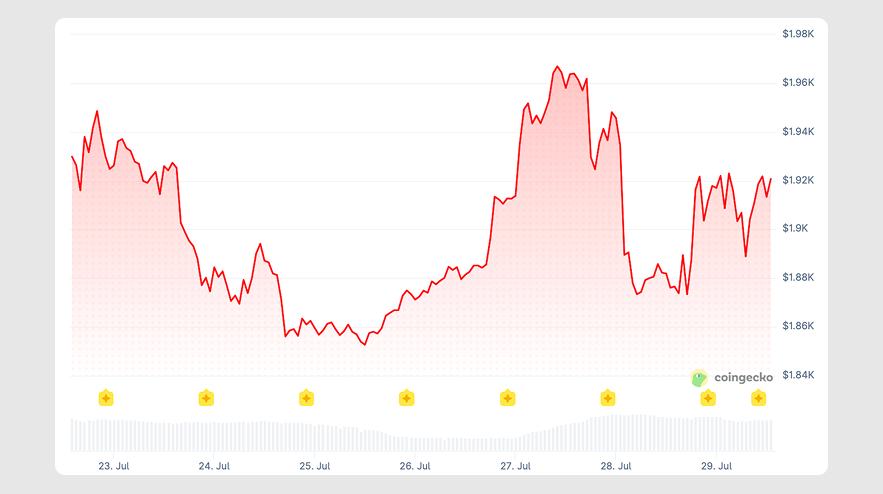
Now at $1,918.40, ETH has gained 2.1% over the past 24 hours and is flat on the week.
Seven-day altcoin dynamics
For the second time in a week, crypto has held up through a sharp unwind in the artificial intelligence trade. While chipmaker stocks tumbled, ETH, XRP, BNB, SOL, and DOGE all followed Bitcoin higher earlier today. Since Monday, sentiment has remained firmly in the “Fear” zone (29/100).
Earlier this month, crypto moved largely in lockstep with AI stocks. According to CoinDesk, that link has now broken down twice in five sessions — last week’s Mag 7 sell-off also barely moved Bitcoin. Crypto miners, however, remain closely tied to AI data-centre demand.
XRP hit by Clarity Act delay
Meanwhile, US regulatory uncertainty continues to weigh on the market after the Senate sidelined the long-awaited Clarity Act (more below). The delay has particularly affected XRP — the framework would codify its commodity classification, making Ripple more appealing to institutional custodians, banks, and ETF issuers looking to build products around the asset.
Standard Chartered's $8 XRP price target also hinges on full Senate passage, combined with $4–$8 billion in new ETF inflows.
All eyes on Fed amid new strikes on Iran
Markets are cautious ahead of the FOMC's interest rate decision, due later today, July 29. Chair Kevin Warsh's limited use of forward guidance has left investors with less clarity on the Fed's next move. Markets currently price in a roughly 64% chance of no change and a 35% chance of a surprise 25-basis-point hike, according to CME FedWatch.
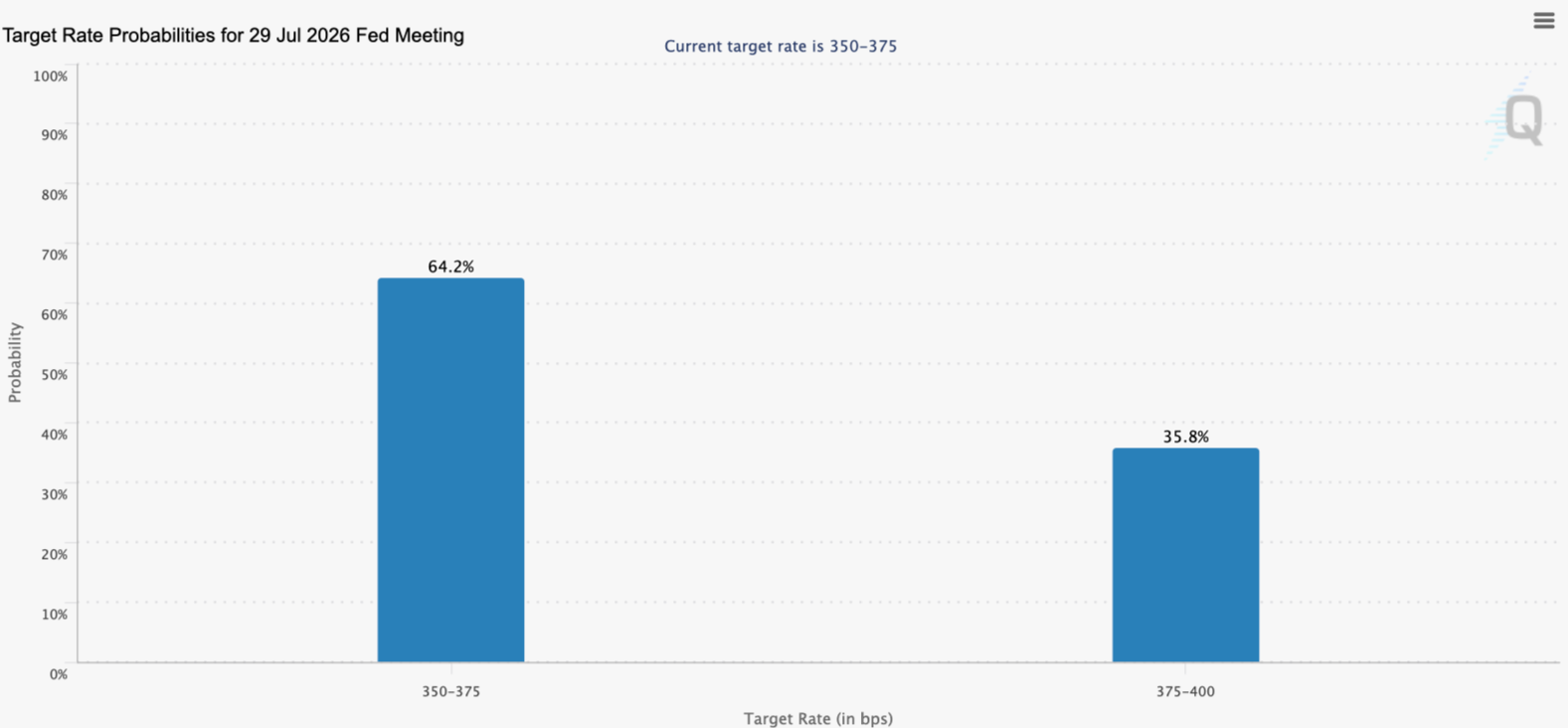
Since 2015, only two FOMC meetings have seen markets more evenly split over the outcome, according to Block Scholes' Thahbib Rahman. The research analyst suggested that “anything remotely dovish from Warsh” help Bitcoin extend its outperformance of stocks.
Brent surged above $87 per barrel after strikes against Iran-aligned militant groups in Iraq — the first joint US-Saudi operation publicly announced by US Central Command. The strikes followed drone attacks against US forces and Saudi energy infrastructure, while direct strikes on Iran remain paused to allow diplomatic talks to continue.

While the US announced a ceasefire with Iran yesterday, markets remain wary. On Polymarket, the odds of the ceasefire lasting for 14 consecutive days fell by 10%.
Beyond the energy pressures from the closed Strait of Hormuz, some Fed officials see AI spending as a potentially bigger inflation risk. All eyes will be on Warsh for signs of how seriously the central bank is taking that risk. Core PCE inflation and second-quarter GDP are due on July 30, alongside another round of megacap technology earnings from Amazon, Apple, Meta, and Microsoft on July 29–30.
Top weekly winners
- BEAT (+36.28%) surged on speculative accumulation ahead of a massive token unlock, fuelled by social media hype, before crashing on July 27 amid profit-taking and pre-emptive selling. The August 1 unlock will release about 21.25 million BEAT, roughly 26.7 times the amount burned in the most recent week.
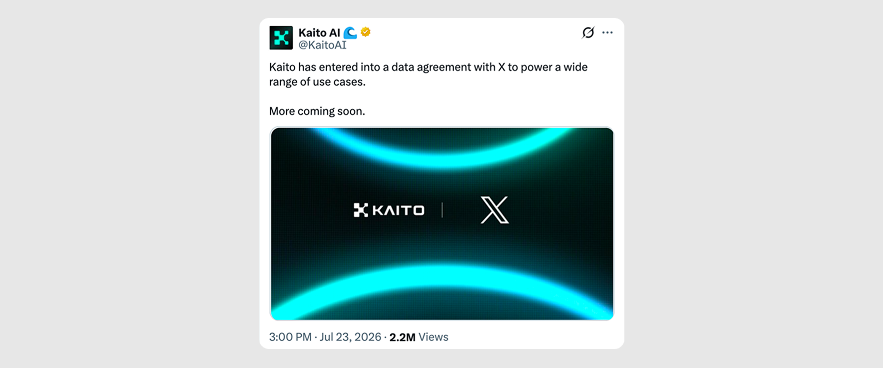
- KAITO (+28.88%) rallied after Kaito AI secured a licensed data agreement with X, giving it deeper access to the platform's social data. Combined with the completion of a scheduled $15 million token unlock, the news triggered heavy retail buying and a wave of short squeezes.
- SHIB (+7.44%) benefited from a spike in speculative trading on South Korean exchanges such as Upbit, a 1,028% jump in token burns over the week, and large-scale exchange withdrawals, reducing the immediately available supply.
Top weekly losers
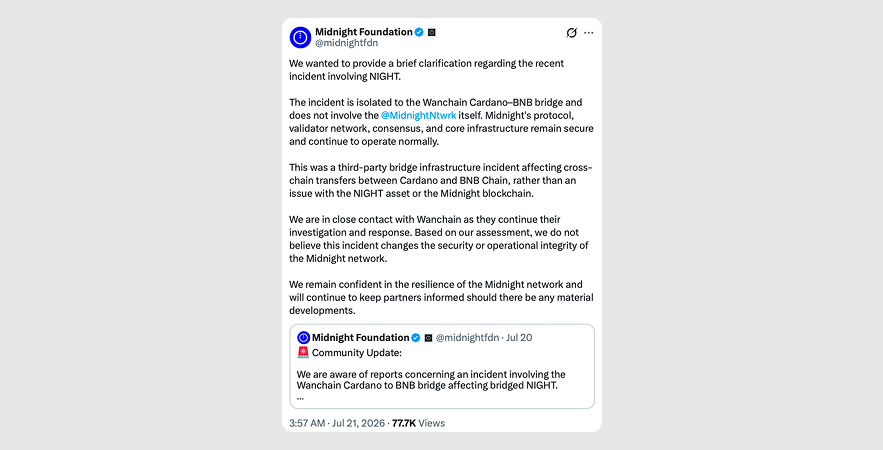
- NIGHT (-24.17%) is struggling to recover from a Wanchain bridge exploit that drained 515 million tokens and sent NIGHT to an all-time low before a partial bounce. A token-unlock overhang and negative social-media sentiment around Cardano-affiliated governance are also weighing on the token.
- WLD (-21.31%) remains under pressure from a heavily discounted $52.5 million institutional private token sale, fading ETF hype, and concerns over extreme holder concentration amid a broader AI sell-off. According to Worldcoin's ETF filings, the top 100 whale wallets control roughly 90% of circulating supply.
- NEAR (-17.37%) is taking a hit as a high-beta bet on the AI narrative. Institutional capital is pulling back from tech and AI-adjacent assets, while cooling sector liquidity has sent NEAR's spot trading volume down 36% in 24 hours.
Cryptocurrency news
Senate puts Clarity Act on ice — time is running out
The crypto industry's biggest legislative hope just hit another wall.
The Senate has sidelined the Digital Asset Market Clarity Act for now, Majority Leader John Thune opting instead to pursue a package of nominees and a Russia sanctions bill. The chamber's limited floor time and procedural hurdles mean the Clarity Act is unlikely to get a vote before the August 8 summer recess.
That leaves a narrow window: a few weeks in September, then the November midterms, then the unpredictable lame-duck session. If it doesn't move soon, the bill may not survive the year.
What's holding it up
Two things. First, floor time is precious. The Russia sanctions bill, now dedicated to the late Senator Lindsey Graham, plus his funeral this week, have consumed the chamber's attention.
Second, the bill itself isn't ready. Lawmakers are still fighting over a contentious ethics provision banning senior government officials — including President Trump — from backing crypto projects. Last week, the White House signaled Trump would accept the restrictions. Democrats immediately countered that the limits don't go far enough to curtail Trump's crypto empire.
Both sides agreed to keep talking, but agreement remains elusive.
Why it matters
If the Clarity Act stalls, the industry faces an uncertain regulatory timeline. The next best avenues are the GENIUS Act's implementation and policy efforts at the SEC and CFTC — regulatory fixes, not legislative certainty.
A similar version already passed the House. The Senate has been the bottleneck for months. First, it was the stablecoin yield debate with banks. Now, it's the ethics clause.
A crowded calendar
Even if the Senate passes it, the bill must return to the House for another vote, where Republican infighting has complicated other initiatives. And Trump has refused to sign an unrelated housing bill until Congress sends him voter-ID legislation — raising questions about whether he'd sign the Clarity Act without conditions.
For now, the industry waits. The clock is ticking. And Washington, as ever, is moving at its own pace.
Morgan Stanley launches ETH and SOL ETFs with staking rewards
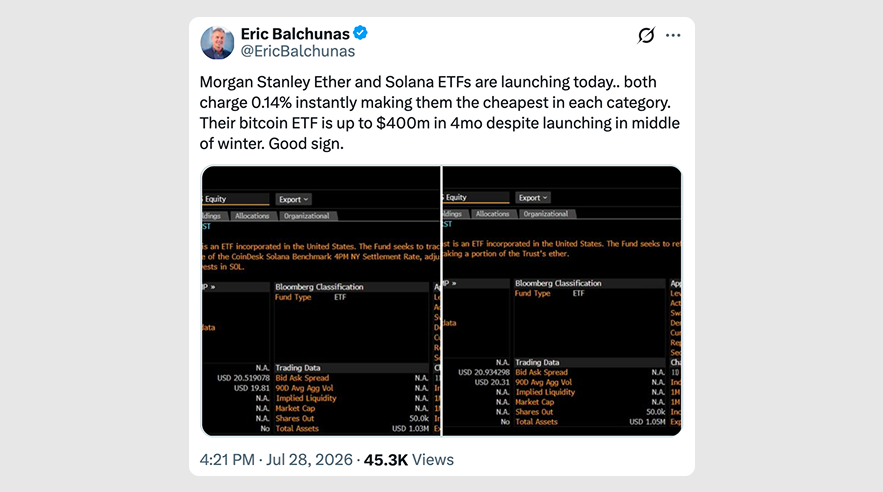
Morgan Stanley is doubling down on crypto and undercutting everyone on fees. Its spot Ethereum and Solana ETFs, launched on July 28, each charge a rock-bottom 0.14% sponsor fee. That's cheaper than Grayscale's Mini Ethereum Trust (0.15%) and Franklin Templeton's Solana ETF (0.19%).
The Ethereum fund trades under MSSE, the Solana fund as MSOL — both on NYSE Arca.
Staking rewards included
Unlike many ETFs that simply track price, the Wall Street giant will stake a portion of the funds' ETH and SOL holdings and pass the rewards through to investors. That yield could make these products particularly attractive to institutional investors seeking income.
A track record of execution
It's not Morgan Stanley's first crypto rodeo. The firm's spot Bitcoin ETF, launched in April, has already pulled in roughly $400 million despite launching in a bear market, according to Bloomberg's Eric Balchunas.
"Since introducing our first ETFs in 2023, we've built a diversified suite of ETFs and ETPs that now exceed $14 billion in assets under management," said Ally Wallace, Morgan Stanley's Global Head of ETFs. "The addition of MSSE and MSOL reflects the natural evolution of our product suite."
Notable timing
Morgan Stanley rolled out spot Bitcoin, Ethereum, and Solana trading for E*TRADE customers just weeks ago. The firm's digital asset division head, Amy Oldenburg, previously told Decrypt: "We're not going to stop at just Bitcoin. It's really about the longer-term journey, and there's quite a long way to go."
The launch comes roughly two and a half years after BlackRock and Fidelity kicked off the spot Bitcoin ETF era. Since then, the market has expanded to include ETFs for tokens like XRP and HYPE. Solana and Hyperliquid ETFs now account for nearly 80% of non-BTC and ETH ETF volume, with Solana ETFs alone holding over $900 million in AUM.
The bottom line
Morgan Stanley isn't just dipping its toes in anymore. With the lowest fees on the market and staking rewards baked in, it's making a serious play for institutional crypto flows. The question now: will rivals follow with their own fee cuts?