How to use AI for crypto trading: Beginner's guide

Crypto markets produce an absurd amount of information — from price feeds to on-chain moves, from token unlocks to governance proposals. Keeping track of it all is close to impossible for a solo human trader, which is exactly where artificial intelligence shines.
AI can summarize, spot patterns, and generate hypotheses — but its real advantage isn't calling the next candle. It's processing immense volumes of data in seconds, helping you move from "what's happening?" to "what might explain it?"
And if you're not willing to hand control of your capital to a bot, there's still plenty of ways to put AI to work.
TL;DR
- AI trading isn't one thing. It's a spectrum, from research and sentiment tracking all the way to fully automated execution.
- LLMs can't see the live blockchain on their own. Don't trust them blindly — AI is only as useful as the data/tools you connect it to.
- Sentiment analysis gives you context, not a signal. Extreme bullish sentiment alongside rising leverage often means the market is getting crowded, not that it's time to buy.
- On-chain AI tools help you track entities, not just individual wallet addresses. This matters since real participants spread capital across hundreds of shifting addresses.
- If you're building or testing a trading strategy with AI, backtest it, then paper trade it for at least a month, before ever connecting it to real capital.
Don't expect a straight line to a trade
AI won't hand you a ready-made trade. The first skill worth building is asking sharper questions than "will BTC go up?" The second is verifying whatever it gives you back — AI can confidently produce wrong data, invent sources, misread context, or work off outdated information without any obvious sign that it's doing so.
A few examples of sharper prompts:
- "Summarize the five biggest catalysts affecting ETH this week."
- "Compare the token unlock schedules of these three projects."
- "What changed in this protocol's latest governance proposal?"
- "Give me the strongest arguments for and against this investment thesis."
- "What assumptions does this thesis depend on?"
A reasonable workflow looks like this: AI generates a hypothesis → you trace it to a primary source → you verify it → you decide.
Level 1: Tracking news and narratives
Crypto moves too fast to read everything yourself. Just consider what it would take to manually track:
- X posts
- Reddit discussions
- Telegram channels
- News coverage
- Forums
- Search trends
LLMs can extract the core themes across all of that and gauge overall market sentiment, which helps you catch narrative rotations and emerging trends before they go mainstream.
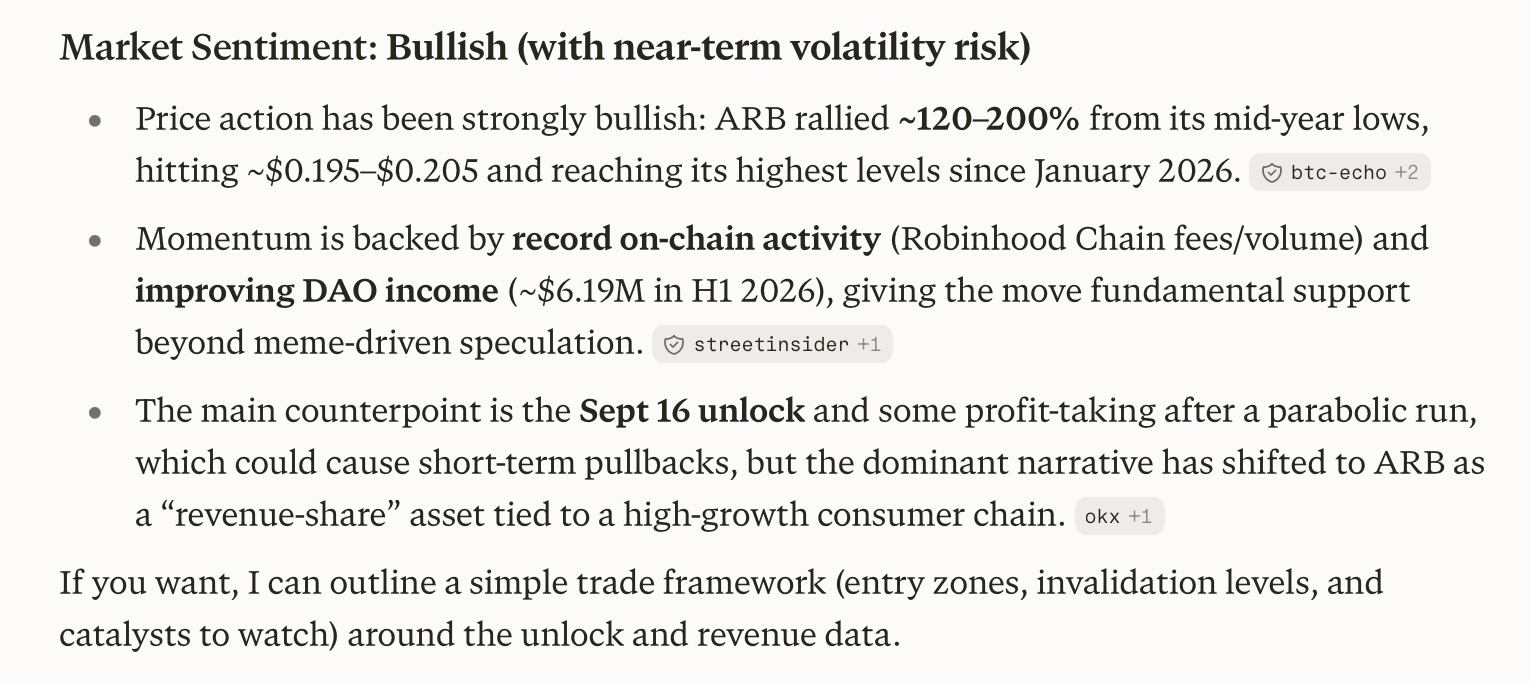
Perplexity runs real-time web search with citations, so you can prompt it to scan crypto-focused communities and X directly to gauge retail mood. Perplexity Finance adds live crypto data tracking, market pulses, and indexes like COIN50, which reflects real-time asset performance.
A useful prompt may look like this:
"Act as a crypto hedge fund analyst. Search for the top news regarding [Project/Sector/Token] over the past 48 hours. Summarize the top 3 macro takeaways, filter out speculative noise, and highlight the general market sentiment (Bullish/Bearish/Neutral)."
Kaito Pro takes a more specialized approach, focused specifically on crypto social and narrative sentiment. It's a vertical search engine that indexes thousands of crypto-specific sources — Crypto X, governance forums, conference transcripts, research reports.
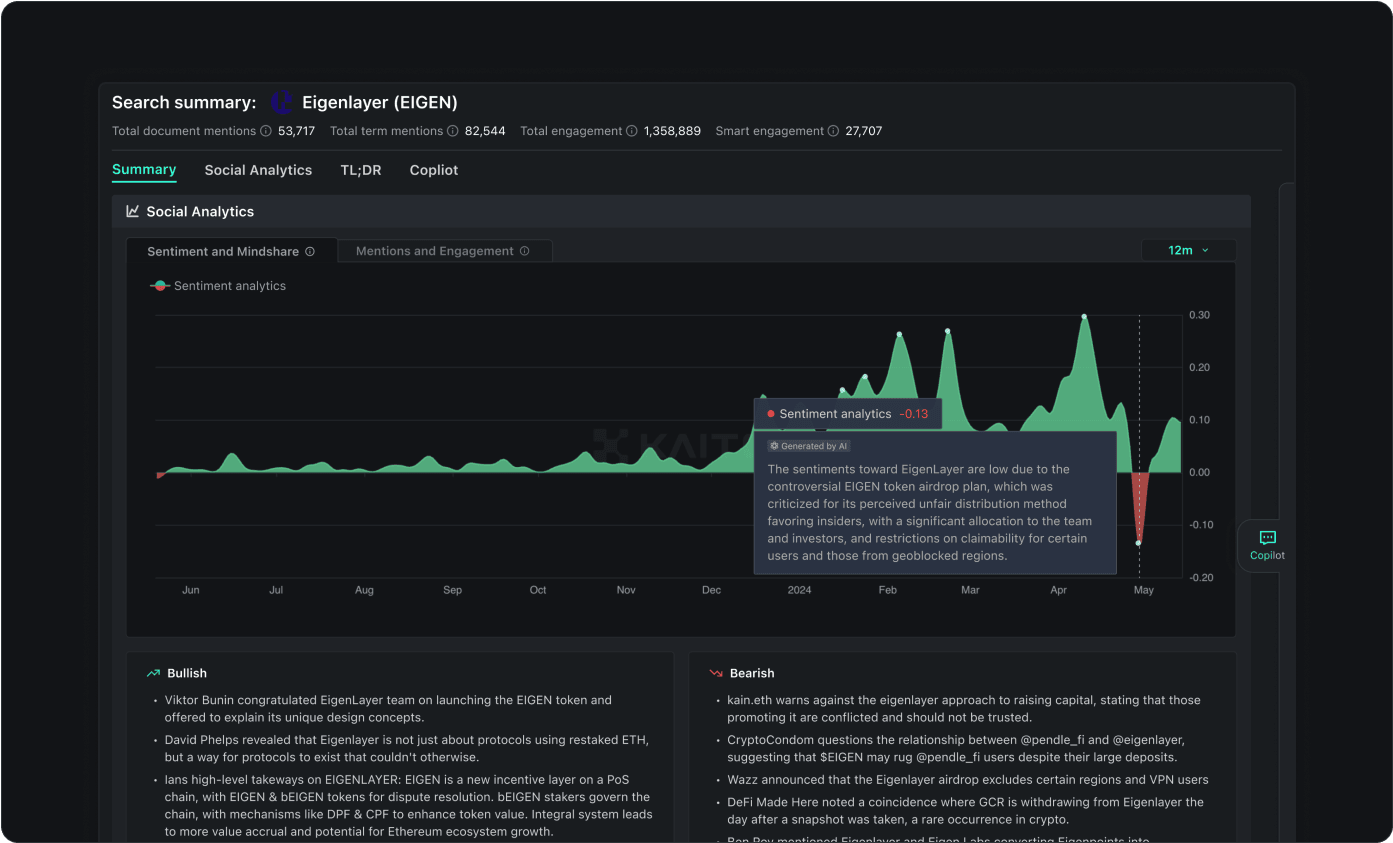
Sentiment isn't a prediction machine
NLP models can classify text as bullish, bearish, or neutral and pick out recurring themes, but that's context, not confirmation. If sentiment suddenly turns extremely bullish while funding rates, leverage, and open interest are all climbing at the same time, the signal is often less "buy" and more "this market is getting crowded."
For deeper sentiment work, Augmento covers topic-specific crypto community sentiment, and StockGeist spans both traditional stocks and hundreds of cryptocurrencies.
Level 2: Analyzing on-chain data
On-chain data is the public record of every transaction stored permanently on a blockchain — sender, receiver, amount, timestamp, all of it visible to anyone.
The problem with a standard block explorer is that it's easy to lose the broader picture. You end up tracking individual wallet addresses one at a time, while actual market participants — whales, hedge funds, exploiters — spread their capital across hundreds of shifting addresses.
What you actually need to track is entities, not addresses, and the fastest way to do that is through platforms that already build machine learning directly into their explorers and entity taggers.
AI can help make sense of enormous volumes of blockchain activity, including:
- Whale movements
- Exchange inflows and outflows
- Wallet clusters
- Token transfers
- Smart contract activity
- Liquidity movements
- Unusual transaction patterns
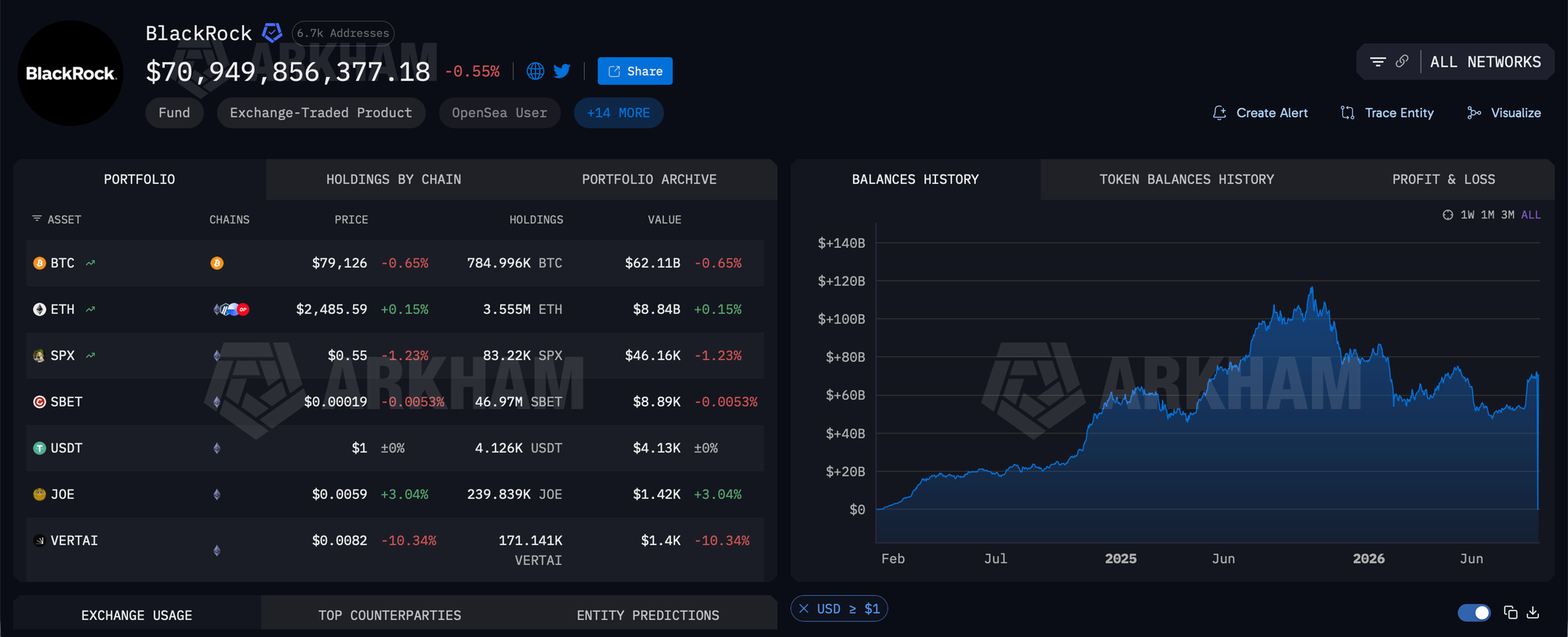
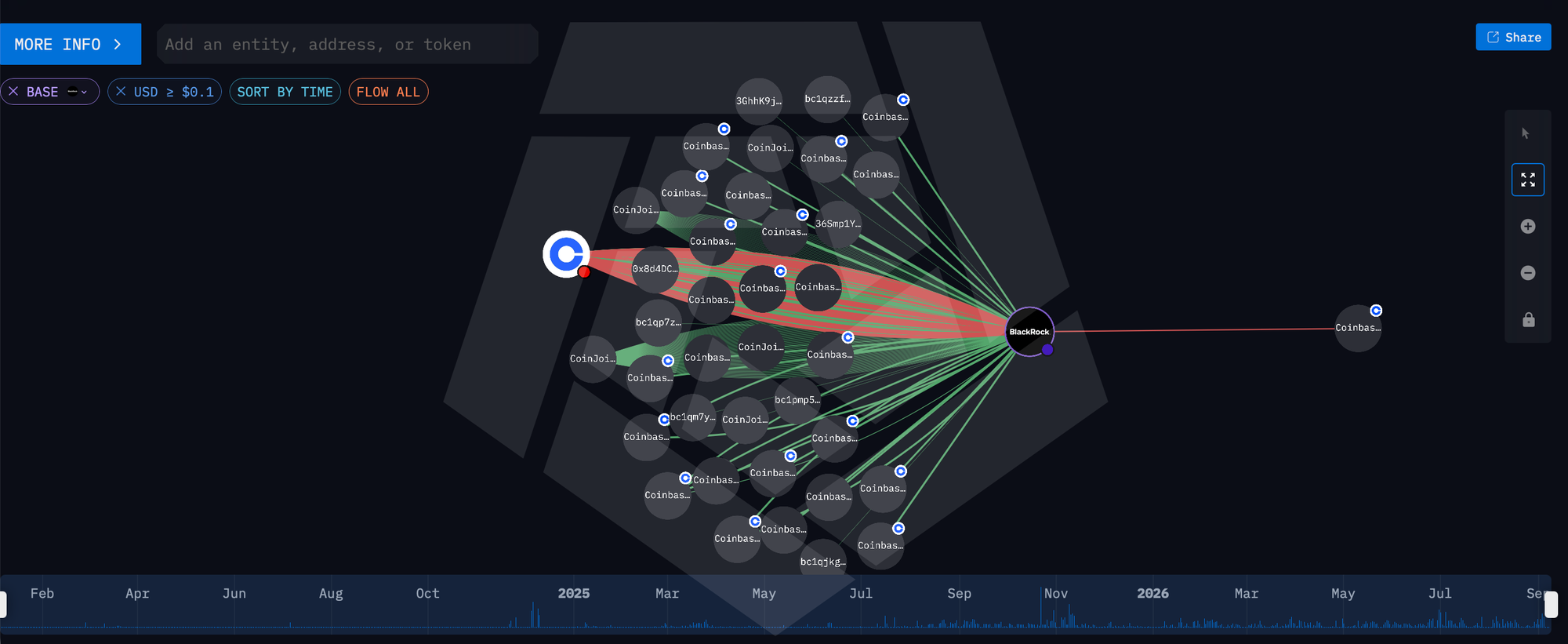
Arkham helps de-anonymize wallet addresses and trace fund flows using its built-in AI engine. Arkham ULTRA clusters wallets into a single entity profile — say, grouping every address tied to BlackRock — so you can set alerts, track transfers, and dig further with features like Tracer and Visualizer.
Nansen automatically flags whale movements, capital inflows, and unusual smart contract interactions. Its wallet-labeling system makes "smart money" easy to track, and it pre-categorizes entities by behavior — VCs, institutional funds, successful traders, whales — while tracking their portfolio moves, win rates, and realized profits in real time.
Level 3: Anomaly detection
Has a major entity suddenly gone on a hidden buying spree? Is a CEX seeing unusually large deposits flowing toward derivatives platforms — a possible signal of an incoming sell-off?
This is exactly the kind of rare, pattern-breaking event AI is well suited to catching: a dormant wallet suddenly moving millions, or a flash-loan exploit unfolding in real time. Some of these systems are designed to detect deviations from established behavioral patterns, allowing them to flag unusual wallet movements, exploits, or major fund shifts.
Dig deeper with OSINT — fund movements alone can leave you guessing at motive. A whale moving $20 million isn't automatically bullish or bearish. The more useful question is more nuanced: who moved it, where did it go, why might they have moved it, and what happened afterward? (Our guide to crypto OSINT goes deeper on this.)
Level 4: AI-assisted strategy development
AI tools can help build, refine, and turn a trading idea into working code — but treat it as a quantitative co-pilot, and a highly specialized one at that. Machine learning models can find patterns even where none genuinely exist, which is exactly why rigorous safety checks matter before any real capital is on the line.
This is well beyond beginner territory, and asking AI for generic trading advice won't get you there. Instead, task it with finding specific mathematical relationships, structural inefficiencies, or behavioral anomalies in crypto markets specifically. Prompt it to combine traditional technical analysis with on-chain metrics for a fuller picture.
Prompts for actual signal generation need strict, specific constraints, covering things like:
- Entry and exit rules
- Transaction fees
- Slippage
- Drawdowns
- Win rate
- Risk/reward
- Out-of-sample testing
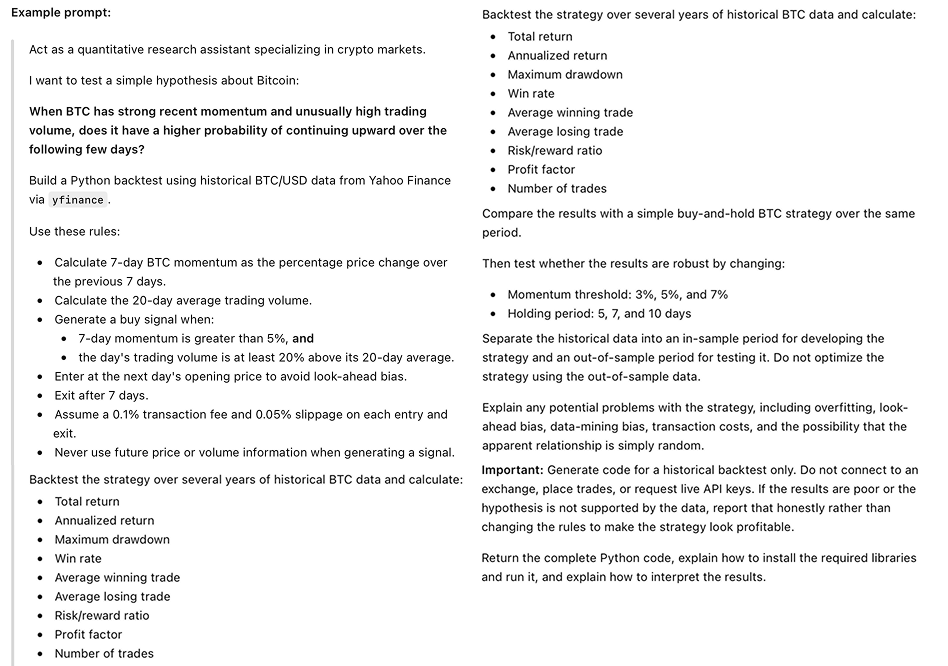
This is an illustrative example, not a trading strategy or financial advice. AI-generated code and backtests should be independently reviewed and validated before use.
One more harsh truth for beginners: you can't just copy-paste generated code and hit run expecting profit. Do that, and you'll likely lose money within minutes to bugs, connection issues, or ordinary market volatility. The underlying statistical idea has to actually hold up first.
A sensible process moves from a rough market observation to a testable script through four stages: generating indicators, turning the idea into Pine Script or Python, backtesting it, and then actively trying to find its weaknesses.
If the backtest results hold up, move to paper trading with fake capital next. Don't risk real money until you've watched the strategy perform consistently on paper for a meaningful sample of trades and you understand every line of the code yourself. At the beginner stage, your only real goal is getting the code to run cleanly and learning to interpret what it outputs.
Let AI write the strategy — then try to break it
Always backtest before risking anything real. But even a clean backtest comes with a catch: a strategy that looks brilliant on historical data may simply have been shaped to fit that specific past, and there's no guarantee it holds up against what the market does next.
Level 5: Automated execution
Trading bots take the process one step further — they execute orders without a person clicking anything. This is also where the risk profile changes considerably, since a bot acting on a bad signal doesn't pause to reconsider the way a human might.
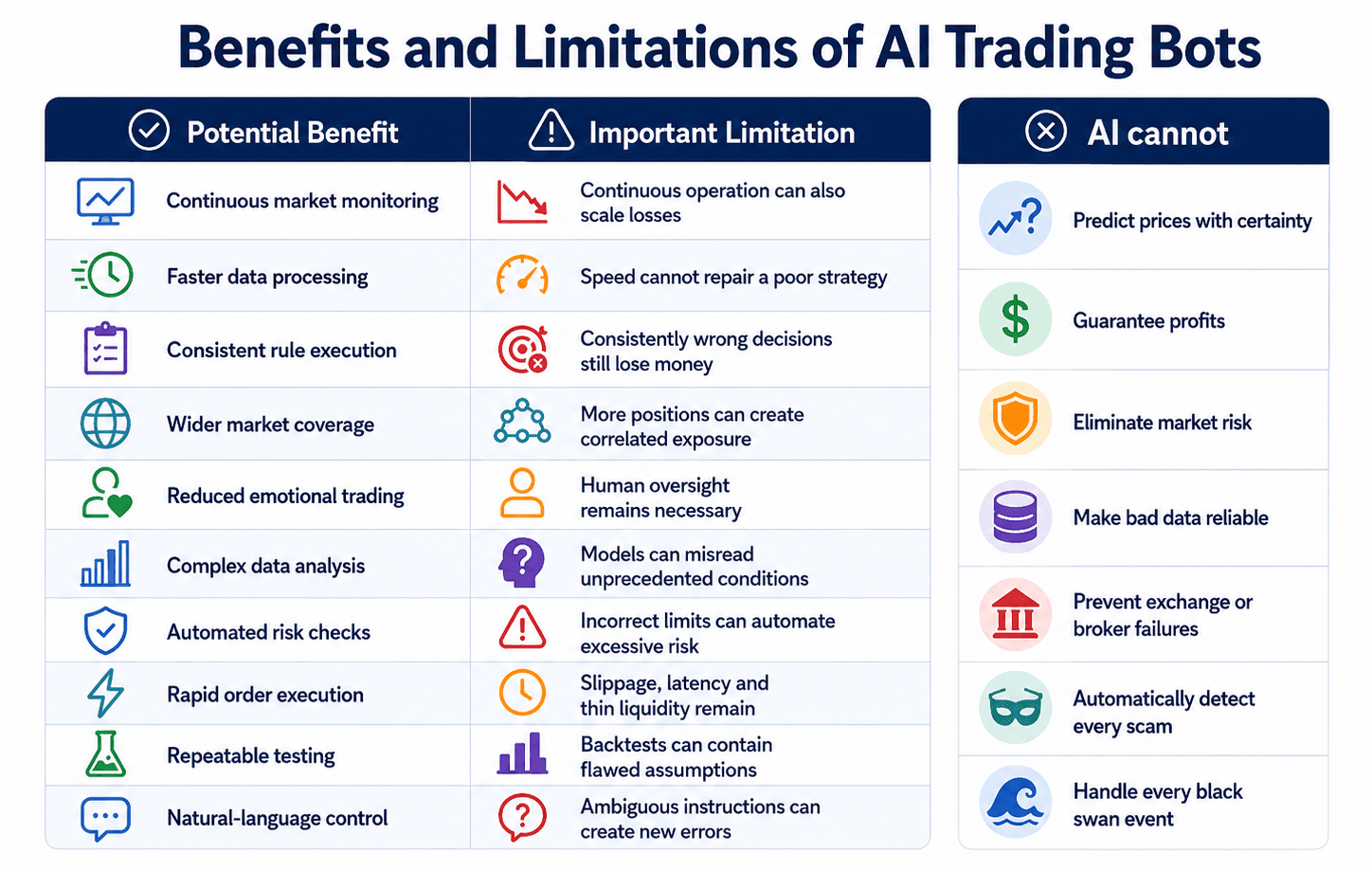
AI-powered or algorithmic bots can automatically execute trades, rebalance portfolios, follow predefined strategies, pursue arbitrage, and react to market signals in real time.
The appeal is real: bots run 24/7, execute faster than a person possibly could, cut out a lot of emotional decision-making, and do the same thing the same way every time. But that consistency cuts both ways.
The risks that come with automation include:
- overfitting to past data
- bad or delayed inputs
- model errors
- market conditions the system was never trained for
- API and security vulnerabilities
- excessive trading that racks up fees
- smart contract or token-level risk (for anything touching DeFi)
"AI" doesn't automatically mean intelligent
A bot following a rigid set of if-this-then-that rules isn't necessarily running sophisticated machine learning underneath. According to CoinTracking, many products marketed as "AI trading systems" are, in practice, automated strategies with little more than an AI label bolted on top. The label sells better than "algorithmic trading bot" does, but it doesn't always describe something different.
Then there are scams that mimic genuine projects. In 2026, an attacker deployed dozens of fake token contracts and liquidity pools designed to look like profitable trades, eventually tricking an automated Ethereum MEV bot into approving malicious trading routes. This successful exploit drained roughly $7.5 million from the bot.
AI hallucination problem
That's where AI tools can actively cost you money rather than just waste your time. The mistakes go far beyond citing sources that were never real or mixing up two similarly named projects.
AI can invent token information that doesn't exist, misread a chart, or work from outdated market data without flagging it as outdated. It may confidently produce calculations that are simply wrong. None of this comes with a warning label — it reads exactly as confident as a correct answer would.
The rule worth keeping in mind: never let an AI's answer become your source of truth on its own. Use it to find the right questions, organize scattered information, generate hypotheses, and analyze data — then verify anything that actually matters against primary sources and live market or on-chain data before you act on it.
Practical AI trading workflow
Putting all of this together, a reasonable workflow looks something like this:
- Step 1 — Define the question. Don't ask "what should I buy?" Ask something more specific, like "what factors could drive ETH over the next month?"
- Step 2 — Gather the data. Price, volume, funding rates, on-chain activity, news, macro conditions, token unlocks — whatever's relevant to the question you actually asked.
- Step 3 — Let AI organize it. Have it summarize the information and surface patterns or competing explanations you might not have noticed on your own.
- Step 4 — Challenge the thesis. Ask AI to argue against your own idea. A model that only tells you what you want to hear isn't doing much for you.
- Step 5 — Quantify it. If there's a real strategy here, build the indicators and backtest them properly.
- Step 6 — Verify. Check the claims that actually matter against original sources and current data, not whatever the model generated from memory.
- Step 7 — Make the decision yourself. AI can make the process faster and more thorough. It doesn't take responsibility for the trade — you do.
Bottom line: Where AI actually fits into crypto
AI's biggest contribution to crypto trading probably isn't predicting prices at all. It's narrowing the gap between traders who have hours to spend on research and everyone else — the edge that used to come purely from having more time, better tools, and the capacity to process enormous datasets by hand.
For an individual trader, that means AI works best as a research assistant, a coding partner, a data interpreter, and a second opinion — not as a replacement for judgment.
There's an important line between using AI to make better decisions and letting an algorithm make financial decisions for you. The first makes trading more informed and more efficient; the second adds another layer of technology, and with it, another layer of risk.
In a market this volatile, where information itself can't always be trusted, understanding that difference matters a lot more than whatever "AI-powered" label happens to be on the product.
This article is for educational purposes only and does not constitute financial or investment advice. AI-generated strategies and backtests can contain errors and should not be treated as evidence of future performance.