Clapp Weekly: Oil jolts crypto, Ripple's trust bank approval, dividend-to-Bitcoin ETFs

BTC price
Bitcoin is recovering from its weekend slide to $79k, as rising oil prices, irregular ETF flows and a wave of liquidations weigh on sentiment. Traders are cautious ahead of today’s Federal Reserve rate decision. The rebound followed the release of Galaxy’s note, “Why Now Is the Time to Add and Hold BTC,” which argues that price trends are improving, ETF demand is resilient, and US debt is rising.
Spot Bitcoin ETFs drew net inflows of $304.73 million in the week ending October 23 and pulled in $110.34 million on Monday after two straight days of outflows. The funds have added 87,000 BTC since the June low, which Galaxy reads as a sign of renewed directional demand as arbitrage activity fades.
Bitcoin slid from $84.7k on October 22, dipped below $82k, and extended its losses on October 24. It then bounced to $79,730, briefly approached $81k, and retreated to around $79.5k on Monday. The recovery gained traction yesterday, and BTC climbed back above $81k earlier today.
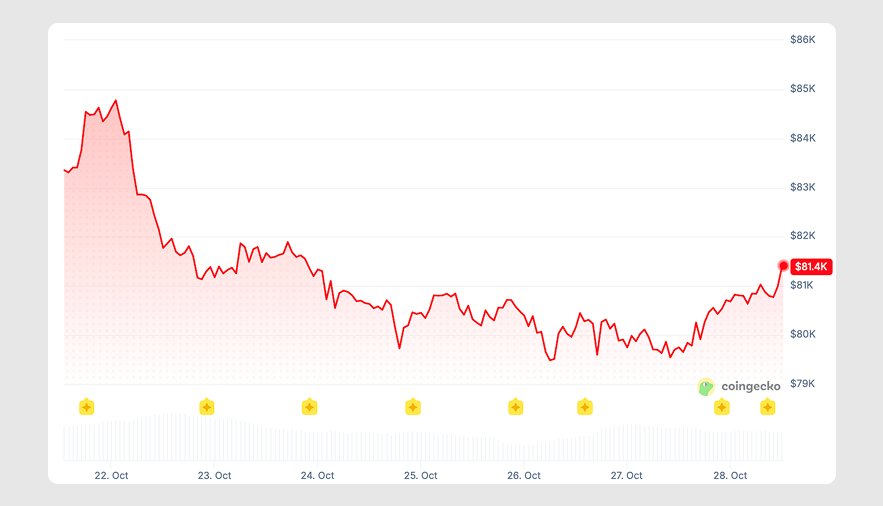
At the time of writing, Bitcoin is trading at $81,431.17, up 1.6% over the past 24 hours but down 2.1% over the week.
ETH price
Ether is struggling to hold $2,350 as ETF outflows add to bearish sentiment. Derivatives data shows leveraged positions shrinking since early October, and funding rates more than halved yesterday, a sign of weaker demand for long positions.
Spot Ethereum ETFs shed $88.58 million on Monday after attracting just $4.35 million last Friday, with last week’s net outflows totaling $220.61 million. So far this month, outflows have reached around $1.26 billion, approaching the monthly record of $1.42 billion set in November 2025.
Ether’s decline mirrored Bitcoin’s pullback. ETH dropped from $2.5k on October 21 to roughly $2.3k the following day, then resumed its slide on October 24. It bottomed at $2,234.39, failed to hold the $2.35k level, and slipped toward $2.3k yesterday. A recovery over the past few hours has since lifted ETH back toward $2.35k.
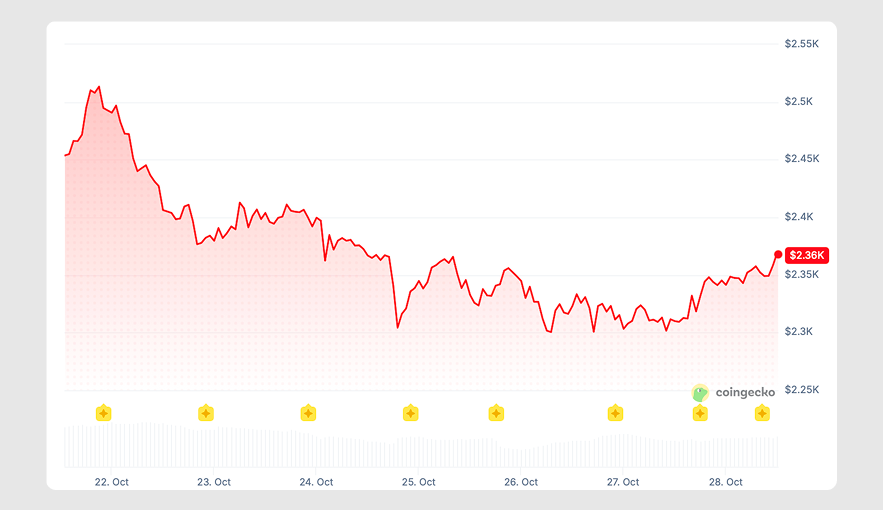
At the time of writing, ETH is trading at $2,362.50, up 2.2% over the past 24 hours but down 3.3% over the week.
Seven-day market dynamics
Renewed strikes in the Middle East have pushed oil higher, with Brent futures trading above $115 a barrel and WTI holding above $101. Crypto took the hit over the weekend, when traditional markets were closed: Bitcoin tested $80k, and major altcoins posted double-digit losses. Declines were widespread, from DeFi and lending tokens such as MORPHO to infrastructure projects and several established altcoins, though their size varied.
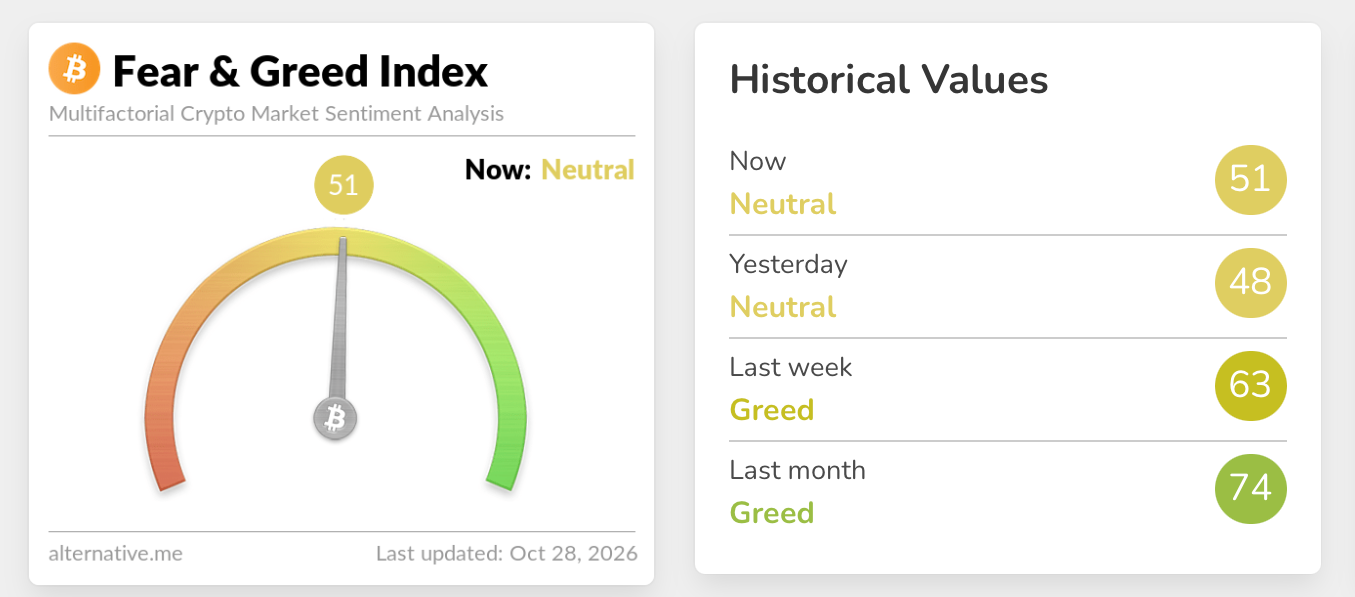
Market sentiment slipped out of the Greed zone last Friday and has since hovered around 50/100, a Neutral reading on the Fear & Greed Index.
New Middle East strikes
Over the weekend, the Houthis said they had targeted three Saudi airports, energy installations, a pipeline, and an air base. A refinery attack followed on Tuesday, renewing supply worries and pushing markets to price in a greater risk of further escalation. The US has reportedly warned several Gulf states that a short but intense military campaign may follow the US midterm elections in November.
Traders are waiting for clarity on President Trump’s next move on Iran. A reported US diesel arrangement with Moscow adds another variable to the outlook, as it could affect Russian crude exports while production in several key OPEC+ members remains below target.
Traders look beyond the Fed's October decision
The October FOMC meeting concludes today, with markets pricing in a hold and CME FedWatch showing close to 91% odds. New York Fed President John Williams has said there is “no need for urgency.” Vice Chair Philip Jefferson echoed that view, arguing policymakers need more time to assess incoming data after September's rate increase to 3.75%–4%, the first hike since 2023.
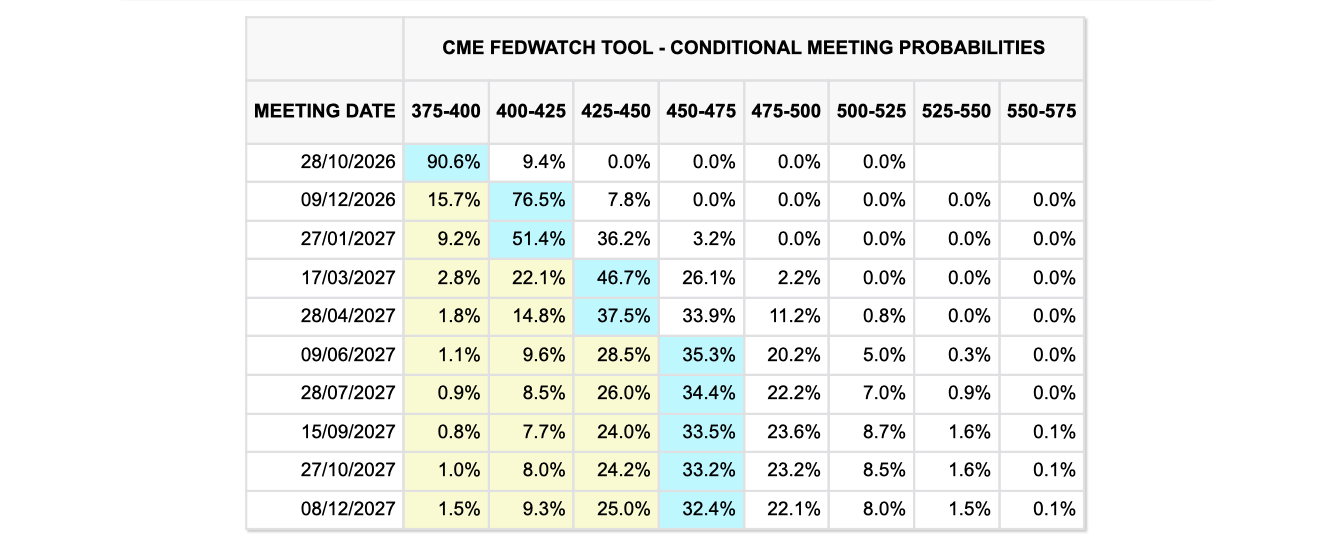
Traders will scrutinize the Fed chair's press conference for clues about a possible December hike. The odds of a further increase now exceed 80%, including nearly 8% for a half-point move. A hike would raise borrowing costs and could pull money out of riskier assets such as crypto.
Williams expects one more hike later this year, a view J.P. Morgan Global Research shares, citing the FOMC’s “dot plot.” The bank’s researchers don’t expect a prolonged hiking cycle, though, arguing that inflation still appears to be driven largely by supply shocks. The next test for that outlook comes Thursday, when September PCE inflation data and third-quarter GDP figures are due at 8:30 a.m. ET.
Top weekly winners
- M (+38.9%) rallied amid a broader rotation into memecoins, while traders also positioned ahead of a November 1 unlock of 56.11 million tokens, or 2.45% of its current circulating supply. The upcoming release may have fueledshort-term trading, although spot liquidity remains thin.
- DASH (+9.3%) gained as technical indicators pointed to a potential breakout and perpetual futures volume surged. Volume jumped more than 77% to $218 million on October 23, alongside rising open interest and a positive funding rate favoring long positions.
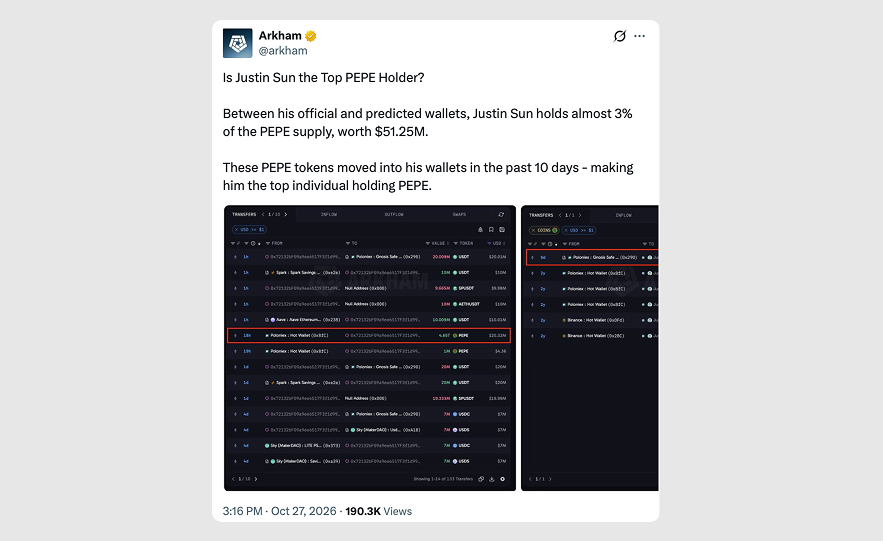
- PEPE (+9.3%) also advanced, following NEAR Protocol’s announcement of confidentiality features for PEPE transactions. Meanwhile, Arkham Intelligence data suggests that wallets linked to Justin Sun now hold nearly 3% of the total PEPE supply, which would make him the top individual holder.
Top weekly losers
- WLD (-25.8%) came under pressure from supply dilution, whale deposits to exchanges, and millions of dollars in long liquidations. A vesting event on October 24 released roughly $59 million worth of WLD, and project-linked addresses reportedly sent around 10.5 million tokens to major centralized exchanges, stoking fears of selling pressure.
- RAIN (-23.8%) plunged as Bitcoin dipped below the psychological $80k level and traders cut risk ahead of the Fed decision. Broader deleveraging and long liquidations may have added to the selling pressure.
- PEARL (-22.2%) has slid steadily since October 21, when it hit an all-time high of $2.46 after being added toCoinbase’s asset roadmap and getting a mention from Grayscale. Profit-taking has weighed on the price since, andreports that the lab quietly raised around $130 million have sparked debate on X, as they appear to conflict with earlier claims that the project had no venture-capital backing.
Cryptocurrency news
Ripple gets final approval for a national trust bank
The Office of the Comptroller of the Currency granted final approval Monday for Ripple National Trust Bank, completing a process that began with a conditional green light in December 2025. The bank will manage the segregated reserves backing Ripple’s RLUSD stablecoin, act as collateral trustee for holders, and offer fiduciary digital asset custody to enterprises.
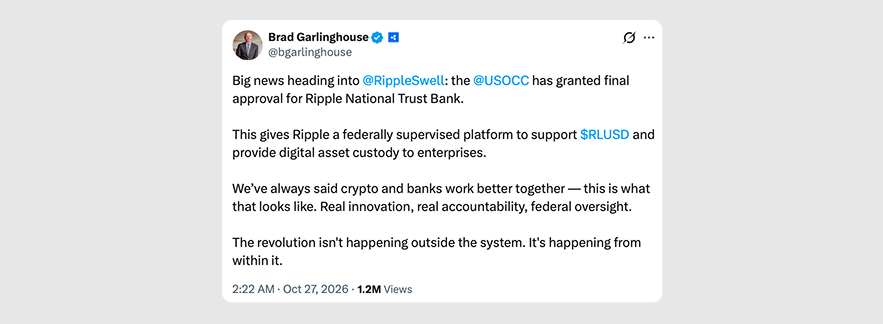
“For years, we’ve said crypto and banks work better together,” CEO Brad Garlinghouse said. “Final approval for Ripple National Trust Bank is what that looks like in practice.” He added on X: “The revolution isn’t happening outside the system. It’s happening from within it.”
Why it matters
Launched in December 2024, RLUSD has grown to a market capitalization of around $2.5-2.6 billion. It is used across Ripple’s payments network and as collateral within its Ripple Prime brokerage, with BNY as its primary reserve custodian.
The stablecoin will continue to be issued by Standard Custody & Trust Company, Ripple’s New York-regulated subsidiary. The new charter adds federal OCC supervision to the existing state-level framework, but it does not make RLUSD a bank-issued stablecoin or a bank deposit, and holders get no FDIC insurance. What changes is the infrastructure behind it: a federally supervised institution now sits behind the stablecoin’s reserves and custody, which matters as issuers try to build trust with institutional clients.
Critics push back
The approval comes amid a wider debate over crypto firms’ access to bank charters. Senator Elizabeth Warren has argued that the OCC’s crypto charters violate the National Bank Act, saying the companies want to avoid the safeguards and obligations imposed on traditional banks. Earlier this month, the Independent Community Bankers of America sued the OCC, calling the charters a “side door into the banking system” that bypasses requirements including capital rules and FDIC insurance. Crypto industry groups, meanwhile, have urged the OCC to defend the approvals.
The broader push
The charter fits into a wider expansion of Ripple’s institutional business. On Tuesday, BNY added XRP and RLUSD to its digital asset custody platform, and the two companies plan to explore tokenized trade finance on the XRP Ledger. Ripple also announced a partnership with Robinhood covering stablecoins, treasury operations, and institutional markets.
Ripple says it will keep working with federal and New York regulators as the bank prepares to begin operations and the US implements the GENIUS Act. Taken together, the moves show Ripple building regulated infrastructure that links digital assets to existing financial services. How much the trust bank matters in practice will depend on how its services roll out.
Franklin Templeton wants your dividends to buy Bitcoin
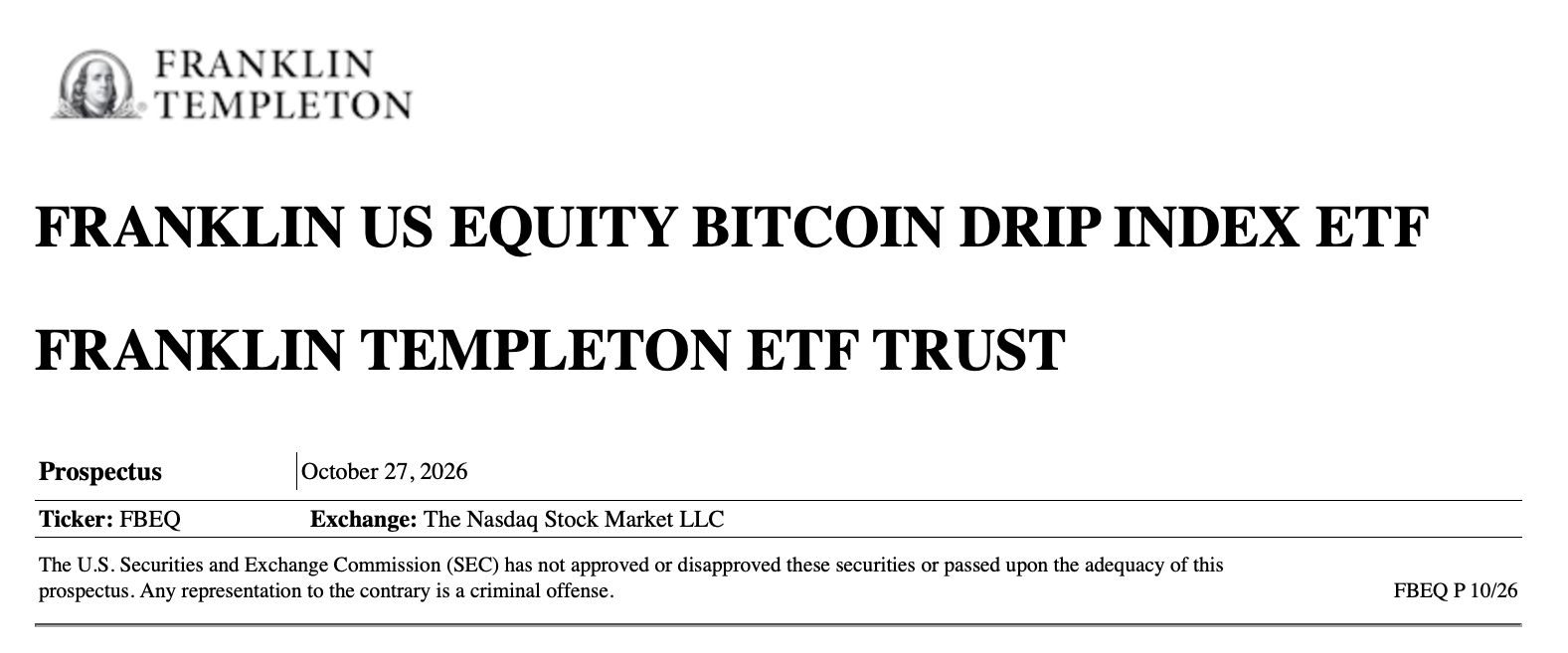
Franklin Templeton has a novel pitch for traditional investors. The $1.7 trillion asset manager has registered two Nasdaq-listed ETFs that hold US equities and route every dividend payment into Bitcoin. The filings, first submitted in June, cleared their final regulatory hurdle this week, with a prospectus effective date of October 27.
Keep your stocks, but let the dividends buy Bitcoin
The Franklin US Equity Bitcoin DRIP Index ETF (FBEQ) works like a traditional dividend reinvestment plan, except the payouts buy Bitcoin instead of more shares. It tracks the VettaFi US Large-Cap 500 Bitcoin DRIP Index, which at inception allocates 95% to the 500 largest US companies and 5% to Bitcoin. Every dividend those companies pay, regular or special, is reinvested into Bitcoin at the market open the day after the ex-date.
The Innovation fund (FBIQ) uses the same mechanic on a narrower index of 100 large non-financial Nasdaq companies. For investors, that turns the dividend stream from America’s biggest companies into a recurring Bitcoin purchase, with no exchange account, no wallet, and no custody decisions.
The guardrails
The Bitcoin allocation has limits. At each quarterly rebalance, anything above 5% is trimmed back to 4.5%. If Bitcoin climbs past 20% between rebalances, it’s cut back within two business days and the proceeds return to stocks.
The funds don’t hold Bitcoin directly. Exposure comes through ETPs, including Franklin’s own spot fund, futures, options, or depositary receipts, sometimes via a Cayman Islands subsidiary. FBEQ carries a 0.09% expense ratio.
Riding the ETF wave
The proposal lands amid a surge of crypto ETF experimentation since the SEC published generic listing standards for crypto-linked funds in late 2025. Bitwise predicted more than 100 such ETFs could launch in 2026, and Bloomberg Intelligence counted well over 100 filings in the pipeline at the end of last year. Franklin’s dividend-into-Bitcoin design is the latest twist after covered-call income products and other structured wrappers, all competing for assets beyond plain spot exposure, where BlackRock’s iShares Bitcoin Trust dominates with tens of billions in net assets.
The bigger picture for Franklin Templeton
Franklin Templeton isn’t new to crypto. It filed for a spot Bitcoin ETF in September 2023, launched EZBC in January 2024, and in April acquired 250 Digital to form Franklin Crypto, an institutional digital asset division. CEO Jenny Johnson has argued that blockchains threaten Wall Street’s fee structure more than its technology, and the DRIP funds extend that thesis to investors who might never buy Bitcoin on their own.
Whether the trade-off appeals to Franklin’s target audience will become clear after launch. The prospectus warns that investors can lose money and that Bitcoin’s price swings may affect the fund’s net asset value. Still, for investors who want crypto exposure without the crypto decisions, it’s a clever piece of product design.