Clapp Weekly: Shaky Bitcoin rebound, Wall Street shuns tokenized stocks, JPM Coin on Ethereum

BTC price
Bitcoin has recovered to $83k after slipping to about $81,400 yesterday, when a sell-off in Asian chip stocks on renewed AI concerns dragged crypto lower. Strong overnight corporate earnings in the US helped extend the rebound.
The dip came despite the largest daily spot ETF inflow in nearly a month. On October 19, US spot Bitcoin ETFs attracted $526.6 million, all of it through BlackRock’s IBIT. Flows have been uneven over the past month, though, and rebounding oil prices and doubts about the long-term AI trade continue to cap Bitcoin’s upside.
BTC lost its grip on $84k on October 14 and bottomed near $80k the following day, then struggled to reclaim $82k. After slipping below $81k again on Monday, it climbed to $82.7k, lost momentum, and fell to $81,423.24 yesterday. The latest rebound has since lifted BTC toward $83.5k.
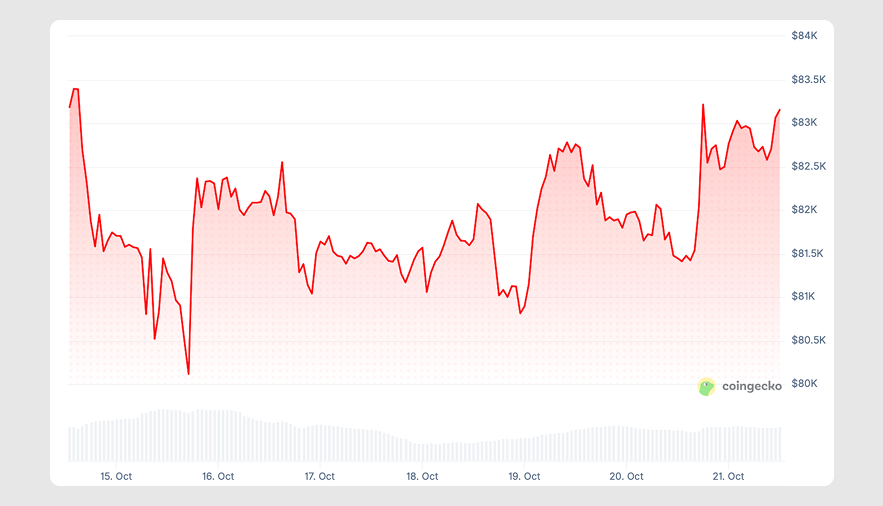
BTC is currently trading at $83,384.88, up 2.6% over the past 24 hours and virtually unchanged on the week.
ETH price
Ether is back above $2.4k as BitMine keeps accumulating, buying 12,535 ETH last week, and as staking hits new highs. A Bitwise report found that staked ETH reached a record 43.80 million in Q3, equivalent to 35.9% of the total supply, though yields slipped as rewards were distributed across a larger pool of staked ETH.
ETFs remain a drag: US spot Ethereum ETFs logged a fifth straight day of withdrawals on October 20, with investors pulling $26.13 million after $103.28 million the day before. That also extends net outflows to four straight weeks.
The ETH price followed BTC lower, sliding from $2.5k to $2,337.78 on October 15. A rebound faltered below $2.4k, and the price dipped to $2,335.57 on October 18 before recovering past that level. After another pullback, ETH rallied to $2,469.93 yesterday.
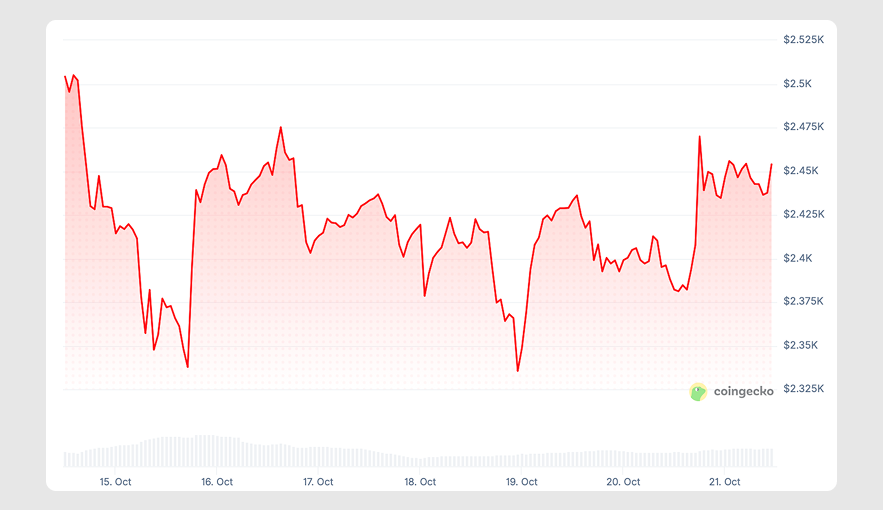
ETH is currently trading at $2,452.76, up 3.0% over the past 24 hours but down 2.1% over the past week.
Seven-day market dynamics
Crypto markets faced fresh liquidations and a broader shift away from risk as Bitcoin pulled back and weakness in equities dampened demand for altcoins. The Crypto Fear & Greed Index stands at 63, signaling Greed, after fluctuating between 52 and 63 over the past week. Mid-cap altcoins also struggled as hotter-than-expected US inflation and consumer data added to risk-off sentiment, while crypto ETFs saw further outflows.
Several factors continue to limit a market recovery: rising AI spending, renewed concerns over the sector’s risks and returns, continued US-Iran hostilities, uncertainty ahead of the US midterm elections, and rising global bond yields. Traders are also looking ahead to the Federal Reserve’s October 28 meeting, where markets expect interest rates to remain unchanged.
Middle East whipsaw
Oil prices swung sharply on Tuesday as conflicting reports emerged about the state of the US-Iran war.
Qatar and Pakistan reportedly presented a proposal to end the conflict that had received preliminary approval from both sides. Brent crude fell another $3 a barrel on the news, while technology stocks pared their losses.
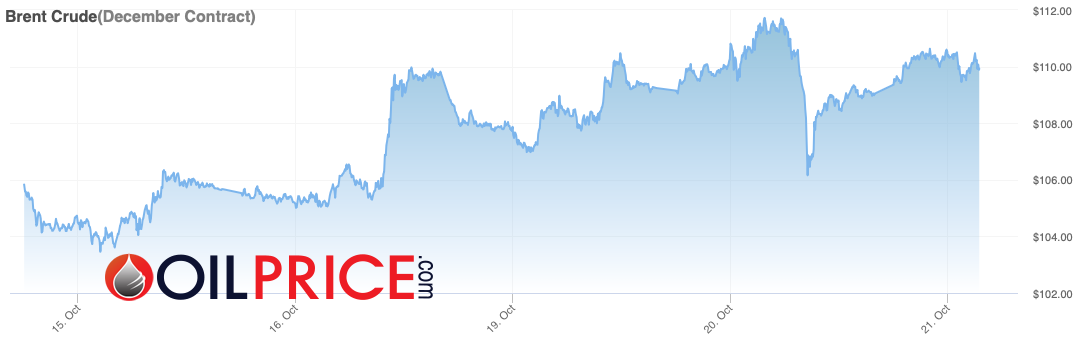
The optimism faded within hours as reports of progress toward a peace deal were denied. Oil reversed course, with Brent climbing above $111 a barrel, its highest level since May. The Nasdaq gave up its recovery and returned to flat, while Bitcoin retreated and altcoins broadly tracked its decline.
AI jitters resurface
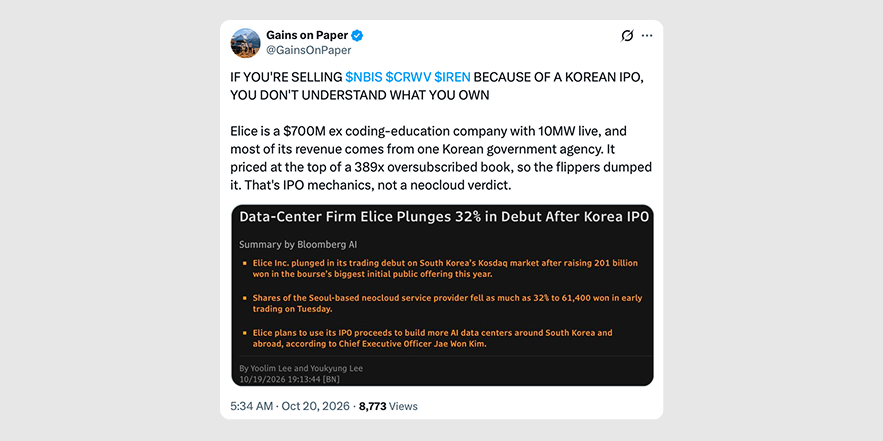
The Tuesday IPO of Elice, a South Korean neocloud provider, added to concerns over the AI spending boom, weighing on Bitcoin alongside gold and technology stocks. The listing raised just $151 million, less than a quarter of the company’s roughly $755 million valuation, despite retail demand that was reportedly more than 400 times oversubscribed.
Elice shares (0158S0) fell more than 30% from their offer price of 90,500 won on their first day of trading. The weak debut added to questions about whether the returns from AI investments can justify the scale of spending. Across the sector, borrowing costs, high debt levels, and capital-intensive expansion plans are facing increased scrutiny.
Top weekly winners
- AKE (+31.7%) rallied on October 15 as trading activity picked up after a multi-week drawdown. Despite the rebound, AKE remains roughly 77% below its September 20 all-time high. High leverage and active futures trading amplify its price swings, while the token has also benefited from broader rotation into micro-cap AI gaming projects.
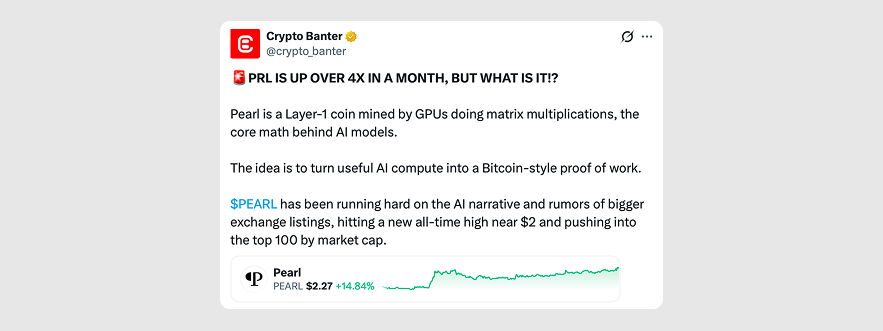
- PEARL (formerly PRL, +20.0%) gained after Coinbase added the token to its roadmap, drawing attention to its AI-powered Proof-of-Useful-Work model, which uses GPUs to secure the network while also supporting AI training. Heavy trading volume and influencer attention fueled the rally, while a listing on Entropy last week added to the momentum.
- WLD (+14.6%) climbed after Worldcoin launched a new World ID offering for banking and finance, designed to verify human users and guard against AI-driven identity fraud. The initiative targets financial institutions and has attracted design partners including Bain Capital, Pantera Capital, and VanEck. Buying momentum also triggered short liquidations, adding fuel to the rally.
Top weekly losers
- STX (-16.7%) retreated amid profit-taking after its early-October rally and a broader pullback in altcoins. The token had surged on renewed interest in Bitcoin staking and Q4 roadmap updates, including BTC bonding and Epoch 4.1, leaving traders with an incentive to lock in gains.
- CC (-15.4%) fell alongside the wider market as macro uncertainty and profit-taking weighed on prices. Annual token dilution may have added to the pressure, despite ongoing development of institutional use cases. Uncertainty around the DTCC Tokenization Service rollout on Canton Network may also be keeping traders cautious.
- BTW (-12.4%) pulled back after a parabolic rally took the token to an all-time high of $2.77 on October 14, briefly lifting it into the top 20 cryptocurrencies by market capitalization. The correction reflects profit-taking after the sharp run-up, compounded by the broader altcoin retreat.
Cryptocurrency news
Microsoft, Alphabet and Goldman Sachs push back against tokenized stocks
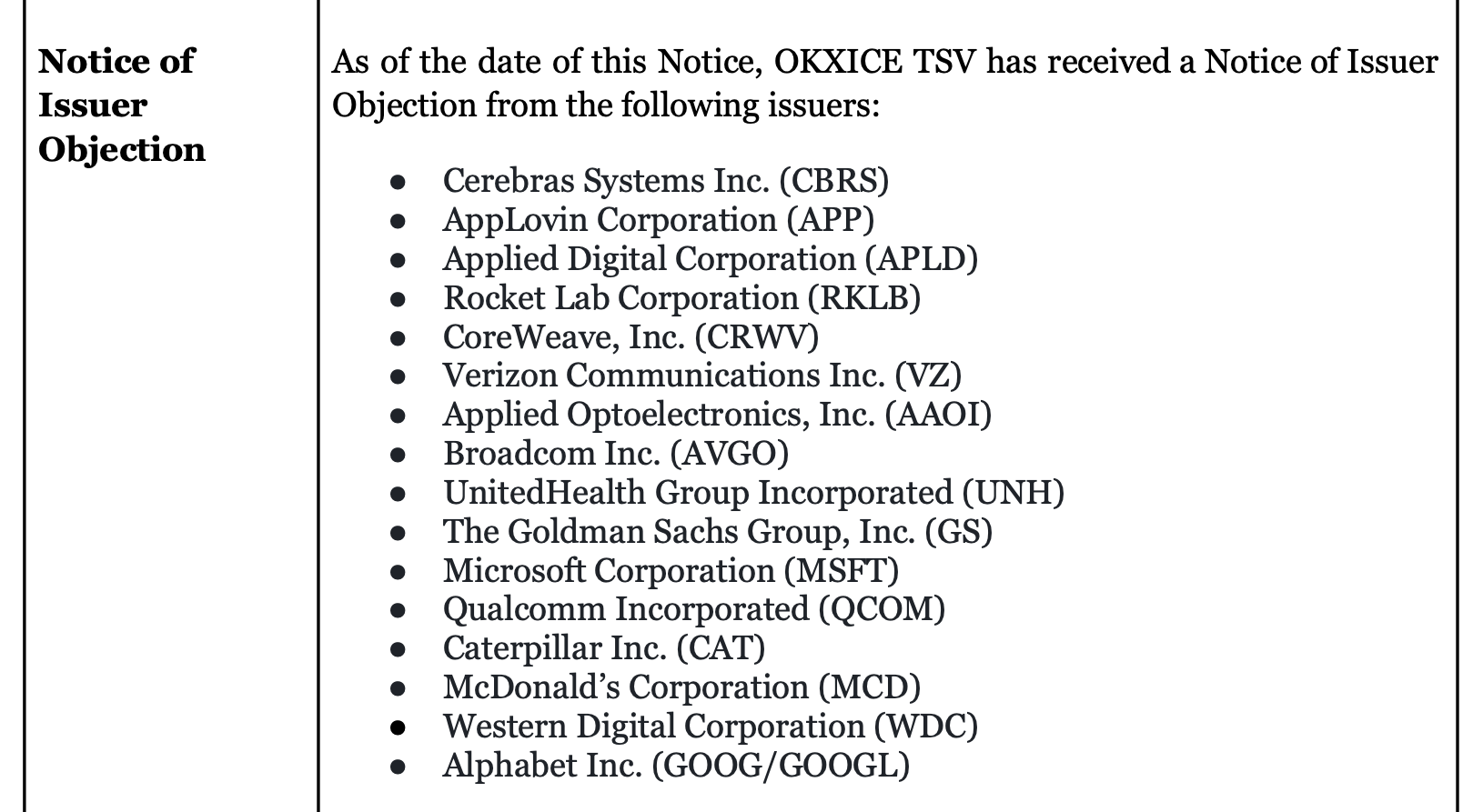
Sixteen companies have now objected to having their shares traded on OKXICE, the planned tokenized stock venue from crypto exchange OKX and NYSE parent Intercontinental Exchange. Microsoft, Alphabet and Goldman Sachs joined the list this week, alongside Qualcomm, Caterpillar, McDonald’s and Western Digital.
The pushback is growing quickly. Seven companies joined the nine previously disclosed objectors in the updated notice dated October 19. Of the 62 companies originally listed by OKXICE, 15 have now objected. Cerebras Systems, the 16th objector, was not on the original roster, leaving 47 companies without a disclosed objection.
No explanation so far
Some of America's largest companies are refusing to let third parties tokenize their shares without their consent. However, the latest public notice does not explain why the companies objected or when they submitted their objections.
Under OKXICE’s proposed model, tokens would be backed one-for-one by underlying shares held through a registered broker-dealer. Token holders would receive equivalent rights, including dividends and voting rights.
Goldman Sachs’ inclusion is particularly notable given the bank’s own investments in blockchain-based markets. Asked whether tokenization, decentralized finance (DeFi) and prediction markets could eat into the firm’s trading revenue, CEO David Solomon recently described the developments as an opportunity:
“The developments are obviously creating more products, greater activity, potentially new clients, broader distribution channels.”
Solomon also compared the shift to electronic stock trading nearly 50 years ago, which initially raised similar concerns.
The Nasdaq angle
Nasdaq is not among the objectors, but it is keeping its distance from the proposed model. The exchange operator has said it will opt its own shares out of the SEC’s innovation exemption. A spokesperson told the Wall Street Journal that Nasdaq does not want its stock traded on a venue that fails to display the best prices in real time or report trades to the consolidated tape.
That is a pointed critique of OKXICE’s structure. The planned venue would not be subject to the same Regulation NMS requirements that govern traditional US stock markets, including rules designed to protect best-price execution and ensure fair access.
A quiet change
The updated notice also contains a subtle shift. The October 15 version said the venue would offer stocks tokenized by third parties unaffiliated with the companies. The October 19 version says it may offer stocks tokenized either by an outside party or by the issuer itself. That could give companies a more direct role in how their shares are represented onchain.
The distinction matters because the SEC’s objection process applies to tokens created by firms unaffiliated with the issuer. A company that issues its own tokens would not be subject to that same third-party objection mechanism.
The bigger picture
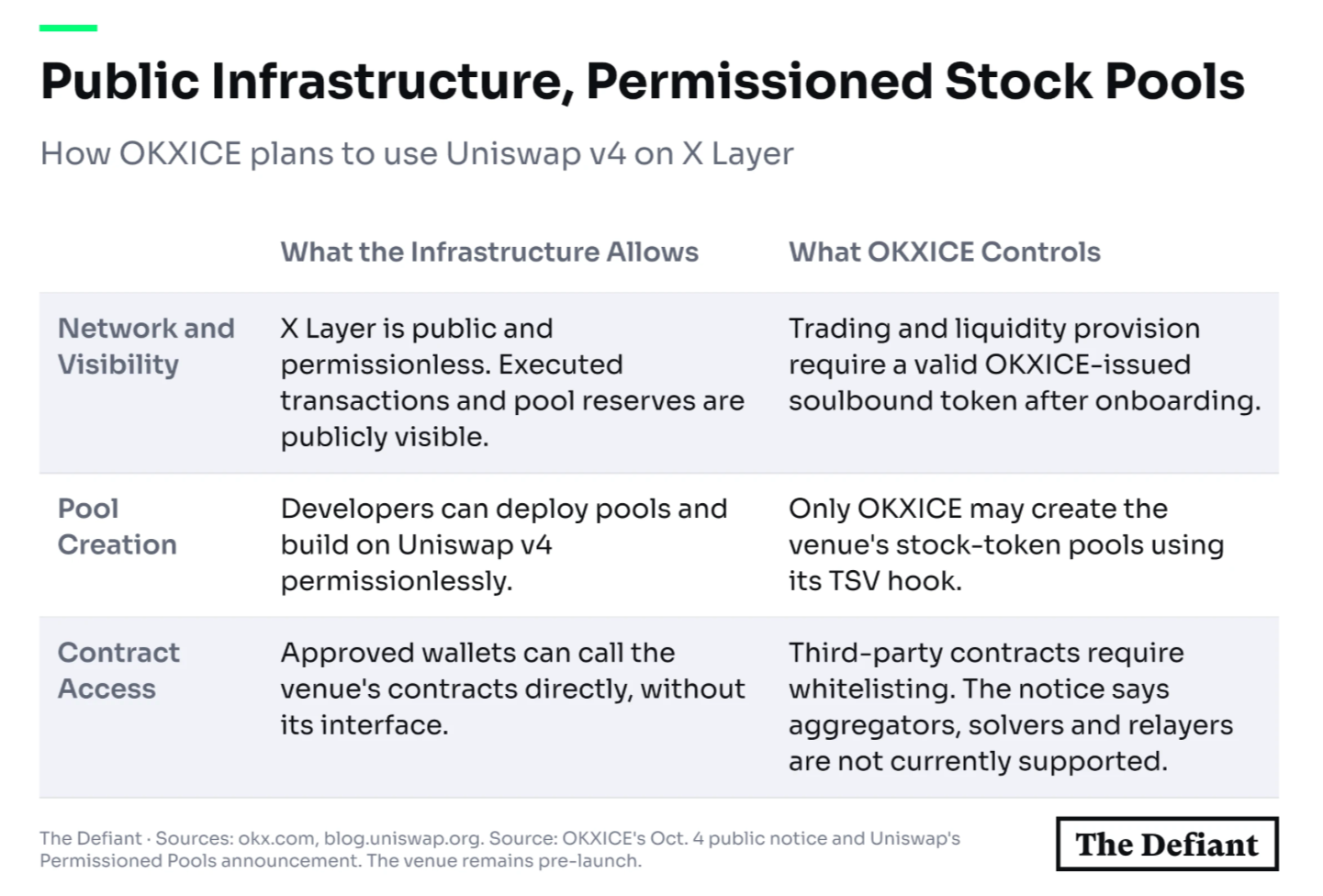
OKXICE announced the planned venue on October 5, under the SEC’s five-year “Innovation Exemption,” issued on September 17. The framework allows qualifying venues to trade tokenized US stocks through automated market makers and liquidity pools. OKXICE plans to operate around the clock on OKX’s XLayer blockchain, with trades settled in stablecoins, and use Uniswap's v4 pools.
Under the SEC’s order, a venue offering tokens minted by an unaffiliated firm must notify the issuer in writing and wait at least 30 calendar days. If the company objects in writing during that window, the venue must disclose the objection within five business days and cannot make that tokenized stock available for trading.
The exemption was intended to make tokenized US equities easier to trade, but the early response shows that regulatory permission alone may not be enough. The companies whose shares would underpin these markets still have a say in whether they participate.
The IMF has also raised concerns, reporting that tokenized US equities were roughly 1.5 times as volatile as their traditional counterparts, with significantly lower trading liquidity. Its study covered five actively traded tokenized US stocks, including Tesla, Nvidia and Alphabet, across centralized and decentralized venues, comparing them with the Nasdaq 100 index.
JPMorgan brings its dollar token to Ethereum — will ETH pump?
JPMorgan has brought JPM Coin to Ethereum. On October 19, the bank’s blockchain division, Kinexys, made its dollar deposit token available to institutional clients on Ethereum mainnet. The token had previously launched on Base, Coinbase’s layer-2 network. The expansion gives clients another public blockchain for moving money.
The move is another sign of growing overlap between traditional finance and crypto. Emma Landriault, global head of Kinexys Labs at JPMorgan, described it as part of a broader convergence between the two sectors:
“It's not just Wall Street going to public chains, but the institutional web3 players getting more embedded and partnering with traditional financial institutions.”
But greater institutional use of public blockchains does not automatically translate into demand for their native tokens.
What JPM Coin is
JPM Coin is a deposit token launched in November 2025 to support peer-to-peer transfers between institutions and provide an onchain liquidity layer for dollar deposits. It operates within the Ethereum Virtual Machine ecosystem, allowing approved clients to move funds around the clock rather than wait for conventional banking hours.
Each JPM Coin represents a US dollar deposit at JPMorgan. The underlying deposits remain liabilities on the bank’s balance sheet, rather than being removed from the banking system whenever tokens move between clients.
Access remains restricted to approved institutional clients. JPM Coin is not a stablecoin available to the general public.
Why Ethereum
JPMorgan cited Ethereum’s established onchain liquidity and range of tokenized assets as reasons for choosing the network. The bank has also deployed tokenized money market funds, including MONY and JLTXX, on Ethereum mainnet. A deposit token on the same network can provide a cash leg for transactions involving those assets.
Kinexys processes more than $7 billion in transactions daily. That is substantial activity, but it covers the broader Kinexys business, not JPM Coin transactions on Ethereum alone. It also remains a small fraction of JPMorgan’s roughly $12 trillion in daily payments.
The ETH question
The news did not immediately translate into a price boost for ETH. On Tuesday, Ether traded near $2,386, down 4.2% over the week. US spot Ether ETFs recorded about $103 million in outflows on October 19, the day JPM Coin went live on Ethereum, followed by another $26.13 million in outflows the next day.
The muted response makes sense. JPMorgan is building payment infrastructure for its clients, not making a directional bet on ETH. JPM Coin users need ETH only to cover network gas fees, and they do not have to hold it as an investment.
Institutional adoption can strengthen Ethereum’s role as financial infrastructure, but the effect on ETH’s price depends on how that activity translates into demand for blockspace and whether investors are willing to hold the asset. A major bank using Ethereum is a meaningful development for the network, but it is not automatically a bullish catalyst for its token.