Who controls tokenized stocks? Wall Street vs. crypto platforms

Tokenization puts shares of publicly traded companies on blockchains, where they can trade around the clock and settle faster. The harder question is who gets to do the tokenizing. Under the SEC’s Innovation Exemption, a crypto venue can list tokenized versions of a US stock without asking the issuer first. Companies can respond by filing an objection, and major corporations are now doing just that.
Tokenization promise meets corporate resistance
Tokenized stocks bring traditional equities onto blockchain networks, enabling 24/7 trading, faster settlement and integration with decentralized finance (DeFi). Crypto platforms see an opportunity to expand their markets beyond digital assets, while investors could gain access to equities through familiar crypto interfaces.
A proposed trading venue from crypto exchange OKX and Intercontinental Exchange (ICE), the parent company of the New York Stock Exchange, would offer tokenized versions of dozens of US-listed companies, pairing them with stablecoins such as USDT, USDC and USDG.
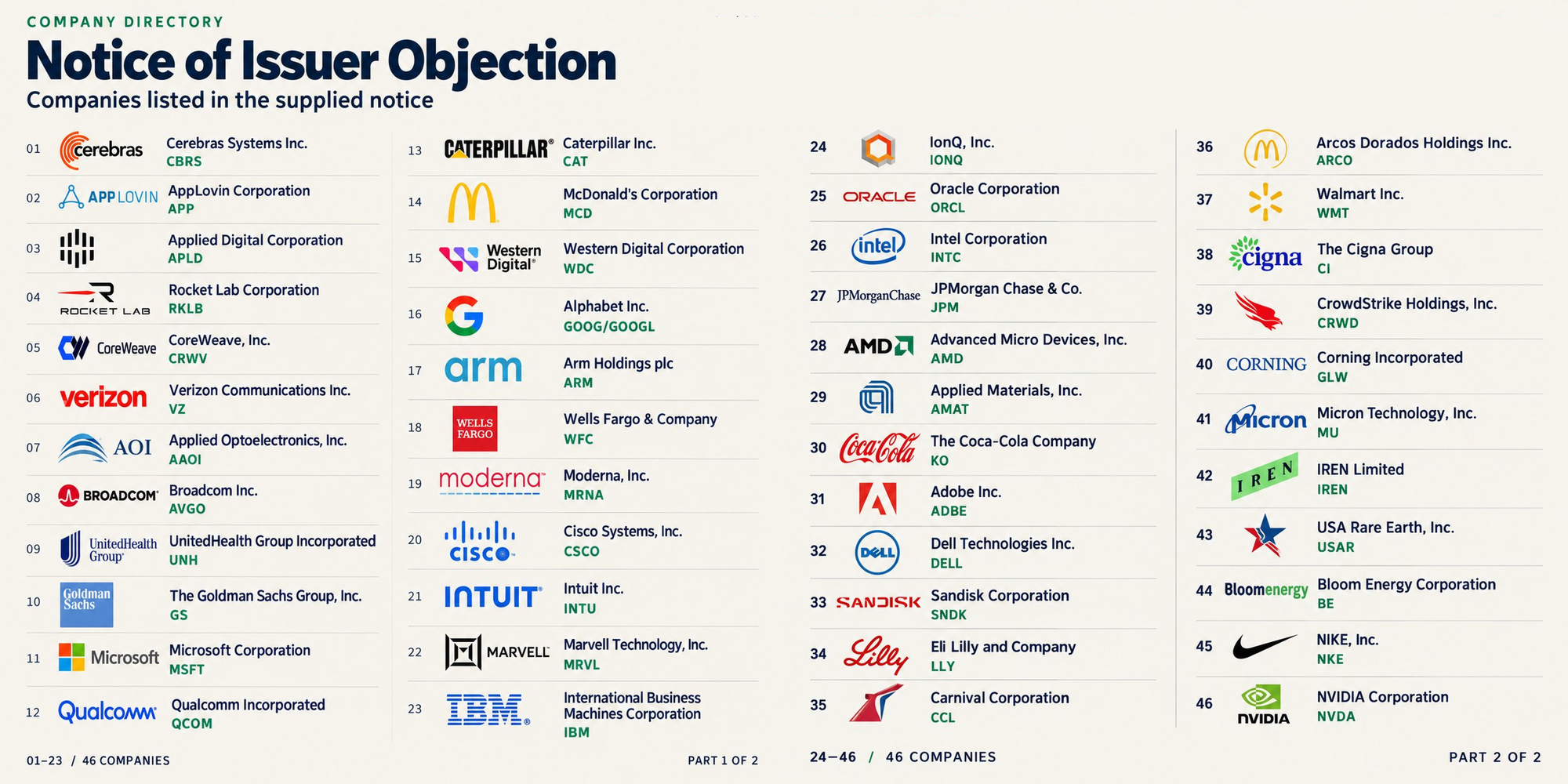
Objections piled up quickly. As of November 1, 50 companies had objected, 43 of them among the 62 originally targeted by OKXICE. The list includes:
- Microsoft and Alphabet
- Goldman Sachs and JPMorgan
- Broadcom and Qualcomm
- Coca-Cola and Adobe
- Wells Fargo and Cisco
How tokenized stocks work
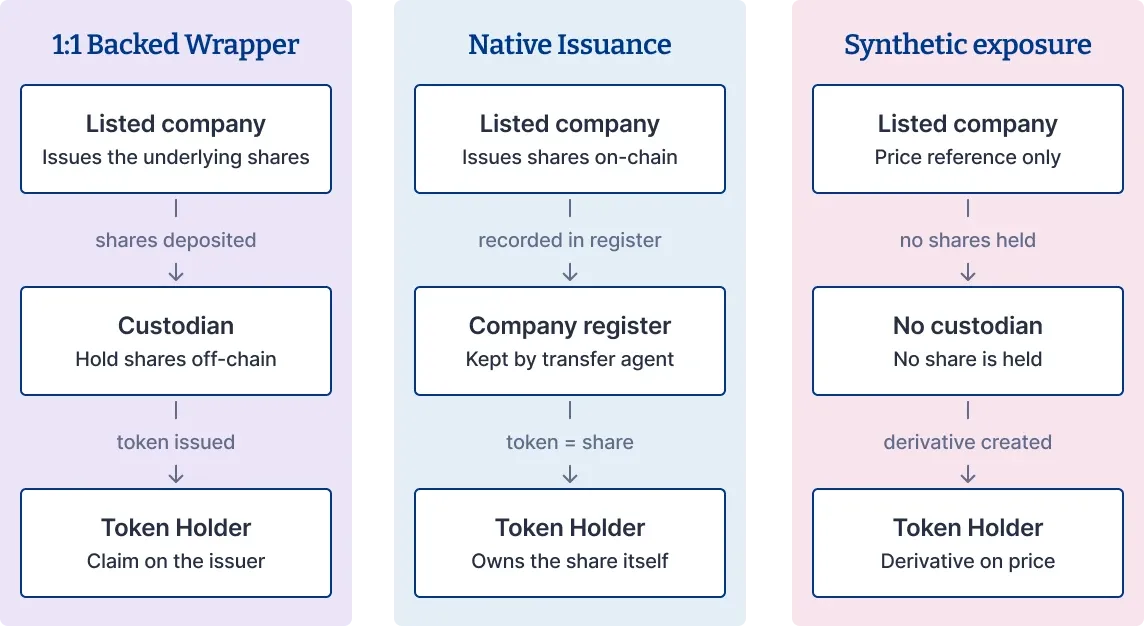
Tokenized stocks are not all the same, and the distinction matters as the legal rights attached to them can vary significantly. The SEC distinguishes between two broad models: securities tokenized by or on behalf of their issuers, and those tokenized by unaffiliated third parties.
Model A: Issuer-sponsored tokenization
The company or an authorized intermediary issues a tokenized version of its stock. The token represents the underlying share, with ownership recorded through the relevant securities infrastructure. Depending on the legal structure, holders can retain the same rights as conventional shareholders, including voting privileges and dividend entitlements. The issuer or its authorized intermediary remains involved in the process.
Model B: Third-party tokenization
The OKX-ICE case falls into this second category. An independent platform or intermediary creates a token representing an existing publicly traded stock without the company's involvement. In a typical asset-backed structure, a custodian or special purpose vehicle (SPV) holds the underlying shares off-chain, while corresponding tokens are issued on a blockchain.
Token holders may have an indirect beneficial interest or contractual claim rather than being registered shareholders themselves. Dividend distributions and voting rights depend on the structure and legal arrangements.
This model also introduces additional counterparty and custody risks. For example, if the entity holding the underlying shares becomes insolvent, token holders may face complications in recovering their interests.
Asset-backed tokens differ from synthetic ones. The latter simply track a stock's price through a derivative or other contractual arrangement and do not necessarily represent ownership of the underlying equity.
SEC opens the door to onchain stock trading
On September 17, 2026, the SEC issued its Innovation Exemption, creating a five-year, conditional framework for trading tokenized US-listed stocks. The order grants temporary relief from specific provisions of the Securities Exchange Act of 1934 to qualifying Tokenized Securities Venues (TSVs) and certain liquidity providers.
Eligible TSVs can operate permissioned automated market makers (AMMs) and liquidity pools without being treated as exchanges under Section 3(a)(1) of the Act. Meanwhile, certain liquidity providers — referred to as "covered firms" — receive limited relief from the definition of a dealer under Section 3(a)(5). This relief applies when they supply liquidity using their own capital and meet the conditions set out in the order.
The exemption comes with conditions, and it doesn't remove the usual anti-fraud and anti-manipulation protections under federal securities laws.
- It doesn't give TSVs the same regulatory status as registered exchanges or alternative trading systems.
- Synthetic exposure to stocks falls outside the exemption's scope.
- Eligible tokens must represent the equivalent underlying stock and provide holders with the same rights and privileges, including voting and dividend rights.
- Issuers also have an opportunity to object to third-party tokenization of their shares. The process involves two separate 30-calendar-day notice periods.
A TSV must publish its own public notice at least 30 days before beginning operations. Separately, when a third party unaffiliated with the issuer tokenizes its stock, the venue must notify the issuer and give it 30 calendar days to object. If the issuer files a timely objection, the venue cannot list that tokenized stock under the exemption. The SEC's official FAQs explain both requirements.
Why are major companies objecting?
Following the exemption, OKX and ICE announced plans to launch a tokenized stock trading venue through their 50/50 joint venture, OKXICE LLC. The proposed platform would use OKX's X Layer blockchain and permissioned automated market maker liquidity pools built on Uniswap v4.
The 50 objectors also include firms that weren't on the original listing roster. Most formal objections have not explained their reasoning publicly. Applied Optoelectronics, a fiber-optic maker, was one of the companies that did speak out, citing concerns about pricing, liquidity and volatility.
The company's spokesperson told the Wall Street Journal that investors could become confused about the firm's involvement in an offering it had neither sponsored nor endorsed. Applied Optoelectronics also saw no clear benefit to the company or its shareholders that justified the uncertainty.
The reasons below are inference from the issuers’ side.
- Companies may not want third-party platforms distributing products based on their shares without their involvement, and under the SEC framework issuers can object to a particular venue but don’t control every platform or tokenization arrangement.
- Investors could assume a tokenized stock is officially endorsed when the issuer has no part in it.
- Extra venues can fragment liquidity and open gaps between tokenized and conventional share prices, and thin trading makes the true market value of a token harder to read.
- Issuers may also worry about how voting, dividends and corporate actions would work across platforms. The exemption requires equivalent rights, but products outside it can have very different legal structures.
A fight over market structure
The argument is about how future securities markets should operate, and OKX is only one party to it. As noted by Forbes, two main issues are fueling the controversy:
- An issuer receives no proceeds when a third party tokenizes existing shares.
- The company has less control over who holds its shares and where they are traded, particularly when tokens can move between platforms.
The third-party model sits outside the traditional structure that connects issuers to regulated venues and intermediaries. Transfer agents maintain official records of share ownership, while exchanges and other regulated market participants operate under rules covering surveillance, settlement and price reporting. Tokenization introduces new ways to represent and transfer shares, potentially changing how these relationships work.
A full-page Wall Street Journal ad placed by the Common Sense Leadership Fund warned CEOs of exactly that: "YOUR STOCK. THEIR TOKENS. YOUR PROBLEM."

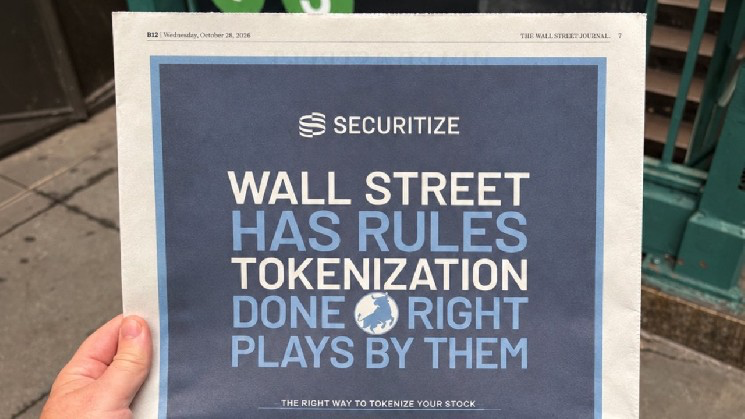
Tokenization firm Securitize responded with a rebuttal in its own full-page WSJ ad: "WALL STREET HAS RULES. TOKENIZATION DONE RIGHT PLAYS BY THEM." The ad promoted what it called "the right way to tokenize your stock": 1:1 backing by real shares, voting and dividend rights, SEC-compliant venues, and lawful transfers subject to KYC and AML checks for verified investors.
The advertising campaign also became a point of contention in its own right. The fund's ultimate backers were unclear, while Nasdaq denied having any connection to the campaign, despite a QR code in the ad linking to a Nasdaq FAQ.
Wall Street versus crypto platforms: who benefits?
Crypto-native platforms (exchanges, fintech apps and DeFi venues) stand to attract more users by bringing stocks onto blockchain rails.
- Reach and trading hours. 24/7 trading lets investors react to news outside exchange hours, and fractional ownership lowers the barrier to expensive shares. Liquidity isn’t guaranteed at every hour, though.
- Revenue and product range. TSVs can capture trading fees, market-making spreads and custody or token management fees, and they can offer selected US-listed equities without issuer sponsorship as long as they meet the exemption’s conditions and the issuer doesn’t object.
- DeFi composability. Whether tokenized stocks can serve as collateral or feed AMM pools depends on the token’s legal and technical structure.
On the other side, public companies could benefit from extra secondary-market liquidity, with new channels and trading windows driving additional interest in their shares. This could generate fresh trading activity without issuers having to build their own distributed ledger infrastructure, as noted by Galaxy. The catch is that issuers receive no proceeds when a third party tokenizes existing shares, which is one of the central points of disagreement.
Traditional financial infrastructure providers may also benefit from integrating tokenization into established clearing, custody and settlement systems. Legacy brokerages, stock exchanges and banks could combine the compliance frameworks of traditional finance with blockchain’s speed and programmability.
One example is Nasdaq Ventures’ collaboration with Kraken’s parent company, Payward, Inc., on a competing tokenized-equity initiative. The partnership deepened in September 2026, when Nasdaq announced a planned $100 million investment in Payward to advance work on the Nasdaq Equity Token (NET) framework.
Unlike the third-party model behind OKXICE, Nasdaq’s approach is issuer-centric. It aims to tokenize public company shares while preserving their legal, regulatory and economic equivalence with traditional shares, and it is still in development rather than live. Nasdaq has also raised concerns about market fragmentation, price discovery and the risks of tokenized markets operating without adequate regulatory oversight.
The clearing infrastructure is moving too. On July 15, 2026, the Depository Trust & Clearing Corporation (DTCC) reported successful production tests involving tokenized assets, and on October 28 it launched its Tokenization Service, which lets eligible securities held at DTC be represented and transferred on supported blockchain networks. That approach builds tokenization into existing custody and settlement rather than having third parties tokenize shares independently.
What this means for investors
Blockchain-based transfers can enable faster, potentially atomic settlement, but secondary-market prices may diverge from those of the underlying shares. Tokenized securities also stay under securities law, so access restrictions and investor eligibility requirements still apply. And a token held through a custodian or SPV carries the counterparty risk described earlier.
Who controls the future of stock markets?
Three groups are pulling in different directions on who should drive tokenization.
- Companies and authorized intermediaries want to retain control over how their shares are represented and traded, and can bring tokenization into existing legal and operational frameworks.
- Crypto trading venues want to use blockchain infrastructure to make equity trading more accessible and flexible, with tokens that plug into other onchain products.
- Traditional market institutions (exchanges, custodians and clearing houses) want to modernize existing systems without losing the safeguards built around them.
Growing activity from exchanges, custodians and institutions suggests tokenization is coming either way. Blockchain makes securities easier to transfer, trade and plug into other financial applications, but it doesn’t settle ownership, shareholder rights, governance or regulatory responsibility.
For now, the main lever issuers hold is the 30-day objection right, and it works platform by platform. The objections so far show they’re willing to use it.