Should you repay your crypto loan early?

Your crypto loan is still open. Interest keeps ticking up. Then some extra cash lands in your account.
The obvious question is: should you use it to repay the loan? It sounds straightforward, but it isn't.
Repaying early certainly saves interest. But it also uses cash that could earn yield, cover an emergency, or be deployed elsewhere.
The right answer depends less on the loan itself and more on what that money could do if you kept it.
TL;DR
- Early repayment saves interest. The sooner you repay, the less you pay in interest over time.
- Most platforms don't charge early repayment penalties. On many CeFi platforms, you can repay early without extra fees. But check your lender's terms first.
- Liquidity matters. If you use cash to repay early, you might not have it available for other opportunities or emergencies.
- Opportunity cost is real. The money you use to repay could have earned yield in savings or been deployed elsewhere.
- Credit lines are flexible. You can repay partially or in full at any time, without closing your access to future liquidity.
What happens when you repay early
Repaying the loan in full stops interest from accruing and unlocks your collateral.
With a fixed-term loan, the relationship ends there—you'd need to apply again if you wanted to borrow in the future.
With a revolving credit line, repayment restores your available credit, so you can borrow again whenever you need to.
Will you pay a penalty?
Many CeFi lenders allow early repayment without penalties, but not all loans are structured the same way.
Some fixed-term products may charge an early repayment fee or include prepaid interest that isn't refundable. That's why it's worth checking the loan agreement before assuming you can exit for free.
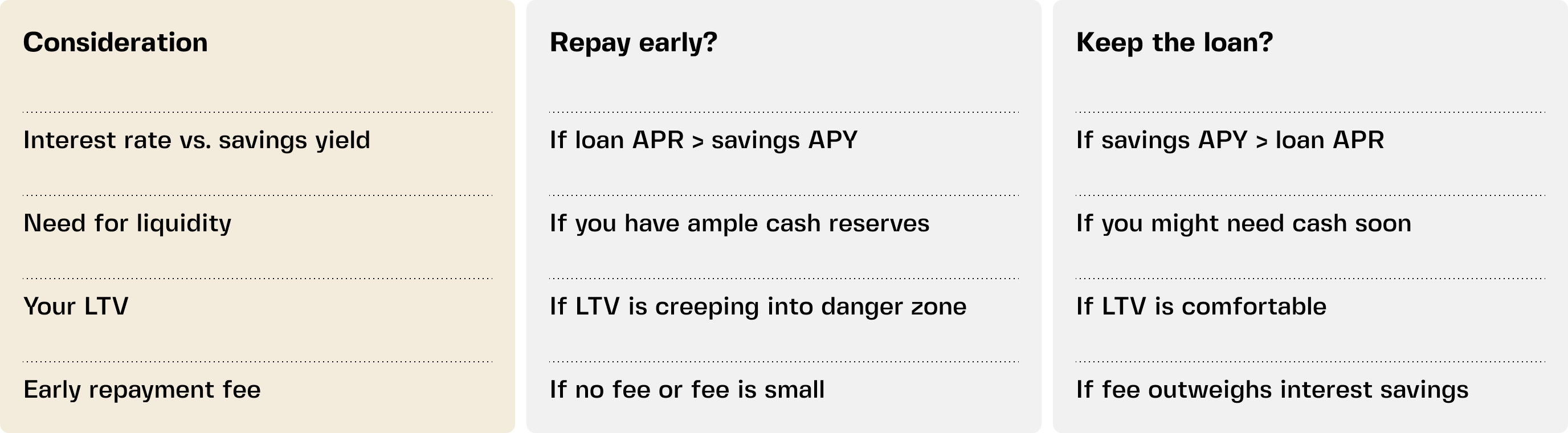
If repayment is partial, several things will usually happen:
1. You may pay less interest
If interest is calculated daily, every repayment immediately reduces the balance you're paying interest on.
With a revolving credit line, interest is charged only on the amount you've actually borrowed, so every partial repayment lowers future borrowing costs.
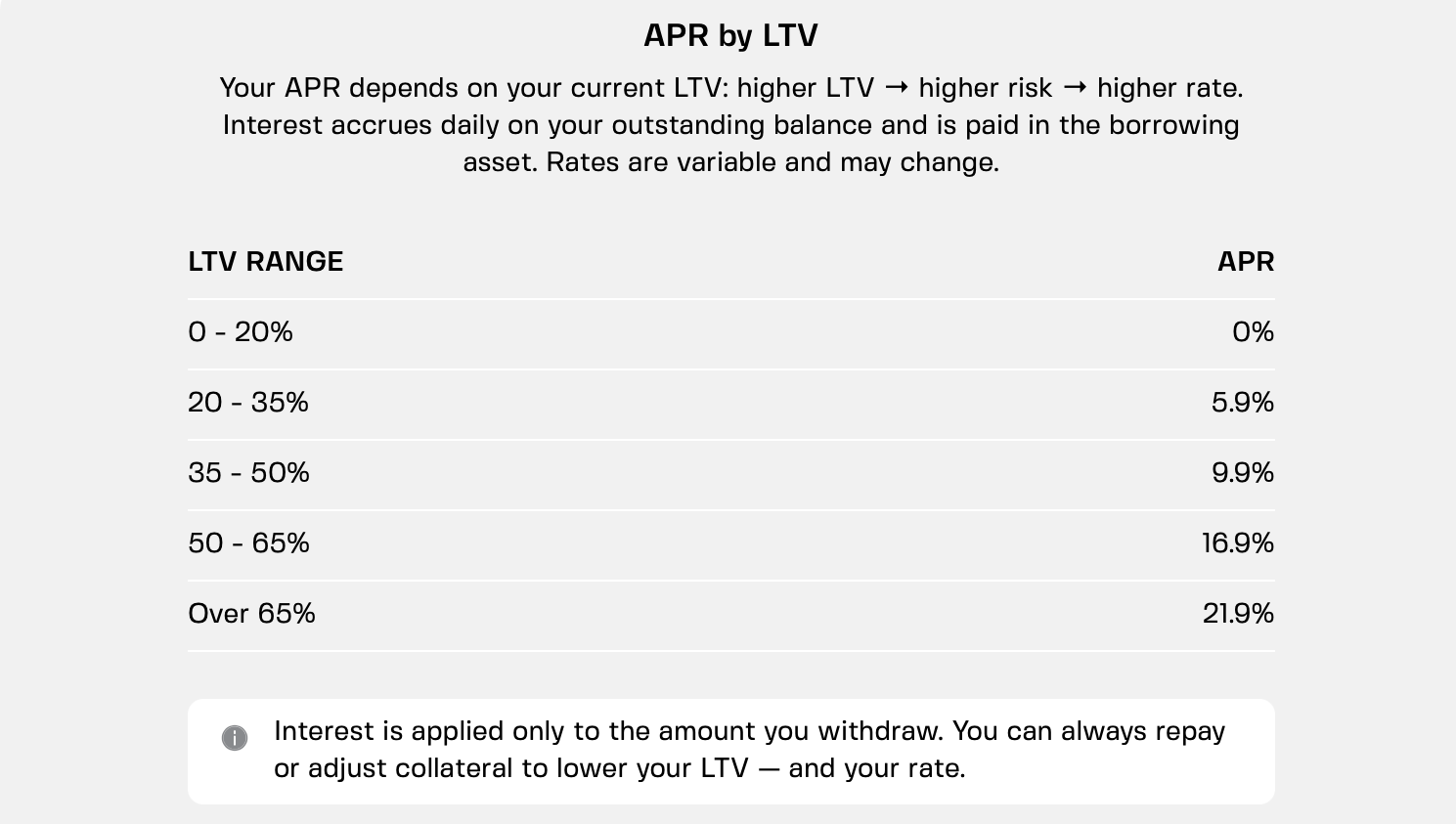
On some platforms, lowering your LTV may also move you into a better APR bracket. On Clapp, for example, borrowers with an LTV of 20% or below can qualify for a 0% APR credit line.
2. Your collateral may remain locked
With most fixed-term loans, partial repayment doesn't automatically release part of your collateral. The loan simply becomes smaller and cheaper to maintain.
Credit lines are often more flexible. If your LTV remains comfortably below the required threshold, some platforms — including Clapp — allow you to withdraw part of your collateral without closing the credit line.
3. Your safety buffer grows
Every repayment lowers your LTV, increasing the distance between your position and the liquidation threshold. That means fewer margin-call worries if markets become volatile.
The experience also differs between DeFi and CeFi.
- On DeFi lending protocols, smart contracts liquidate positions automatically once the liquidation threshold is reached — usually without warnings.
- Most CeFi lenders generally notify borrowers as their LTV rises, giving them an opportunity to add collateral or repay part of the loan before liquidation becomes necessary.
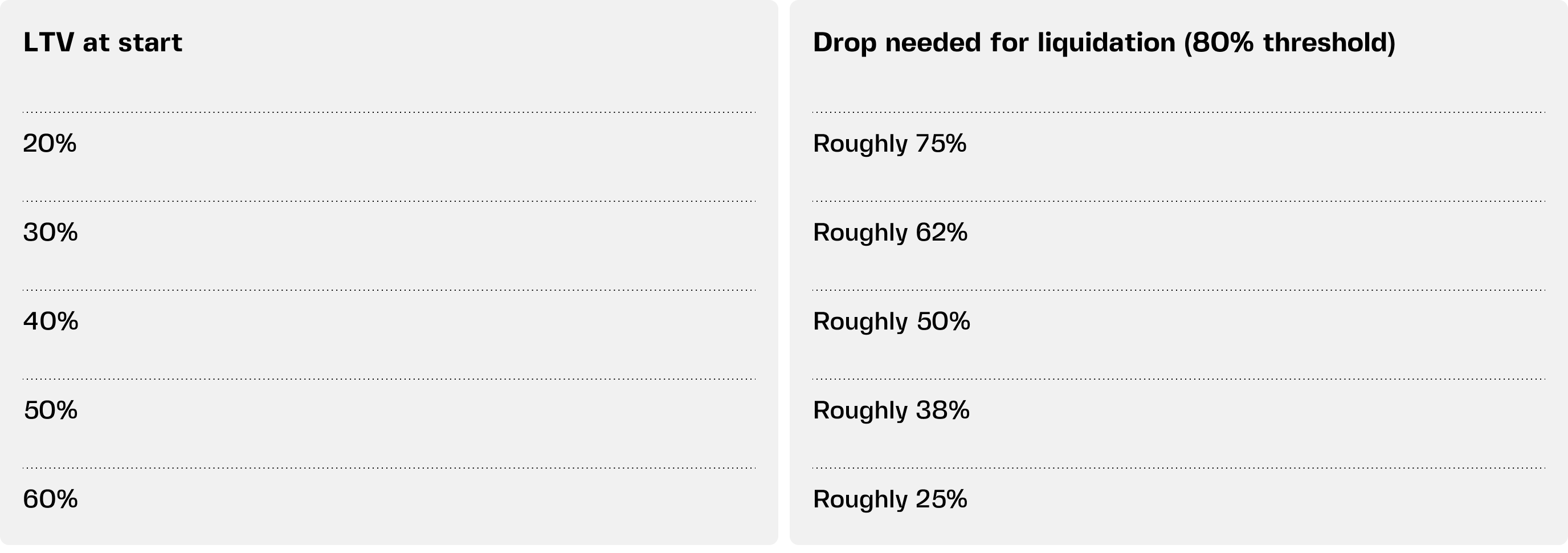
How much protection does a lower LTV actually provide? The table below shows the approximate market decline required to reach liquidation, assuming a typical liquidation threshold of 80% LTV. Exact thresholds vary between platforms, but the principle remains the same: the lower your starting LTV, the larger your safety buffer.
4. You free up your credit line
On revolving credit lines, every repayment restores part of your available borrowing limit. That gives you flexibility if an emergency or investment opportunity appears later. Keeping the line permanently maxed out does the opposite — it leaves little room for unexpected events while increasing borrowing costs and liquidation risk.
In practice, early repayment is rarely an all-or-nothing decision. Many borrowers simply make partial repayments over time, reducing interest costs while keeping liquidity available if they need it later.
The case for repaying early
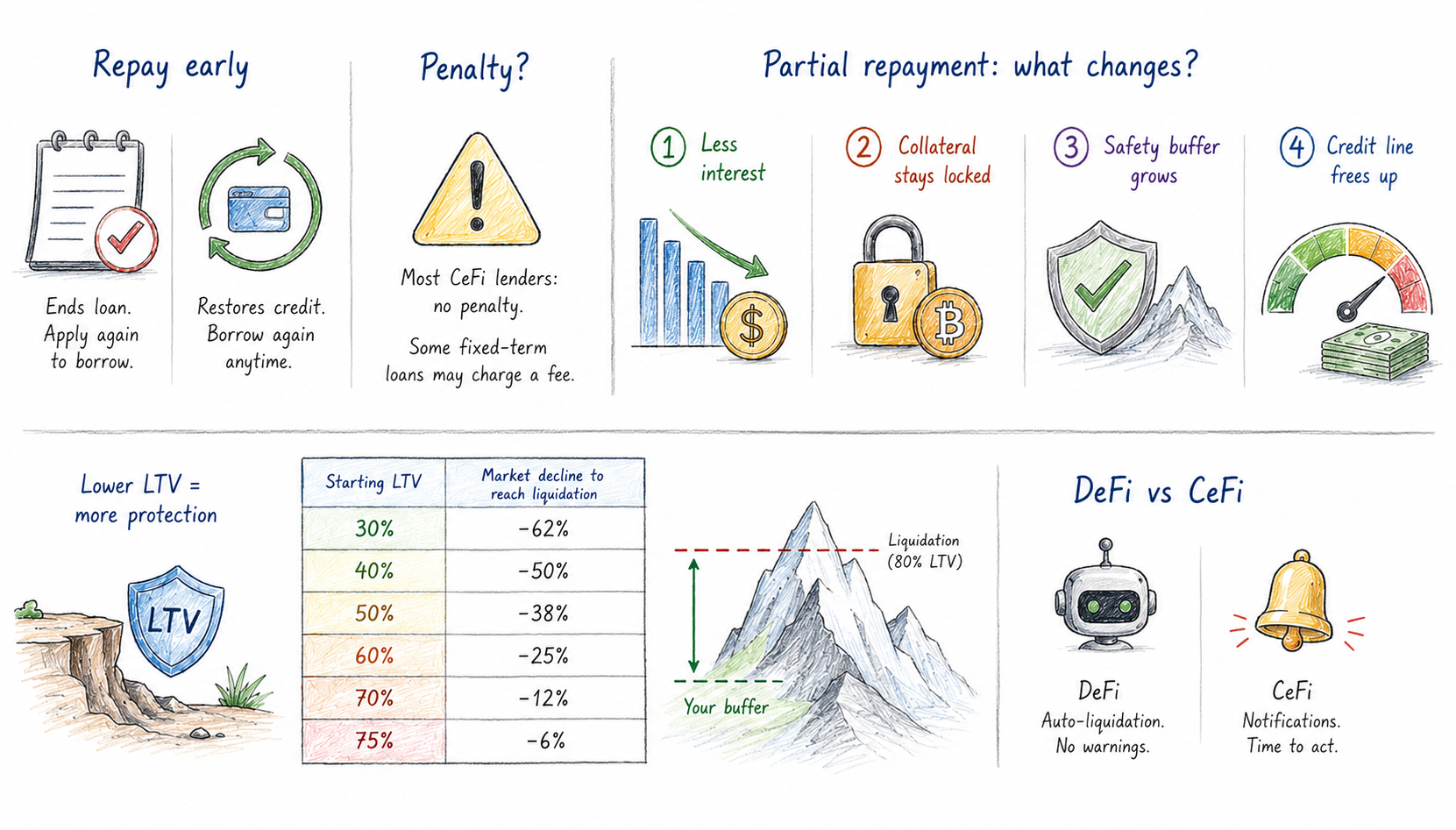
Repaying early makes sense when:
Your cash isn't earning much. If it's sitting in an account earning almost nothing, using it to repay a loan charging 6% APR produces a predictable return by eliminating future interest.
Your LTV is getting close to the danger zone. A partial repayment can lower your LTV and give you more breathing room during volatile markets.
You're finished with the loan. If you no longer need the liquidity, closing the loan gets your collateral back and simplifies your finances.
The case for not repaying early
Keeping the loan open and holding onto your cash might be the better move when:
- Your money can work elsewhere. If your savings earn 5% APY while your loan costs 6% APR, the effective cost of keeping the loan is only about 1%. Paying that difference may be worthwhile if it preserves liquidity.
- You might need liquidity soon. Once you repay, accessing that cash again may require opening a new loan or drawing on a credit line. Keeping liquidity available has value, even if it isn't immediately needed.
- You have a 0% APR credit line. If your borrowing costs are zero, there's no rush to repay. You're not losing money by keeping the loan open. Just make sure your LTV stays low.
- Early repayment fees eat into the benefit. If your lender charges early repayment fees, compare the savings in interest against the fee before making a decision.
Opportunity cost matters
When you use cash to repay a loan, you're also giving up everything else that cash could have done.
- Could it have earned yield in savings?
- Could it have served as collateral for another investment?
- Could it have remained available for an emergency?
That's why the interest you save is only one side of the equation. The other is the value of keeping that cash available.
For example, suppose you have a $10,000 loan at 6% APR and $10,000 in cash. You could repay the loan today and save about $600 in annual interest.
Or you could keep the loan, place that cash into Flexible Savings earning 5.2% APY, and collect roughly $520 over the same period. Your effective borrowing cost falls to around $80 for the year.
In other words, you're paying about $80 to keep $10,000 of liquidity available.
Whether that's worthwhile depends on how much you value liquidity. If you're expecting investment opportunities or simply want a larger financial cushion, keeping the loan open may be the better choice.
The credit line advantage
This is where credit lines really begin to stand out.
With a fixed-term loan, repaying early usually ends the relationship. If you need liquidity again later, you'll often have to apply for a new loan.
A revolving credit line works differently. You can borrow, repay, and borrow again without reopening the account or going through a new approval process.
That flexibility makes partial repayments particularly useful.
- Repay what you no longer need. A smaller outstanding balance means less interest.
- Keep your credit line available. Even after repaying the full drawn amount, the credit line remains open for future needs.
- Lower your LTV. Partial repayments increase your safety buffer and reduce liquidation risk without giving up access to future liquidity.
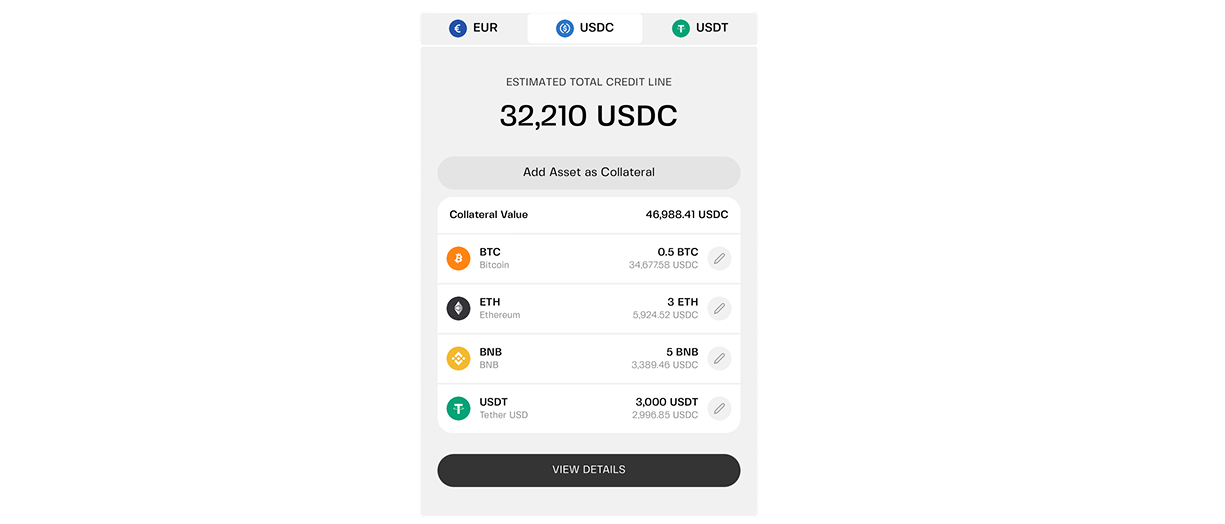
On Clapp, credit lines can be repaid at any time without early repayment penalties. As you repay, your available credit is restored automatically, giving you flexibility without sacrificing future borrowing capacity.
Bottom line: There's no universal answer
If you're paying 6% APR while your cash sits in a bank account earning almost nothing, repaying early is effectively a guaranteed return.
If your cash can earn 5% APY, however, the effective cost of keeping that same loan falls to roughly 1%. For many borrowers, that's a reasonable price to pay for keeping liquidity available.
And if you're using a 0% APR credit line, interest isn't the deciding factor at all. Managing your LTV and preserving financial flexibility become much more important.
The best decision isn't necessarily the fastest repayment. It's the one that balances borrowing costs, liquidity, and risk.
Frequently asked questions
1. Do crypto loans charge early repayment fees?
Many platforms don't. Binance Flexible Loans and Strike allow early repayment without penalties. Others may cap fees at a small amount. Always check your loan agreement before repaying early.
2. Can I repay a credit line early?
Yes. On Clapp and many other platforms offering revolving credit lines, you can repay partially or in full at any time without penalties. As you repay, your available credit is restored automatically, so the line remains ready whenever you need it.
3. Does repaying early affect my LTV?
Yes. Partial repayments reduce your outstanding loan balance, which improves your LTV. That lowers your liquidation risk.
4. What happens to my collateral when I repay early?
Once the loan is fully repaid, your collateral is released back to you. For credit lines, partial repayments keep your collateral in place but reduce your LTV.
5. Should I repay early if I have a 0% APR credit line?
Not necessarily. If your borrowing costs are zero, repaying early doesn't reduce interest expenses. Many borrowers prefer to keep the liquidity available while maintaining a conservative LTV. If your circumstances change, you can always repay later.