How MPC wallets protect your crypto without a seed phrase

Most crypto wallets come with a ritual. You write down 12 or 24 words, tuck the paper somewhere safe, and hope nobody ever finds it. You also hope you never lose it.
That list of words is your seed phrase, and whoever holds it can move your coins. An MPC wallet takes a different route. Instead of keeping the entire private key in one place, it distributes control across several key shares. In some MPC setups, the full key is never assembled, so there's no single piece of paper or device to lose, copy or steal.
This guide explains how that approach works, including what happens when your phone disappears, how MPC compares with a hardware wallet and an exchange account, and what the technology doesn't fix.
TL;DR
- MPC stands for multi-party computation. It allows several parties to work together to sign a transaction without sharing their individual key shares.
- In a threshold setup, no single share is enough to authorize a transaction. For example, a 2-of-3 wallet requires any two of its three shares.
- If you lose your phone, the other shares may allow you to recover access without a seed phrase. The exact process depends on the wallet's design.
- Unlike traditional multisig, MPC can produce a standard transaction signature, so the coordination happens off-chain.
- MPC doesn't eliminate every security risk. You still need to protect your account and understand who holds the key shares.
Why one key in one place is a problem
Every crypto wallet relies on a private key. A seed phrase, also known as a recovery phrase, is a set of words that can be used to restore access to it. The private key is a cryptographic secret used to create digital signatures that prove control over your assets and authorize transactions. Without it, you can't sign them, so the network won't move your coins.
The traditional setup keeps the private key in one place — on your phone or in the secure chip of a hardware wallet. A seed phrase provides a backup, usually written on paper or engraved on a metal plate. That creates a single point of failure:
- Lose your seed phrase, and your coins may be gone for good. There's no help desk for a lost recovery phrase.
- Leak it, and someone else can empty your wallet from anywhere in the world, often within minutes.
- Photograph it, email it or save it in your notes, and a copy may be sitting somewhere you've forgotten about.
Think of a house with one key. You can hide it well, but if it's lost or copied, the whole house is exposed. Multi-party computation, or MPC, changes the lock rather than the hiding place.
Multi-party computation crypto wallet explained
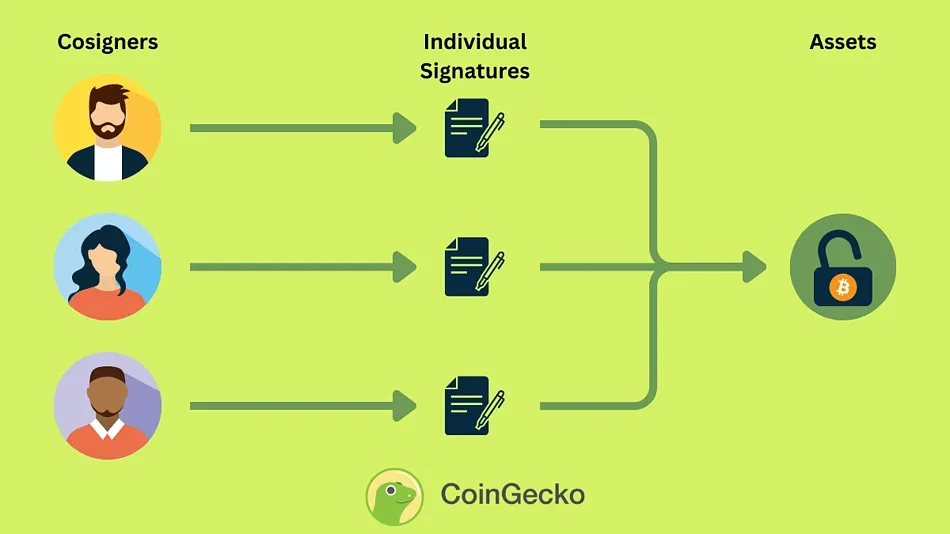
In simple terms, MPC wallets split the control of a private key into shares that are kept in different locations. The core principle is distributed key management with off-chain transaction signing. Here's how it works in a threshold-signature MPC setup.
The key is born in pieces
Your private key never exists as one complete piece. When an MPC wallet is created, each party receives its own key share, which cannot authorize a transaction on its own. Nobody sees or holds the full key because the shares are designed to work without being put back together.
Think of three people who each hold one piece of a combination. No one knows the whole number, yet together they can open the safe.
Signing needs the parties to agree
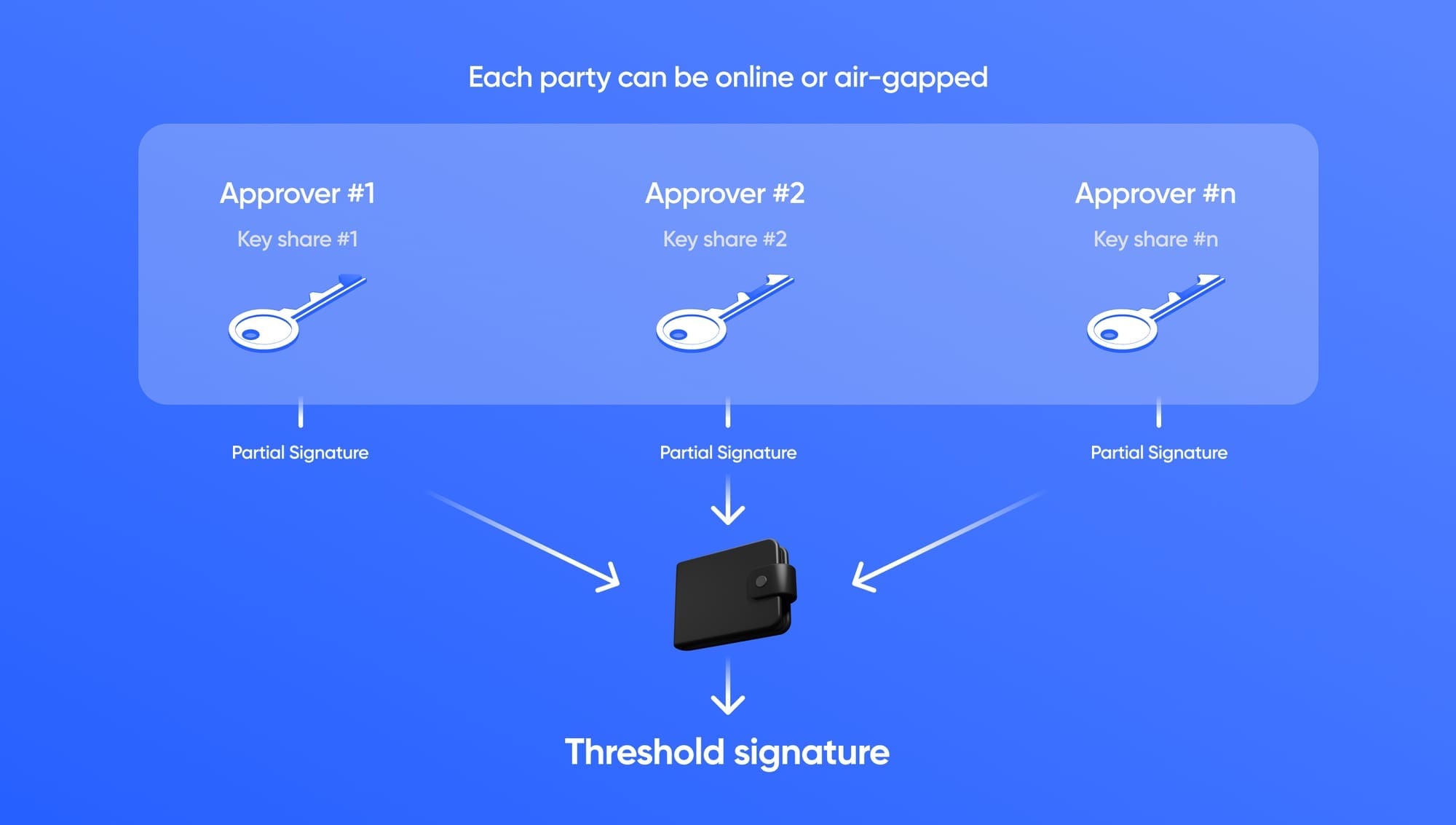
When you send crypto, the separate parties communicate. Each one performs a cryptographic computation using its own share and passes along a partial result. Those results combine into one valid signature, without the private key itself being reconstructed.
Most MPC setups use a threshold that determines how many shares are needed to approve a transaction. In a 2-of-2 setup, both participants must take part. For example, one share may be held on the user's device and the other by the service provider.
The 2-of-3 model is more flexible. It adds a third share, which may be held by a backup or recovery service. Any two shares are enough to sign a transaction, but one alone can't do it. That's why stealing a single share isn't enough to authorize a transaction.
What the blockchain sees
To the blockchain, an MPC transaction looks like any other, with a single address and signature. The network doesn't know or care that the signature came from several parties.
That separates MPC from many traditional multisig setups, where multiple signatures or an approval script are part of the on-chain transaction. With MPC, the coordination happens off-chain, and only the final signature reaches the network for the transaction to go through.
What happens if you lose your phone
With a classic self-custody wallet like MetaMask or Ledger, you can regain access to your wallet from a new device if you kept your seed phrase safe. Otherwise, your coins may be gone for good.
With an MPC setup, your phone usually holds one share, or access to one, instead of the whole key. The remaining shares can help you recover access. If your phone is broken or inaccessible, three things may follow:
- Your phone alone can't move your funds. A thief would need the other parties to cooperate, and they shouldn't do so without the required checks.
- You can prove who you are and set up a new device. The service verifies you through its recovery procedure, and your shares may be refreshed or reissued. The exact steps depend on how the wallet is built. Some consumer MPC wallets use social login, email verification or cloud-encrypted backups as part of the process.
- You don't need a 24-word seed phrase. Recovery relies on the setup itself, not on something you had to guard for years. With a threshold scheme like 2-of-3, you may still have enough shares available to restore access, even if one is lost. Some wallets use email verification or cloud-encrypted backups as part of this recovery process.
The trade-off is that your login now matters a lot. In many MPC wallets, access to your account and recovery steps are the new front door. A weak password, a hacked email account or a SIM swap can cause more damage than a stolen phone.
MPC is only one part of the security puzzle. Our app security settings checklist will help you lock down the rest, from setting a strong password and enabling 2FA to spotting phishing scams.
MPC vs hardware wallet vs exchange account
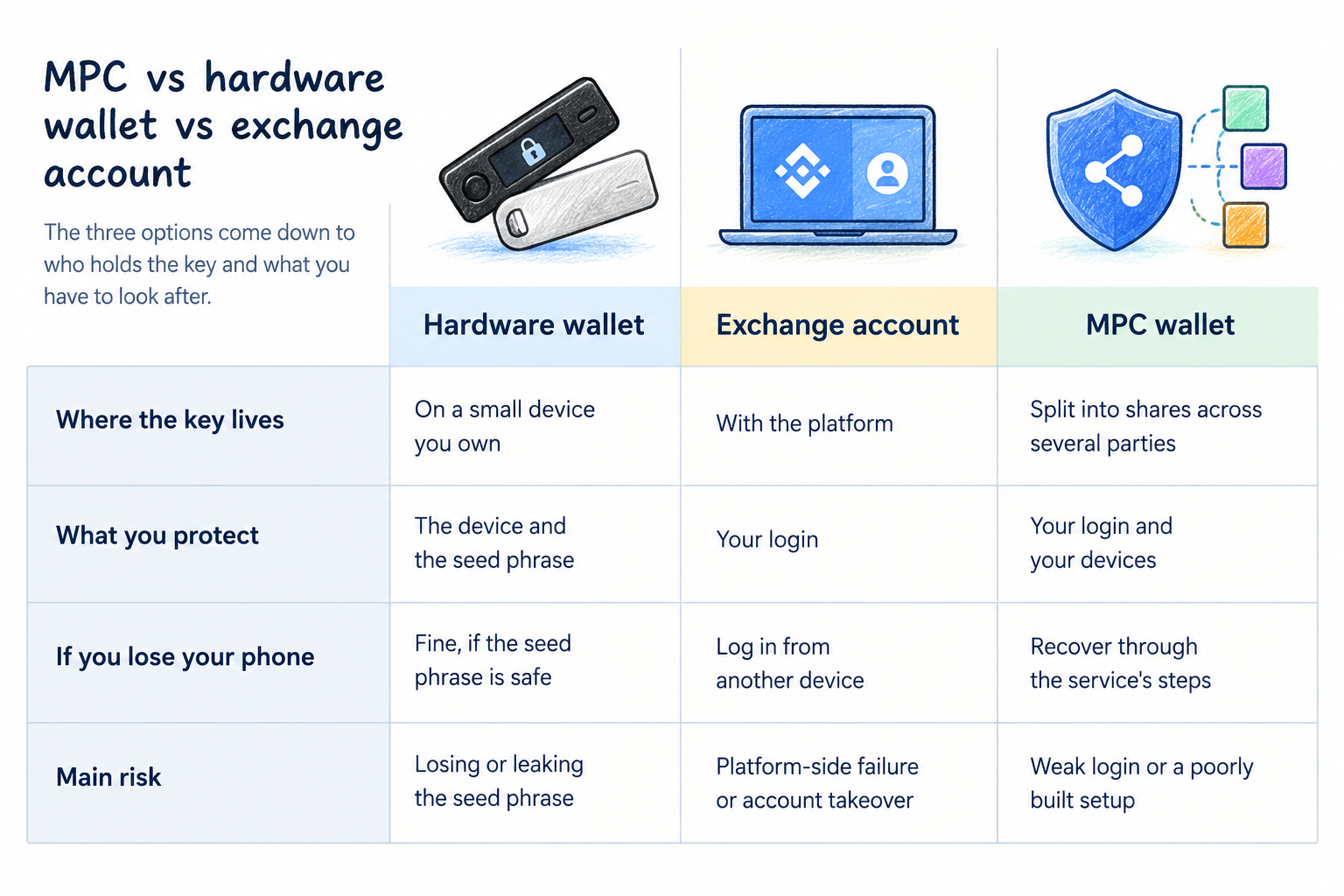
The three options come down to who holds the key and what you have to look after.
Hardware wallet vs exchange account vs MPC wallet
Compared with a hardware wallet
A hardware wallet keeps your key offline on a dedicated device. Many long-term holders prefer this setup, but you are responsible for keeping the device and its backup safe.
MPC trades some of that hands-on control for convenience. You don't need to carry a dedicated device or guard a paper backup, and losing one device doesn't necessarily mean losing access to your funds. If you're unsure about how much to hold and where to store it, our look at cold wallet versus custodial storage can help you decide.
Compared with an exchange account
On an exchange, the platform typically controls the keys and you hold a login. If the platform has a bad day or your login is compromised, your coins may be at risk. You trust the company's custody and security arrangements.
An MPC-based wallet sits in between. The key isn't held by you in one place, and it isn't necessarily held by one company in one place either. The design spreads control so that no single party can act alone. However, some MPC wallets still rely on a service provider to hold a share or manage recovery. For a closer look at what changes once a platform holds your coins, see where your crypto actually sits.
What MPC doesn't fix
MPC is a better lock, but it's not magic. Here's what to keep in mind.
- It depends on the design. Who holds the shares, how many are needed to sign, and how recovery works all affect how safe the setup really is.
- You still need to protect your account. If someone takes over your login and passes the recovery checks, they may be able to act as you. Phishing, fake support messages and reused passwords remain common ways people lose crypto.
- It isn't always pure self-custody. In many MPC setups, a platform holds one or more shares. That's what can make recovery possible, but it also means you rely on that platform to run things properly. Read how any wallet describes who holds what.
- Mistakes still stick. Send coins to the wrong address or use the wrong network, and MPC can't undo it. Blockchain transactions are generally final once confirmed.
What to look for in an MPC-based wallet
When comparing options, these questions can help:
- Who holds the key shares, and can any one party move funds alone?
- How does recovery work if you lose your phone or change devices?
- Is the technology run by institutional MPC custody providers, or is it a home-made scheme?
- Are your assets kept apart from the company's own money?
- How do you confirm transactions, and can you add extra approval steps?
MPC on Clapp
Digital assets in your Clapp Wallet are held on a segregated basis — in plain words, your balance is kept apart from Clapp's own funds. The keys behind it are protected with institutional MPC custody technology provided by Fireblocks, which distributes private-key shares across isolated devices to avoid a single point of failure.
This is backed by additional security measures. Clapp's infrastructure is audited against SOC 2 Type II and ISO 27001 standards, while its operational practices align with the CryptoCurrency Security Standard (CCSS). A policy engine adds another layer of control: large withdrawals require approval from multiple security officers, and automated rules can block suspicious activity.
The infrastructure also uses AWS cloud services, Cloudflare's web application firewall and DDoS protection, encryption for data in transit and at rest, and regular vulnerability scanning. Together, these measures cover different parts of the security setup, from key management and transaction approval to infrastructure and data protection.
For any app you consider, look closely at how platform security is set up.
What MPC means for your crypto security
An MPC wallet replaces a single point of control with a system in which several key shares work together. There's no seed phrase to misplace in many MPC setups, and losing one device doesn't necessarily mean losing access to your funds. You still need strong logins and a healthy dose of caution, but distributing key control can reduce the risks associated with keeping the entire key in one place.
Hardware wallets, exchange accounts and MPC each fit a different kind of person. Pick the one whose trade-offs you actually understand. To see MPC protection in a real product, take a look at Clapp's MPC-based wallet.
Frequently asked questions
Is MPC the same as multisig?
No. Multisig uses several complete keys, while MPC splits control of a private key into shares that work together off-chain to produce a signature. The blockchain can therefore see a standard signature from an MPC wallet, rather than the separate participants involved in signing. Both approaches aim to avoid a single point of failure, but they work differently.
Do I still need a seed phrase with MPC?
Usually not. In many MPC setups, there's no 12- or 24-word phrase to write down, because key control is distributed among several shares rather than relying on one complete key stored in a single place. Recovery relies on the wallet's own process, such as verifying your identity and setting up a new device. The exact approach depends on the implementation.
What happens if I lose my phone?
A lost phone doesn't automatically give someone access to your funds, because it holds only part of what's needed to sign. You'd verify yourself, move to a new device, and follow the wallet's recovery process to restore or refresh the required shares. The exact process depends on the wallet.
Can an MPC setup be hacked?
Nothing in crypto is untouchable. An attacker would need to compromise enough shares to meet the signing threshold, which can be much harder than stealing one complete key. The weak spots are often human: phishing, weak passwords and account takeovers.
Is MPC the same as self-custody?
Not always. In many MPC designs, a service holds one or more shares so that recovery is possible. That gives you convenience, but you may still rely on the service. A hardware wallet where you control the device and seed phrase gives you more direct control, but also puts more responsibility on you.