Clapp Weekly: BTC falls to $64K, Anthropic IPO, MSCI drops Strategy

BTC price
Bitcoin is having a rough November: down nearly 16% for the month and around 20% from its early October peak, with buyers struggling to hold the $62,000–$66,000 range. The pressure comes from a broader tech sell-off and concerns about Strategy, while investors compete for capital ahead of Anthropic’s IPO. After a seven-day outflow streak, spot Bitcoin ETFs took in just $7.99 million on November 16, only to give it all back, and more, with $239.94 million in net outflows the following day.
Selling pressure has also pushed realized losses to levels last seen around the market lows of 2018, 2020, 2022 and early 2023. Leverage has largely been flushed out, with more than $2 billion in liquidations over the weekend. Recent buyers did much of the selling: coins held for less than six months account for a big share of the losses.
BTC fell from around $74,000 on November 12 to a low of $62,612.09 on November 15. The rebound that followed barely got above $65,000. Bitcoin then hovered just under that level, slipped again yesterday and recovered part of its losses.
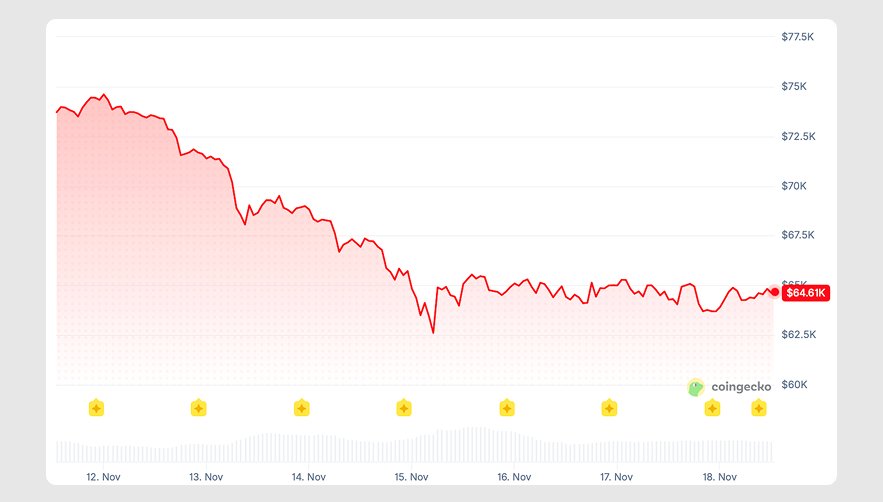
At press time, BTC is trading at $64,615.84, up 0.5% over the past 24 hours but down 12.7% over seven days.
ETH price
Ether is at its lowest point since July 2026. Fundstrat’s Tom Leeblamed the decline on the Nvidia fallout and on investors raising cash ahead of Anthropic’s IPO. BitMine’s ETH holdings fell in value from $14.3 billion to $11.8 billion in a week, though the company bought another 7,653 ETH and now holds 4.97% of supply. Spot Ether ETFs have also faced sustained withdrawals since November 5, losing roughly $640 million in total. The only exception was November 13, with a modest $2.36 million inflow.
Ethereum has a technical headache of its own. An Ethereum Foundation developer warned that the planned Glamsterdam upgrade could break as many as 15,000 smart contracts, putting a few hundred thousand dollars at risk. Independent audits turned up hundreds of compatibility issues, which has delayed testing. No release date has been confirmed.
ETH tracked BTC closely, dropping below $2,000 on November 11 and sliding further to a low of $1,729.19 on November 15. It then bounced toward $1,800 and traded in a fairly narrow range, with a brief dip yesterday followed by another modest rebound.
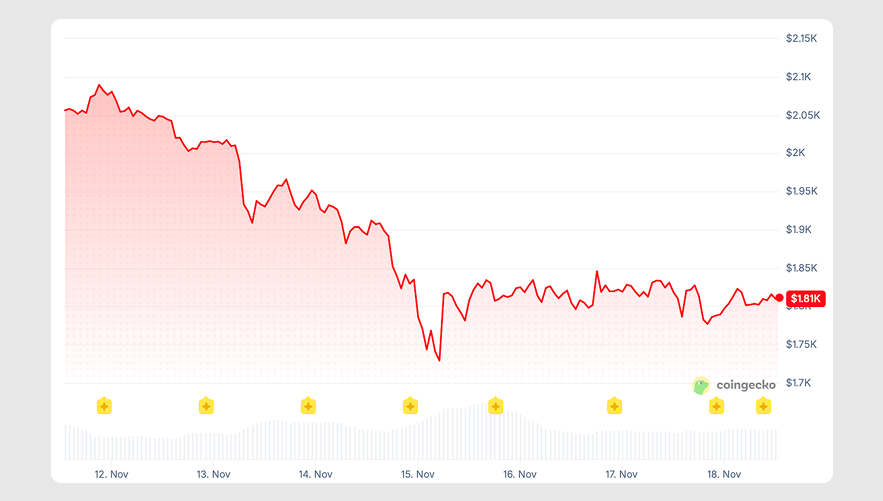
At press time, ETH is trading at $1,811.55, up 0.4% over the past 24 hours but down 12.5% over the past seven days.
Seven-day market dynamics
Extreme Fear has taken hold: the CoinGlass sentiment gauge has dropped to 10/100, down 11 points since Friday. Risk assets are under pressure from several sides, including the scramble for capital ahead of Anthropic’s IPO and uncertainty over Strategy’s removal from MSCI’s global indexes. Tech stocks are sliding after the turmoil at Nvidia, though analysts disagree on how much that has contributed to Bitcoin’s decline.
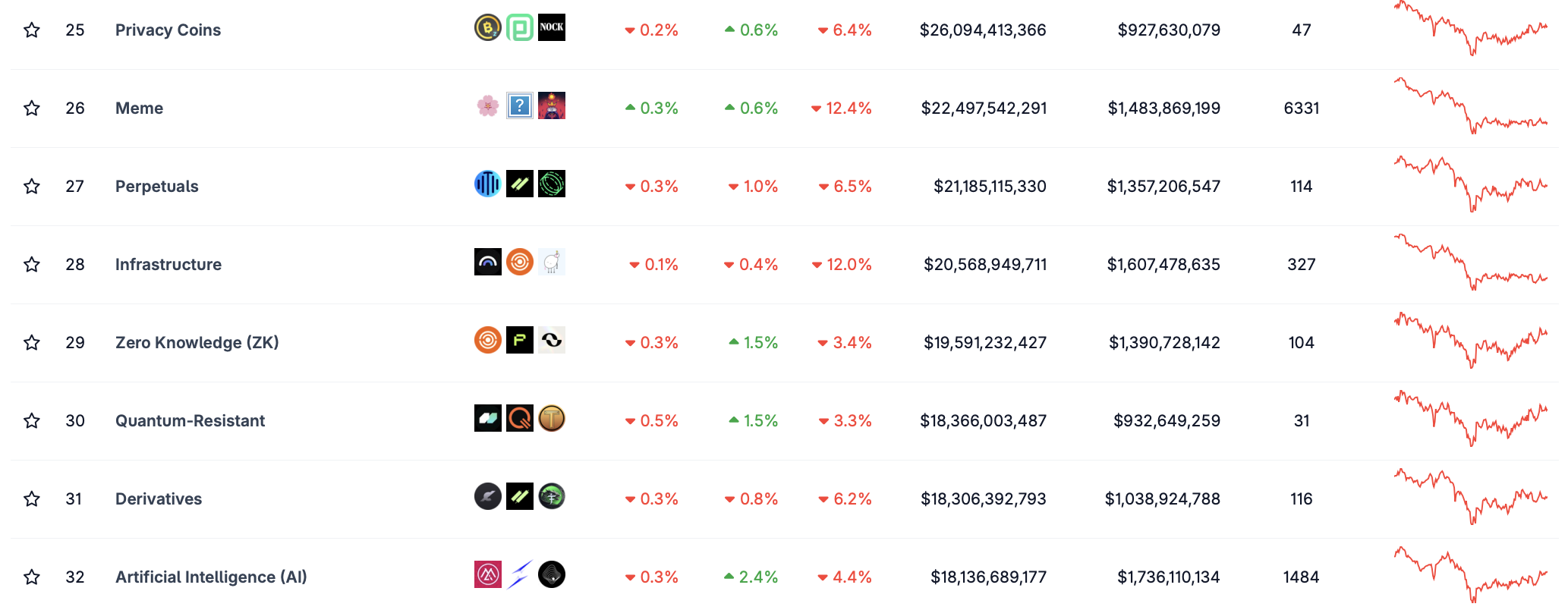
Bitcoin and Ether are among the weakest majors this week. BNB is down 12.4% and Solana 9.0%. XRP has held up relatively well, though it is still 4.9% lower. Sectors tell a different story: despite the tech sell-off, AI tokens have lost just 4.4%, doing better than privacy assets (-6.1%) and memecoins (-12.4%). AI agent tokens have barely moved.
Finding the culprit: Nvidia vs Anthropic
Xapo Bank CEO Seamus Rocca blames the latest downturn partly on demand for Anthropic shares. He points to the IPO’s subscription books, which drew six times as many orders as there are shares, arguing that investors are pulling capital out of liquid markets to chase what could become the largest public listing in history.
Crypto analyst Ted Pillows, however, sees other forces as more important: the tech sell-off, inflation, ETF outflows and a wave of leveraged positions being unwound. US spot Bitcoin ETFs have lost more than $2 billion over two weeks, while bullish positions accounted for nearly 64% of liquidations in a single 24-hour period. “A large part of the move was forced selling from traders who simply couldn’t maintain their positions,” Pillows wrote.
Broader pressures remain
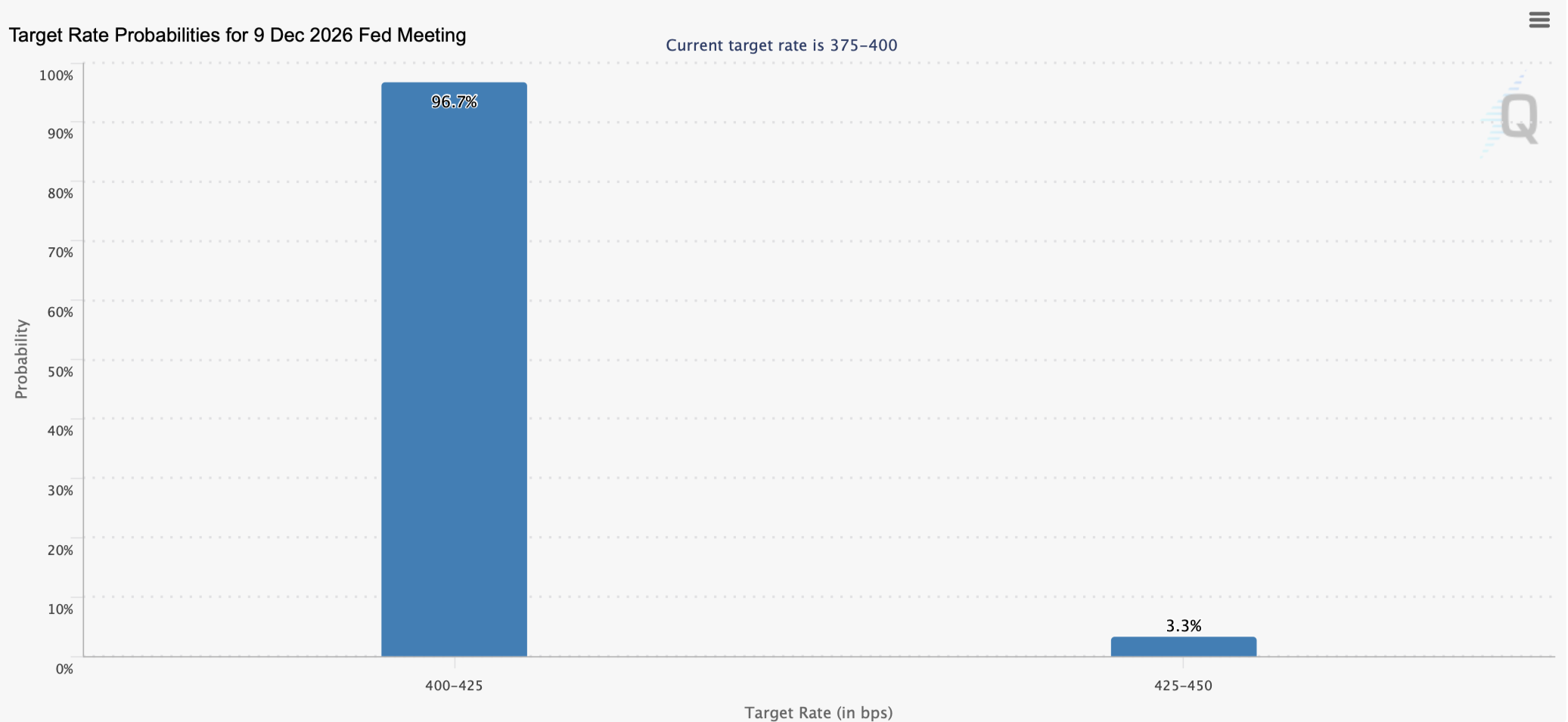
Inflation worries and political uncertainty after the US midterms are adding to the cautious mood. Last week, expectations of further Fed rate hikes erased Bitcoin’s summer rally. Higher rates make safer assets such as US Treasuries more attractive relative to riskier ones. The 10-year yield is still above 5% after its November 11 surge, and the three-year yield has climbed 45 basis points over the past three months.
Top weekly winners
- PEARL (+20.5%) rallied after Coinbase opened spot and perpetual futures trading for the token. The FP8 hard fork then went live on the Pearl testnet, and NEAR Intents reported $10 million in PEARL trading flows, according to CoinGecko’s news listing.
- PIEVERSE (+18.9%) climbed after the launch of Confidential Agents, an upgrade that extends hardware-backed security from wallets to agent memory, messages and stored data, even when agents are idle.
- RAIN (+16.8%) bounced back after an earlier sharp drop. With no clear project-specific catalyst, this looks like a relief bounce rather than a response to any fundamental change. Concentrated holdings and speculative positioning have long made the token volatile.
Top weekly losers
- BTW (-60.5%) extended its decline as the broader sell-off, a rotation of capital ahead of the IPO and massive liquidations piled on. The sharpest leg down began on November 13, and the price now appears to be stabilizing around $0.45. Token unlocks and concentrated selling are adding to the supply overhang.
- PEPE (-29.8%) fell with the broader market, and heavy long liquidations made it worse. With no fresh token-specific catalyst, the drop fits the pattern of memecoins getting hit hardest when investors retreat from risk.
- ENA (-25.4%) took the same market beating, compounded by a token supply overhang and buybacks that have yet to be activated. On November 16, publicly traded Ethena treasury firm StablecoinX also reported a $100.2 million net loss for the third quarter, but that loss belongs to the treasury company, not the Ethena protocol. The protocol’s synthetic dollar, USDe, has kept its peg, and its circulating supply has held steady.
Cryptocurrency news
Anthropic's $900B AI bet puts Bitcoin's sell-off in perspective
Anthropic is preparing to list on Nasdaq this week under the ticker ANT, and the IPO is drawing attention well beyond the tech sector. The indicative price range is $70 to $78, though a newer report suggests pricing could exceed $80. The number that jumps out of the filing is $900.9 billion in infrastructure purchase commitments and lease agreements, most of them tied to computing capacity through 2045.
The IPO is one of the year’s biggest tests of investor appetite for the AI boom, and with Bitcoin struggling, some analysts wonder whether investors are selling crypto to free up cash for it. Binance’s former CEO Changpeng Zhao and Fundstrat’s Tom Lee have both floated the idea that the IPO is competing with crypto for capital.

Massive growth, massive obligations
The scale shows how expensive the race to build frontier AI models has become. Anthropic reported $17 billion in third-quarter revenue, yet still posted a $567 million operating loss. That loss stemmed partly from $5 billion of expensive short-term compute and $2 billion in non-cash donation-matching charges.
Google, Amazon and Microsoft are suppliers, distributors and competitors all at once. Anthropic’s long-term contracts with cloud providers and infrastructure suppliers are meant to lock in the computing power needed for future growth, but they also leave the company with enormous obligations.
SpaceX CFO Bret Johnsen doubts Anthropic can build data center capacity fast enough to meet its 2027 growth targets. He was blunt about the pitch: “they are in an IPO roadshow, so I guess they’re saying things.”
BTC falls in a familiar pre-IPO pattern
The theory has a recent precedent. Strive CEO Matt Cole noted that Bitcoin fell 19% in the 50 days before SpaceX began trading on Nasdaq in June. BTC kept sliding after the debut, bottomed 18 days later, then climbed 28% above its listing-day close by day 100. But analyst Ted Pillows isn’t convinced Anthropic is a major driver of the current decline, blaming broader macro factors, ETF exits, and liquidation cascades (see above).
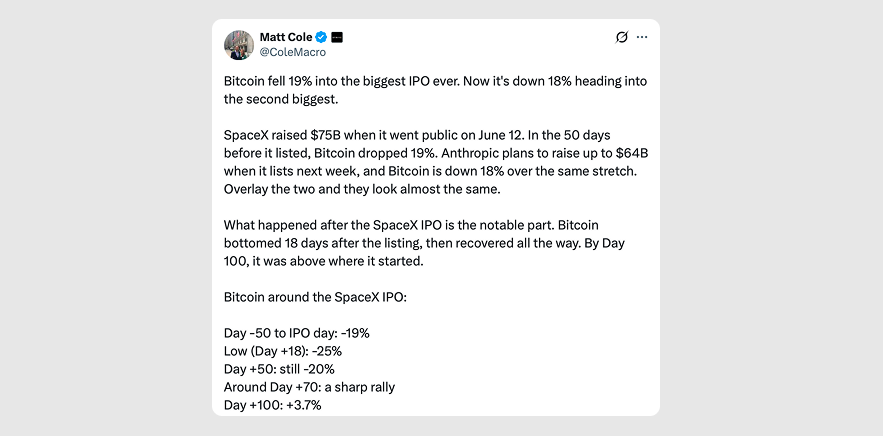
The timing may be more striking than the actual link. Anthropic’s listing arrives as risk appetite weakens across markets, so Bitcoin may be feeling a broader retreat rather than losing capital to a single IPO.
MSCI drops Strategy from its indexes. Could Bitcoin feel the fallout?
Strategy’s long-running push to win Bitcoin a place in traditional portfolios has hit a setback. MSCI has confirmed it will remove Strategy (MSTR) from its global equity indexes after market close on November 30. Metaplanet will also drop out of the relevant benchmarks, while Ethereum treasury firm SharpLink has been put on a watchlist.
The decision follows MSCI’s new eligibility framework for what it calls “non-operating companies,” meaning businesses whose value comes primarily from holding assets rather than running conventional operations. Under the revised rules, companies must meet certain operating-asset requirements and pass financial ratio tests. Strategy was removed right away because it had already failed the criteria across two annual reporting periods.
Index providers’ treatment of digital asset treasury companies is shifting. MSCI considered excluding firms with at least 50% of their assets in digital currencies in 2025, but shelved that proposal after industry pushback. Its latest approach looks more broadly at business structure, though Strategy argues the treatment is discriminatory.
The bigger concern is what happens to Bitcoin funding
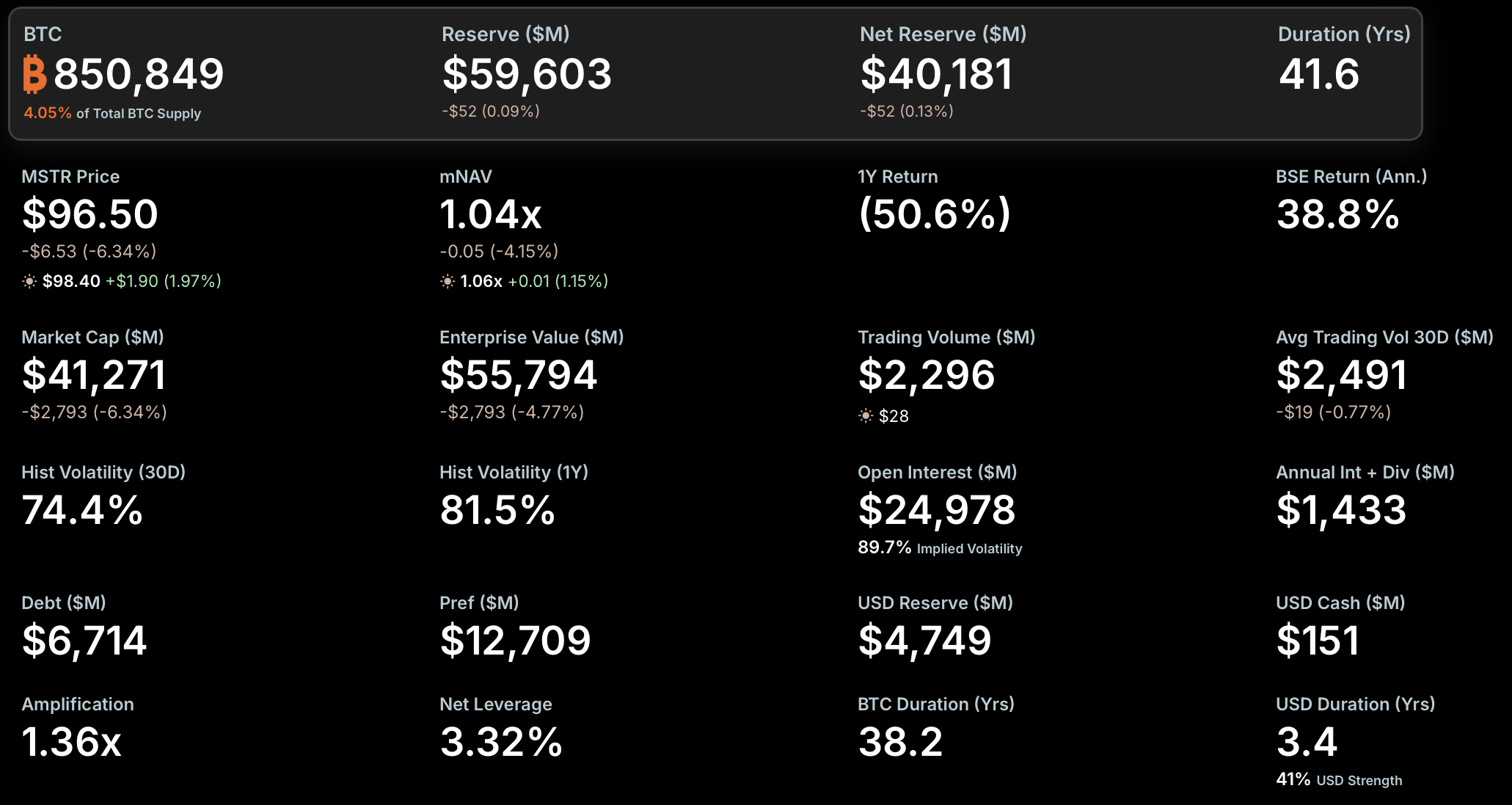
Passive funds tracking the affected benchmarks will have to sell their MSTR shares. Strategy estimates MSCI-linked funds own around 13 million shares, roughly 3.1% of its basic shares outstanding and less than one day’s trading volume. CEO Phong Le has called the expected impact limited. The company also warned of possible exclusion in its third-quarter filing, so the decision was less of a surprise.
The consequences could reach beyond the initial stock sales. Strategy has built its Bitcoin accumulation model onraising capital through equity and preferred-share offerings, which work best when its shares trade at a premium to the value of its Bitcoin holdings. If index exclusion puts sustained pressure on that premium, raising money could get more expensive or harder.
For Bitcoin, a weaker funding position could slow Strategy’s purchases or, in a more severe scenario, force it to sell some of its holdings to meet obligations. Neither outcome follows automatically from MSCI’s decision, though, and the rules don’t require Strategy to sell any BTC.
For now, the removal looks more like a potential headwind for institutional demand than an immediate threat to Bitcoin’s supply. The key signals are Strategy’s premium to net asset value and its ability to raise capital. Whether other index providers follow MSCI’s lead matters too.