15 crypto lending terms every borrower should know

Crypto lending products come with their own jargon, and understanding how terms like “LTV,” “margin call,” and “liquidation threshold” connect can decide how your loan or credit line plays out.
This guide covers the crypto lending terms you’ll see most often, in the order you’re likely to run into them. Read it once, and the screens stop feeling like a foreign language.
What goes in and what comes out
These five terms describe the shape of a crypto-backed loan: what you put up and what you can use. The descriptions below follow Clapp credit lines, whose core concepts overlap with many other centralized and decentralized platforms, though details vary.
1. Collateral
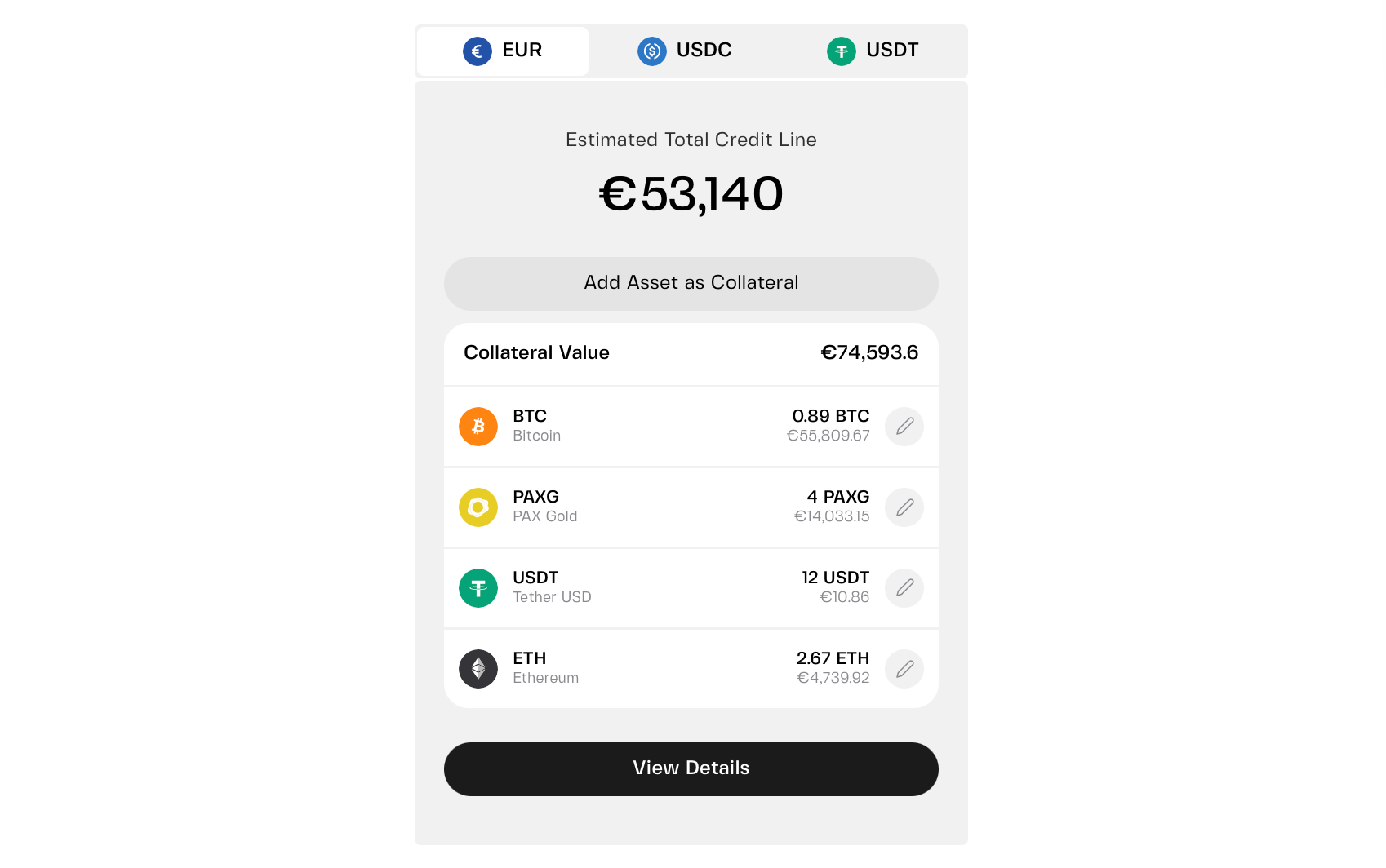
Collateral is the crypto you set aside to back your loan or credit line. In the app, it’s the asset and amount you pick when opening a credit line, for example some BTC or ETH.
On Clapp, your collateral stays tied to the credit line while it’s open, and you get an equivalent amount back after full repayment. In the meantime, its value rises and falls with the market, and every swing changes how much room you have before liquidation becomes a risk.
Many lending products tie a loan to a single collateral asset, but Clapp offers a multi-collateral credit line. You can combine up to 21 assets in one collateral pool and reshuffle it while the line is open. The idea is diversification: when one asset loses value, the others in the pool absorb part of the hit to your LTV, and you can adjust the mix as the market changes.
The terms on volatility, the liquidation threshold and top-ups below show why that flexibility matters.
2. Overcollateralized
Most crypto loans are overcollateralized, meaning the crypto you post must be worth more than what you borrow. For instance, borrowing €3,000 in stablecoins might require putting up collateral worth €5,000, depending on the asset and lender. Generally, stablecoin collateral unlocks the highest borrowing limits, as fiat-pegged tokens are designed to stay steady while Bitcoin swings.
The extra value protects the platform, as crypto prices move and rapid downturns can eat into collateral value fast. Our guide to why loans are overcollateralized provides more details on that buffer. In the app, you see it as a gap between your collateral value and your loan amount.
3. Credit line
A credit line is a pool of borrowing power you can use when you need it, rather than one lump sum handed over on day one. Like a loan, its size is defined by your collateral. The difference is you can use some of it, all of it, or none of it for now. The credit line remains active until you close it, or liquidation happens (see below).
If you want to see the whole flow from start to finish, how a crypto credit line works walks through it with a real-life expense.
4. Draw
A draw is the moment you actually take money out of your credit line. If your line allows €50,000 and you take a slice of it to cover rent, that is your draw.
In the Clapp app, the “Withdraw” button takes you to the screen where you either enter the Amount to Borrow manually or choose a percentage of your available amount, from 10% to 100%. Once you tap “Borrow to Wallet,” the funds land in your Clapp Wallet, so you can withdraw to another app or use them within the Clapp ecosystem.
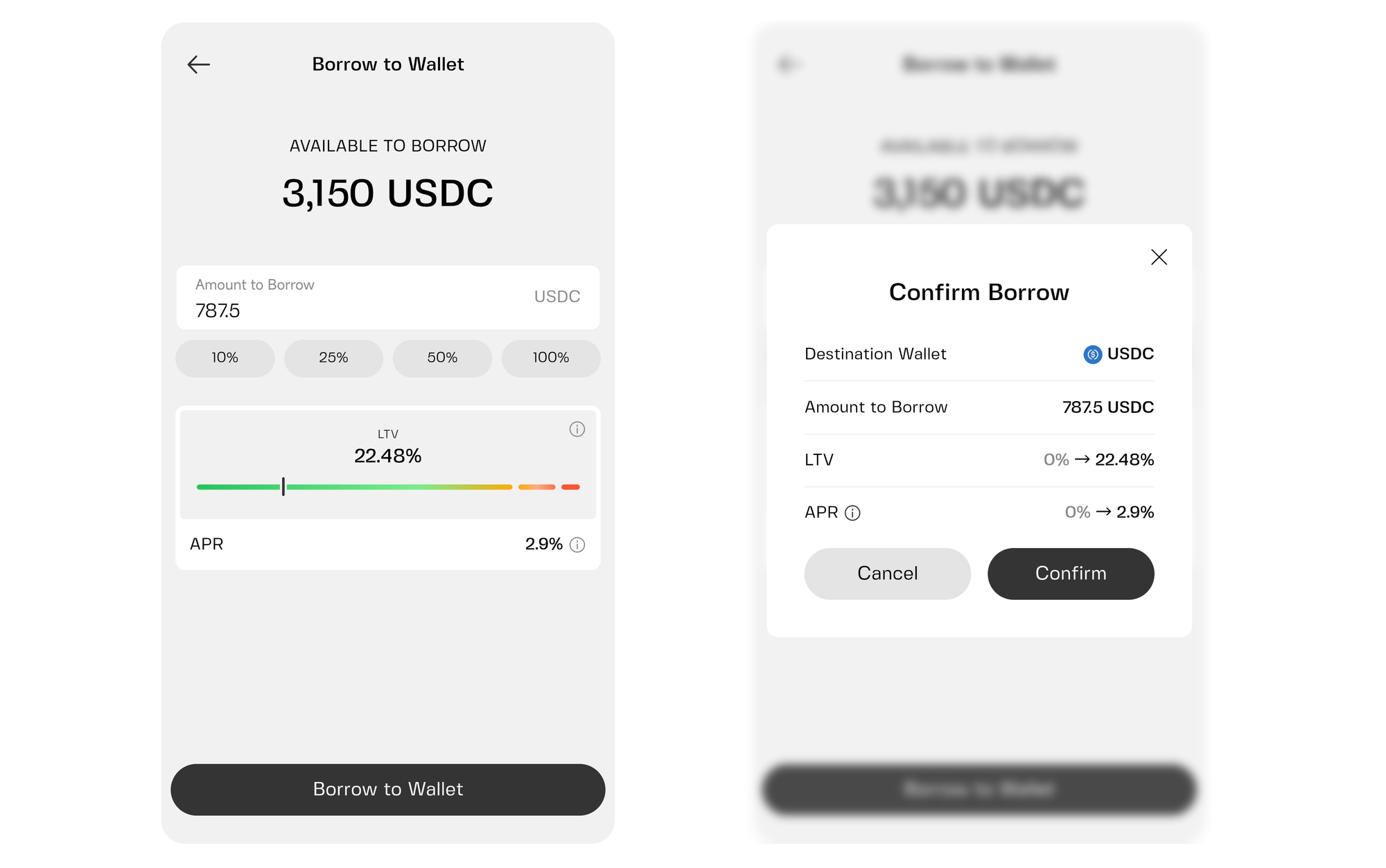
At this point, your Available to Borrow amount decreases by what you’ve drawn, which is also added to your Outstanding balance, the total you owe, including accrued interest and fees.
Fixed-term crypto loans pay out a lump sum, with interest charged on the entire amount from day one. With a credit line, interest is based only on what you’ve drawn, not on what’s merely available, and reaches 0% for low-LTV positions on Clapp (more below).
5. Available credit
Available credit is what’s left to draw. It’s your initial credit line limit minus what you’ve already taken. You’ll see this number change in two ways: it shrinks when you draw, and it grows back when you repay.
This mechanism resembles how a fiat credit card works. In practice, it’s liquidity that stays on hand, ready for use whenever you need it, provided the LTV stays within the lender’s acceptable range..
What you pay and how it's measured
Four terms that decide the cost and the risk of your loan.
6. LTV (loan-to-value)
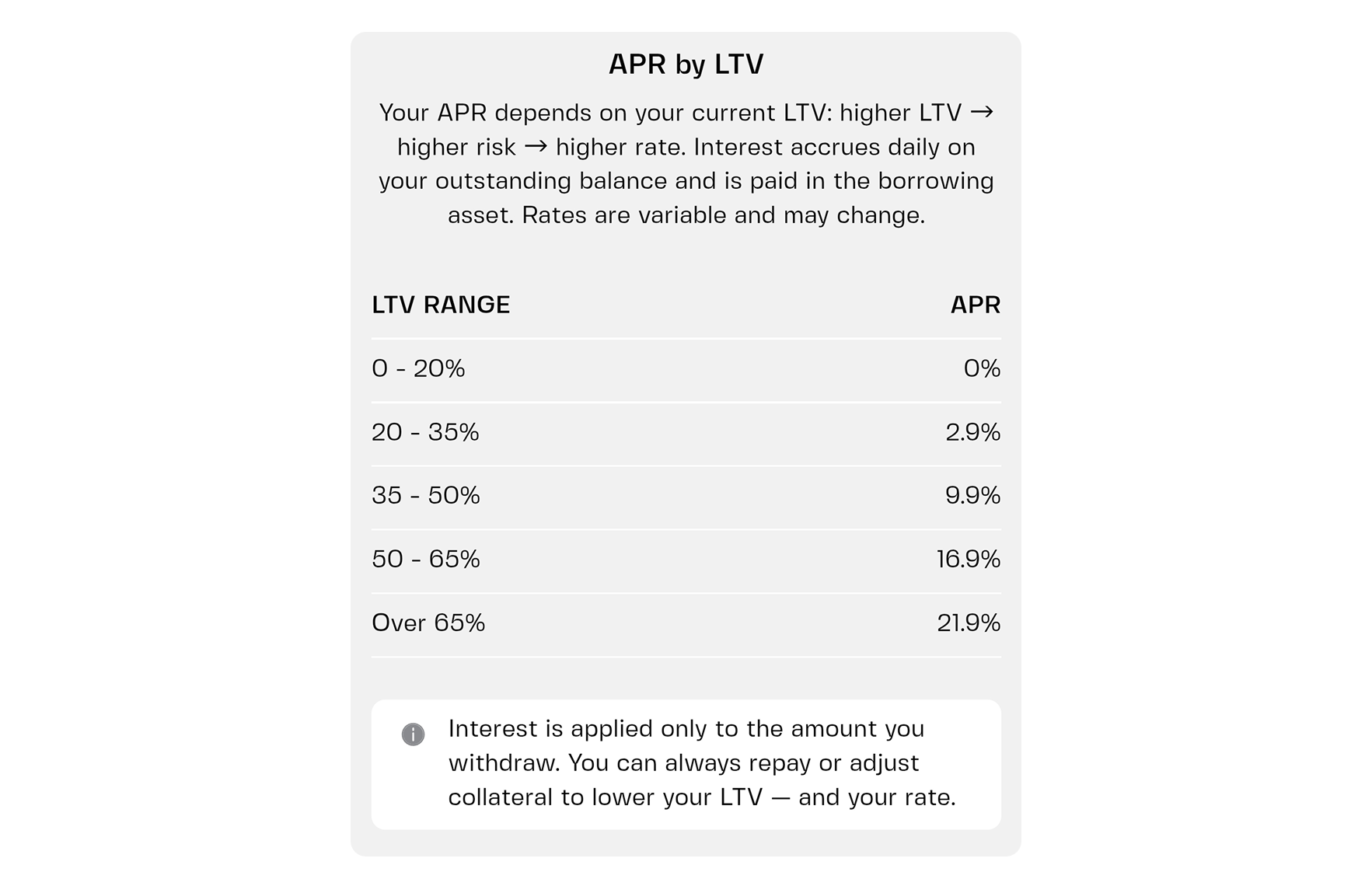
LTV is the size of your loan compared with the value of your collateral, shown as a percentage. If you’ve drawn €3,000 against collateral worth €10,000, your LTV is 30%. Liquidation thresholds usually sit well above that level, so 30% leaves a wide margin of safety against price moves. Drawing just €2,000 against the same collateral would put you at 20%, which falls in the 0% APR band on Clapp.
It’s the single most important number on the screen, changing in real time. Lower LTV means more headroom. Higher LTV means less room if prices fall.
7. Max LTV
Max LTV is the highest LTV allowed when you borrow, essentially your maximum credit limit. It differs by collateral asset. For BTC, the maximum LTV is 70%, and for ETH it’s 60%. In a multi-collateral pool, your limit is a blend of each asset’s maximum, so adding stablecoins can raise it.
Max LTV is a ceiling, but don’t aim to reach it. Borrowing right up to it leaves you very little slack if the market goes south and pushes you into the priciest rate bands, as the next term shows. Many borrowers pick a draw well below the maximum.
8. APR (annual percentage rate)
APR is the yearly cost of borrowing, shown as a percentage. On Clapp’s credit line, your APR is directly tied to the LTV band and ranges from 0% to 21.9%. The smaller your draw relative to your collateral, the lower the cost, and keeping LTV at 20% or below unlocks 0% APR. Check the number shown in the app before confirming a draw.
9. Accrued interest
Accrued interest is the interest that has built up on your loan so far but hasn’t been paid yet. It grows over time based on what you’ve drawn and your APR, and Clapp calculates it daily on your updated balance. On screen, it shows up as part of what you owe. It’s worth a glance now and then.
The safety net when prices move against you
Crypto prices can drop fast. These terms explain what happens then and what you can do about it.
10. Volatility
Volatility describes how sharply an asset’s price moves up and down. Crypto is more volatile than most things people borrow against, like property or a car.
Why does it matter for a loan? Because your collateral’s value changes daily, and so does your LTV, even if you haven’t touched your loan. It’s the reason the next four terms exist. It also explains why a pool that mixes several assets can be steadier than a single coin, since they don’t always move together.
11. Liquidation threshold
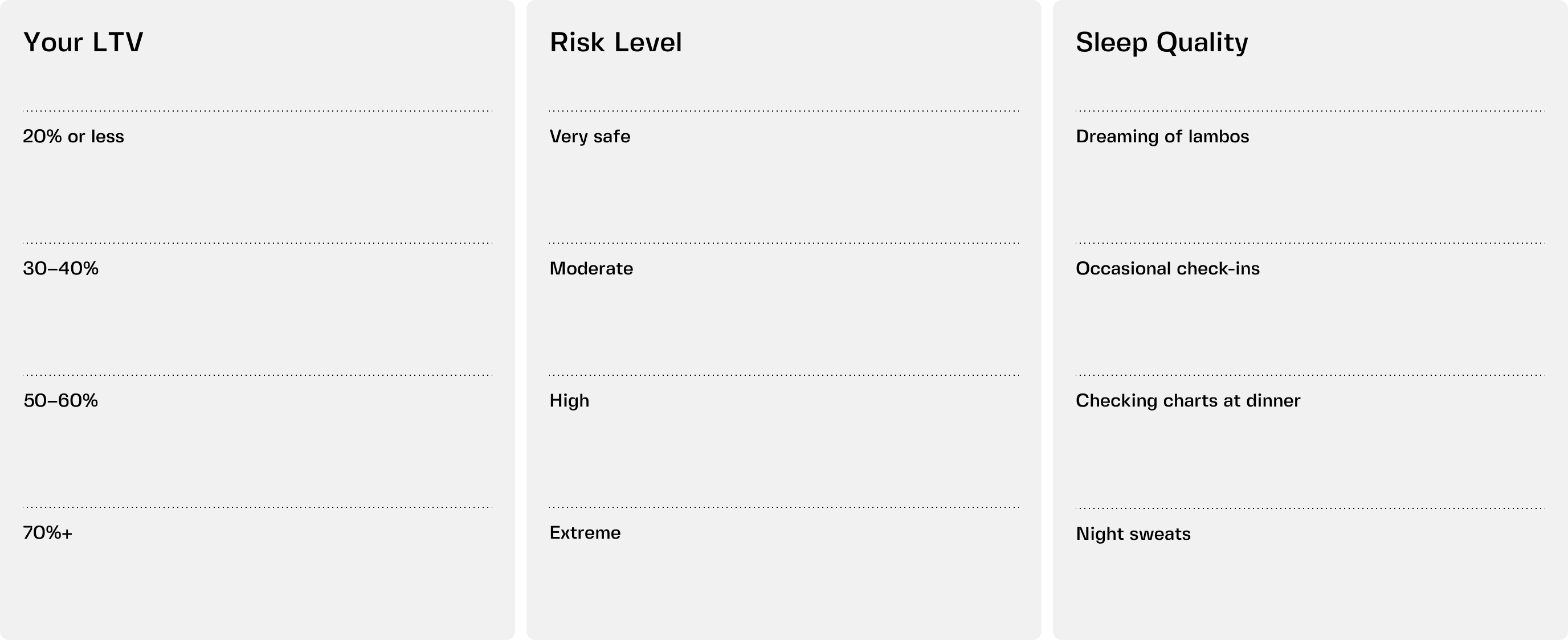
The liquidation threshold is the LTV level at which part of your collateral can be sold to repay the loan (commonly between 80% and 95%, depending on the lender). It sits above your starting LTV, and the space between the two is your breathing room, or LTV buffer.
Say your LTV is 30% today. If the price of your collateral falls and your LTV creeps toward the threshold, you’re moving toward the danger zone. For a deeper look at the gap, see LTV and liquidation threshold. In the Clapp app, your current LTV is shown next to the levels that matter.
12. Margin call
A margin call is a notification alerting you when your LTV comes dangerously close to the liquidation level. Think of it as a smoke detector giving you time to act during moderately paced market declines: you can top up your collateral or repay part of the loan. When prices nosedive, though, that window may be too short.
In DeFi lending, margin calls generally don’t exist: smart contracts trigger automatic liquidation with no prior warning. Centralized lenders may or may not send alerts, so read the terms carefully. Alerts are typically an option rather than an obligation.
13. Top-up
A top-up means adding more collateral to an open loan or credit line. The more crypto backs what you borrowed, the further you sit from the liquidation threshold.
Suppose your collateral loses value and your LTV rises from 30% to 45%. Adding more crypto pulls it back down. In the app, you choose the asset and amount and confirm. For a walkthrough, see setting up LTV alerts and top-ups. Repaying part of the loan works too, since a smaller debt against the same collateral lowers the ratio as well.
With a multi-collateral line, you have another lever: reshuffling the pool, for example trading some volatile assets for stablecoins. That makes another jump less likely if prices dip again.
14. Liquidation
Liquidation is what happens if your LTV reaches the liquidation threshold: some or all of your collateral can be sold to cover the loan. It’s the outcome every careful borrower tries to avoid.
The sale exists to cover the loan once the collateral’s value has fallen too far. You’d lose some of your crypto, and you’d have no say in the sale price. That’s why alerts and top-ups matter.
15. Repayment
Repayment is paying back what you’ve drawn, plus the interest that has built up. You can do it in part or in full, depending on how you use the credit line.
When you repay, your loan balance falls, your LTV falls, and your available credit grows. Once the loan is fully repaid, an equivalent amount of your collateral returns to your wallet.
How the terms fit together
You put crypto worth €10,000 into your credit line as collateral. You draw €5,000 for a rent deposit. Your LTV is 50%, the lender’s liquidation threshold is at 80%, and you’re overcollateralized, though with a thinner buffer than someone borrowing at 20% LTV. Interest starts to accrue at your APR, which depends on your LTV band.
A few weeks later, the market falls. Your collateral has lost a third of its value and is now worth about €6,667, and your LTV has climbed to 75%, even though you haven’t borrowed another cent. That’s volatility at work. Your crypto lender may send you a margin call alert.
You have two sensible options. You can top up with more collateral, or repay part of the loan. Either one lowers your LTV. If you do nothing and the price keeps falling toward the liquidation threshold, a part of your collateral is sold to cover the loan, which is essentially a forced sale and, in many jurisdictions, a taxable event.
Habits that make these terms easier to live with
Knowing crypto lending terms is half the job. The other half is a few small habits, because credit lines carry risk and prices can move fast.
- Borrow less than the maximum. Staying well below max LTV leaves space to absorb a rough week.
- Set alerts early. An alert at a comfortable level beats a surprise at a stressful one.
- Keep spare crypto or cash in mind. Make sure you have resources for emergency top-ups.
- Check your LTV after sharp market moves. It takes a few seconds and saves worry later.
- Mix your collateral. A pool that holds stablecoins alongside volatile assets softens the blow when prices fall.
Putting it all together
Fifteen terms sound like a lot, but they follow one simple story: you back a loan with collateral, you draw what you need, you watch your LTV, and you act early if the market moves. Borrow only what you have a clear plan to repay.
For the wider picture, borrowing against crypto explained covers the basics in plain language. To see these terms in action, explore the credit line in the Clapp app (availability depends on your country).
Frequently asked questions
What are the most important crypto lending terms for beginners?
Start with collateral, LTV, liquidation threshold and top-up. Those four explain what you put in, how safe your loan is, when it becomes unsafe, and what you can do about it. The others add detail on cost and flow.
What does LTV mean in a crypto loan?
LTV stands for loan-to-value. It compares your loan amount with the value of your collateral. If you’ve borrowed €3,000 against collateral worth €10,000, your LTV is 30%. A lower LTV means more headroom against price drops.
What is the difference between a draw and a loan?
A draw is the amount you take from your credit line at a given moment. The loan is what you owe in total, meaning your draws plus accrued interest. You can have a credit line without any draw, in which case you owe nothing.
What happens if my LTV gets too high?
If your LTV rises toward the liquidation threshold, you can lower it by adding collateral (a top-up) or by repaying part of the loan. If it reaches the threshold, some or all of your collateral can be sold to cover the loan.
Do I get my collateral back?
Yes. On Clapp, legal ownership of the collateral transfers to Clapp while the credit line is open, and you keep a contractual right to an equivalent amount back once the balance is repaid in full. If liquidation has taken place, the part that was sold is not returned.