Crypto's CLARITY Act fails. SEC and CFTC move without it

Not much changes for crypto users, but the ground under the industry has shifted. The Senate blocked the CLARITY Act on September 15, leaving the US without the comprehensive market-structure law the industry wanted. Two days later, the SEC and CFTC answered anyway, each using authority they already have to grant real, if narrower, relief.
TL;DR
- CLARITY Act was designed to establish a clearer division of responsibility between the SEC and CFTC, but the Senate failed to advance it on September 15.
- Failure leaves the US without the comprehensive federal crypto market-structure framework the industry has been seeking.
- SEC and CFTC responded within days by using powers they already have to provide targeted relief without waiting for Congress.
- SEC created a temporary, conditional exemption for certain venues trading tokenized US stocks onchain.
- CFTC expanded no-action relief to qualifying providers of passive trading software, including self-custodial wallet interfaces.
- These measures provide practical relief, but they are not a substitute for legislation. They can be narrower, conditional, time-limited, and subject to change under future agency leadership.
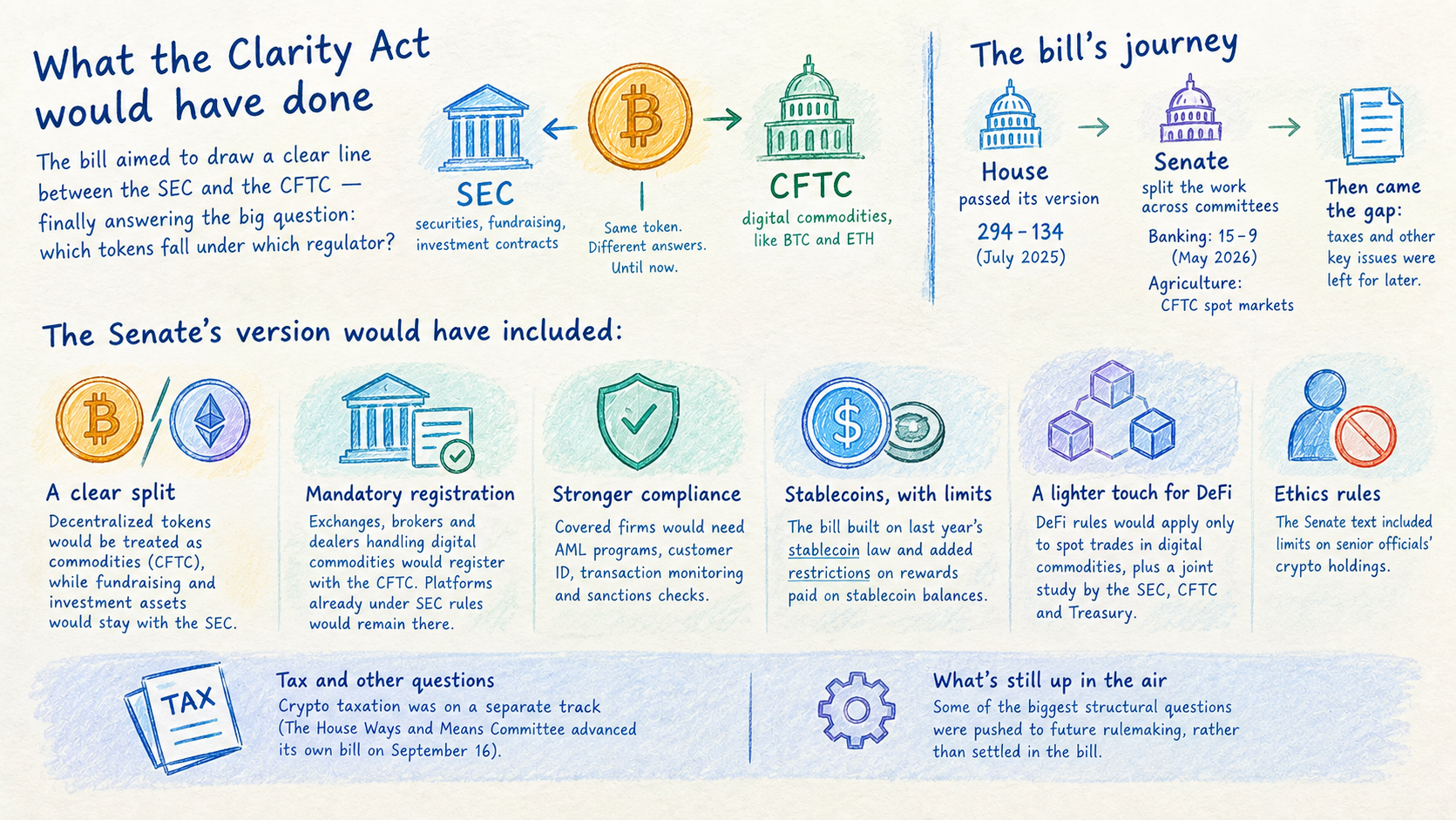
What the CLARITY Act would have done
The bill's central job is to settle whether a given token answers to the SEC or the CFTC. The answer has often depended on who was asking. Under former Chair Gary Gensler, the SEC treated many tokens as securities. The CFTC treats Bitcoin and ether as commodities. Courts have ruled case by case without resolving the larger question.
The House passed its version, H.R. 3633, 294–134 in July 2025. The Senate wrote its own text across two committees. Banking approved a revised version 15–9 in May 2026, and Agriculture handled CFTC oversight of spot markets.
In broad strokes, the Senate text would have:
- Drawn the SEC/CFTC line. Tokens on sufficiently decentralized ("mature") blockchains would be digital commodities under the CFTC. Fundraising and investment contracts would stay with the SEC.
- Registered intermediaries. Exchanges, brokers and dealers handling digital commodities would register with the CFTC. Platforms already registered with the SEC would stay under SEC rules.
- Added compliance duties. Covered intermediaries would need anti-money-laundering programs, customer identification, suspicious-activity monitoring and sanctions compliance.
- Built on the GENIUS Act. Last year's stablecoin law set the core stablecoin rules. The Senate text added limits on rewards paid on stablecoin balances.
- Touched DeFi lightly. The final draft applied its DeFi provisions only to digital commodity spot transactions and called for a joint SEC, CFTC and Treasury study.
- Restricted officials' crypto interests.
Taxation was left to a separate track. The House Ways and Means Committee advanced its own crypto tax bill on September 16. The Senate text also pushed some of the hardest structural questions to later rulemaking.
What actually happened on September 15
The vote was on cloture on the motion to proceed, meaning whether to start debate at all. It needed 60 votes and got 49. No senator voted on the bill's substance.
Every voting Democrat opposed it, including the seven who helped negotiate the text. Four Republicans, Sens. Josh Hawley, Susan Collins, Jerry Moran, and Thom Tillis, also voted no, but Tillis switched at the end of the roll call for a procedural reason. Only a senator on the prevailing side can file a motion to reconsider, and he did. His move keeps the bill technically alive, and it means the real level of support was closer to 50.
No single cause explains the result, and the roll call doesn't say why any senator voted as they did. Reporting points to four disputes.
Ethics
This was the most visible one. President Trump's June financial disclosure reported about $1.4 billion in crypto-related income for 2025, and Democrats pushed for language that would keep senior officials from profiting off the rules the bill would create.
Republicans and the White House offered ethics language before the vote. Critics said it covered officials' spouses but not their children, and it was set to expire in January 2029. A last round of talks in Tillis's office broke down as the vote began, and the two sides gave different accounts of why.
Stablecoin yield
Bank groups argued that stablecoin rewards would pull deposits out of banks. Negotiators tried to bridge the gap with language barring rewards that work like deposit interest, and a mechanism letting the Treasury secretary restrict rewards if community banks saw measurable deposit flight.
The banks say they still want targeted changes to yield policy in any next attempt. The fight had already run for months after Coinbase CEO Brian Armstrong withdrew support for an earlier draft in January.
Illicit finance and DeFi
In May, Sen. Elizabeth Warren argued the bill left decentralized services with too little sanctions and anti-money-laundering oversight, pointing to mixers like Tornado Cash. Sen. Cynthia Lummis and other supporters said the bill strengthens enforcement. Law enforcement groups also raised concerns about developer protections.
Timing
The Senate largely set aside the House bill and wrote its own, which pushed the process into an election year. The vote came less than seven weeks before the November 3 midterms.
Where the bill goes from here
Tillis's motion to reconsider keeps a path to the floor open, and seven Senate Democrats say they remain committed to bipartisan talks. But Lummis said before the vote that a failure would mean "it's over," and the calendar is against the bill. Senators leave Washington in early October and don't return until after the midterms.
According to a Forbes contributor's account, some advocates are eyeing the lame-duck session, others are turning to regulators to fill the gap, and some have written the bill off, though most are privately planning for the next Congress.
The cast will change either way. Tillis and Lummis, two of the lead Republican negotiators, are not seeking reelection, and SEC Commissioner Hester Peirce departs October 2. Whoever writes the next version faces the same competing interests: banks that want yield changes, crypto groups that will keep pushing, and law enforcement groups focused on illicit finance.
The official Banking Trades Statement (issued by the American Bankers Association, Association of Military Banks of America, Bank Policy Institute, Consumer Bankers Association, Financial Services Forum, Independent Community Bankers of America, Mid-Size Bank Coalition of America and National Bankers Association) reads:
"The nation's banks continue to support creating a strong, durable regulatory framework for digital assets that will set the course for U.S. global leadership for decades to come. We believe Congress can accomplish that goal while protecting the bank lending that drives economic growth. As lawmakers consider next steps, we encourage them to adopt targeted changes to stablecoin yield policy. We stand ready to work with all stakeholders to achieve this important goal."
Regulators' response
SEC Chair Paul Atkins was unequivocal: "with or without legislation, we will act decisively within the SEC's statutory authority to deliver certainty for American investors and for the entrepreneurs shaping our technological future." CFTC Chair Michael Selig also stated publicly that his agency would move forward using existing statutory authority and was "locked in and ready to ship its rules for the new frontier of finance."
That doesn't mean the agencies were caught improvising. The SEC's plan B was announced ahead of the vote, and the exemption had been widely anticipated. The CFTC's letter builds on relief it granted to one company in March. The vote gave both agencies a reason to act publicly and quickly.
SEC's Innovation Exemption
On September 17, the SEC issued a five-year order allowing qualifying "Tokenized Securities Venues" (TSVs) to trade blockchain-based versions of US-listed stocks without registering as national securities exchanges. It is part of Project Crypto, the initiative Atkins launched last year.
The order carves out a lane for automated market makers and liquidity pools where tokenized stocks trade. Firms that supply liquidity get a matching exemption from dealer registration. Both run until September 17, 2031. The main conditions:
- Real stock only. Each token must carry the same rights as the underlying share, including economic interest, dividends, voting and a claim on assets in liquidation. Synthetic products that only track a price don't qualify.
- Listed US stocks only. The order covers NMS stocks, broadly shares that trade on national exchanges.
- Issuer veto. If someone other than the issuer tokenized the stock, the venue must give the issuer 30 days' notice, and the issuer can object and block the listing.
- Permissioned venues, public rails. Operators must be US persons and control who can trade, but smart contracts must be public, auditable and deployed on a permissionless blockchain.
- Limits on scale. No leverage, caps on symbols and trading volume, transparency requirements, and coordinated trading halts with primary listing exchanges.
- Secondary trading only. Nothing can be issued or offered for the first time through a TSV, and Securities Act registration or an exemption is still required. The relief covers venues and liquidity providers, not companies that tokenize stocks.
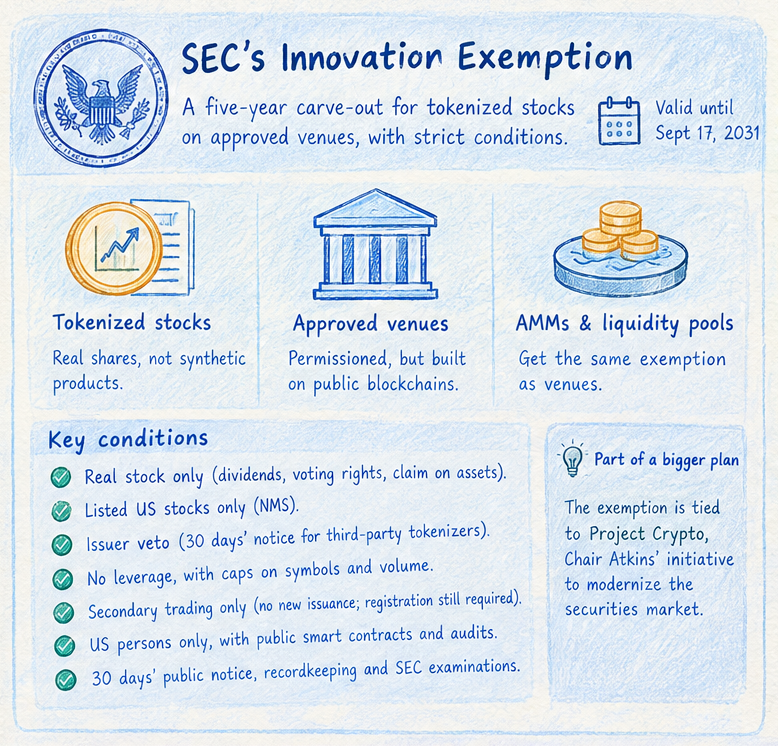
Venues must also give 30 days' public notice before starting, keep records and consent to SEC examinations. The SEC is taking comment on every aspect, including whether to make the exemption permanent or extend it to other securities. Atkins called the order temporary.
CFTC's passive software relief
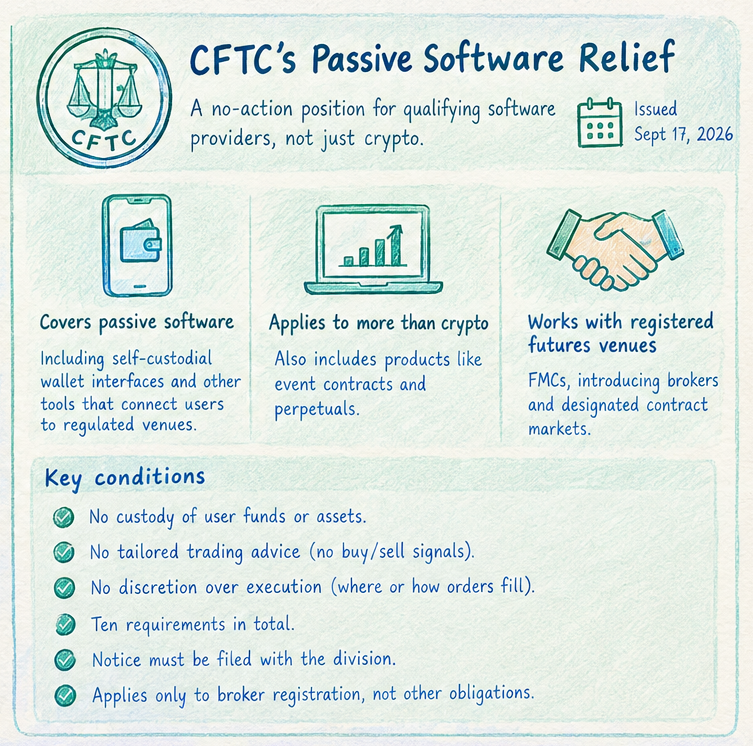
Also on September 17, the CFTC's Market Participants Division issued Staff Letter 26-25. It extends to all qualifying providers of passive software the no-action position first given to Phantom, a self-custodial wallet developer, in March. Staff will not recommend enforcement against providers for failing to register as introducing brokers, as long as they meet the letter's conditions.
The relief covers software that helps users trade with registered futures commission merchants, introducing brokers and designated contract markets. That includes self-custodial wallet interfaces. It is not limited to crypto, and it reaches products like event contracts and perpetuals. The core idea is the line between providing software and acting as a broker. The headline conditions:
- No custody of users' funds or assets.
- No tailored trading advice, meaning no express buy or sell signals for particular trades.
- No discretion over execution, meaning where or how orders are executed.
The letter sets out ten requirements in all, and providers must file a notice with the division to rely on it. It also covers only broker registration, not other obligations that could apply.
Why none of this is a law
Both actions came from authority the agencies already had, which is why they moved fast. It is also why they're fragile.
The SEC's exemption is explicitly temporary and conditional. The CFTC letter binds only the issuing division, not the full Commission, and doesn't rewrite the statute. Either can be narrowed, replaced or allowed to expire under new leadership. The SEC itself calls its order an interim step toward durable rulemaking.
Recent SEC history shows how quickly regulatory policy can change. The agency has withdrawn previously proposed rules and changed its approach to crypto enforcement and regulation under the current administration.
- On June 17, 2025, after the change in administration, the agency rescinded 14 proposed rules pertaining to investment adviser disclosure obligations and broker-dealer regulation.
- On September 3, 2026, the SEC proposed to rescind the entire investment adviser "pay-to-play" rule. In place since 2010, it imposed a two-year ban on providing compensated investment advisory services to a government client after making a political contribution to certain elected officials or candidates.
- Under the Trump administration, the SEC shifted from its enforcement-first posture, dismissing several enforcement actions against crypto firms. The agency also created a crypto task force to develop a comprehensive regulatory framework.
Rulemaking is also under way. Comments on the SEC's Regulation Crypto Assets proposal close October 20, and firms should audit their offerings against it before then.
Friendlier, but on borrowed time
Congress failing to pass a market-structure law doesn't leave crypto unregulated. The agencies are making room for parts of the market, from tokenized stocks to wallet software that connects users with regulated venues.
What the industry still lacks is a statute that clearly divides responsibility between regulators, sets registration rules for spot crypto intermediaries, and is harder for a future administration to undo. For businesses, the environment is getting friendlier without getting more permanent.