Registered, licensed, authorised: Not the crypto synonyms you think

You're scrolling through a crypto platform's footer, and there it is: a line about being "registered," another mentioning a "licence," maybe a third about being "authorised" somewhere in Europe. They sound like synonyms. They're not.
Mixing them up is an easy way to trust a platform for the wrong reasons. Knowing the actual difference between registered and licensed crypto exchange status, and where "authorised" fits into that picture, tells you what a platform's footer is really promising, and what it isn't.
Three words, three different regulators, three very different levels of protection — and that gap is exactly where marketing may fill in the blanks.
TL;DR
- "Registered," "licensed," and "authorised" describe three different relationships with three different regulators — not three levels of the same protection.
- Registration usually just confirms a platform's anti-money-laundering setup — it's not an endorsement or an investor protection scheme.
- A licence permits one specific activity, like moving payments or issuing e-money. It doesn't automatically cover crypto trading, custody, or lending just because the company holds it.
- MiCA authorisation covers more ground and can be passported across the EEA, but it doesn't fix your returns, shield you from a market crash, or guarantee every product a platform offers is covered.
- None of these words tell you whether your funds are actually protected — that's a separate question worth asking directly.
Why these words end up on every crypto platform's footer
Most platforms that touch money have some legal disclosure buried near the bottom of their site. None of these words — registered, licensed, authorised — is a general safety seal. Each describes a different relationship with a different authority, covering a different slice of what the platform actually does.
A registered vs licensed crypto platform comparison only makes sense once you know what each term is actually promising. Typically, platforms themselves aren't the ones clearing up the confusion.
Registered: Merely an AML checkbox
"Registered" almost always refers to an anti-money-laundering registration. In the United States, for example, a crypto business that moves money or virtual currencies typically has to register as a money services business with FinCEN (the Financial Crimes Enforcement Network). This, however, doesn't mean FinCEN endorses or approves its products, nor is it an investor protection scheme.
Similar registers exist in other countries under different names. Being registered means the regulator has checked the platform's financial-crime controls and compliance setup. The business has identified itself to the authority and agreed to follow reporting rules.
Securing a full operational or prudential banking licence is an entirely different story. Registration doesn't tell you whether the platform's products are safe, whether your funds are protected if something goes wrong, or whether anyone has reviewed the platform's financial health.
This is perhaps the most commonly misunderstood term in crypto compliance. If you want the fuller picture of how AML rules apply to businesses more broadly, our guide to crypto compliance is a useful next stop.
Licensed: Permission to do one specific job
A licence — like the New York BitLicense or a CASP licence under Europe's MiCA (Markets in Crypto-Assets) framework — is a different animal entirely. It's a specific permission, granted by a specific authority, to carry out a specific regulated activity. That makes it narrower than registration — a licence authorises one particular activity, not a general permit to operate.
- A payment licence (Payment Institution, or PI) lets a company move money on your behalf.
- An e-money licence (Electronic Money Institution, or EMI) lets it issue electronic money and hold customer funds under defined rules.
Neither one automatically covers crypto trading, custody, or lending.
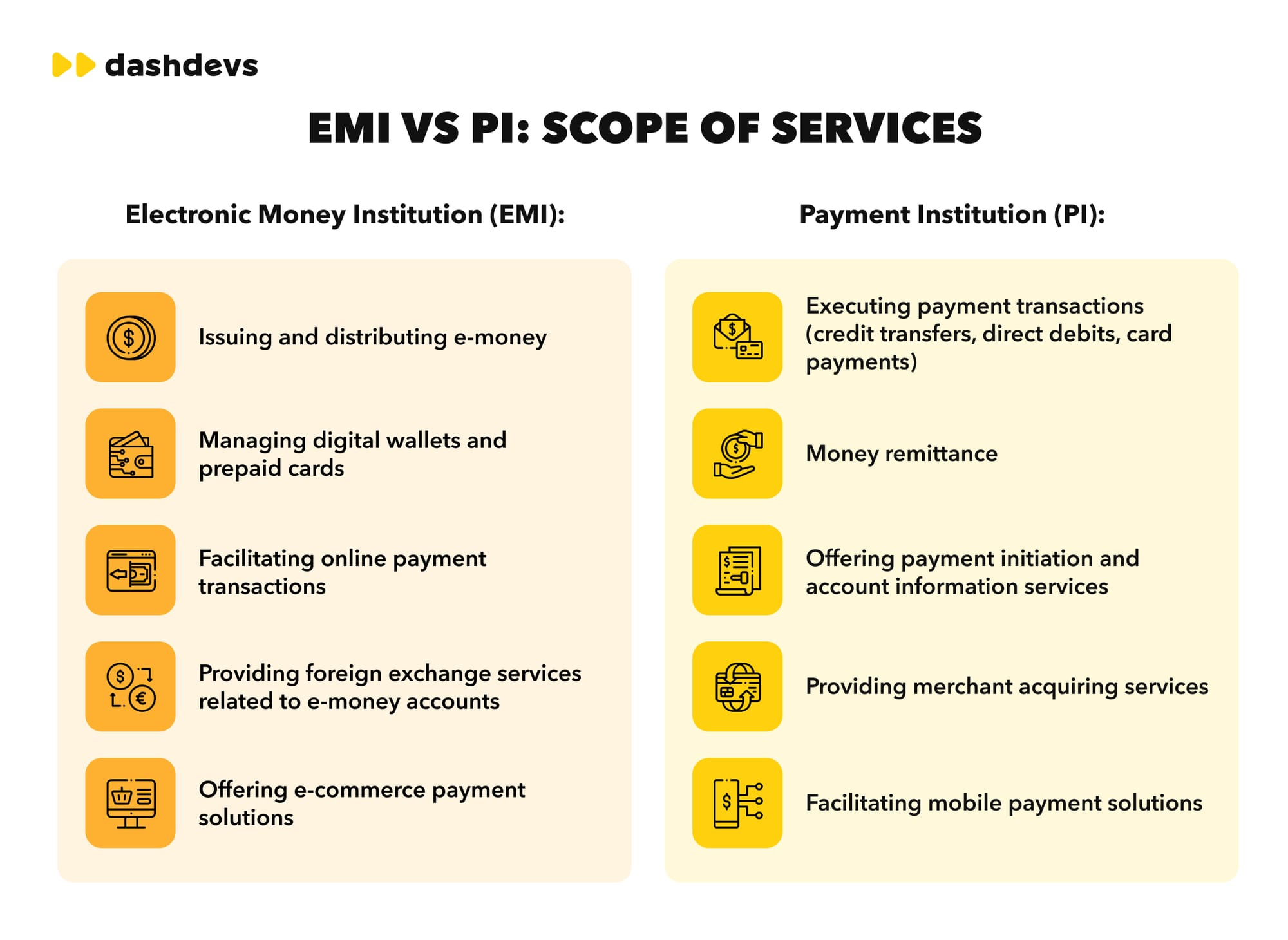
Getting licensed requires going through rigorous audits, proof of capital reserves, and strict anti-money laundering compliance.
Yet a licence does not extend a halo over everything else on the crypto platform. For instance, an entity licensed to provide crypto custody cannot offer crypto lending or yield-generation products under that same framework. It can genuinely hold a payment or e-money licence for the euro side of its business — the part that issues an IBAN or a card — while its crypto products sit under a completely different framework, or under none at all.
If it mentions a licence, dig deeper into the specifics — "licensed for what, exactly, and does that cover the product I'm using?"
Authorised: MiCA's version of a green light
In Europe, the newer word to know is "authorised," specifically CASP authorisation under MiCA — the Markets in Crypto-Assets regulation, which fully came into effect on December 30, 2024. Existing national-level providers had until July 1, 2026 to convert to CASP status.
A Crypto-Asset Service Provider authorised under MiCA has gone through a defined process covering things like governance, safeguarding of client assets, and operational resilience, and that authorisation can, in principle, be passported across the EEA.
That sounds like a strong stamp. In some ways it is indeed more comprehensive than a bare AML registration. Under MiCA, the CASP framework covers the following services:
- Custody and administration: safekeeping and managing crypto-assets on behalf of clients
- Trading platforms: operating a trading platform for crypto-assets
- Crypto-to-fiat exchange: exchanging crypto-assets for funds
- Crypto-to-crypto exchange: exchanging one crypto-asset for another
- Order execution: executing crypto-asset orders on behalf of clients
- Placement: placing crypto-assets on the market
- Order reception and transmission: receiving and forwarding crypto-asset orders on behalf of clients
- Crypto-asset advice: providing advice relating to crypto-assets
- Portfolio management: managing crypto-asset portfolios on behalf of clients
- Transfer services: providing crypto-asset transfer services on behalf of clients
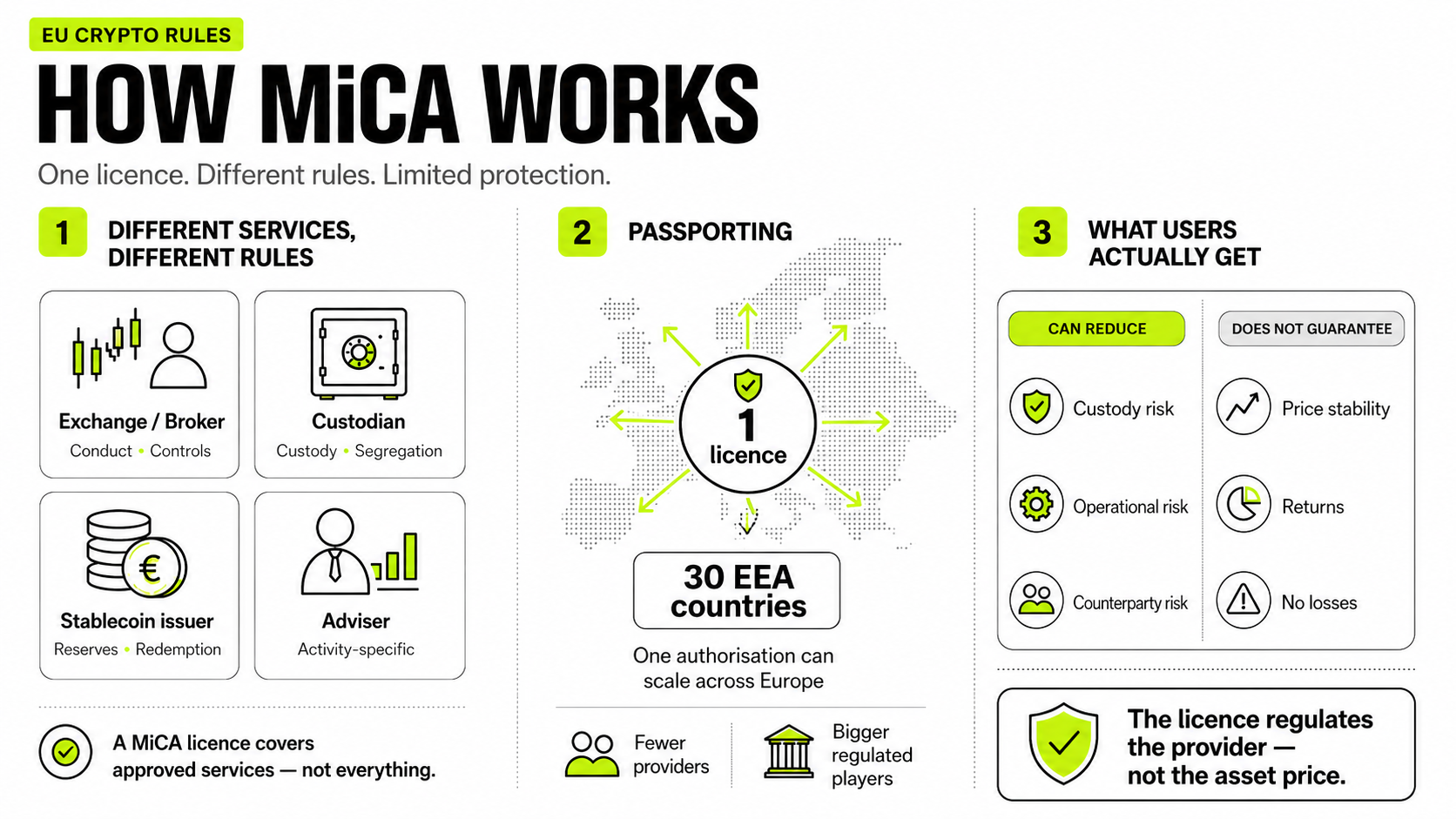
However, there are a few caveats.
First, authorisation doesn't automatically cover every product a company offers — a platform can be authorised as a CASP and still launch a new feature, like a lending or yield product, that falls outside that scope entirely.
Secondly, authorisation concerns the operator and specific services meeting a regulatory bar — it doesn't mean returns are fixed. Nor does it shield you from systemic economic crashes, recessions, or industry-wide downturns. As with any part of finance, crypto or traditional, past performance never guarantees future results.
Finally, MiCA protections may not travel to every country a platform mentions on its website. While CASP authorisation is passportable across the EU/EEA, it does not automatically extend worldwide or cover non-EEA jurisdictions.
Understanding how oversight actually works in practice — including how investigators and regulators piece together who is behind a given platform — is a good complement to this; our guide to how investigators trace crypto actors shows that side of the picture.
How to read a platform's disclosures
Once you know the three words aren't interchangeable, reading a platform's own disclosures gets a lot easier. Here's a simple approach:
- Find the specific register entry. A registration number or licence number should be checkable on the relevant authority's public register. If a platform claims something you can't find on an official list, that's a red flag.
- Ask what it covers. Does the licence apply to the euro account, the card, the exchange, the lending product? Companies sometimes hold multiple registrations and licences across multiple legal entities, each covering a different piece of the service.
- Ask which country. Availability and coverage depend heavily on where you live. A licence or authorisation valid in one country doesn't automatically apply everywhere the platform operates.
- Separate "regulated" from "protected." Even a licensed or authorised entity's crypto products can lose value. None of these words are a substitute for understanding what you're actually holding and what happens to it if the market moves against you.
This is really the heart of the difference between registered and licensed crypto exchange claims you'll see across the industry — one is a compliance checkbox, the other is a specific operating permission, and mixing them up leads people to assume more protection than actually exists.
For an example of how our platform lays this out, Clapp's Licenses and Registrations page is worth a look.
Beyond the legal fine print, it's also worth checking things like custody setup and how funds are actually held. Clapp's security page walks through that practical side.
Three words, three different jobs
"Registered," "licensed," and "authorised" each answer a narrow question, and none of them answers the broader one you actually care about — is this safe for my money.
Once you know what to look for, reading any platform's disclosures gets a lot less mysterious, and the registered vs licensed crypto platform distinction starts being a useful filter. If you want to see how one platform lays out its own registrations, partner-issued accounts, and product structure in practice, Clapp's own disclosures are a reasonable place to start looking.
Frequently asked questions
What does "registered" mean for a crypto platform?
It usually means the platform has completed an anti-money-laundering registration, such as an MSB registration with a financial-crime authority. It confirms the business is on record with that authority and follows reporting rules — it does not mean the authority endorses the business or its products, and it isn't an investor protection scheme.
What does "licensed" mean for a crypto platform?
A licence grants permission for a specific regulated activity, like moving payments or issuing e-money, from a specific authority. It covers only the activity named in the licence, so it's worth checking whether the licence actually applies to the product you're using rather than assuming it covers everything the platform offers.
What does "authorised" mean under MiCA?
CASP authorisation under MiCA means a crypto-asset service provider has met defined requirements around governance, client-asset safeguarding, and operational standards, and can potentially offer services across the EEA. It doesn't mean returns are fixed or that market risk disappears.
Is a registered crypto platform automatically safer than an unregistered one?
Not necessarily in the way people assume. Registration mostly reflects anti-money-laundering compliance, not a review of financial health or product safety. A platform can be properly registered and still carry real market risk, or it might hold a licence for one part of its business and none for another.
How can I check a platform's registrations and licences myself?
Look up the specific register entry or licence number on the relevant official authority's public database rather than taking a footer claim at face value. Then check what activity the licence or registration actually covers, and confirm it applies in your own country, since coverage often varies by jurisdiction.
Why does the difference between registered and licensed matter for everyday users?
Because assuming they mean the same thing can lead you to overestimate the protection you have. A registration tells you about anti-money-laundering compliance; a licence tells you a specific activity meets a regulatory bar. Reading the fine print with that distinction in mind helps you judge what a platform's disclosures actually promise — and what they don't.