Retail investors in crypto — exit liquidity or the market's real engine?

Individual investors are estimated to account for roughly a quarter of US equity trading volume. In crypto, their role goes beyond trading: retail participants provide liquidity, test new applications, participate in governance, and often become the earliest users of emerging networks and protocols.
But as institutional participation grows, the balance is changing. The question is no longer simply whether retail traders matter, but what role they play in a market increasingly shaped by both individuals and professional capital.
TL;DR
- Retail investors do more in crypto than trade — they provide liquidity, test new protocols, vote in governance, and become the earliest users of emerging networks.
- The resource gap between individual and institutional investors has narrowed sharply, driven by cheaper data, on-chain analytics, social coordination, and AI-powered research tools.
- Retail still dominates ownership of major assets like Bitcoin, even as institutions increasingly dominate trading volume — these are two different measures telling two different stories.
- Retail can move markets disproportionately to its size, especially in thinner, smaller-cap assets, through mechanisms like gamma squeezes and short squeezes.
- "Retail is exit liquidity" oversimplifies a relationship that runs both directions — institutions bring depth and liquidity, retail brings distribution, experimentation, and the communities that make new projects viable in the first place.
Who are retail investors?
Retail investors are non-professional market participants trading with their own capital, typically through exchanges, brokers, wallets, and other consumer-facing platforms, and generally in smaller size than institutions.
The category spans a genuinely wide range of behavior:
- Day traders chase short-term price movement, often opening and closing several positions within a single session.
- Swing traders hold positions for days or weeks, aiming to capture medium-term trends.
- Long-term investors buy and hold for months or years, weighted toward long-term appreciation over short-term timing.
- DeFi users lend, borrow, provide liquidity, or trade through decentralized protocols.
- Stakers commit assets to proof-of-stake networks to help secure them and earn rewards.
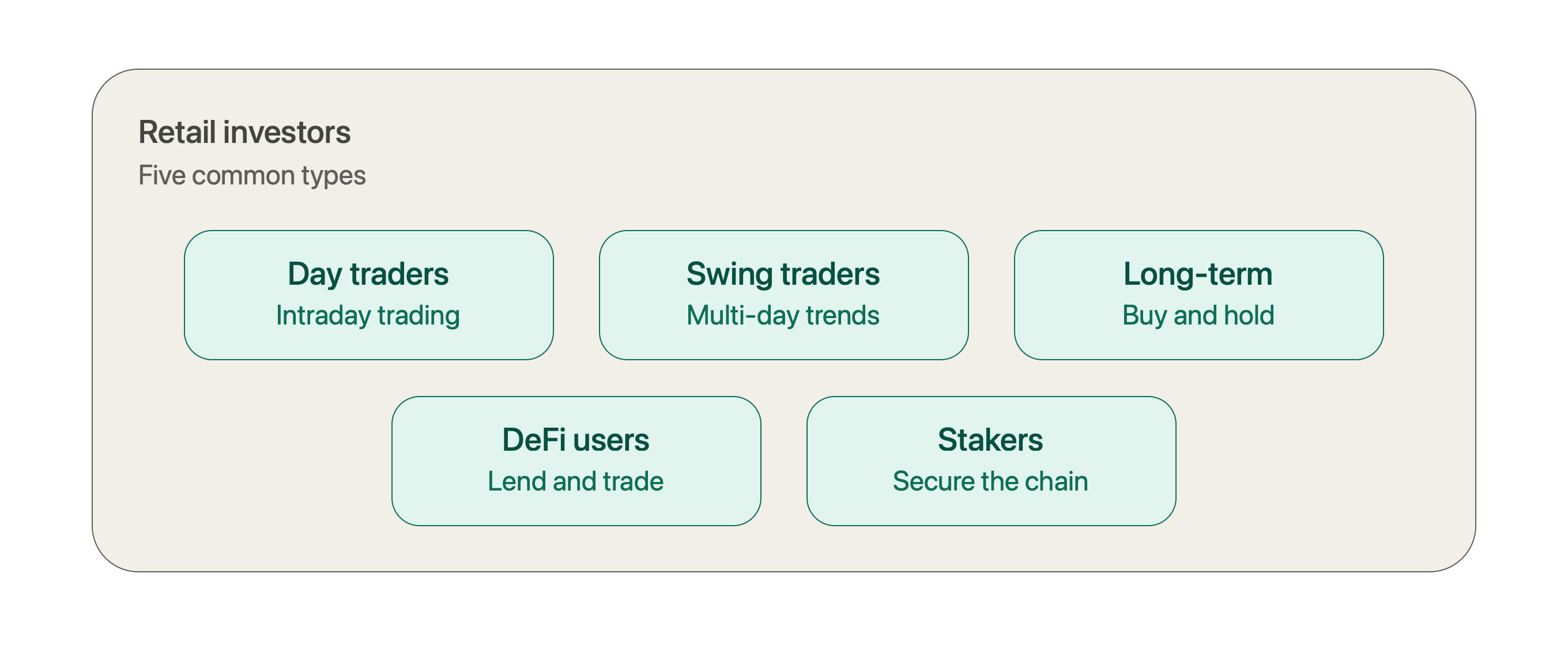
These groups aren't interchangeable, and not every DeFi user or staker counts as a retail investor by default. Together, though, they show how much broader retail participation in crypto actually is compared with simply buying and selling tokens.
The resource gap is closing
Retail investors have historically operated with far fewer resources than hedge funds, market makers, and other professional players, who bring dedicated research teams, sophisticated execution systems, proprietary data, and specialized risk infrastructure to the table.
That gap has narrowed considerably. Lower trading fees, real-time market data, on-chain analytics, algorithmic tools, social platforms, and AI-powered research have put increasingly sophisticated capabilities in individual traders' hands. The two still aren't on equal footing, but the cost of accessing information and infrastructure has fallen dramatically for everyone.
Social media has also compressed the speed at which retail coordinates around information. Communities on X, Telegram, Discord, Reddit, and elsewhere can share research, narratives, token launches, and market reactions almost instantly. AI is accelerating that process further, making market research, data analysis, and personalized trading tools accessible to people who previously needed specialized technical skills to do any of it themselves.
Retail does more than trade
In traditional markets, retail participation is usually measured through trading volume alone. Crypto makes that definition too narrow to be useful.
Retail participants can help bootstrap an entire ecosystem from nothing. When a new blockchain, app, or token launches, individuals are often among its first users, liquidity providers, token holders, and community members — contributing in several distinct ways:
- Liquidity provision — supplying assets to decentralized exchanges and protocols, increasing available liquidity while taking on risks like impermanent loss
- Staking — committing tokens to proof-of-stake networks and helping secure their infrastructure
- Governance — voting on protocol parameters, treasury decisions, upgrades, and other proposals
- Early adoption — testing new applications and giving feedback before a product reaches a wider market
- Content and community building — tutorials, research, reviews, memes, and other content that introduces new users to a project
A protocol doesn't become useful just because its code works — it needs users, liquidity, developers, and communities actually willing to engage with it, and retail participants can supply several of those ingredients simultaneously.
How much can retail traders actually move markets?
Measuring retail's real influence is genuinely difficult, since trading volume, asset ownership, and ecosystem participation are three different things that don't always move together.
Retail can hold a relatively small share of total capital while still having an outsized effect on short-term price, particularly in smaller, thinner-liquidity assets, where coordinated buying or selling moves markets more easily.
The same dynamic shows up in traditional markets, too — retail accounted for roughly 20–25% of US equity trading activity in 2025 by J.P.Morgan's estimates, though its influence runs considerably higher in specific products. Cboe estimated retail traders made up roughly 50–60% of SPX zero-days-to-expiry options trading during 2025.
That activity can shape market maker behavior directly — heavy call buying forces market makers to hedge by buying the underlying asset, which is one mechanism behind a gamma squeeze: rising demand for calls increases hedging pressure, and if the asset keeps rising, the hedge grows further, reinforcing the move.
A short squeeze works through a different mechanism: traders who are short an asset get forced to buy it back as the price rises, adding demand and potentially accelerating the move further.
Example: GameStop
GameStop's rally in January 2021 is a textbook example. Retail investors from the r/wallstreetbets community on Reddit started buying its heavily shorted GME stock, driving the price from around $17 to an intraday peak of $483.
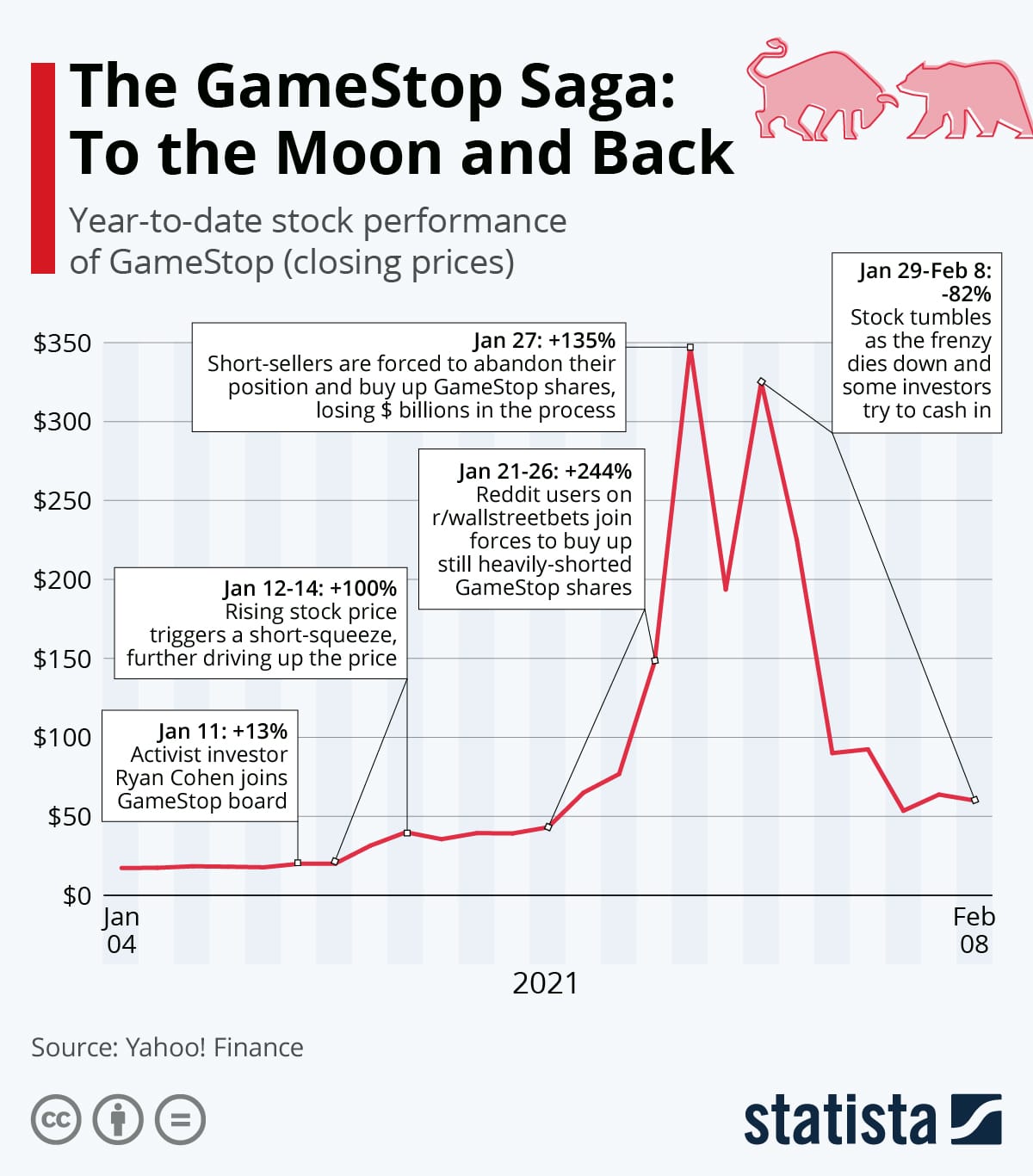
That move inflicted billion-dollar losses on institutional short-sellers — Melvin Capital alone lost roughly 53% of its value that month and needed a $2.75 billion emergency injection from Citadel and Point72 to stay solvent — as short-sellers rushed to buy back shares and cut their losses, driving the price up even further.
The rally only cooled when app-based brokers restricted buying due to clearinghouse collateral demands. Some traders profited immensely; others faced dramatic losses.
Bitcoin's record short squeeze in 2026
The same mechanism plays out in crypto, sometimes at even faster speed since there's no market close to interrupt it.
On August 19–20, 2026, Bitcoin's price surged nearly 8% in a single day, from around $64,000 toward $70,000, triggering roughly $2.7 billion in short liquidations — the largest single-day short squeeze in records going back to 2021. More than $1 billion of that came in the space of about an hour, as traders who'd bet against BTC for six weeks were forced to buy it back at a loss.
Each forced buy pushed the price a little higher, which triggered the next short's liquidation, and the cycle fed itself. Short positions made up roughly 92% of all liquidations that day, outnumbering long liquidations by more than ten to one.
As with GameStop, the rally wasn't driven by sustained new demand so much as forced buying unwinding all at once — a distinction that matters, since squeeze-driven rallies can prove fragile once the short-covering runs out and buying pressure has to come from somewhere else.
Retail investors can also run on a different clock than institutions. An individual trading personal capital doesn't necessarily face the redemption requests, fund mandates, or institutional risk limits a hedge fund does — which doesn't guarantee retail holds longer, but it can give some individuals more flexibility over their own time horizon.
When retail-driven launches get gamed
Sometimes traders don't just support a project. The openness of token launches makes the first few minutes of trading one of the easiest windows in crypto to manipulate — and increasingly, the manipulation isn't coming from a human at all.
A few of the more common tactics:
- Sniping. Automated bots execute pre-programmed buy orders in milliseconds, capturing the lowest possible price before human participants can react.
- Wallet splitting. Purchases get spread across dozens of wallets to fake organic demand, tricking screeners and latecomers into thinking a token is more popular than it actually is.
- Bundled transactions. On networks like Solana, some operators pay validators to package their buy order into the exact same block as the liquidity launch itself, guaranteeing they're first in line before the pool is even public.
- Pre-funded insider wallets. Wallets that receive a meaningful chunk of supply before public trading opens, then sell into the wave of retail buyers once the token goes live — sometimes framed as team, marketing, or market-maker allocations rather than disclosed insider positions.
Sniper bots specifically work by watching the mempool — the queue of unconfirmed transactions waiting to be included in the next block — for the exact transaction that adds a token's initial liquidity. The moment that transaction is visible, the bot fires its own buy order to land in the very next block, often before a project's own community even realizes trading has opened.
Being first in line at the lowest possible price means the bot can then sell straight into the wave of retail buyers who arrive seconds or minutes later, pocketing the spread and leaving the token's chart looking like a spike followed by a cliff.
That's what happened to Hunter Biden's LAPTOP memecoin in September 2026, according to the team's version of events. The token launched at $0.05, spiked as high as $190–$300 within its first couple of minutes, then crashed more than 98% within about an hour.
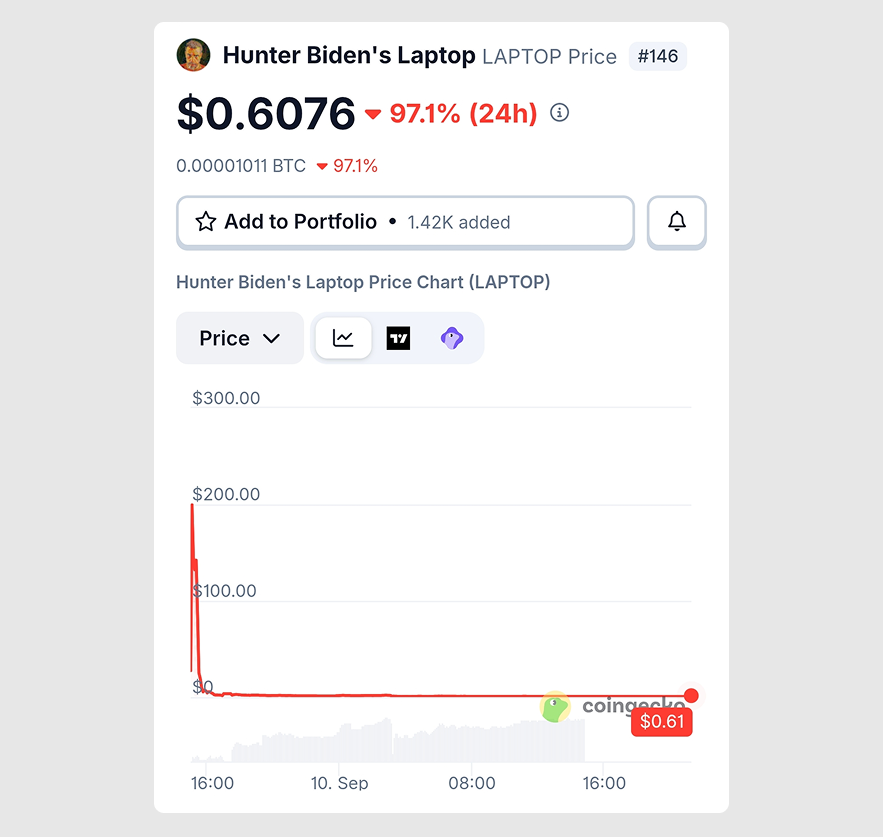
However, that explanation didn't go unchallenged. Blockchain intelligence firm Arkham traced a wallet that had received 100 million LAPTOP — about a tenth of total supply — a week before launch, and that sold more than 42 million of them once trading opened.
Crypto: Where retail has mattered more than usual
Retail investors were central to crypto's early development. Bitcoin, ethereum, and many later networks grew without the institutional infrastructure that dominates traditional finance — individuals bought tokens directly, ran nodes, provided liquidity, voted in governance, experimented with new applications, and built the communities around emerging projects from scratch.
That role remains significant, though the balance is shifting. One useful distinction here is between ownership and trading activity, because they currently tell very different stories.
River's 2025 research estimated individuals controlled about 65.9% of Bitcoin's supply, against 7.8% held by funds, 6.2% by businesses, and 1.5% by governments — figures based on public filings, address attribution, and prior research rather than a complete on-chain census.
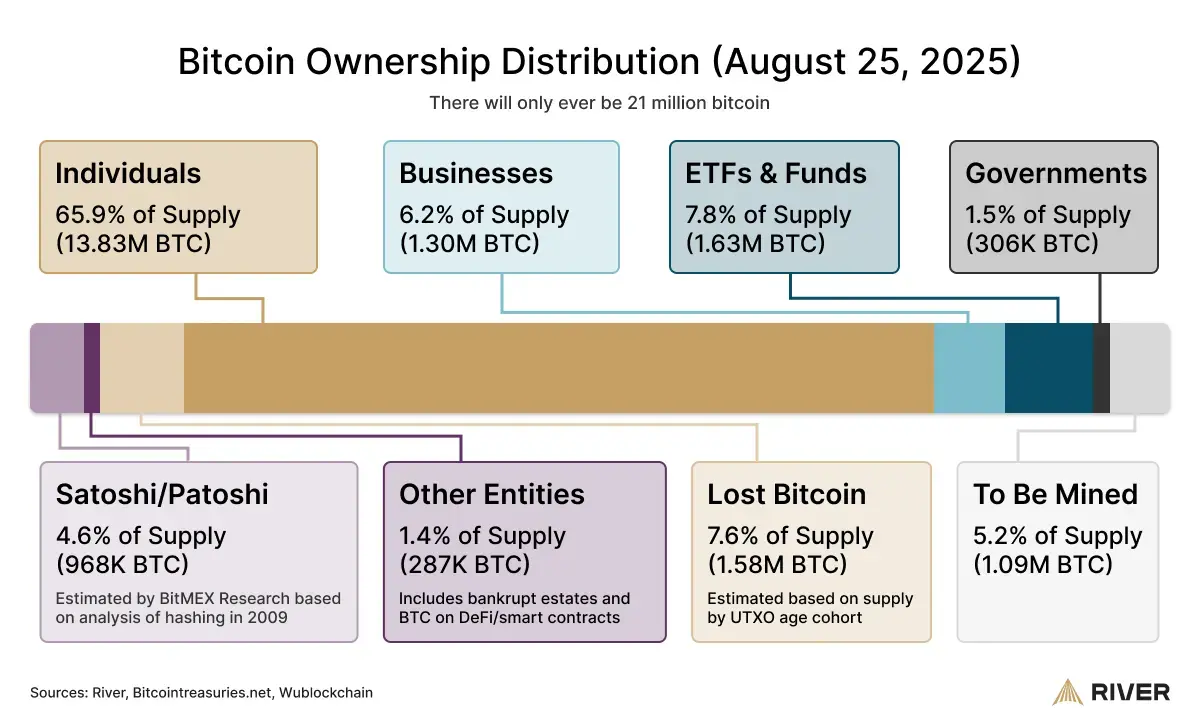
Trading paints a different picture. A July 2026 report from market maker Wintermute found institutions accounted for 72% of spot trading volume on its OTC desk during the first half of 2026, up from about 61% in the second half of 2025. That's real evidence of growing institutional presence, though it describes activity on one OTC desk specifically — not the full scope of global crypto spot trading.
Wintermute also linked that growing institutional share to lower realized volatility and tighter liquidity concentration in a smaller set of assets, reporting realized volatility falling from roughly 70% in earlier cycles to around 45% by the time of its analysis. Bitcoin's more recent data lines up with that: Glassnode's Annualized Realized Volatility showed one-year realized volatility of about 43.9% as of September 20, 2026.
Put together, this isn't a simple story of institutions replacing retail. Retail may still dominate ownership of some major assets and remain critical to ecosystem activity, while institutions increasingly shape liquidity and price formation in the most heavily traded markets — two trends running in parallel rather than one canceling out the other.
What makes retail different in crypto specifically?
Crypto changes the relationship between individual investors and the financial infrastructure around them. In traditional markets, retail generally interacts through intermediaries — brokers, custodians, clearing systems, exchanges. Crypto strips some of those layers out entirely: a user can hold assets directly in a self-custodial wallet, trade through a decentralized exchange, interact with a protocol without opening an account anywhere, or inspect activity directly on a public blockchain.
That creates a few structural differences worth naming:
Public data. Public blockchains expose transaction data that would be difficult or impossible for an individual to access in traditional markets. On-chain analytics can reveal wallet activity, token flows, and liquidity movements — not always easy to interpret, but often publicly accessible in a way traditional finance rarely offers.
Permissionless access. Many decentralized protocols let anyone meeting their technical requirements interact directly, without conventional finance's gatekeepers — though permissionless doesn't mean risk-free, given smart-contract vulnerabilities, MEV, slippage, gas costs, and real information asymmetries.
24/7 markets. Crypto trades continuously rather than around fixed exchange hours, which makes participation more flexible for retail traders. It also means the market never fully closes — price moves and liquidation events can happen while traditional financial institutions are shut for the night.
Different barriers for institutions. The same openness that draws retail in creates real friction for institutions, which have to navigate custody, compliance, reporting, risk management, liquidity, and operational infrastructure that varies by jurisdiction. This doesn't put retail in a structurally better position overall — it just means the two groups run into different obstacles participating in the same market.
Is retail just "exit liquidity"?
The phrase "retail is exit liquidity" has become common shorthand in crypto — the idea that sophisticated investors accumulate early and eventually sell to less-informed retail buyers later.
That pattern genuinely happens sometimes. Where the phrase falls short is as a complete description of what retail participation actually does. Retail traders create demand, provide liquidity, vote in governance, use applications, and build the communities that determine whether a project attracts users at all.
The relationship runs in both directions, in fact. Institutional capital brings deeper liquidity, larger pools of capital, and professional market-making to established assets. Retail brings broader distribution, experimentation, community activity, and demand for the assets and applications institutions tend to overlook early on.
How the retail role is changing
Crypto's retail era isn't ending, but it's getting more complicated. Institutions now hold a much larger presence across Bitcoin, ether, derivatives, ETFs, custody, and tokenized assets, and Wintermute's 2026 data is one clear signal of how fast that shift is moving.
At the same time, retail holds onto something institutions can't easily replicate: large-scale grassroots participation. Individuals are still the ones trying new applications, trading long-tail assets, providing liquidity to emerging protocols, voting in governance, building communities, and turning obscure projects into names people actually recognize.
Framing the future as retail versus institutions misses what's actually happening. The market is shaped by how the two groups interact — institutions increasingly setting liquidity and price formation in the largest assets, retail staying essential for adoption, experimentation, and the long tail of the ecosystem. Trading volume alone won't capture that. In crypto, the people using the network can matter just as much as the people trading the asset.