LTV vs. liquidation threshold: The numbers you can't ignore

Crypto loans have been around for roughly a decade, but some terms can still feel confusing. Platforms have very different LTV limits and liquidation rules, while margin calls are far from universal.
Most people look at these numbers individually and move on. They rarely stop to think about the space between them, and that space is what matters most when markets move.
The distance between your current LTV and the liquidation threshold is your safety buffer: the room you have to breathe, and the number that decides whether a crash makes you nervous or keeps you up at night.
Here's a look at the core concepts behind the jargon: what each number means, why the gap matters, and how to keep it wide enough to give yourself time to react.
TL;DR
- LTV is your current loan-to-value ratio — how much you've borrowed compared to your collateral.
- Liquidation threshold is the LTV at which your collateral becomes subject to liquidation. Cross it and the platform may start selling your assets to cover the loan.
- The gap between them is your safety buffer — the wider the gap, the more room before liquidation.
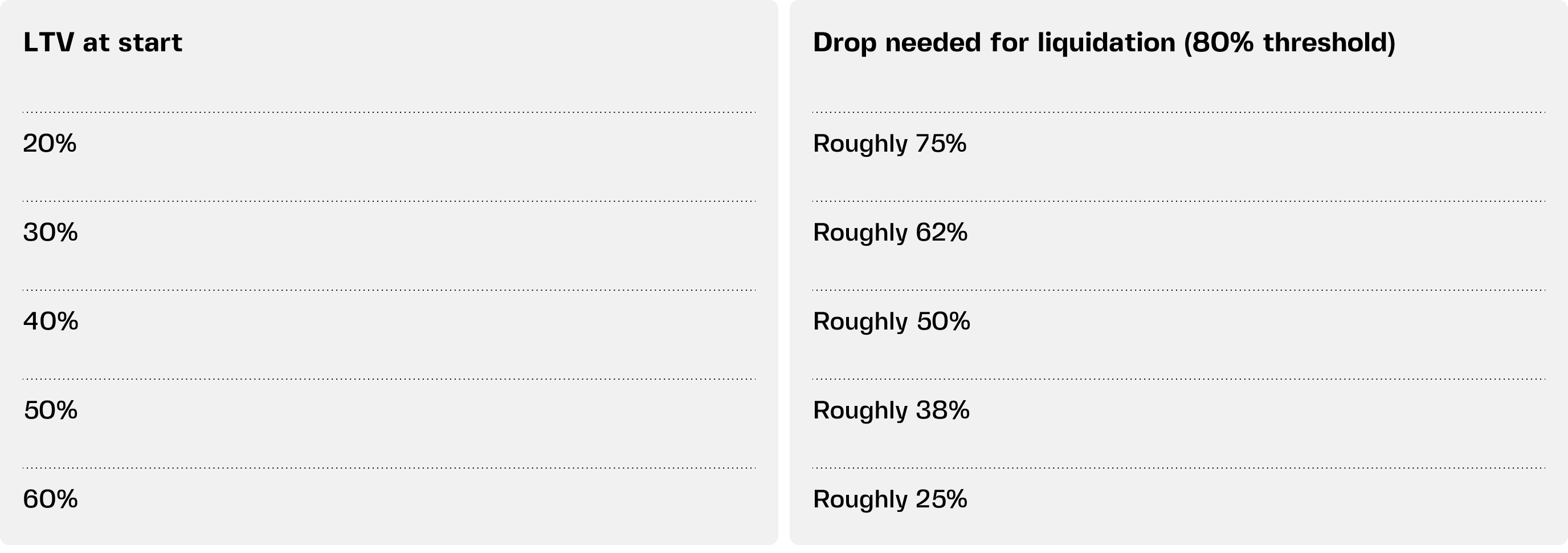
- A 20% LTV with an 80% liquidation threshold gives you roughly a 75% price-drop buffer. At 60% LTV, that buffer shrinks to about 25%.
- Lower LTV means a wider gap — simple math, but it makes a real difference in what happens when prices fall.
Starting point: LTV
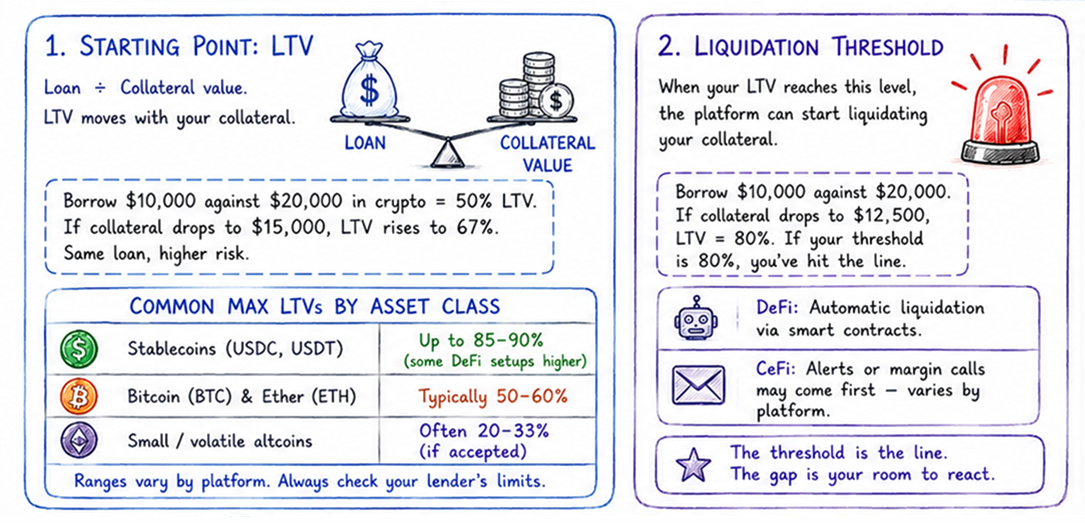
LTV (loan-to-value ratio) is your loan amount divided by your collateral value. It's one of the core metrics in crypto lending because collateral values can shift by the second.
Unlike conventional fiat loans, the overwhelming majority of crypto lending products are overcollateralized. LTV is the number that measures it.
Say you pledge $20,000 in crypto to borrow $10,000 — that's 50% LTV. Now say your collateral drops to $15,000 overnight. Your loan hasn't changed, but your LTV has: it's now 67%.
LTV moves with the value of your collateral. That means the risk of your loan can shift even if you haven't borrowed another dollar — and it sets both your borrowing power and your room to absorb a market move against you.
How LTV caps your borrowing power
That initial limit depends on the assets you pledge as collateral. Bitcoin and Ether generally have lower LTV limits than stablecoins because they're prone to sharper price swings. Smaller altcoins, if accepted at all, usually allow even less borrowing against them.
The more volatile the collateral, the more conservative the borrowing limit.

Common maximum LTVs by asset class
- Stablecoins (USDC, USDT): up to 85–90% maximum initial LTV on some platforms; specialized DeFi configurations can go higher
- Bitcoin (BTC) & Ether (ETH): typically capped around 50–60%, depending on the platform
- Small/volatile altcoins: often capped at 20–33%, if accepted at all
These are broad ranges, not universal rules — your platform's actual limits always take precedence.
Liquidation threshold
When markets decline, your collateral loses value and your LTV rises. At some point the lender needs to protect itself from the collateral becoming insufficient to cover the loan. That's the job the liquidation threshold does.
Say you borrowed $10,000 against $20,000 in crypto. If that collateral falls to $12,500, your LTV climbs from 50% to 80%. If 80% is your liquidation threshold, you've hit the line where the platform can start liquidating your collateral.
- In DeFi, this can happen automatically through smart contracts, without a human stepping in to warn you first.
- Centralized lenders may send alerts or margin calls before the actual threshold, giving you time to add collateral or repay part of the loan — but this varies by platform.
The threshold marks the line; the gap between your real-time LTV and that line is your room to react.
- Borrow $10,000 against $50,000 in Bitcoin and you're at 20% LTV — a conservative position with a large buffer. Some lenders reward very low LTV with lower rates, potentially even 0%.
- Borrow $30,000 against that same $50,000 and you're at 60% LTV — much closer to the threshold, with far less room for a sharp move.
Do different assets carry the same liquidation thresholds?
Not necessarily. Like initial LTV limits, liquidation parameters can depend on the collateral asset, its volatility, liquidity, and the platform's risk model. Stablecoins can support higher thresholds because they're designed to hold a relatively stable value, though they still carry depeg risk.
Your liquidation buffer isn't a fixed number — as your collateral's value changes, so does your LTV, and so does the distance between your position and liquidation.
This is part of why stablecoins can be attractive collateral, but there's a catch: you're committing capital that could otherwise sit as dry powder for market opportunities.
Flexible credit lines solve this by letting you manage collateral while the line stays open — on Clapp, for example, you can swap collateral assets without closing it. With other products, particularly fixed-term loans, collateral may stay locked until repayment.
The "best" collateral usually isn't whatever gets you the highest LTV. It's whatever balances borrowing power, risk, and flexibility for what you're actually trying to do.
Am I close to liquidation if I use my full credit line?
It depends on how much collateral is backing the line, not simply on whether you've used your full credit limit.
Here's what happens, assuming an 80% liquidation threshold: you have a $20,000 credit line backed by BTC currently worth $40,000.
- Withdraw the full $20,000 and your LTV sits at 50% — you're nowhere near liquidation, with a substantial buffer left before the 80% threshold.
- Now say BTC falls. At $30,000 in collateral, your LTV rises to about 67%. At $25,000, it reaches 80% — the assumed threshold.
Here's the real difference between available credit and safety buffer — having $0 of unused credit doesn't automatically put you near liquidation. What matters is how much collateral value remains relative to what you owe. And because a credit line has no fixed repayment schedule, you can choose when to repay, as long as the position stays within the lender's requirements.
If the lender supports multi-collateral borrowing, there's another layer of flexibility — you may be able to add or swap collateral as conditions change. Replacing some BTC with stablecoins, for instance, can reduce your exposure to further price swings without necessarily closing the credit line.
The LTV/liquidation-threshold gap is how much market movement your position can absorb before you have to act.
How to build a wider gap
- Borrow less from the start. At 20% LTV, an 80% liquidation threshold leaves a 60-percentage-point gap. At 50% LTV, that gap shrinks to just 30 points. In practice, that's the difference between calmly riding out a crash and scrambling to react in the middle of one.
- Add collateral early. Waiting until you're at 70% LTV puts you in a race against the market once prices start moving. Adding collateral while your LTV is still low just buys you more room to work with.
- Keep dry powder ready. Stablecoins sitting in Flexible Savings can be moved into your collateral pool whenever you need them. That reserve means you're not scrambling for cash in the middle of a sharp move.
- Use multi-collateral pools. Mixing stablecoins with volatile assets helps absorb price swings. If BTC drops while your stablecoins hold their value, your total collateral falls less than it would if BTC were your only asset.
What Clapp makes possible
On Clapp, keeping your LTV at 20% or below can qualify you for 0% APR and still leave a substantial buffer before liquidation.
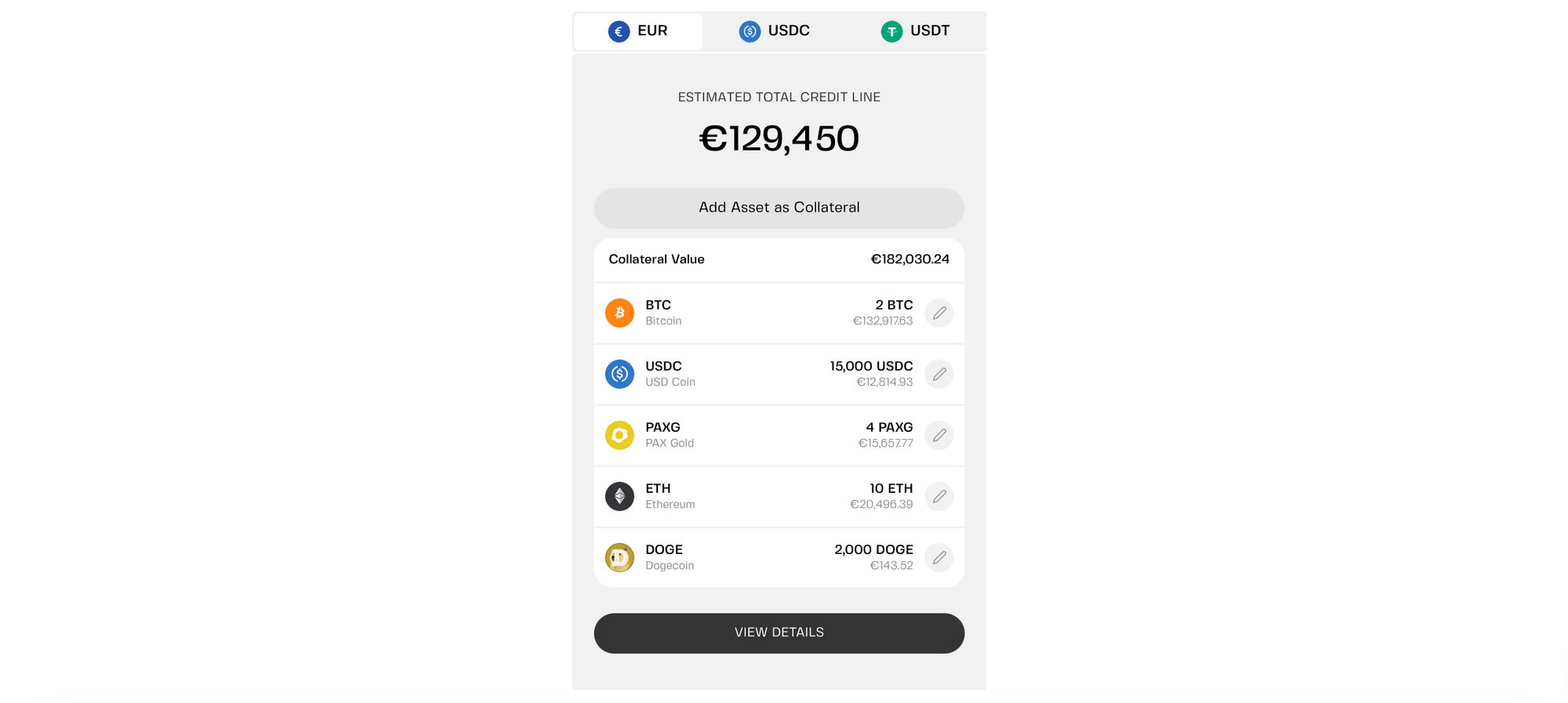
You can also combine up to 25 assets in one collateral pool and swap collateral without closing your credit line. In practice, that lets you add stablecoins when volatility picks up, or shift your mix entirely as your strategy changes.
This gives you more room when you get the timing wrong.
Two numbers, one gap
LTV is where your loan stands right now. The liquidation threshold is the point where the lender stops watching and starts selling. What sits between them is your actual breathing room.
Wide gap, and a crash is something you can watch happen. Narrow gap, and you're making decisions in the middle of one — usually not the decisions you'd have made with a clear head.
So borrow conservatively, keep some collateral in reserve, and think of that gap as a cushion. Not as extra credit you haven't used yet.
Frequently asked questions
What's a safe LTV to avoid liquidation?
20–30% LTV is generally a conservative range. At 20%, your collateral would need to fall about 75% to reach an 80% liquidation threshold; at 30%, about 62%. The exact safe level depends on the platform, asset, and threshold.
Does the liquidation threshold vary by platform?
Yes. CeFi platforms often use thresholds around 70–80%, while DeFi protocols can set different thresholds for different assets. Always check the exact terms before borrowing.
Can I get a margin call before liquidation?
On CeFi platforms, often yes. You may get notifications when your LTV crosses certain warning levels, giving you time to add collateral or repay part of the loan. DeFi protocols generally rely on automated liquidation rather than a traditional margin call.
What happens if my LTV hits the liquidation threshold?
The platform can begin selling your collateral to cover the outstanding loan. The process varies — some CeFi products liquidate only part of the collateral, while DeFi protocols run their own automated mechanisms.
How can I widen my gap without borrowing less?
Add more collateral, or use a more diversified pool. Stablecoins can soften the impact of a drop in volatile assets, and multi-collateral products give you more flexibility to adjust the mix as conditions change.