Fixed savings, step by step: What 'locked' really means and what happens at the end of the term

The word "locked" sounds like a door closing behind you. When it comes to crypto, it makes some people flinch — you may picture not being able to reach your money right when you need it the most.
The reality is hardly sinister. With fixed-term crypto savings, you agree on a rate and an end date at the start, and you leave the amount alone until that date arrives. Set and forget. Typically, there's very little to manage while the term is running.
This guide walks through the whole thing in order: the day you open a position, the weeks in the middle, and the day the term ends. By the end you'll know what you can and can't do at each stage, so "locked" stops being a mystery.
TL;DR
- You choose the asset, amount, and term upfront, and see the exact rate before confirming — nothing changes after that point.
- The rate stays fixed for the full term, no matter what the market does. The fiat value of what you earn can still move, since that depends on the asset's price, not the rate.
- You generally can't withdraw early. That's what "locked" actually means here, and it's the one real trade-off.
- At the end of the term, what happens depends on your auto-renewal setting: with auto-renewal on, your deposit and interest roll into a new fixed term; with it off, the funds return to your wallet.
Day 0: Choosing your asset, amount and term
So, how do locked crypto savings work in practice? Before confirming your fixed-term parameters, you make three crucial choices that shape the rest of the timeline.
Pick the asset
Which asset do you want to put to work? Some people pick a stablecoin because they want the value to stay steady while it earns — and because they can currently secure a higher rate on it. Others pick a major like BTC or ETH because they plan to hold it anyway and earn in the meantime. That's yield and price exposure in parallel.
USDT, USDC and EUR currently offer the highest rates on Clapp. The trade-off is that BTC and ETH also come with price exposure.
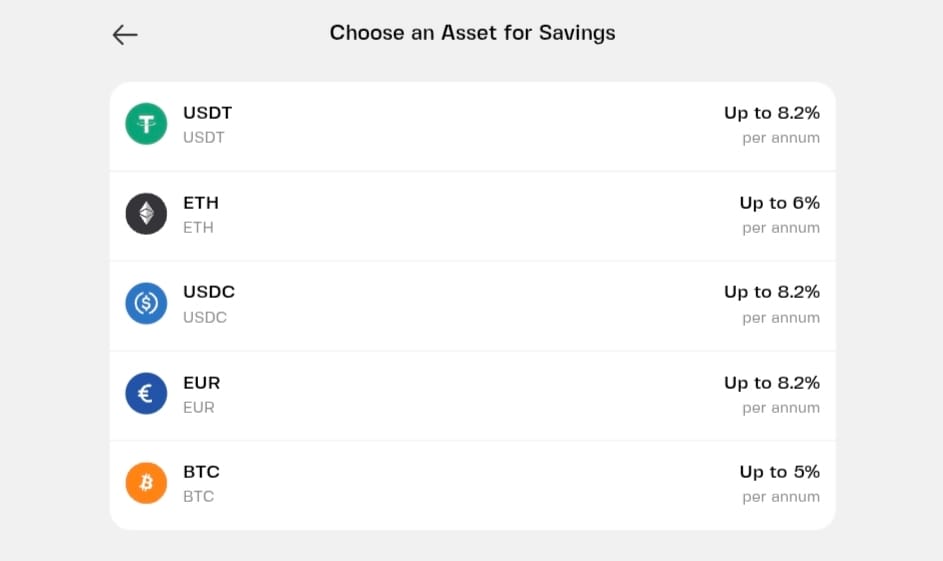
Suppose you deposit BTC into a product paying 5% APR (annual percentage rate). This interest is paid in the same type of asset you deposited — you get more BTC on top of BTC, but the fiat value of your savings still moves with the market.
Thus, a stablecoin position and a BTC position can behave very differently over the same term. Fixed savings fix the rate, not the price of the coin.
Not every asset or term is offered in every country, so what you see in the app depends on where you live.
Pick the amount
The main rule of fixed savings is only to commit what you won't need before the term ends.
Consider keeping a cushion in something you can reach quickly, and depositing only the money you've already mentally set aside. (If you're unsure, our guide to the optimal starting amount is worth reading first.)
Pick the term
The term is the length of time your position stays open. A longer term means a longer wait before your deposit becomes available again.
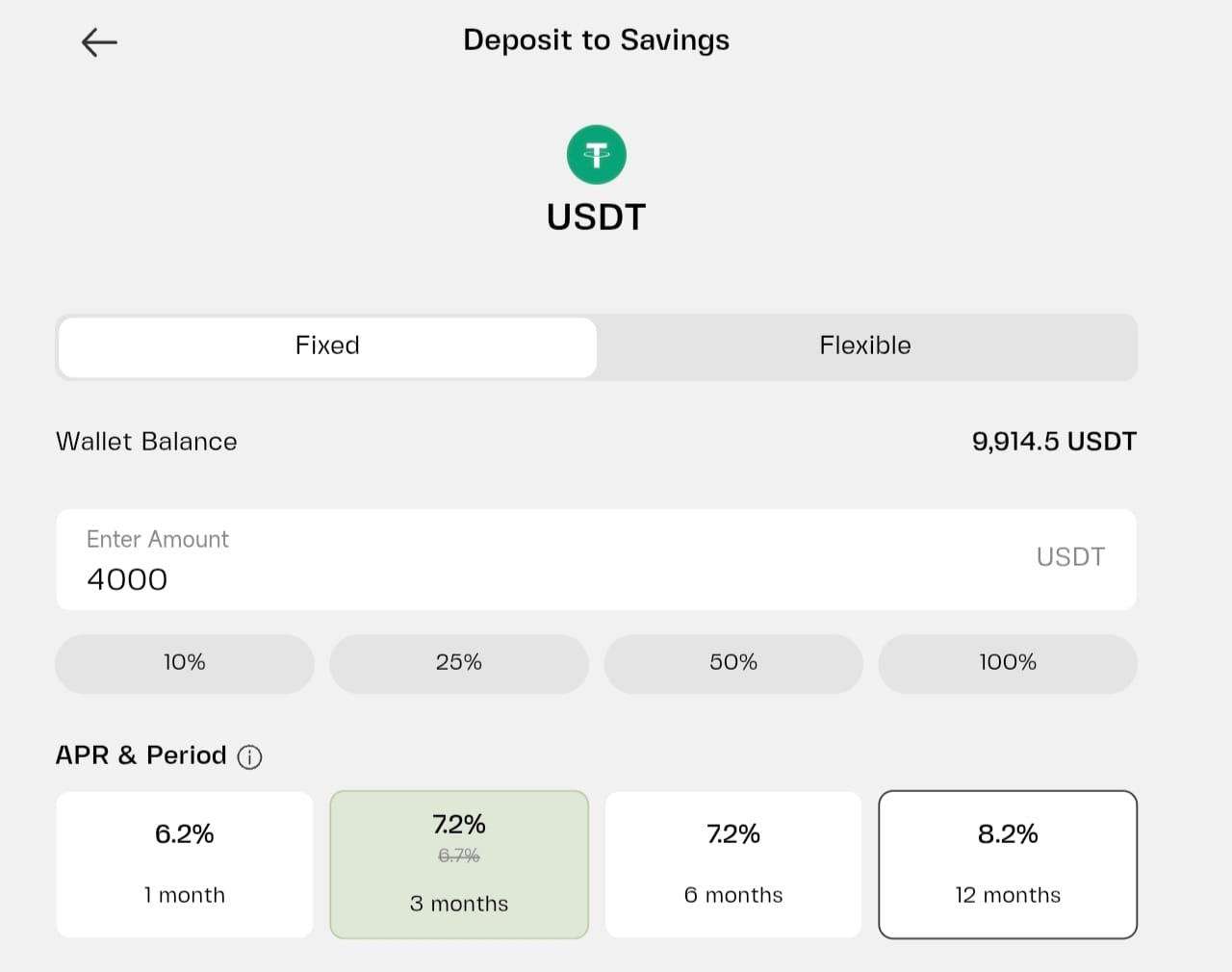
Choose a term that ends a little before the date you'll need the money, not on it.
Say Maya wants to pay €3,000 for a summer holiday next year, and she wants to earn yield on that money in the meantime. Picking a term that finishes a few weeks before she makes her travel arrangements will give her time to decide what to do with the result.
See the rate before you confirm
Before you press the Confirm button, the app will typically show a summary — the rate for the asset and term you picked. For example, Clapp offers Fixed Savings rates up to 8.2% APR. If the term is shorter than a year, the rate for your chosen combination may differ from that headline figure, as platforms often offer better rates for longer commitments..
Specifics vary between products and platforms. Aside from the amount, interest, and dates, study the product description carefully.
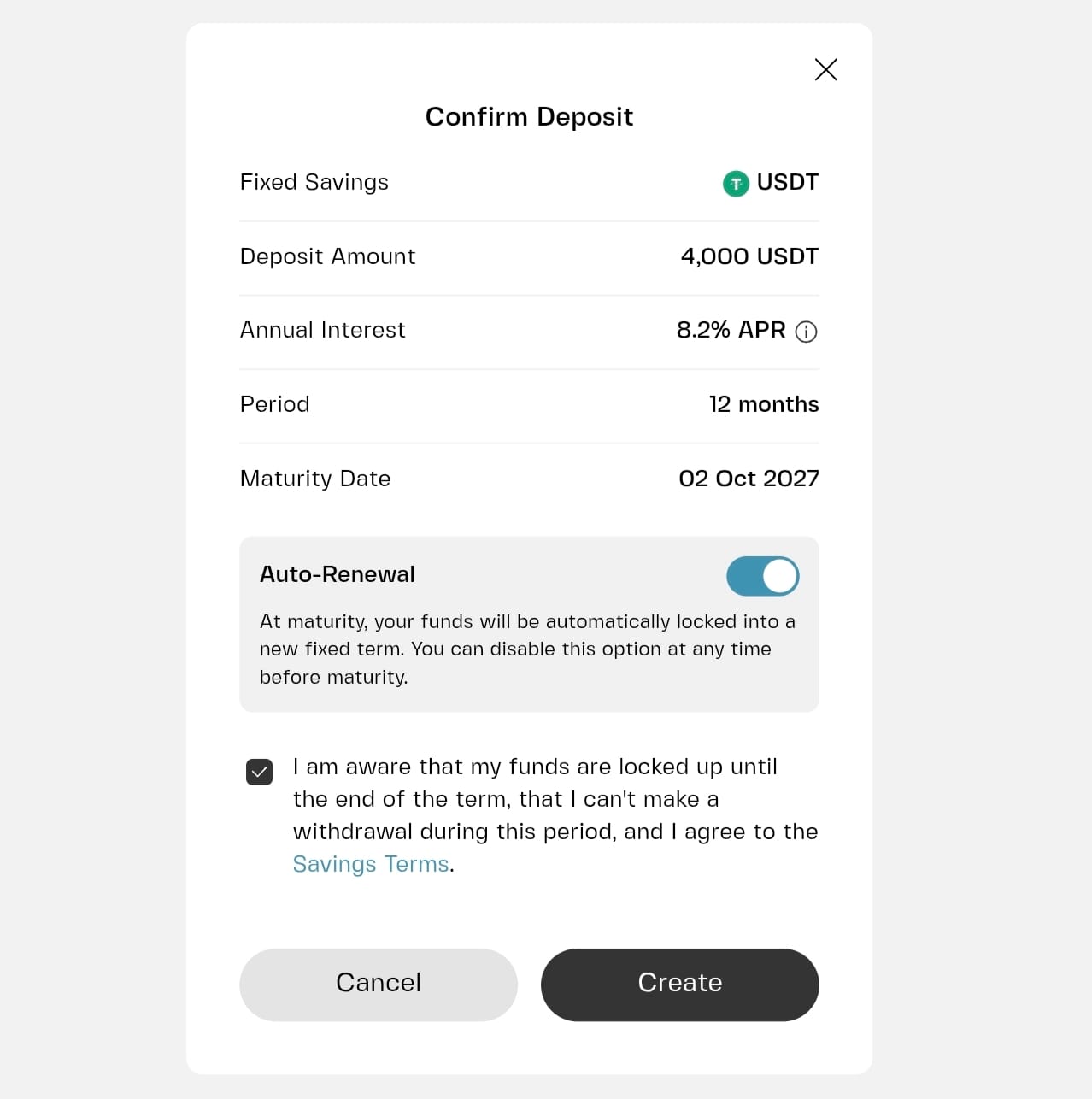
With Clapp's Fixed Savings, you "lock in a fixed rate for a term selected at opening. Your rate is fixed upfront for the full term." In plain words, the rate you see on the confirmation screen is the rate you keep until the term ends. No changes halfway through, regardless of any market swings.
During the term: What happens while you wait
Once you confirm, your position opens and the clock starts. Then there's very little for you to do.
How interest builds up
Interest accrues over the term at the rate you saw on Day 0. You can open the position in the app whenever you like to check how it's going. It's a good habit for the first week, because seeing it work makes the whole thing feel less abstract.
If you want to understand exactly how that displayed rate turns into real earnings, see our breakdown of APR vs. APY — it matters when you're comparing offers across platforms.
Why the rate doesn't move
This is the main reason people choose fixed term crypto savings in the first place. The rate was set when you opened the position, so a quiet week, a busy week or a sudden headline won't change it.
That works in both directions. Whether rates elsewhere rise or fall after you've opened your position, yours stays where it was. The trade-off for this certainty is giving up the chance to chase something better mid-term.
Savings carry risk, and returns can vary once you count price movements. Learn more about what a fixed rate does and doesn't promise in Clapp's deep dive.
What you can't do
That's the actual meaning of "locked": early withdrawal isn't available during the term. If an unexpected bill appears in month two, this position can't help you pay it.
You accepted a closed door in exchange for a rate that stays put. In exceptional cases, you can request early closure through support, but all accrued interest is forfeited.
If you need your money earlier
While your long-term holdings are deposited for a fixed period, your cushion for emergencies doesn't have to sit idle.
Split your money into several buckets. Some goes into a fixed position for a shorter wait; some stays flexible for the "just in case" bucket.
In Flexible Savings, your assets also earn yield, but they also remain accessible. (For a direct side-by-side, see our comparison of flexible and fixed savings.)
The end of the term: What comes back and what you decide
On the final day — the end date you saw on Day 0 — one of two things happens, depending on your auto-renewal setting.
If auto-renewal is on, your deposit plus accrued interest automatically rolls into a new fixed term at the rate available at that point. If auto-renewal is off, the position closes and the funds are returned to your wallet.
What you decide next
Clapp has auto-renewal enabled by default, but you can turn it off before the term ends. If you leave it on, the new term uses the rate available at renewal, not the rate you originally locked in. Choose a path that suits you:
- Turn off auto-renewal. Your deposit and accrued interest return to your wallet when the term ends. If you'd rather keep the money accessible, you can move the funds to Flexible Savings or withdraw them.
- Keep auto-renewal on. Your principal and interest automatically move into a new fixed term at the current rate.
Don't assume. Check your auto-renewal setting before the end date, so the last day holds no surprises.
A quick note on timing
Think about the end date as the start of a new decision, not just a finish line. If the rate you'd get on a new term is lower than what you had, flexible savings or withdrawing might suit you better. If it's attractive, renewing might be right.
Is a locked position right for you?
So, who benefits from fixed-term savings? Usually it's people who:
- Already know they won't touch the money for a while.
- Want a rate they can plan around, not one that shifts week to week.
- Prefer a clear end date to open-ended access.
It's usually not the right fit if you're building an emergency fund, if your plans are uncertain, or if you'd lose sleep over not being able to reach the money. In those cases, flexible savings or simply holding in your wallet may suit you better.
If you want to see how the product looks in the app, the fixed-term savings page shows the options. Remember that availability depends on your country.
"Locked" sounds scarier than it is
With fixed term crypto savings, you make your choices on Day 0, wait through the term while the rate stays the same, and decide what happens next when the end date arrives. The main limit is that you can't normally take the money out early, so only commit what you can leave alone.
If that sounds like a plan you can live with, you can explore fixed savings in the Clapp app and see the rate for your chosen asset and term before you confirm anything.
Frequently asked questions
How do locked crypto savings work?
You choose an asset, an amount and a term, then see the rate before you confirm. That rate stays the same for the full term. You can't withdraw early during the term. When it ends, your auto-renewal setting determines what happens next. If it's enabled, your deposit and accrued interest automatically roll into a new fixed term at the rate available at that point. If it's disabled, the funds return to your wallet.
Can I take my money out before the term ends?
No. Early withdrawal isn't available on a fixed position, which is what "locked" means here. If you might need quick access, keep that part of your money in flexible savings or in your wallet.
Does the fixed rate change if the market moves?
Not normally. Fixed Savings can't be closed early by the user. In exceptional cases, you can request early termination through support, but approval isn't guaranteed and any accrued interest is forfeited if the request is approved.
What happens on the last day of the term?
It depends on your auto-renewal setting. If auto-renewal is enabled, your deposit plus accrued interest automatically starts a new fixed term at the rate available at that point. If auto-renewal is disabled, the position closes and the funds are returned to your wallet. Check the setting before maturity if you don't want the deposit to renew.
Can I open more than one fixed position?
Yes. You can open another position while the first one is running, for instance with a different asset or a different term. Each position keeps its own rate and its own end date.
Does a fixed rate mean the outcome is certain?
No. The rate is fixed, which means it's set upfront and doesn't move. But savings carry risk, and the value of the asset you earn in can rise or fall.