What actually happens to your collateral during a crypto-backed loan

You deposit some Bitcoin, receive liquidity, and life goes on. But where do those coins sit while your borrowing is open? This guide follows your crypto loan collateral from the moment you post it to the day you close the loan or credit line, including how a market drop can affect it along the way.
TL;DR
- The assets you post as collateral in a crypto-backed loan or credit line are tied to the debt until it is repaid.
- LTV is the key number to watch. It changes with the value of your collateral and determines how much buffer you have before liquidation.
- Collateral arrangements differ between lenders. With Clapp, legal ownership transfers to Clapp, while you retain a contractual claim to an equivalent amount of the same asset after full repayment.
- If LTV rises too far, the lender can liquidate collateral. Keeping LTV lower, adding collateral, or repaying the balance can reduce that risk.
- You get liquidity without selling, but also take on interest costs, liquidation risk, and the terms attached to your collateral.
Why lenders ask for more collateral than they lend
Crypto-backed loans aren't typically issued against collateral worth exactly the amount borrowed. Such loans are usually over-collateralized; the gap gives the lender a buffer against price swings while giving the borrower some room before liquidation becomes a risk.
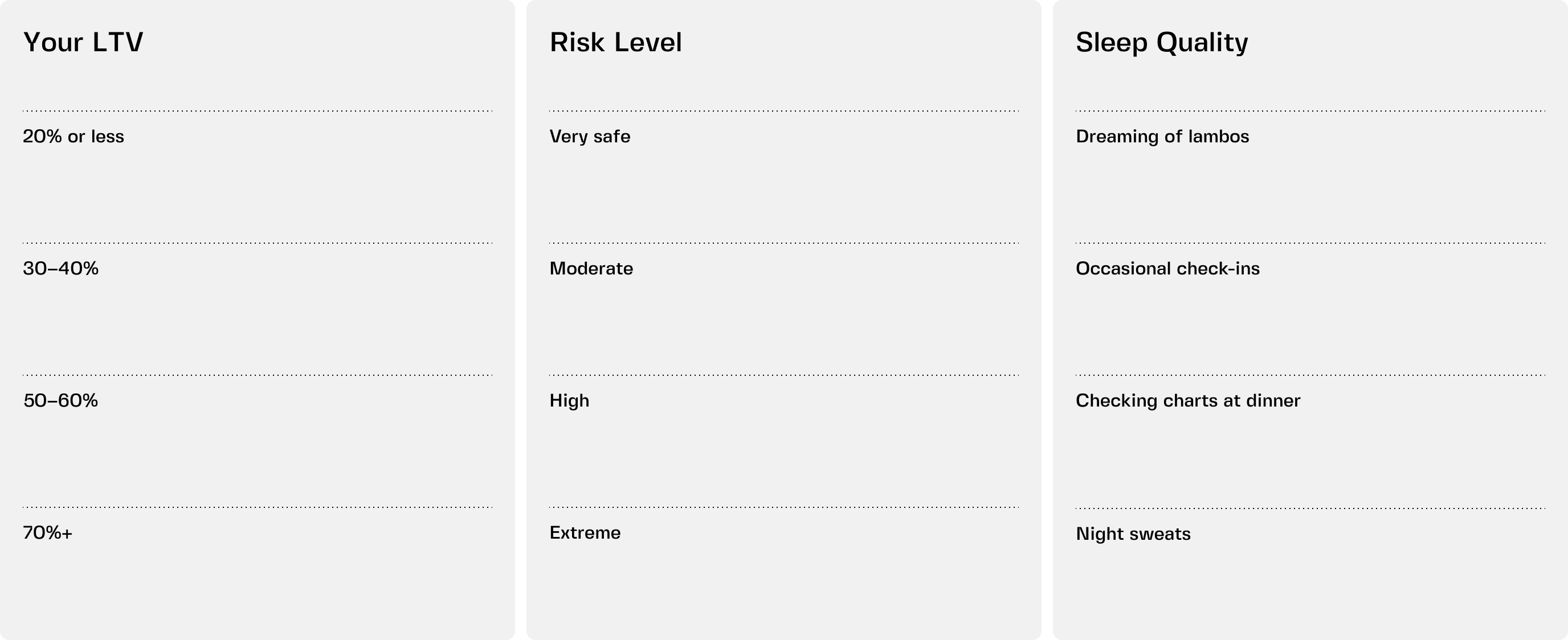
Put in €10,000 of Bitcoin and borrow €5,000, and your loan-to-value ratio (LTV) is 50%. The smaller it is, the further prices can fall before you reach the liquidation threshold, the LTV at which the lender can start selling your collateral.
That's why loans need extra collateral. Borrowing right up to the maximum leaves you almost no room.
What happens when you open a credit line
You pick the asset you want to use as collateral (say, BTC), choose how much to borrow, and confirm. From that point the collateral leaves your available balance. It still shows in the app, but it's marked as collateral, so you can't move or trade it. You still have exposure to the underlying asset: if Bitcoin doubles while the credit line is open, the Bitcoin you get back is worth twice as much.
Where the collateral goes next depends on the lender. A CeFi platform may hold it with a custodian, while a DeFi protocol will usually lock it in a smart contract. The more important question is who owns it while the loan is open, which is why you should read the Terms and Conditions before you borrow, not after.
Some lenders take a security interest and leave title with you. Others, including many custodial CeFi platforms, take legal title and owe you equivalent assets back. Clapp works the second way: when the credit line is approved, legal and beneficial ownership of the collateral transfers to Clapp. You no longer hold title to those assets, but have a contractual right to receive an equivalent amount of the same type of digital asset once the credit line is fully repaid.

Either way, the collateral stays tied to your debt until the terms say otherwise. If its value drops far enough, the lender can liquidate some or all of it to cover the loan.
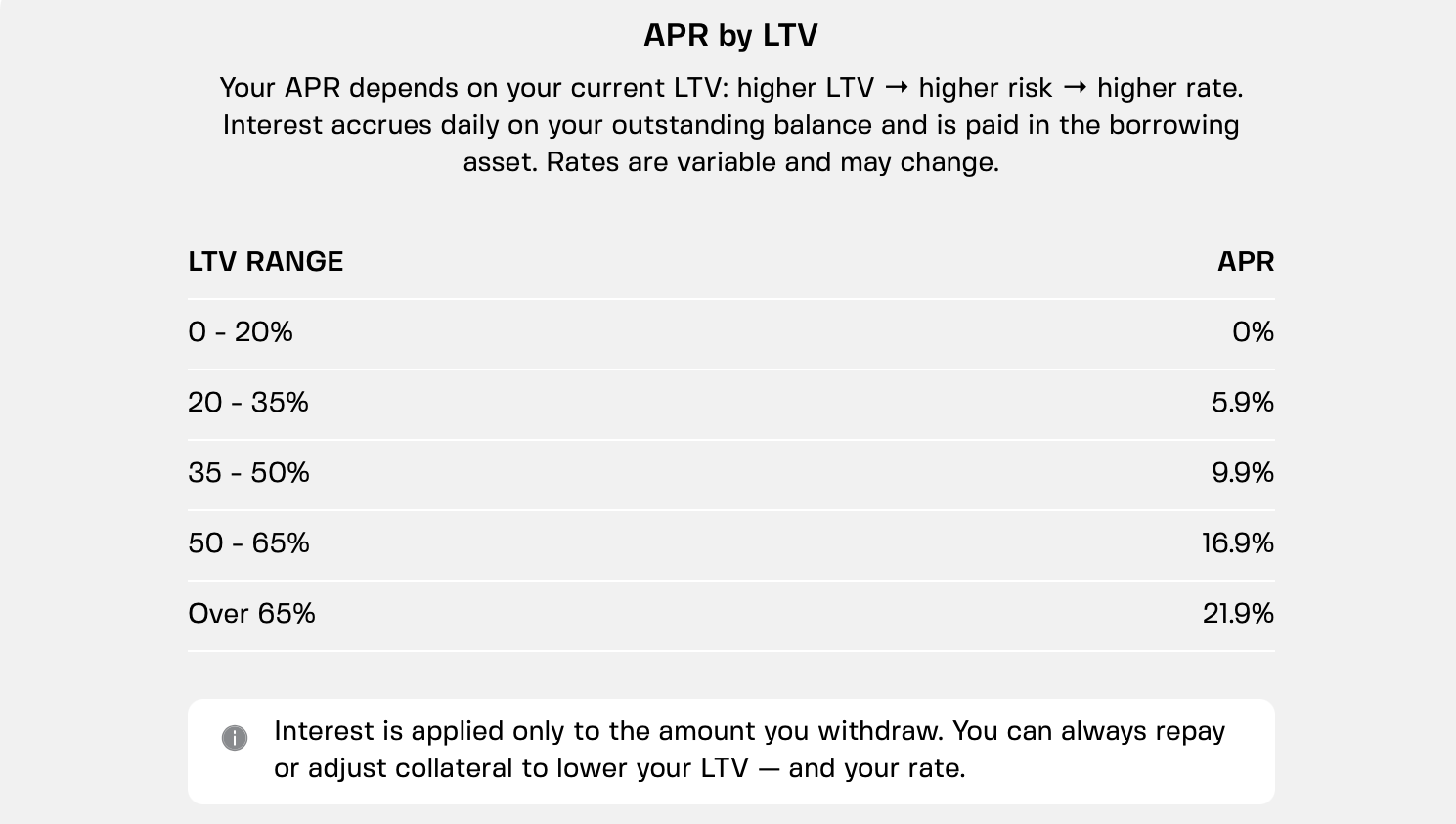
That doesn't mean your collateral is locked away until the end. On Clapp, you can withdraw part of it while the credit line is outstanding, provided the resulting LTV stays within the permitted range. And because the interest rate is tied to LTV, keeping your LTV at 20% or below means 0% APR.
While the loan/credit line is open
Day to day, LTV is the number that matters. It compares what you owe with what your collateral is worth right now. Your loan amount stays fixed while your collateral's value moves with the market, so LTV moves too. Prices up, LTV down. Prices down, LTV up.
Here is what a bad weekend looks like. You borrow €7,000 against €10,000 in Bitcoin, which is 70% LTV. Bitcoin drops 15%, so your collateral is now worth €8,500 against the same €7,000 loan. Your LTV is about 82%. Nothing about the loan changed, but if your liquidation threshold were 80% (a hypothetical figure here), you would have just crossed it.
What happens next depends on where you land:
- Below the threshold: nothing happens automatically. The loan stays open and you decide whether to act.
- Above the threshold: the system doesn't wait for you to log in. We walk through that scenario in what happens when the market crashes overnight.
Value drops, ratio rises, and then either you act or the threshold acts for you. The buffer between your LTV and the threshold is your reaction time, so start well below the maximum.
Three ways to bring your LTV down
- Add collateral. Adding €1,000 in Bitcoin to the example above brings LTV from 82% to about 74%. This only works if you have time to do it, and with a thin buffer you may not.
- Repay part of the loan. With €5,000 owed against €10,000 in collateral (50% LTV), repaying €2,000 leaves €3,000 against the same €10,000, so LTV falls to 30% without touching your collateral.
- Reshuffle your collateral. Clapp's multi-collateral credit line lets you borrow against a pool of assets: major cryptocurrencies, stablecoins, smaller-cap tokens, even fiat. The pool's LTV reflects each asset's value and borrowing limit. Swapping volatile assets for stablecoins or fiat can lower the overall LTV and reduce your exposure to further price swings, if you have time to make the switch.
What you pay
Each supported asset has its own maximum LTV, and your interest rate depends on which LTV band you sit in. Bitcoin, for instance, can currently be borrowed against at up to around 70% LTV, and Clapp's credit line APR runs from 0% to roughly 22%. The lower your LTV, the more room you have before liquidation becomes a risk.
Your risk: Liquidation and losing collateral
Borrowing against crypto, whether through a loan or credit line, carries a risk of losing your collateral. If your LTV exceeds the liquidation threshold, your collateral may be sold without prior notice. The lender may sell enough to reduce the outstanding exposure, and you see the result afterward: less collateral, a lower loan balance, or both.
Alerts can help, but they don't guarantee you'll have time to act. Our guide to Liquidation without notice explains where alerts fit and where they don't.
This is not borrowing against a house or a salary. Prices can move faster than you can react, and the only real protection is the distance between your LTV and the threshold.
Getting your collateral back
Once you repay the full balance, your collateral is released or an equivalent amount of the same asset is returned, depending on the lending structure. For the mechanics from deposit to final repayment, see how a crypto-backed loan works.
Credit lines are more flexible than fixed-term loans here, because you don't always have to clear the whole balance to get some collateral back. Full withdrawal is available once there's no outstanding balance. Partial repayment lowers your LTV but doesn't release your collateral automatically.
What you actually control
Once you know the path your crypto loan collateral takes (for example, out of your balance, owned by the lender while the loan runs, then returned in equivalent form when you repay), it stops being a black box. The market will move whether or not you're watching. What you control is how much buffer sits between your LTV and liquidation.
Frequently asked questions
What happens to my crypto when I open a credit line?
our collateral is moved out of your available balance and held or controlled by the lender while the credit line is open. The exact legal arrangement varies: some lenders leave ownership with you, while others take legal title and owe you equivalent assets back when the debt is repaid. On Clapp, legal ownership of the collateral transfers to Clapp, and you have a contractual right to an equivalent amount of the same type of digital asset once the credit line is fully repaid.
Do I get my collateral back after repayment?
That depends on the lending structure. You may get the same assets back, or, where ownership transferred to the lender, an equivalent amount of the same type of asset. On Clapp, you get an equivalent amount back once the credit line is fully repaid, and you can withdraw part of your collateral earlier as long as your LTV stays within the permitted range. The agreement should spell this out.
Can I add more collateral if the market drops?
Usually, yes. Adding collateral or repaying part of the loan or credit line can lower your LTV and create more room before liquidation.
Does my collateral get sold automatically if prices fall?
Not simply because the price falls. Liquidation typically happens when your LTV reaches the lender's liquidation threshold. The exact trigger and amount sold depend on the lender's terms.
Will I get a warning before liquidation?
Not necessarily. Liquidation can happen without prior notice once your LTV passes the threshold. Some lenders send alerts, but don't count on having time to act. A wider gap between your LTV and the threshold gives you more protection against sudden price moves.
How is my interest rate decided?
It depends on the lender and the product. In many crypto credit lines, the rate is linked to your LTV, with lower LTVs often qualifying for lower rates. On Clapp, an LTV of 20% or below qualifies for the 0% APR tier.