Which crypto gives you the most borrowing power — and why stablecoins win

Borrowing against crypto can be a quick way to access liquidity without selling your holdings. But there's an important question to answer first:
What are you using as collateral?
Most people default to their biggest holding. Bitcoin feels like the obvious choice. Ethereum works too. Stablecoins feel more like cash.
But the asset you choose can make a big difference — to how much you can borrow, and how much room you have before liquidation becomes a concern.
A $50,000 position in stablecoins doesn't give you the same borrowing power as $50,000 in BTC. And $50,000 in BTC doesn't carry the same risk as $50,000 in a smaller altcoin.
Let's look at why.
TL;DR
- Stablecoins generally offer the highest LTV limits because their prices are designed to stay stable. Some platforms allow LTVs of 90% or more.
- Volatility determines borrowing power. The more an asset can move, the more collateral buffer lenders typically require.
- Bitcoin usually sits in the middle. It offers relatively high LTV compared with many crypto assets, but its price can still move sharply.
- Ethereum and altcoins generally require more buffer. Smaller or less liquid assets can come with significantly lower LTV limits — or may not be accepted at all.
- Multi-collateral pools can spread the risk. Combining stablecoins with volatile assets can give you both borrowing power and market exposure.
Why LTV varies by asset
LTV, or loan-to-value, is simply the amount you borrow compared with the value of your collateral.
Borrow $5,000 against $10,000 of crypto and your LTV is 50%.
The reason you can't usually borrow the full value of your collateral is simple: crypto prices move.
If your collateral falls while your loan stays the same, your LTV rises. At some point, the position can reach the platform's liquidation threshold and part or all of the collateral may be sold to repay the loan.
That's why lenders don't treat every crypto asset equally.
Volatility is one of the biggest factors behind LTV limits.
An asset that can lose 30% in a short period needs a larger safety buffer than one designed to stay close to $1.
Bitcoin is a good example. Despite growing institutional adoption and a more mature market, BTC remains considerably more volatile than traditional broad-market assets — over the past year, its annualized volatility was roughly 35%, making it about 4.5 times more volatile than the S&P 500.
The BTC price can still move tens of percent during major market corrections, and lenders have to account for that risk.
The more volatile the collateral, the more conservative the LTV limit tends to be. It's about giving the loan enough room to survive a price move.
Asset class breakdown
Here's how collateral typically compares across major digital asset classes.
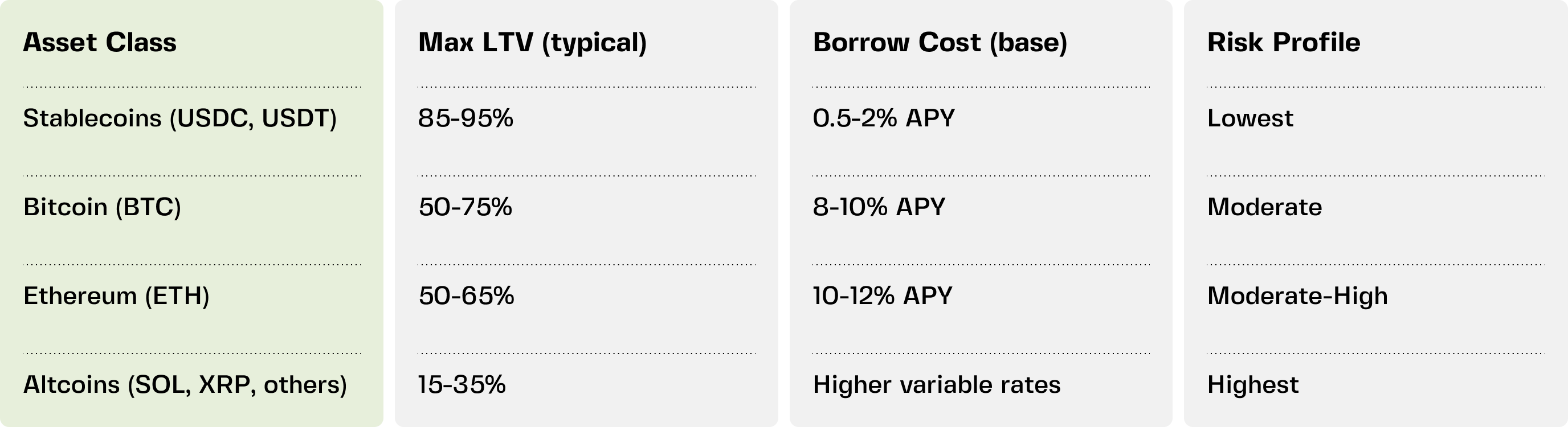
The crucial point isn't the exact percentage on any one platform, but the relationship between the assets. The same $50,000 of collateral can provide very different borrowing capacity depending on what it's made of.

What the differences mean
Stablecoins — USDC, USDT and similar assets
Stablecoins generally receive the highest LTV limits because they're designed to maintain a stable value. That makes the collateral value much less likely to move sharply from one day to the next.
Bitcoin
BTC typically offers a relatively high LTV compared with more volatile crypto assets. Its deep liquidity and established market help, but it can still experience major price swings, so lenders leave a buffer.
Ethereum
ETH can offer competitive LTV, but its price tends to be more volatile than BTC. That can translate into slightly more conservative limits.
Altcoins
Smaller-cap assets tend to sit at the other end of the scale. Lower liquidity and larger price swings mean some lenders either assign much lower LTV limits or don't accept them as collateral at all.
The gap can be substantial
$50,000 in stablecoins can give you several times the borrowing capacity of $50,000 in a highly volatile altcoin.
But there's an important catch:
Higher LTV doesn't automatically mean better borrowing.
Borrowing at 90% LTV gives you much more liquidity upfront, but leaves very little room for anything to go wrong. Even a relatively small change in collateral value can push the position toward liquidation.
Borrowing less can mean giving up some immediate liquidity in exchange for a much larger safety buffer.
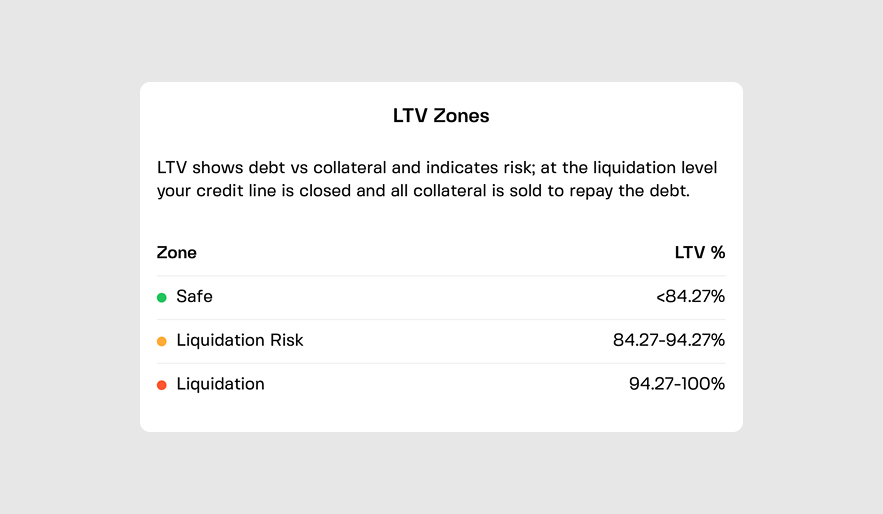
The stablecoin advantage: Higher LTV, lower risk
Stablecoins are a unique type of collateral. They don't offer the upside of BTC or ETH, but they can give you something those assets can't: predictability.
If you borrow against $45,000 of USDC, a normal market selloff doesn't suddenly turn that $45,000 into $30,000 of collateral.
That makes the LTV much easier to manage. Here's an example.
You borrow $40,000 against $45,000 in USDC at 89% LTV.
- If USDC remains at its $1 target, the collateral remains around $45,000 and the LTV remains around 89%.
Now compare that with borrowing $30,000 against $50,000 in BTC at 60% LTV.
- If BTC falls 30%, your collateral drops to $35,000. Your $30,000 loan hasn't changed, so your LTV jumps from 60% to about 86%.
That's the key difference: the loan didn't become larger. Your collateral became smaller.
Of course, stablecoins aren't risk-free. Depegging, platform risk and the specific terms of the lending product still matter.
And there's another trade-off: you're not getting any BTC-style upside from your collateral. USDC isn't going to double because the crypto market rallies. And that's fine if your goal is liquidity rather than investment exposure.
Multi-collateral: combining stability and upside
You don't necessarily have to choose one asset. Some credit lines let you combine several assets in a single collateral pool. That can be useful when you want to keep exposure to volatile assets while also adding a more stable buffer.
Suppose you split $50,000 collateral between $30,000 in BTC and $20,000 in USDC. You then borrow $25,000, so your starting LTV is 50%.

Here's what happens if BTC falls 30%:
- Your BTC is worth $21,000.
- Your USDC remains around $20,000.
- Your total collateral is now $41,000, so your LTV rises to about 61%.
If the entire $50,000 had been BTC, the same 30% drop would leave you with $35,000 of collateral and an LTV of about 71%.
While you've still moved closer to the liquidation threshold, the stablecoin portion has absorbed part of the price shock — giving you time to protect your position by adding collateral or repaying.
That's the real advantage of a multi-collateral pool.
On Clapp, you can also adjust the mix as market conditions change. Combine up to 25 collateral assets and add, remove or swap collateral without closing the credit line.
Add stablecoins when you want more protection, or increase your volatile-asset exposure when you're comfortable taking more risk.
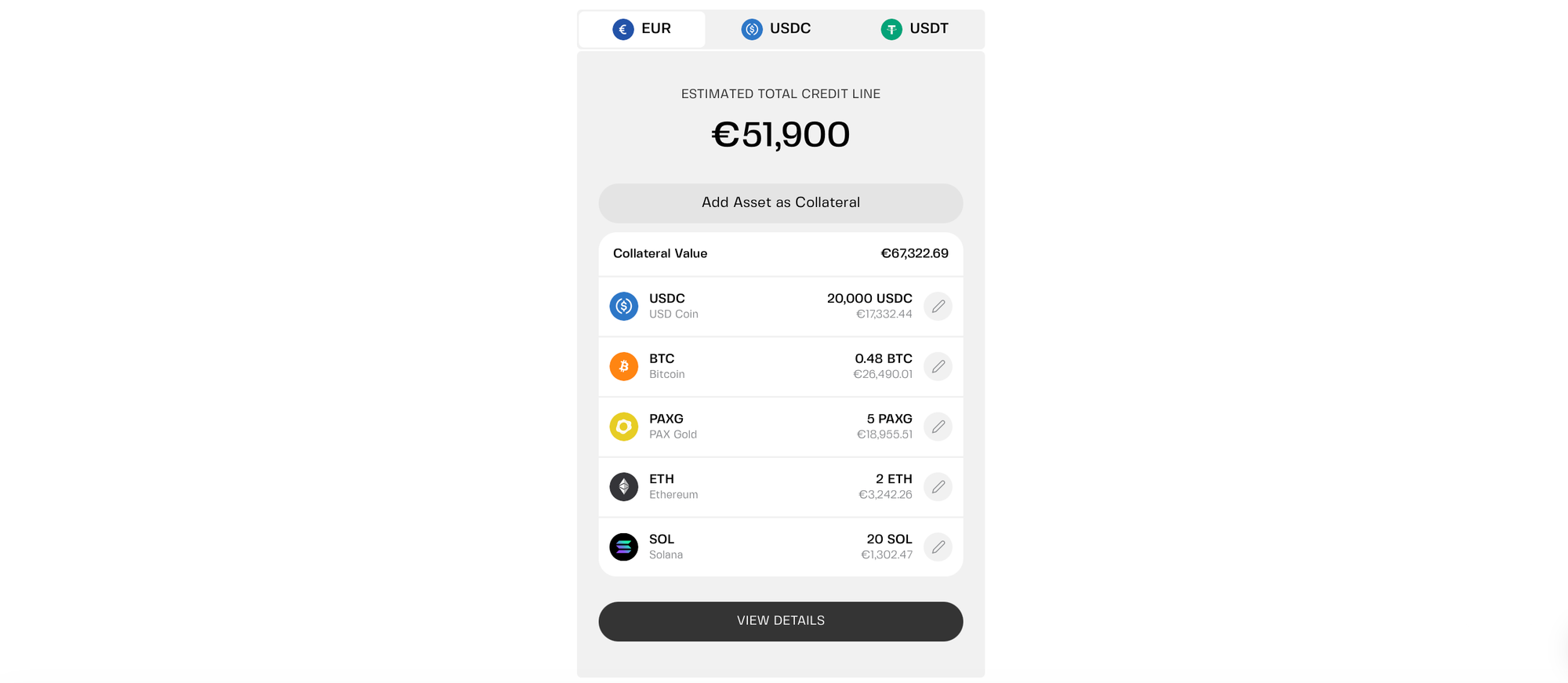
When each asset makes sense
Stablecoins can make sense when:
- You want maximum borrowing capacity.
- You want to minimize price-driven LTV changes.
- You don't need your collateral to appreciate.
- Predictability matters more than upside.
Bitcoin can make sense when:
- You want to keep BTC exposure while accessing liquidity.
- You're comfortable with a lower LTV than stablecoin collateral may allow.
- You have enough buffer to withstand a significant BTC drawdown.
Ethereum can make sense when:
- You want to maintain ETH exposure while borrowing.
- You're comfortable with somewhat greater volatility.
- You have additional collateral or cash available if LTV rises.
Altcoins can make sense when:
- You have strong conviction in the asset.
- You're comfortable with a much lower LTV.
- You understand that liquidity can disappear quickly during a selloff.
There's no universally best collateral asset
Stablecoins give you stability and borrowing power. BTC and ETH let you keep market exposure while accessing liquidity. Smaller assets can work too, but usually require a much larger safety buffer.
The right choice depends on what you're trying to achieve.
- If you want maximum borrowing power with minimal price volatility, stablecoins are hard to beat.
- If you want to keep your crypto exposure while unlocking liquidity, BTC or ETH may make more sense.
- And if you want both, a multi-collateral pool can combine the two.
The important thing is to look beyond the headline LTV. Ask how much you can borrow, how far your collateral can fall, and how much room you have before liquidation.
That's what determines whether your collateral is working for you — or putting your loan under unnecessary pressure.
Frequently asked questions
1. Why do stablecoins generally have higher LTV limits than Bitcoin?
Because their value is designed to remain stable. BTC can lose a significant percentage of its value during a market selloff, while a well-functioning stablecoin is designed to remain close to its peg. Lenders can therefore typically offer higher LTV limits against stablecoins.
2. Can stablecoins be used as collateral while still earning yield?
It depends on the platform. In many lending products, collateral is locked and doesn't generate separate yield while it's backing a loan. Some platforms offer different structures, so check the specific terms before assuming your collateral will continue earning.
3. What's a safe LTV for Bitcoin collateral?
There's no universal number because it depends on the liquidation threshold, the asset's volatility and your own risk tolerance. A 20% LTV provides a much larger buffer than 50% or 60%. For example, with an 80% liquidation threshold, a 20% starting LTV would require roughly a 75% drop in collateral value to reach that level.
4. Can I combine stablecoins and volatile assets as collateral?
Yes, if the platform supports multi-collateral borrowing. Combining assets can reduce the effect of a sharp move in any single asset. On Clapp, borrowers can combine up to 25 assets in one collateral pool.
5. Should I convert BTC to stablecoins to get a higher LTV?
Not automatically. Selling BTC may create tax consequences depending on your jurisdiction and removes your BTC market exposure. If you still want to hold BTC, keeping it as collateral — or combining it with stablecoins in a multi-collateral pool — may be a better fit.