Why institutions aren't leaving crypto after the crash

Bitcoin is now 50% below its all-time high, after a decline that began in October 2025 and has dragged on for nearly a year. Retail interest has cooled, and the AI trade is stealing crypto's thunder — but institutions remain invested. Their long-term conviction raises an obvious question: if crypto's institutional story was just a bull-market phenomenon, shouldn't they be pulling back by now?
For big players, this crash isn't proof that crypto doesn't work. If anything, it's pushed them to be more disciplined about how they access it.
Here's why institutional crypto adoption is becoming more selective, more regulated, and more infrastructure-driven.
The institutional thesis survived the drawdown
Big-money thinking is more complex than a simple bullish-or-bearish split, and the strongest evidence against a retreat is what these players themselves say they're doing. Coinbase and EY-Parthenon's 2026 Institutional Investor Digital Assets Survey found overwhelming interest in continued exposure. Of the 351 institutional investors surveyed in early 2026:
- 73% plan to increase crypto allocations.
- 74% expect crypto prices to rise over the following 12 months.
- 49% have increased their focus on risk management, liquidity, and position sizing.
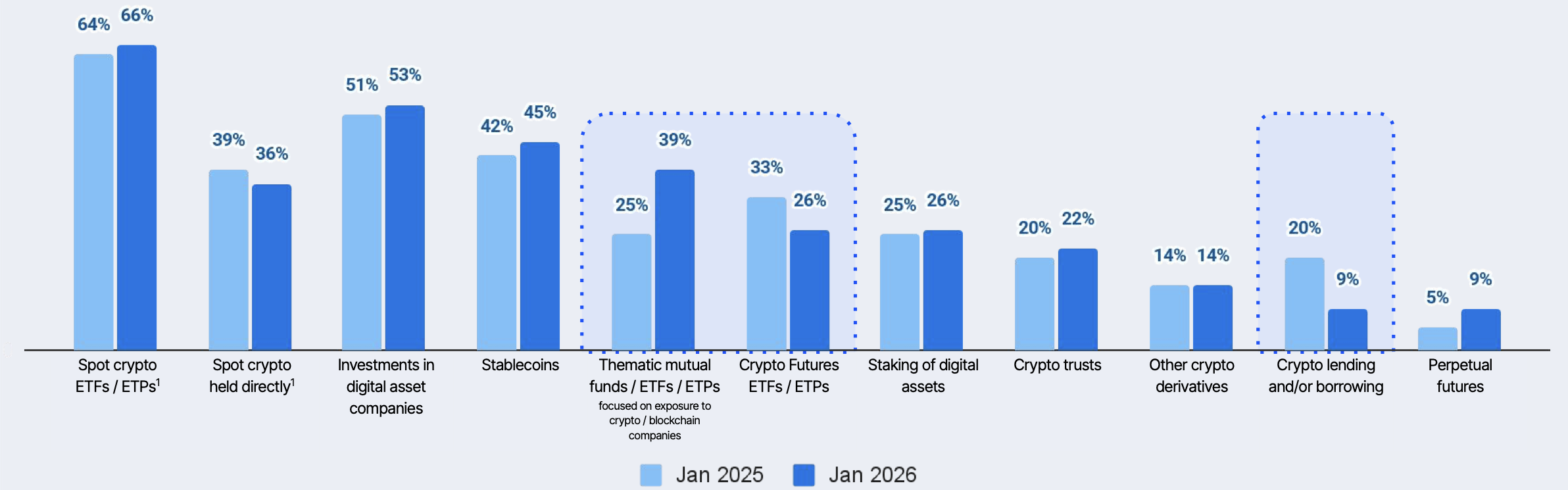
- 66% already have exposure through spot crypto ETFs/ETPs.
- 81% prefer spot exposure through a registered vehicle.
That 74% price call hasn't aged well — Bitcoin is down 50% since the survey, not up. But institutions holding on despite a wrong price call is arguably stronger evidence of conviction than institutions holding on because a price call worked out.
From speculation to allocation
Belief in crypto's long-term prospects remains strong. But the more important takeaway is that institutions are becoming more selective without abandoning the asset class — a shift the report describes as "greater discipline, more robust governance, and access via regulated products."
An institution can reduce leverage, demand better custody, and prefer ETFs while still increasing its long-term crypto exposure. "Volatility drives discipline, not retreat," as the report puts it. The quality bar for engagement is simply higher now.
PwC's Global Crypto Regulation Report 2026 goes further, stating that institutional involvement has "crossed the point of reversibility."
The crash made risk management more important
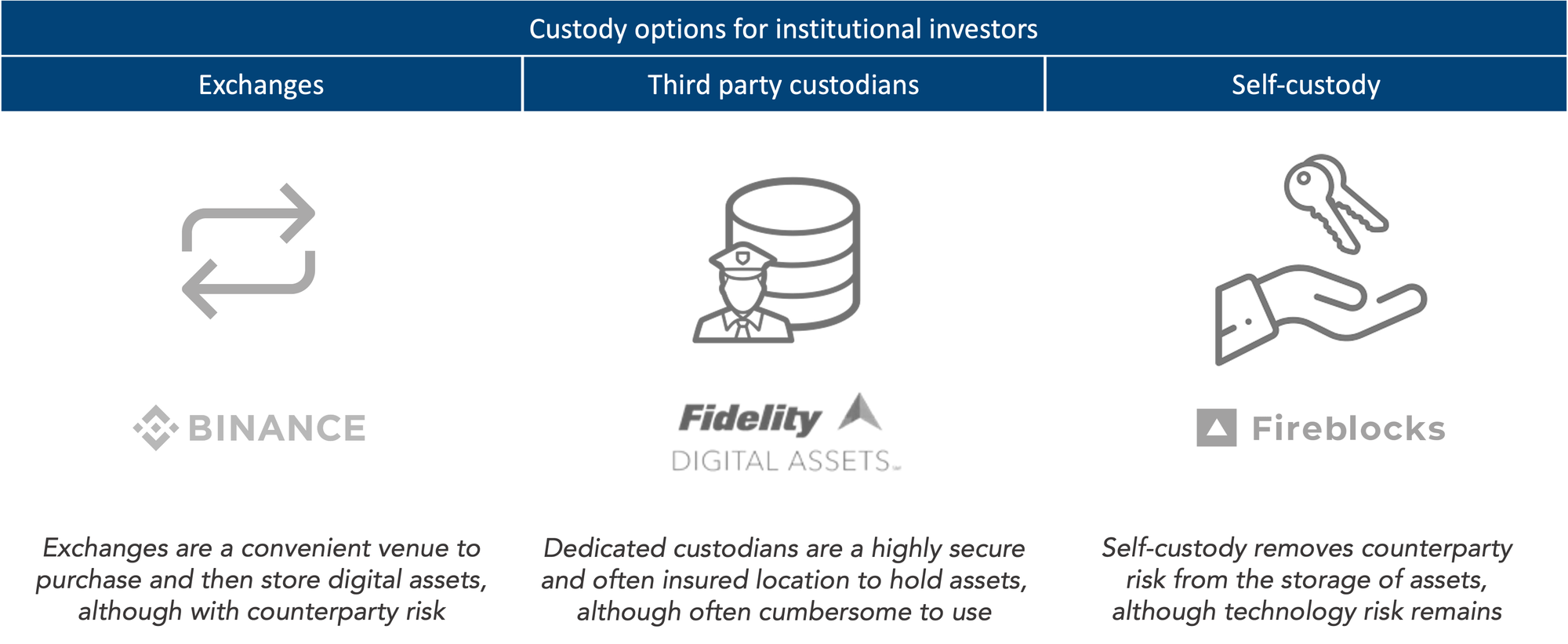
The Coinbase survey found that 49% of institutions increased their emphasis on risk management, liquidity, and position sizing following the volatility. That's a sign of market maturation: institutions now want a proper framework for exposure, and increasingly prefer indirect forms like ETFs over direct token custody to avoid private-key management risk.
Position sizing has shifted away from speculative, high-leverage bets toward disciplined, rules-based allocations — typically capped at 1% to 5% of a portfolio. Morgan Stanley also recommends regular portfolio rebalancing as a key risk management tool, describing crypto exposure as "an opportunistic allocation" mainly suited to "growth oriented portfolios."
That shift shows up across several areas of risk management:
- Counterparty and operational risk. Regulatory hardening and a move toward licensed gateways have changed how institutions assess counterparty risk. The focus has moved from exchange solvency concerns toward more complex, multi-layered evaluations covering off-exchange settlement infrastructure, strict stablecoin compliance, and continuous on-chain monitoring.
- Custody. Institutions have moved beyond simple cold storage and private-key security. Beyond safeguarding token holdings directly, they now manage the structural risks of indirect fund exposure through integrated control hubs, multi-party computation (MPC), cross-asset collateral management, and regulatory alignment.
- Crypto-native threats. Institutional risk models have moved past simply mirroring traditional IT risk. They now account for hazards specific to crypto, like smart contract bugs and oracle manipulation — which requires close coordination between fraud teams, AML specialists, sanctions officers, compliance departments, and business units.
- Regulatory risk. Where institutions once focused mainly on avoiding uncertainty, they're now integrating compliance directly into their TradFi infrastructure: opting for regulated vehicles like ETFs, following clear federal frameworks, and automating on-chain risk controls.
Institutional adoption doesn't have to look like aggressive buying during a bull run. It can just as easily look like tightening processes during a downturn.
ETFs changed the institutional entry point
At its core, institutionalization is about making crypto fit into Wall Street's existing systems rather than asking Wall Street to adapt to crypto's.
In January 2024, eleven spot Bitcoin ETFs reshaped institutional adoption by replacing complex wallet management with a regulated, familiar financial wrapper. Traditional asset managers, pensions, and wealth funds could now allocate capital without dealing with exchanges, setting up custody and operational controls, or working through compliance questions themselves.
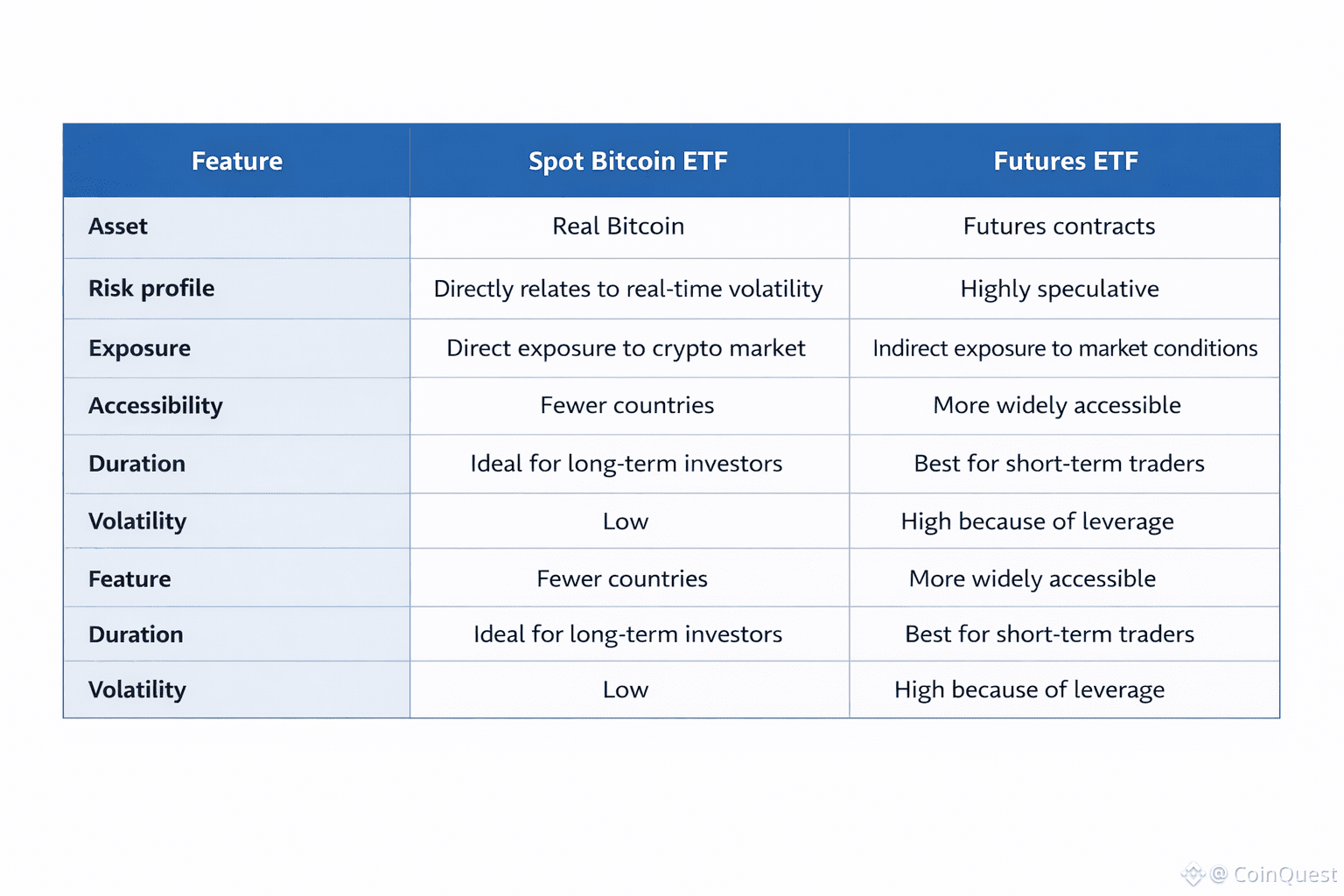
The spot products marked a genuine turning point, even though crypto ETFs linked to futures had existed since October 2021.
The older, futures-based model was prone to tracking errors, since those products effectively represented IOUs for future delivery rather than real holdings — so ETF prices could diverge from actual crypto prices.
Spot ETFs, by contrast, hold actual cryptocurrency reserves and maintain tight price alignment with the underlying asset through their creation and redemption mechanisms — a meaningful shift from paper exposure to real backing.
Three advantages made spot ETFs a default on-ramp for many investors:
- Lower operational barriers. Institutions can trade shares directly through standard brokerage accounts without touching on-chain infrastructure. Previously, investing in crypto meant taking on tech-firm-like responsibilities — managing keys, cold storage, and custom compliance processes.
- Structural legitimacy. Products approved and issued by major asset managers like BlackRock and Fidelity removed much of the regulatory second-guessing. Those issuers also absorb the operational risk, using qualified third-party custody under audited security controls.
- Simplified compliance. Crypto ETFs slot into conventional tax reporting, audit, and custody pipelines, meeting the requirements of strict corporate and fiduciary mandates.
Beyond just bringing more money into the market, ETFs changed the architecture of institutional participation. They turned crypto into something a portfolio manager can access through a familiar investment framework.
That's a large part of why 81% of respondents in the Coinbase survey prefer spot exposure through a registered vehicle, and why two-thirds (66%) already have exposure through spot crypto ETFs and ETPs.
Stablecoins may be the clearest evidence of institutional persistence
Stablecoins are increasingly used for more than trading, which is telling: fading interest in speculative tokens doesn't mean fading interest in blockchain-based financial infrastructure. In July 2026, stablecoin transaction activity grew faster than supply, suggesting their role is shifting from simple trading collateral toward genuine financial infrastructure.
Non-trading use cases now include:
- Cross-border payments that bypass slow legacy correspondent banking networks, offering near real-time settlement at lower fees. Networks like Visa Direct have integrated stablecoin rails for global money movement.
- 24/7 treasury operations, letting corporations and funds manage liquidity outside traditional banking hours and optimize cash management and short-duration yields.
- Asset tokenization across bonds, real estate, and private equity via smart contracts, using atomic "delivery vs. payment" (DvP) settlement that cuts settlement risk from days to seconds.
- Inflation hedging and remittances, particularly in emerging markets, where stablecoins offer a way around weak domestic currencies and reduce friction in international transfers. Argentina is a striking example: with consumer price inflation above 30%, the country recorded $34 billion in stablecoin transactions in 2024 — the highest crypto adoption rate in the Western Hemisphere.
But persistence isn't the same as indiscriminate buying.
What institutions are actually leaving behind
Institutions are becoming harder to impress.
Adoption is climbing, but it's selective — and that selectivity means some things inevitably get left behind. In their pursuit of compliant liquidity and tightly controlled risk, big players are walking away from narratives, strategies, and tokens that don't hold up to scrutiny. The industry has largely moved past crypto's hype and noise:
- excessive leverage
- illiquid tokens
- opaque counterparties
- speculative DeFi protocols
- meme-driven strategies
- unregulated venues
- "number go up" investment theses
That doesn't mean every institutional crypto strategy has come through the downturn intact. Brevan Howard's crypto-focused hedge fund suffered substantial losses in 2025 as Bitcoin's bull run faltered — a sharp reversal after gains of 43% and 52% in 2023 and 2024, respectively, when the fund rode crypto's recovery from the 2022 lows.
It's a reminder that institutional discipline reduces risk, not eliminates it.
DATs complicate the discipline narrative
By early 2026, more than 200 publicly listed companies were holding crypto on their balance sheets, collectively managing over $115 billion. Their digital asset treasuries (DATs) are concentrated, often leveraged, single-asset corporate bets funded through equity and debt issuance rather than diversified allocations sized at 1–5% of a portfolio.
Strategy holds 840,447 BTC — still the largest corporate Bitcoin position as of August 20206, even after ending a 13-week buying streak earlier in the year. BitMine Immersion Technologies has taken the same approach with Ethereum's ether holding over 3 million ETH and continuing to buy aggressively even as other large treasuries pulled back.

Bitmine now trades at a discount to the value of the ETH it holds, and the model's stress points are becoming visible: some treasuries have paused accumulation entirely, others have shifted toward generating yield on existing holdings rather than buying more.
DATs aren't the same trade as the ETF-driven flows. They show that institutional-style crypto exposure isn't one thing. It ranges from the cautious, risk-managed allocations big asset managers favor to the high-conviction, high-leverage strategy some public companies are still willing to run.
Next phase: From crypto exposure to financial infrastructure
The broader shift underway is crypto moving from something institutions invest in to something they build into their core operations. Beyond Bitcoin and ether, the modern institutional crypto stack now spans:
- regulated ETFs and similar products
- dollar-pegged stablecoins for fast liquidity
- tokenized securities and other traditional assets
- instant on-chain settlement networks
- continuous 24/7 market access
These are the major themes shaping the next stage of crypto's development — less about price exposure, more about plumbing.
Bottom line: The institutions didn't leave. They changed the rules.
The crash exposed real weaknesses in crypto. At the same time, it also exposed something else: which parts of crypto institutions actually want. Not speculative upside for its own sake, but regulated access, reliable custody, tokenized products, and infrastructure that runs 24/7. What they're after is stable payment rails, transparent risk, and deep liquidity — not the next narrative.
That means the speculative layer of the market can keep shrinking while the underlying financial infrastructure keeps growing underneath it. The next institutional crypto cycle may end up looking very different from the last one — and, on the surface, considerably less exciting.