Overcollateralized crypto loans: Why lenders ask for more than they give

Want to borrow $10,000 against crypto? Your lender may ask for $15,000, sometimes even twice that amount, in collateral.
At first glance it can feel like a bad deal — you're putting up more than you're getting back. But there's a solid reason for it, and overcollateralization is actually what makes lending against volatile assets possible in the first place.
Here's why crypto loans work this way, what it means for you, and how that extra collateral protects your position rather than just padding the lender's margin.
TL;DR
- Overcollateralization means you borrow less than you pledge, as a buffer against volatility.
- Crypto prices can move quickly, so the extra collateral protects the lender if your assets fall in value.
- A lower LTV gives you more room before liquidation — often fewer margin calls and, on some platforms, lower interest rates.
- Stablecoins generally need less overcollateralization because their prices are designed to stay stable.
What overcollateralization actually means
You deposit more crypto than you borrow. The exact amount is set by the lender's LTV (loan-to-value) rules — your loan balance divided by the current value of your collateral.
- Deposit $15,000 in Bitcoin and borrow $10,000, and you're at roughly 67% LTV, or about 150% collateralization.
- Deposit $20,000 against the same $10,000 loan and you're at 50% LTV, or 200% collateralization. The more collateral relative to the loan, the larger the buffer.
It helps to think of LTV as the distance between your loan and liquidation, not as a penalty for borrowing.
LTV limits also depend on the asset itself — less volatile collateral generally supports more borrowing power, which is why stablecoins can back much higher LTVs than smaller-cap tokens, some of which top out around 10–15% on certain platforms.
Why lenders ask for a buffer
Crypto prices move, and your LTV moves with them. If your collateral drops in value, your LTV climbs; if it rises, your LTV falls.
Say you borrowed $10,000 against $10,000 in BTC — 100% LTV. A 20% drop in Bitcoin leaves your collateral worth $8,000 while you still owe $10,000, forcing the lender to sell at a loss. Overcollateralization exists to prevent exactly that.
And a 20% drop isn't hypothetical.
- Bitcoin crashed roughly 40–50% in a single day on March 12, 2020, as COVID-19 rattled global markets.
- It fell more than 20% on January 11, 2021, after a parabolic run.
- It tumbled around 30% on May 19, 2021, amid pressure from China and a derivatives-driven selloff.
- Several single-day declines over 20% also hit during the 2018 bear market. Big moves are part of crypto's history, and lenders price that risk in from the start.
The buffer gives collateral room to fall before a loan turns unsafe — protecting the lender, but also buying you time to react before liquidation kicks in.
How does liquidation work?
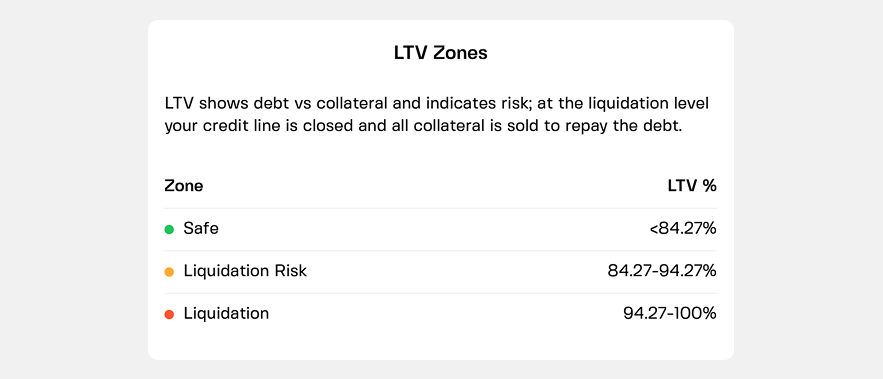
If your LTV crosses the lender's threshold — commonly somewhere between 80% and 85%, depending on the platform and asset — the platform may sell some or all of your collateral to repay the loan. In DeFi, this is usually handled automatically by smart contracts, so there's often little chance to intervene once the conditions are met. Centralized platforms tend to send warnings as your LTV approaches the danger zone.
So treat the liquidation threshold as a line to stay far away from, not a target.
LTV tiers: The safety levels
The table below shows how much collateral a $10,000 loan needs at different LTV levels, and how much room remains before an 80% liquidation threshold.
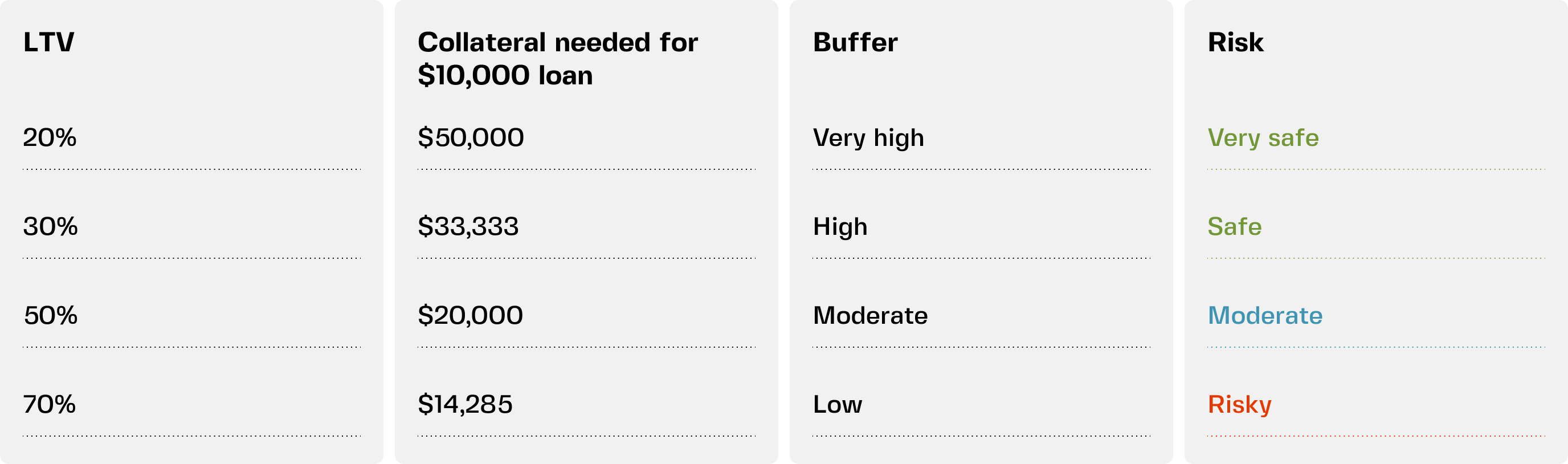
A lower LTV buys more room.
At 20% LTV, Bitcoin would need to fall about 75% before hitting an 80% liquidation threshold; at 70% LTV, a far smaller decline gets you there.
If the market turns against you, options scale with how much room you have — add collateral, repay part of the loan, or simply wait it out if your LTV is still comfortably below the threshold.
Here's how LTV tiers work on Clapp:
What this means for your borrowing costs
Lenders price risk, and risk tracks LTV. Keeping your LTV low can lower your borrowing cost on platforms with tiered pricing.
On Clapp, staying at or below 20% LTV qualifies for 0% APR, since a large collateral buffer means a significant crash would have to happen before the position nears liquidation.
Higher LTVs leave the lender less protected, so rates climb accordingly. Exact pricing varies by platform and asset, but the underlying logic is consistent: more buffer, less risk, lower cost.
Why stablecoins need less overcollateralization
Stablecoins aren't built to swing 30% in a day — they're designed to hold close to a peg, whether that's a USD peg like USDT and USDC or a commodity peg like XAUT.
Less volatility means less buffer is needed, which is why stablecoins can support LTVs as high as 75–85% on some platforms.
The trade-off matters, though. Stablecoin collateral gives you borrowing power and stable value, but none of the upside you'd get from holding BTC or ETH. You're trading potential appreciation for liquidity — a fine deal when liquidity is what you actually need.
There's no single best collateral asset; it depends on whether you're optimizing for borrowing power, market exposure, or stability.
Our full guide to collateral assets breaks down BTC, ETH, altcoins, and stablecoins in more depth.
Multi-collateral: Spreading the buffer
Multi-collateral pools let you combine BTC, ETH, stablecoins, and other supported assets into a single collateral base instead of leaning on one coin's price.
Say you're holding BTC you don't want to sell, plus stablecoins sitting idle — putting both into the same pool means you don't have to choose between market exposure and borrowing capacity.
The stablecoins add collateral value without much volatility; the BTC keeps its upside. Together they make a steadier base than either would alone.
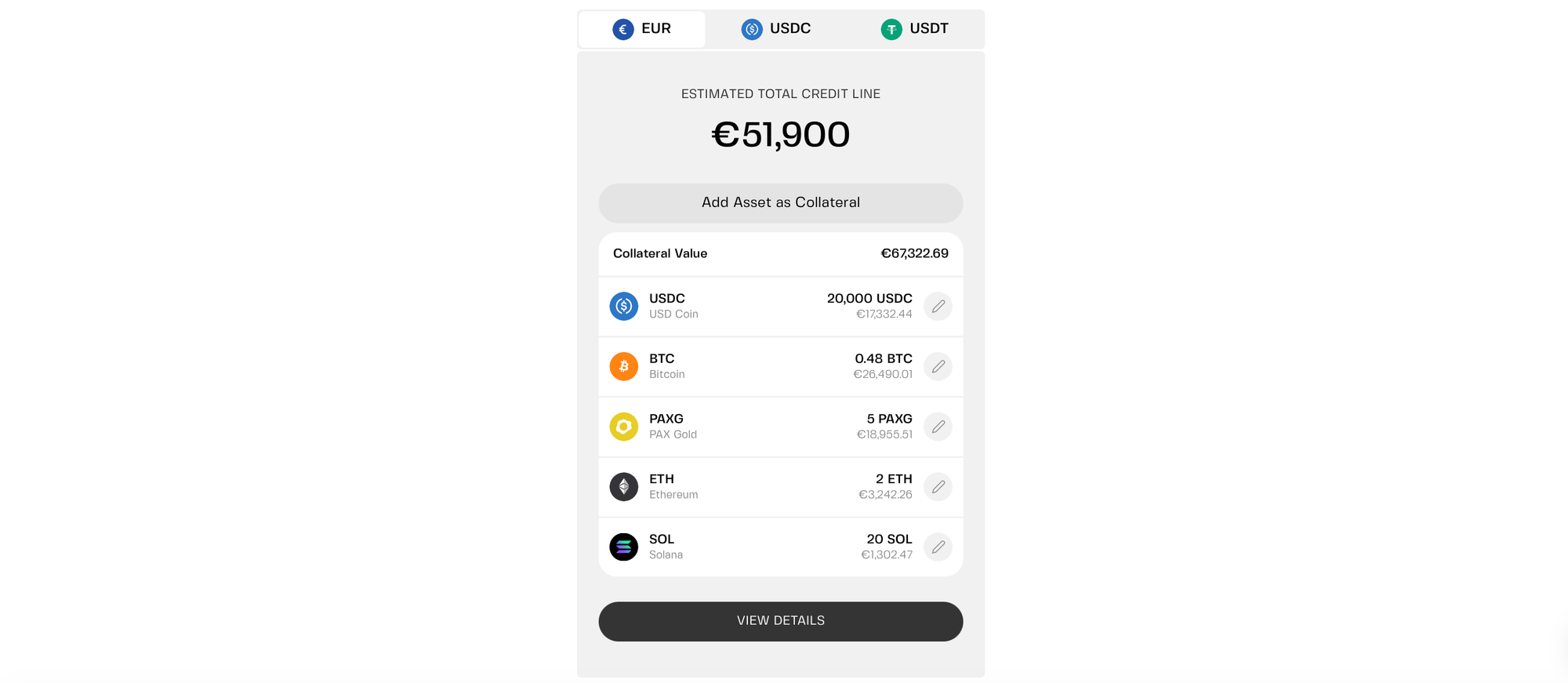
The mix isn't fixed, either. Clapp lets you adjust collateral while a credit line stays open — add stablecoins for more stability, add volatile assets for more exposure, or pull collateral out as you repay.
Overcollateralization makes crypto loans possible
So why do lenders ask for more than they give? Because without that buffer, crypto's swings would make lending too risky to offer at all. A 20% Bitcoin drop isn't rare — it's happened multiple times in the last few years — and overcollateralization is simply the mechanism that absorbs those swings before they turn into losses for the lender or a forced sale for you.
Seen that way, the extra collateral isn't the lender taking more than its share. It's the price of borrowing against something that can lose a fifth of its value overnight.
The size of that price — how much extra you need to put up — comes down to one thing: how volatile your collateral is. Stablecoins need the least buffer, BTC and ETH need more, and smaller altcoins need the most.
Frequently asked questions
1. Why can't I borrow the full value of my collateral?
Because prices move. Borrow 100% and a 20% drop can leave the loan undercollateralized almost immediately. The buffer protects the lender and gives you time before liquidation.
2. What's a good LTV for beginners?
20–30% LTV is a conservative starting point. At 20%, you have a very large buffer. At 30%, you still have substantial room for market declines. Higher LTVs increase both borrowing power and liquidation risk.
3. Does overcollateralization affect my interest rate?
Yes, on platforms that use LTV-based pricing. Lower LTV can mean lower borrowing costs. On Clapp, borrowing at 20% LTV or below qualifies for 0% APR. Higher LTVs can carry higher rates.
4. Can I reduce overcollateralization later?
Yes, if your platform allows you to adjust the credit line. You can repay part of the loan to lower your LTV or add more collateral to increase your buffer. Some platforms also let you swap or rebalance collateral without closing the credit line.
5. Is overcollateralization the same on every platform?
No. LTV limits depend on the platform, the asset, the loan product, and the liquidation rules. CeFi and DeFi platforms can also handle liquidations differently. Always check the specific LTV, liquidation threshold, and collateral rules before borrowing.