Bitcoin price predictions for 2026: How high — or low — can BTC go?

As 2026 enters its final stretch, uncertainty around Bitcoin's trajectory is building. Predictions range from a bearish drop to $38,000 to a dramatic surge toward $250,000. Here is a look at forecasts from financial giants and some of the market's best-known analysts.
TL;DR
- Bitcoin's 2026 has been brutal. Down nearly 50% from its October 2025 peak of $126,080, with a 33% drop in the first half of the year alone.
- Price forecasts are all over the map. Predictions range from NYDIG's bearish $38,000 scenario to a bullish $200,000–$250,000 target from Fundstrat's Tom Lee. Most major banks have cut their targets this year.
- ETF outflows are a major headwind. US spot Bitcoin ETFs recorded $4.5 billion in outflows in June alone, their largest monthly net outflow since launch.
- The Fed is the next big catalyst. The July 29 FOMC meeting could set the tone for the rest of the year, with rate-hike odds climbing to nearly 38%.
- The four-year cycle may be evolving. Institutional adoption, spot ETFs, and macroeconomic forces are changing the old halving-driven playbook. Whether the cycle is dead or just transforming remains an open question.
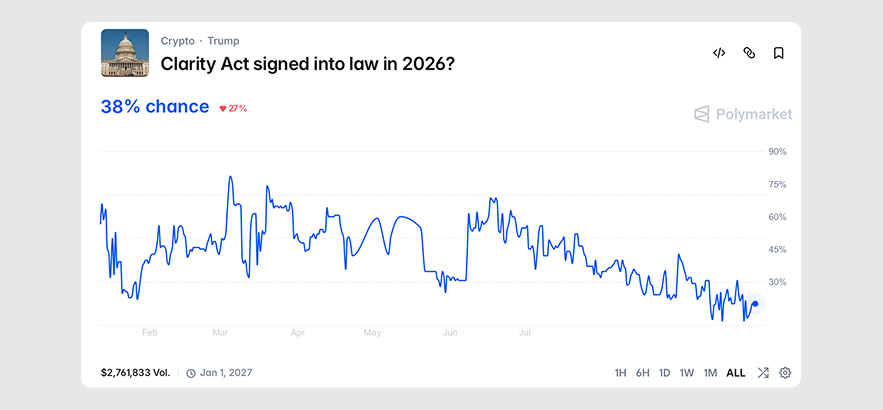
- Biggest risks ahead: Fed policy, ETF outflows, Strategy's corporate treasury pivot, and regulatory stagnation with the Clarity Act's odds slipping to 38%.
Bitcoin's 2026 has been rough
Crypto's trajectory this year has been shaped by geopolitical tensions, surging energy prices, and shifting Federal Reserve policy.
Starting on a strong note, Bitcoin reached a peak of nearly $96,900 on January 15. By the end of June, it had crashed to a 21-month low near $58,000, losing 33% in the first half of the year.
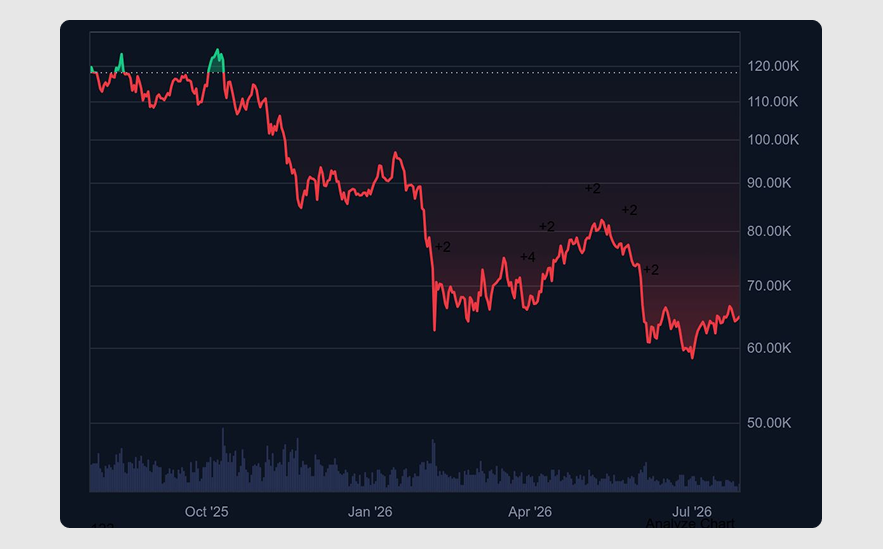
At the end of June, BTC was down more than half from its October 2025 peak of $126,080. In the second quarter, it fell 13.4% while tech equities gained 43.5% and the Nasdaq 100 rose 27.7%.
Outflows from spot Bitcoin ETFs have been a major source of selling pressure. The 13 US-listed funds recorded $4.5 billion in June outflows, their largest monthly net outflow since launch.
As of July 27, 2026, BTC remains below $65,000, with traders looking to the upcoming FOMC rate-setting meeting as the next major catalyst. On July 29, the Federal Reserve is widely expected to leave rates unchanged, but the odds of a rate hike — another potential bearish driver — have climbed to nearly 38%.
BTC price by the end of 2026
Most revisions have moved in one direction: down. Citigroup, Standard Chartered, and Bernstein have all lowered their price targets in response to this year’s sharp drawdown.
As noted by CoinGecko, Tom Lee is an outlier, having kept his $200,000–$250,000 target unchanged despite the market's decline.
- Standard Chartered has reaffirmed its $100,000 year-end price target, previously cut from $150,000. Referring to Strategy’s recent Bitcoin sales, Geoff Kendrick, the bank’s global head of digital assets research, has described them as “mostly noise rather than a signal.”
- Bernstein has lowered its prediction from $200,000 to $150,000, viewing the current weakness as a sign of market maturation. The firm sees two major catalysts for the next six months: greater regulatory clarity, provided the Clarity Act is signed into law, and continued buying by the largest corporate treasuries.
- Fundstrat’s Tom Lee remains considerably more bullish, with a target of $200,000–$250,000. He argues that the sell-off has flushed excess leverage, potentially setting the stage for a stronger second half of the year. Lee views Bitcoin as “digital gold” and attributes its potential upside to structural adoption, institutional ETF inflows, and a more accommodative Federal Reserve.
- Fundstrat’s Sean Farrell has reiterated his $115,000 year-end target, although he believes Ethereum may offer greater upside given the growing tokenization trend.
The most bearish scenario: NYDIG
NYDIG’s Q2 review, “Leverage Not Spot Demand Is Driving Bitcoin While Value and Momentum Buyers Wait,” outlines a scenario in which Bitcoin could bottom at $38,000–$39,000, roughly a 70% decline from the latest all-time high.
The scenario is based on previous four-year cycles. In 2014, 2018, and 2022, Bitcoin suffered peak-to-trough declines of roughly 75%–85%. Applying a similar pattern points to October 2026 as a potential bottom — exactly four years after the low of the previous cycle.
However, if volatility remains subdued, as it did through much of 2025, the drawdown could be considerably milder.
BTC price in 2027 and beyond
Galaxy Digital’s Alex Thorn still has a $250,000 target for Bitcoin by the end of 2027. Meanwhile, Citigroup’s 12-month forecast through mid-2027 includes a bearish scenario of $53,000 from a base price of $82,000. Those estimates have already been cut twice this year.
Looking further ahead, Coinbase CEO Brian Armstrong has suggested that Bitcoin could reach $1 million by 2030. ARK Invest’s Cathie Wood has gone even further, envisioning $1.2 million over the same timeframe.
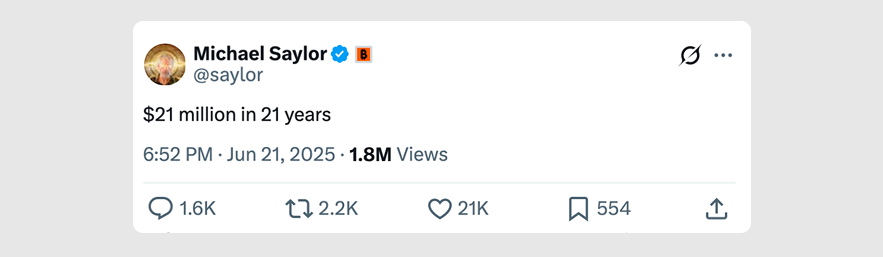
Michael Saylor, perhaps the biggest Bitcoin bull of all, expects the cryptocurrency to reach $21 million by 2046.
In early 2026, JPMorgan famously predicted $266,000 for Bitcoin over an unspecified “long term”, citing its growing appeal relative to gold since the previous October. However, the projection was a structural thought experiment rather than a near-term price forecast. The bank has also explicitly said the figure is “unrealistic” for 2026.
The four-year cycle: dead or evolving?
Bitcoin’s four-year cycle has historically revolved around its halving events, with accumulation, a post-halving bull market, and a sharp correction typically unfolding in sequence.
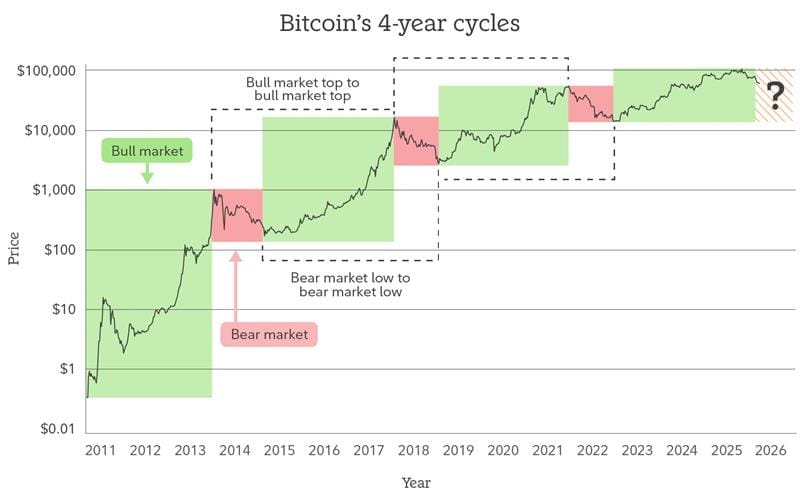
But the pattern may be losing some of its predictive power as Bitcoin matures. Institutional adoption, spot ETFs, deeper liquidity, macroeconomic forces, and the shrinking absolute impact of each halving are all changing the market’s dynamics.
That does not necessarily mean the cycle is dead. Instead, it may be becoming less predictable and less dominant, with Bitcoin increasingly responding to forces that have little to do with its four-year supply schedule.
At the beginning of the year, while Fidelity stood by its traditional “cycle intact” thesis, Bitwise and Grayscale both suggested the cycle had broken down. Today, the timing of the drawdown looks closer to the old playbook, even if its depth remains much milder.
Bitcoin has remained below its October 2025 peak for roughly 294 days, with a drawdown of around 48.5%. That remains well below the 75%–85% drawdowns seen in previous cycles and highlighted by NYDIG, but the duration of the decline is beginning to look more familiar.
For a deeper look at what is changing — and whether Bitcoin’s four-year cycle is actually breaking down — read our full guide: Bitcoin's four-year cycle is changing — but is it dead?
Is the market maturing?
In the final days of 2025, Galaxy Digital’s Alex Thorn supported his firm’s bullish long-term view with what he saw as evidence of a maturing market. Acknowledging that the new year was “too chaotic to predict,” he pointed to several signs of structural maturity:
- Declining long-term Bitcoin volatility
- Options market behaviour shifting towards patterns seen in traditional macro assets
- Deepening institutional integration
Six months later, reality has complicated that “dampening swings” narrative. That said, the current 48.5% peak-to-trough decline remains far less dramatic than the 75%–85% drawdowns seen in the previous three cycles.
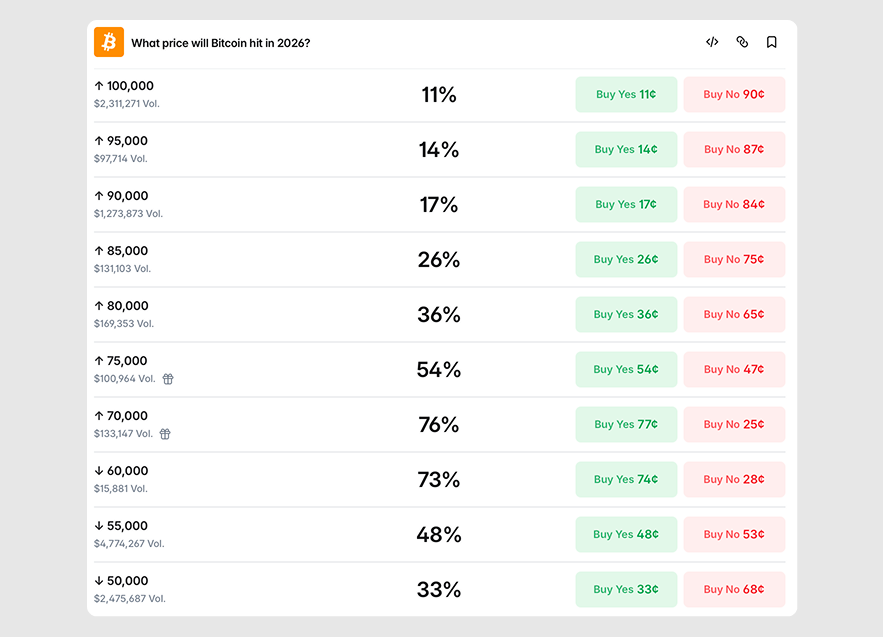
The bigger change may be in the odds of extreme outcomes. In December, Thorn saw roughly equal probabilities of Bitcoin reaching $50,000 or $250,000 by year-end. Today, Polymarket gives BTC just a 26% chance of reaching $85,000, while the odds of reaching $100,000 have slipped to 11%.
Looking ahead: Biggest risk factors for BTC
Fed turning hawkish
The most important near-term catalyst is the Fed decision expected on July 29, along with Fed Chair Kevin Warsh’s tone at the subsequent press conference. With energy prices still elevated despite a recent pullback, a hawkish hold remains the most likely scenario.
Market observers are particularly focused on any signs of a “higher for longer” stance. The probability of a rate hike has also climbed to a significant 38%.
Persistent ETF outflows
US-listed spot Bitcoin ETFs recorded monthly outflows between November 2025 and February 2026. After just two months in positive territory, the negative trend resumed: net outflows reached $2.43 billion in May, followed by $4.51 billion in June.
According to Reuters, Citi has cut its 12-month net ETF inflow assumption to zero from $10 billion, expecting broader investor adoption to remain on hold until the next major catalyst. The bank cited stagnating US crypto legislation, concerns about potential selling by corporate treasuries, and rotation into AI.
Strategy's pivot to selling
For years, Michael Saylor’s Strategy stuck to its “never sell” mantra. Now, the software firm is reshaping how it manages its Bitcoin holdings — the largest corporate treasury in the world — with its perpetual preferred stock STRC (Stretch) playing a growing role in its capital strategy.
Strategy's ability to keep paying preferred dividends ultimately depends on its broader financial position. The 843,775 BTC currently in its coffers (around $53.9 billion) remains a major part of the asset base supporting its overall capital structure.
Traders took notice when the company sold 32 BTC between May 26 and May 31 — its first Bitcoin sale since 2022 — with the proceeds earmarked for preferred-stock distributions.
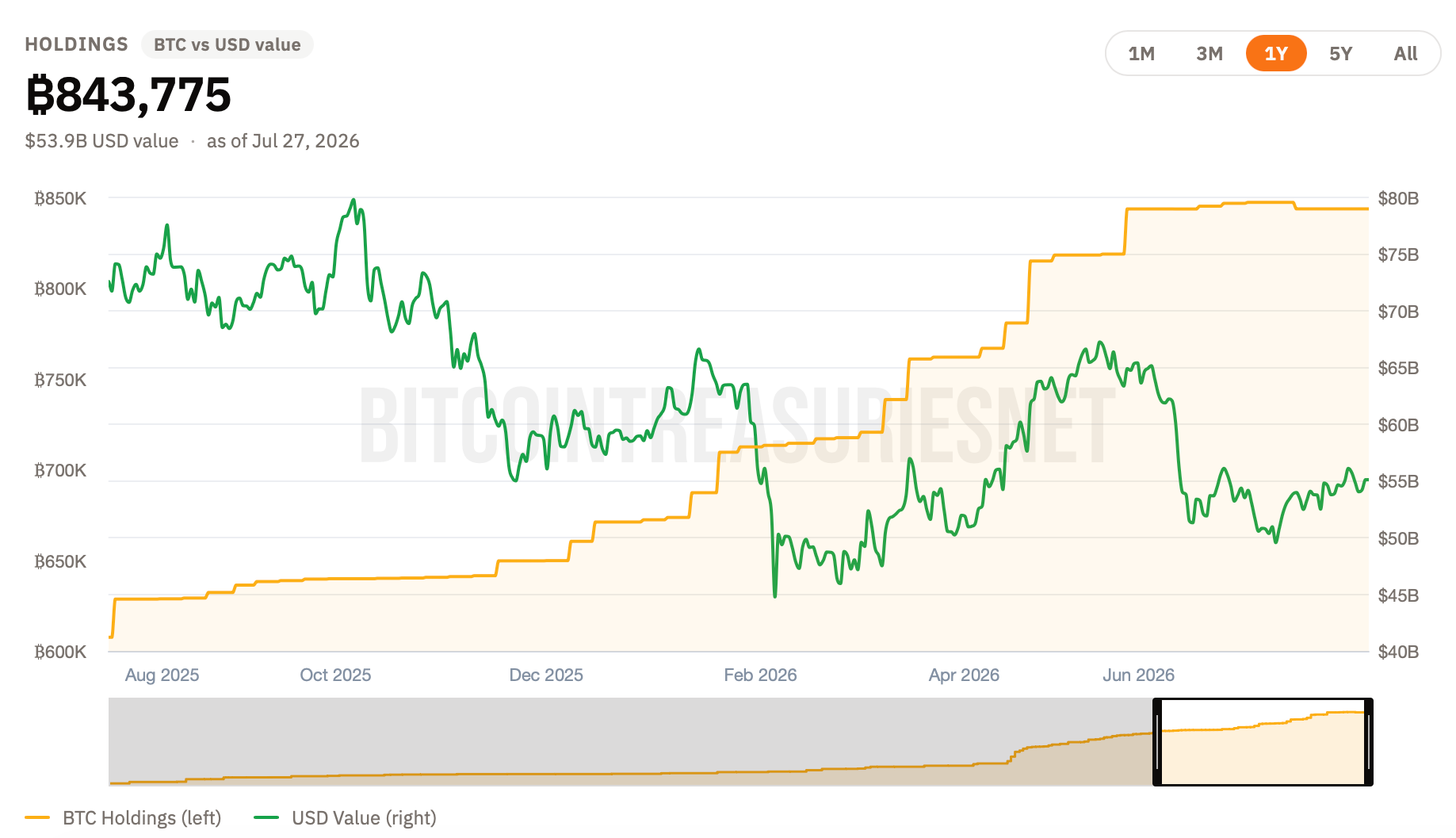
That shift became much more significant in late June and early July, when Strategy sold 3,588 BTC for roughly $216 million between June 29 and July 5. The proceeds were used to fund preferred-stock distributions and replenish its USD reserve.
The company has also authorised a BTC Monetization Program that allows it to sell up to $1.25 billion of Bitcoin to strengthen that reserve and support other capital-management needs. As of July 5, the full $1.25 billion capacity remained available.
Learn more about Strategy's new policy in our guide: Inside STRC’s drop: Stress test for Strategy’s Bitcoin funding engine.
Stagnation of crucial US regulation
The crypto industry had hoped that the Digital Asset Market Clarity Act would move through the Senate before the August recess. Now, Senate Majority Leader John Thune has indicated that completing the bill before the recess is increasingly unlikely, although he still hopes to get the floor process started.
Meanwhile, members of both parties have raised concerns about various sections of the final working draft. In particular, provisions “including those addressing ethics for elected officials, consumer protection, illicit finance, conflicts of interest and market integrity must be strengthened,” according to a joint statement from a core group of negotiators.
On Polymarket, the odds of the Clarity Act being signed into law this year have slipped to 38%, down from 74% on May 10.
Wall Street's fading confidence
Bitcoin forecasts have become increasingly split. While Citi, Standard Chartered, and Bernstein have all lowered their 2026 targets, Tom Lee continues to defend a much more bullish outlook. JPMorgan's $266,000 figure is a long-term theoretical valuation rather than a 2026 target, making it a different kind of forecast altogether.
This widening gap highlights how little consensus there is around Bitcoin's next move — and how quickly expectations can shift as market conditions change.
Bottom line
Bitcoin’s path through the rest of 2026 is unusually wide open. Forecasts range from a deep cycle-driven correction to $38,000–$39,000 to a renewed rally towards $200,000–$250,000, with ETF flows, Fed policy, regulation, and institutional demand likely to decide which scenario gains the upper hand.
The NYDIG case is worth watching particularly closely: a further roughly 40% decline from current levels would put BTC in the $38,000–$39,000 zone by October, matching the depth and timing of previous cycle bottoms in 2018 and 2022.
For now, the market has not delivered a clear verdict on whether Bitcoin’s old four-year rhythm is fading or simply taking a different shape. What is clear is that the forces moving BTC have become more complex.
The next few months should show whether that new market structure can withstand another serious drawdown — or whether institutional adoption has genuinely changed the way Bitcoin bottoms.