Clapp Weekly: BTC loses $60K, OKXICE launch, South Korea moves to lift ICO ban

BTC price
Bitcoin sank below $60,000 again after handing back its Nvidia-driven bounce within hours. Realized losses have nearly doubled in a week and, relative to annual capital inflows, are at their highest since the FTX collapse in November 2022. Bitcoin's correlation with the Nasdaq 100 is at its highest since September 2022, while US spot Bitcoin ETFs have shed $4.3 billion in net capital over the past 20 trading days.
As Glassnode predicted, selling intensified once support at $62k–$66k broke. US buyers are absent, and capitulation is setting in. "A convincing close below $60k and the June low at $58.5k could open the way to the Realized Price at $53.2k. Every past bear market closed below it," the company's report says.
BTC lost its grip on $64k and nosedived on November 20, bottoming out at $55,711.45 the following day. It then crept back toward $61.4k, surged to $63,697.28 on November 23 and sank sharply again.
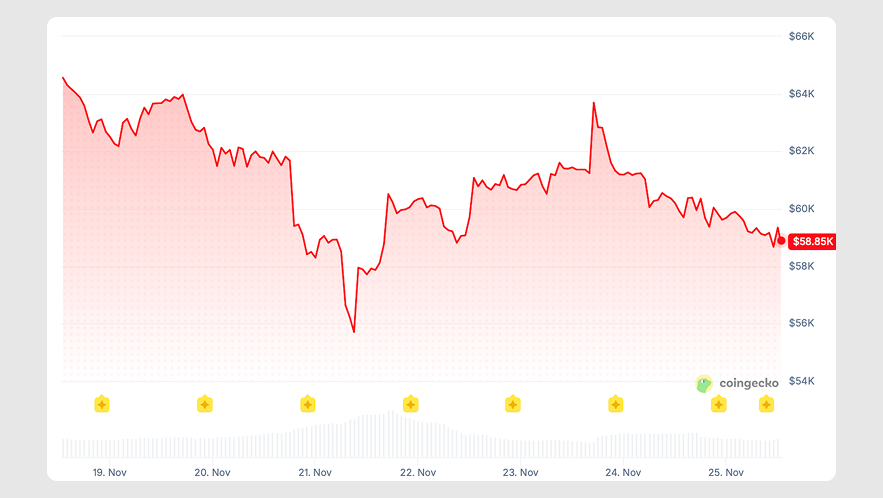
At press time, BTC is trading at $58,861.62, down 1.8% over the past 24 hours and 8.8% over the past 7 days.
ETH price
Ether fell below $1,700 as weakness across US stocks spilled into crypto, though its performance against Bitcoin has held relatively stable over the past two weeks. Crypto analyst Michaël Van de Poppe sees room for a relief rally toward $1,900–$2,000, while veteran trader Peter Brandt warns of further decline. Spot Ethereum ETFs have seen outflows for eight full weeks in a row, shedding another $64.02 million on Monday.
The two largest corporate treasuries still signal confidence. BitMine bought 7,819 ETH over the past week, while SharpLink repurchased $10 million worth of its own shares (SBET), in line with its long-term strategy of increasing its ETH per share.
ETH mirrored BTC, slipping from $1.8k and nosediving on November 20. It reversed at $1,559.00 the following day and gradually regained ground. A brief surge to $1,805.03 on November 23 was short-lived, as the decline resumed almost immediately.
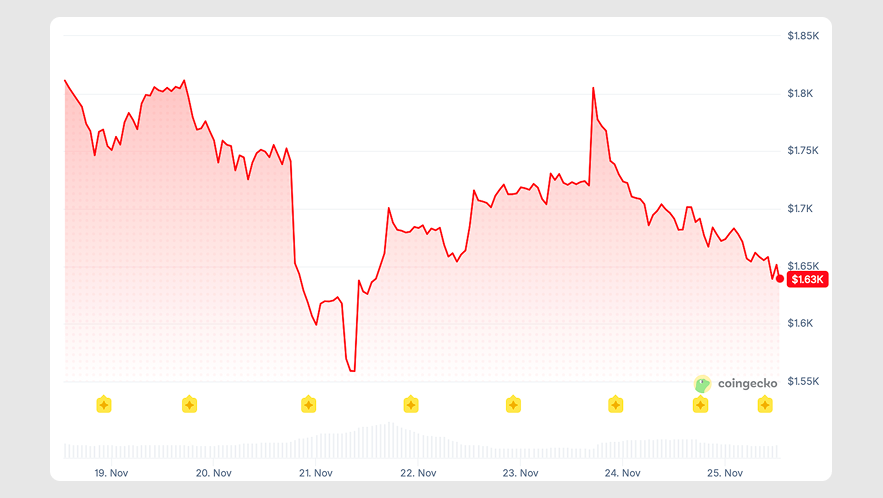
At press time, ETH is trading at $1,638.90, down 2.8% over the past 24 hours and 9.0% over the past seven days.
Seven-day market dynamics
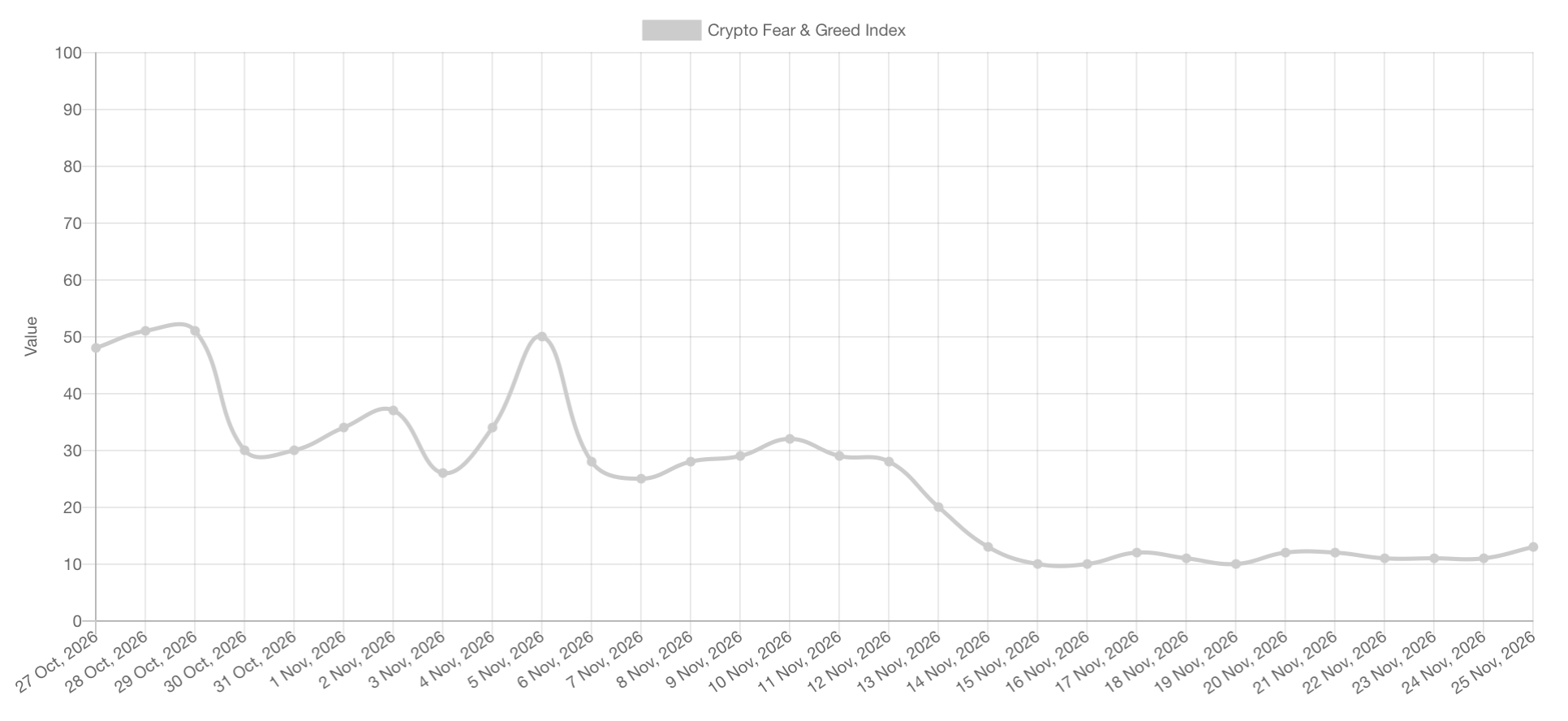
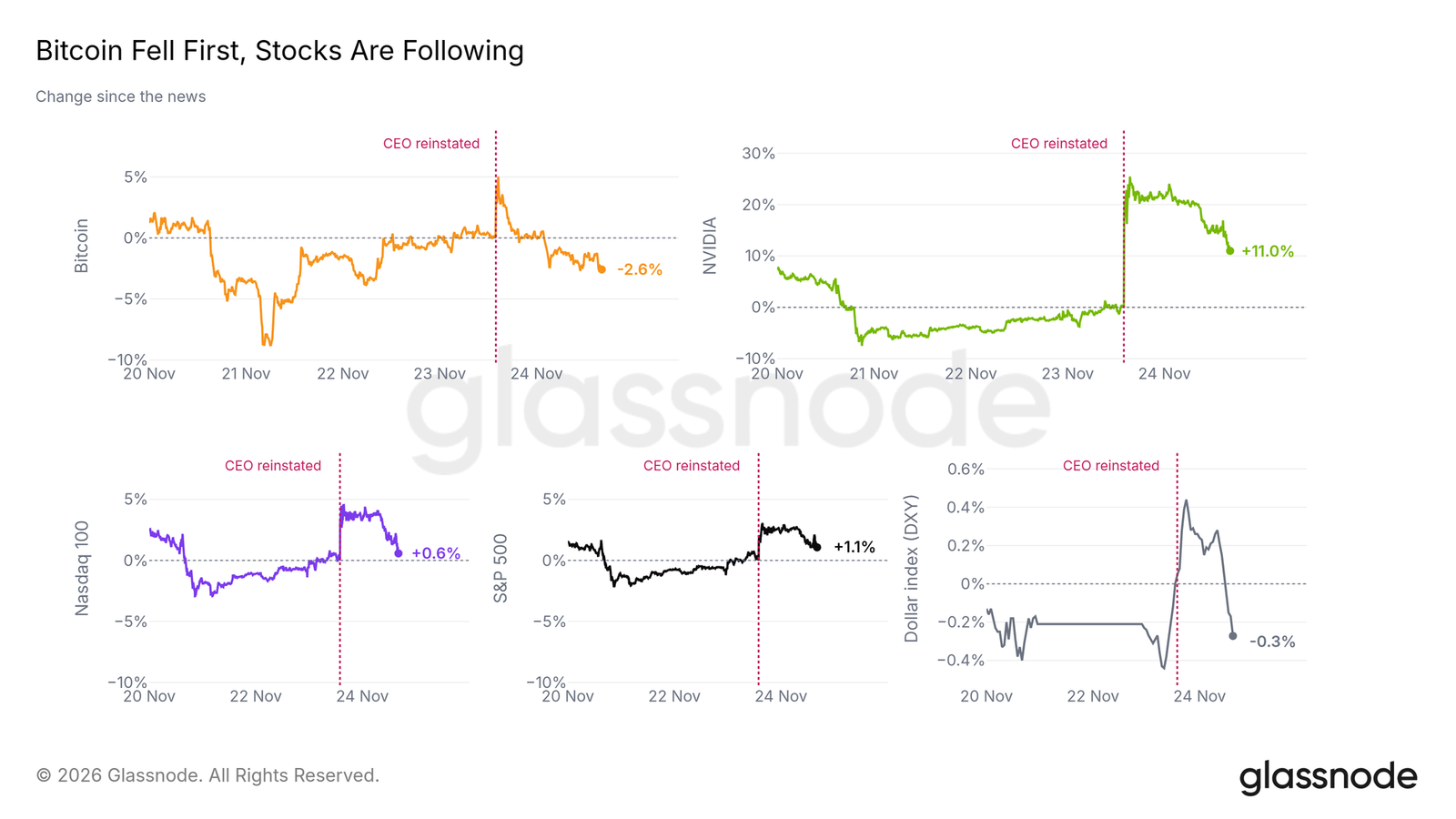
Sentiment has stayed in Extreme Fear over the past week (now 13/100), and the market kept selling despite Jensen Huang's surprise comeback as Nvidia CEO. Stocks rebounded, but Bitcoin's recovery was completely erased less than six hours later: after gaining 5% in about half an hour, it sank back and dragged the rest of the market with it.
All majors are down on the weekly chart, with ZEC bearing the brunt of the decline (-23.0%), followed by HYPE (-13.8%). The total market cap shed over $200 billion in just four hours, sinking to $2.11 trillion last night, slightly above the November 21 low of $2.10 trillion. Liquidations across the market reached $342.61 million over the past 24 hours, with $271.48 million in longs.
Even stocks couldn't hold the Nvidia rally
On Monday, Nvidia brought back Jensen Huang as CEO, less than two weeks after the resignation. President Trump himself made clear he wanted Huang reinstated and later touted the decision on Truth Social. The move has been dubbed "one of the greatest U-turns of all time," according to The Guardian. However, investigations into the espionage allegations against Huang are still ongoing.
Most of the Nasdaq's gain since the news is gone. Glassnode called Bitcoin "the canary in the coal mine," noting that it reversed before stocks did. A rally that reverses this fast usually means investors are rushing to sell, and if the stock sell-off continues, Bitcoin holders may face more pressure.
Why Bitcoin's plunge is stronger
Bitcoin's relative weakness comes down to ETF exits and shrinking institutional interest at current prices. Spot demand has also declined, and a rebound in both would be the first sign of an impending recovery. Long-Term Holders, a cohort that is usually the slowest to sell, accounted for most of the realized BTC losses between mid-April and mid-November, a pattern seen around the last three bear markets.
Those downturns (2015, 2018 and 2022) pulled Bitcoin at least three quarters below its all-time high before reversing. The coin is now roughly 50% below its all-time high, but it has yet to close below the Realized Price, now at $53.2k, roughly 10% away. In each of the past three bear markets, Bitcoin ended up significantly below the Realized Price, which supports Glassnode's suggestion that a deeper decline may be coming.
Tariff concerns return
News of potential new tariffs on China and other US trading partners added to the pressure on markets. As early as this week, US Trade Representative Jamieson Greer may present the findings of an investigation into industrial subsidies in China, the EU and 14 other economies that the Trump administration believes are harming American companies.
Its conclusions could lead to higher tariffs on goods from those countries. That prospect raises fresh concerns about global growth, especially as traders await a Fed rate hike in December. On CME FedWatch, the odds of a 25-basis-point hike currently stand at over 97%.
Top weekly winners
- BTW (+78.1%) rallied through the past week with no project-specific news behind it. Thin daily trading volume ($4.261 million) relative to its market cap ($1.188 billion) amplifies price moves.
- PIEVERSE (+40.4%) jumped after the project opened early access to its Confidential Agents feature, which brings hardware-backed privacy to agent memory, messages and credentials. Sentiment also got a lift from the successful absorption of a large mid-November unlock.
- VVV (+20.0%) defied the broader pullback on demand for private AI as concerns grow around centralized AI labs handling user data, a worry sparked by recent security breaches. Supply reduction through token burns and bullish commentary from high-profile figures like Arthur Hayes are supporting sentiment.
Top weekly losers
- RAIN (-39.9%) has been sliding since its November 16 rally unwound, with no news catalyst to hold it up.
- ZEC (-23.0%) gave in to the broader pressure amid massive long liquidations and institutional withdrawals, after three straight weeks of net ETF outflows. The boost from Grayscale launching its new Zcash ETF (ZECX) with amplified exposure was short-lived.
- INJ (-21.2%) also followed Bitcoin's plunge, and the excitement around the launch of the Veyra mainnet upgrade faded quickly. The upgrade aims to enhance real-world asset support, institutional trading capacity and cross-chain connectivity.
Cryptocurrency news
OKXICE brings stocks onchain, but Wall Street isn’t quite ready
The joint venture between crypto exchange OKX and Intercontinental Exchange (ICE), the parent company of the New York Stock Exchange, launched its tokenized securities trading venue on November 23. The platform lets eligible US customers trade selected stocks around the clock on blockchain infrastructure, free of conventional market hours.
Six companies in the initial lineup
Coinbase, Circle, Strategy, Robinhood, BitGo and Securitize were available on day one. OKXICE plans to expand the lineup to 113 assets, including stocks, ETFs and other exchange-traded products, with additional participants such as Fidelity Investments, eToro and Strive set to join.
Unlike stock-linked derivatives, these tokens represent actual shares on a 1:1 basis. Holders are entitled to applicable dividends, voting rights and other corporate actions. Trading takes place against USDC through permissioned liquidity pools on OKX's X Layer network, and investors keep their tokens in self-custodial wallets.
Disappointing volume after a wave of objections
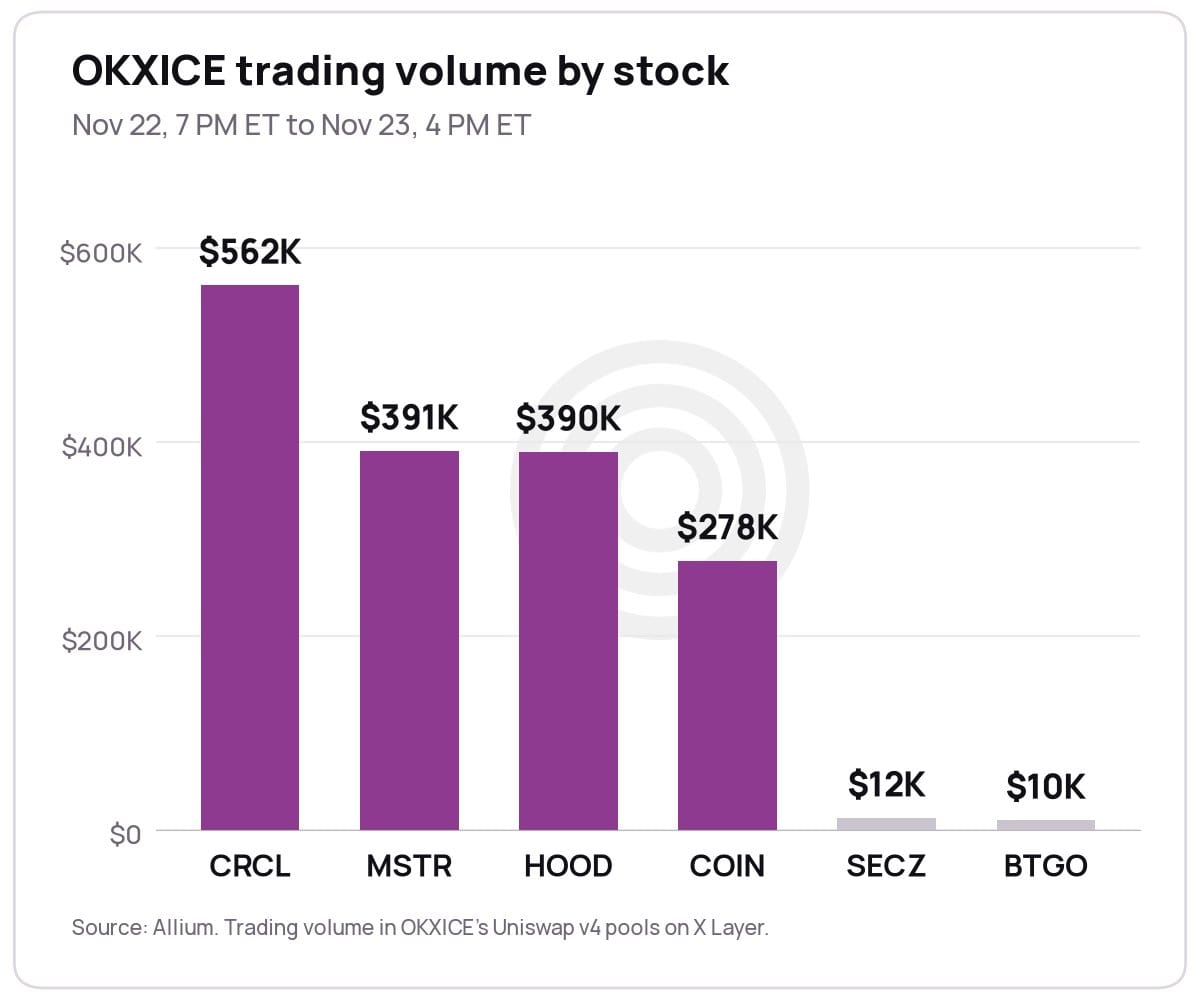
OKXICE aims to combine the accessibility of crypto with the ownership rights of traditional securities, but the first trading session suggests it will take time to get there. According to blockchain analytics firm Allium, the platform recorded approximately $1.64 million in trading volume on its first day. Activity was also heavily concentrated: Circle, Strategy, Robinhood and Coinbase made up 99% of the total.
An even bigger challenge has come from the companies whose shares OKXICE initially wanted to tokenize. Of the 62 issuers originally approached, 56 objected. Apple, Nvidia, Amazon, Meta and Tesla were among those that pushed back, citing concerns about liquidity, volatility and the use of their shares in third-party products. Some insiders also told CNBC that the 30-day objection window gave companies too little time to decide whether they were ready to participate.
OKXICE operates under the SEC's five-year Innovation Exemption, which lets eligible platforms test blockchain-based securities trading under specific conditions. The service is not a registered exchange or broker-dealer. That permission, however, has not translated into broad issuer support.
Then there is the question of how long 24/7 trading will stay a unique selling point. Nasdaq and other traditional market operators are exploring extended trading hours, which could narrow the gap between onchain venues and conventional exchanges.
Looking ahead
For now, OKXICE is a key test of whether blockchain can make stock ownership and trading more flexible. The next challenge is turning that promise into sustained demand, which will take enough participating companies and liquidity to make round-the-clock markets practical.
South Korea moves to lift nine-year ICO ban, bringing token fundraising back onshore
South Korea may soon reopen a fundraising route it shut down nearly a decade ago. The country's Financial Services Commission (FSC) has proposed lifting its 2017 ban on initial coin offerings (ICOs), which would let domestic companies sell newly issued tokens under a regulated framework.
The proposal is part of a broader draft law
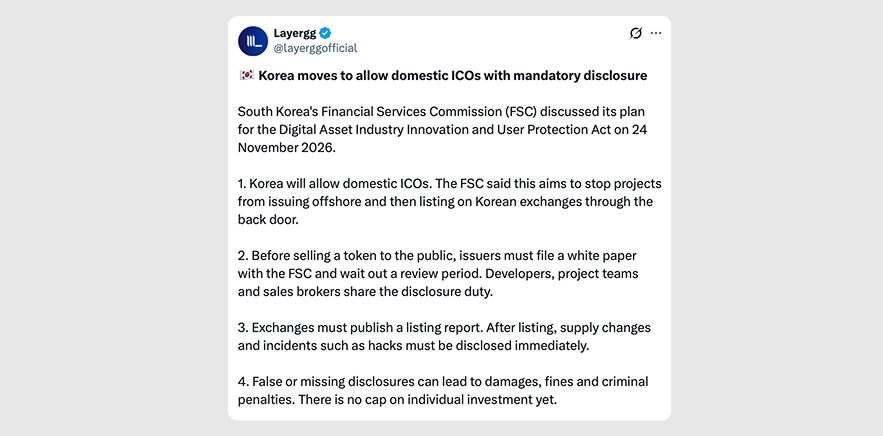
The Act on Digital Asset Industry Innovation and User Protection was unveiled on November 24. If the National Assembly approves it, it would let local crypto projects raise capital through token sales, with disclosure requirements modeled on traditional securities offerings.
Under the proposed rules, issuers would have to submit a digital asset white paper to the FSC before selling tokens. The document would cover the project's business model, token supply, planned use of proceeds and investment risks. Retail buyers would also receive shorter prospectuses to help them assess each offering.
The regulator would be able to request corrections to submitted disclosures, while issuers could face civil liability, financial penalties and even criminal prosecution for misleading statements or omissions. A mandatory waiting period, potentially seven days, would give investors time to review the details before a sale begins.
Why the ban was imposed
South Korea introduced its blanket ICO ban in September 2017 amid concerns about speculative fundraising, fraud and investor losses. The restriction didn't eliminate domestic demand, though. Many Korean projects moved their legal entities and token sales overseas, often to places like Singapore, before seeking access to Korean investors.
The FSC now wants to reverse that trend and bring crypto investment, business activity and jobs back into the country. For local startups, regulated token sales could offer an alternative to relying entirely on venture capital or setting up offshore structures.
Part of a broader planned overhaul
The draft legislation would also let consortiums in which domestic banks hold a majority stake issue won-pegged stablecoins. It would introduce ownership limits for major shareholders of crypto exchanges, generally capping their stakes at 20%, with exceptions of up to 34% subject to regulatory approval.
The proposed changes reflect South Korea's effort to shift from restricting crypto activity to supervising it more directly. Still, lifting the ICO ban would not mean unrestricted token fundraising. Projects would have to meet disclosure and accountability standards, with regulators retaining oversight.
For now, the proposal still needs parliamentary approval. If passed, it could mark a significant shift for one of the world's most active retail crypto markets and give domestic blockchain companies a clearer path to raising capital without moving their operations abroad.