How MEV bots can profit from your crypto trades

You swap tokens on a decentralized exchange (DEX) and the final price comes out worse than the app showed. Or you buy a memecoin and receive fewer coins than quoted. Slippage and market volatility explain some of these gaps, but in DeFi a bot has often gotten there first, profiting from the order in which transactions are processed.
MEV bots watch pending transactions and act on them before they are confirmed. Not every bot is harmful, since the effect depends on the strategy it runs. Centralized exchanges sequence orders internally, which removes much of this exposure while adding risks of their own.
TL;DR
- MEV (maximal extractable value) is the profit bots make by reading pending transactions in the public mempool and influencing the order in which they are confirmed.
- Front-running and sandwich attacks make a user's swap execute at a worse price, and sandwich bots profit on both sides of the trade.
- Arbitrage and DeFi liquidations are also MEV. They help keep prices aligned and lending markets solvent, though competition between bots can push up gas fees.
- Wide slippage tolerance makes sandwich attacks easier. One Bitquery study found Solana sandwich bots took $29.7 million from memecoin buyers over 11 months.
- Centralized exchanges match orders internally, so public-mempool attacks don't apply. Deposits, withdrawals and latency arbitrage still carry risk.
- Tight slippage settings, private transaction routing and a check of the execution details reduce exposure.
What is MEV and how does it work?
Once submitted, an Ethereum transaction isn't included in a block right away. It first sits in a holding area maintained by network nodes, known as the memory pool, or mempool (also called the transaction pool or txpool). Because the mempool is public, bots can read transaction details before they are confirmed and react to them.
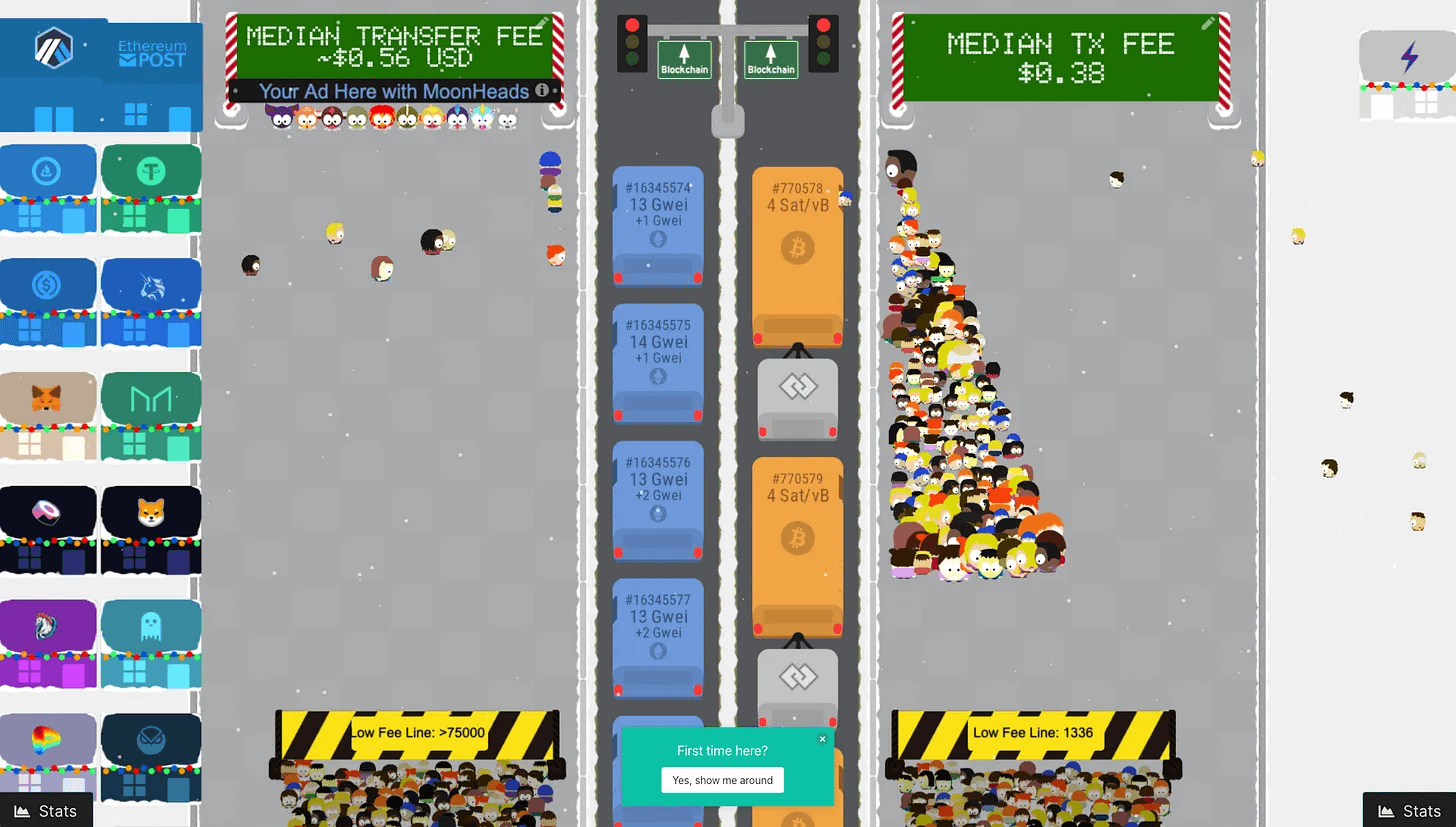
That's the basis of MEV: profit made by using knowledge of other people's transactions to influence the order in which they enter a block. The term originally stood for "miner extractable value," before validators took over block production on Ethereum.
Back in 2014, Redditor u/pmcgoohan described this scenario in a post suggesting that miners could extract value by reordering transactions in a block and by exploiting what they knew about incoming ones. The idea of "searchers" came later, for users or bots that scan mempool transactions for such opportunities.
In practice, a swap is submitted to the DEX and becomes visible in the mempool while it waits. A bot that spots a profit opportunity submits its own transaction, sometimes with a higher fee, to influence the processing order.
Four ways MEV bots make money
Front-running
A bot looks for unconfirmed transactions likely to move a token's price, such as a large swap. It then jumps ahead in the execution order, so the user's transaction executes later at a worse price. It's one of the most recognizable forms of MEV.
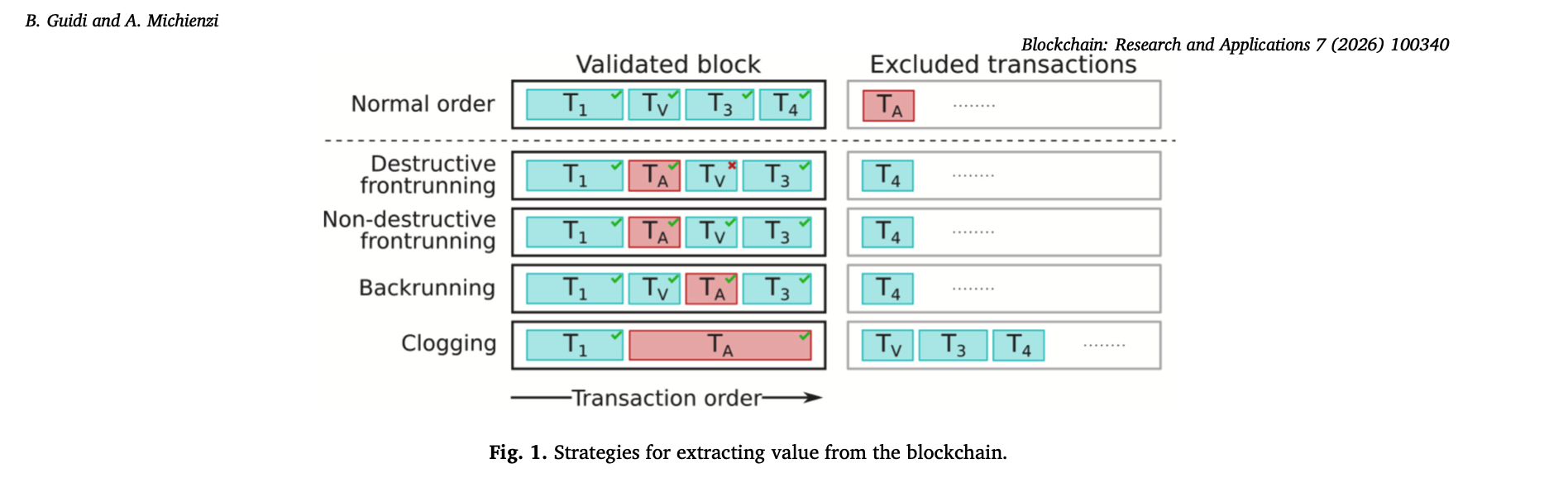
- A bot spots a pending trade and submits its own transaction first, with a higher gas price or priority fee, often 10% to 50% higher.
- The bot's trade executes before the user's order is processed.
- The user's transaction executes at a less favorable price, which gives the bot its profit.
Sandwich attacks
A sandwich attack combines a front-run with a back-run. When a user is buying, the bot buys just before the swap and pushes the price up. The user's trade then executes at that worse price, as long as it stays within their slippage limit, and the bot sells right after to capture the difference. The higher the user's slippage tolerance, the more room the attack has.
In September 2026, a wallet spent about $240 in SOL on a memecoin. Just before it, another wallet had bought the same coin on the same DEX and pushed the price up, so the first wallet received 6% fewer coins than it would have otherwise. About two seconds later, the bot sold everything it had bought, making about $11 on the attack, or about $8 after fees.
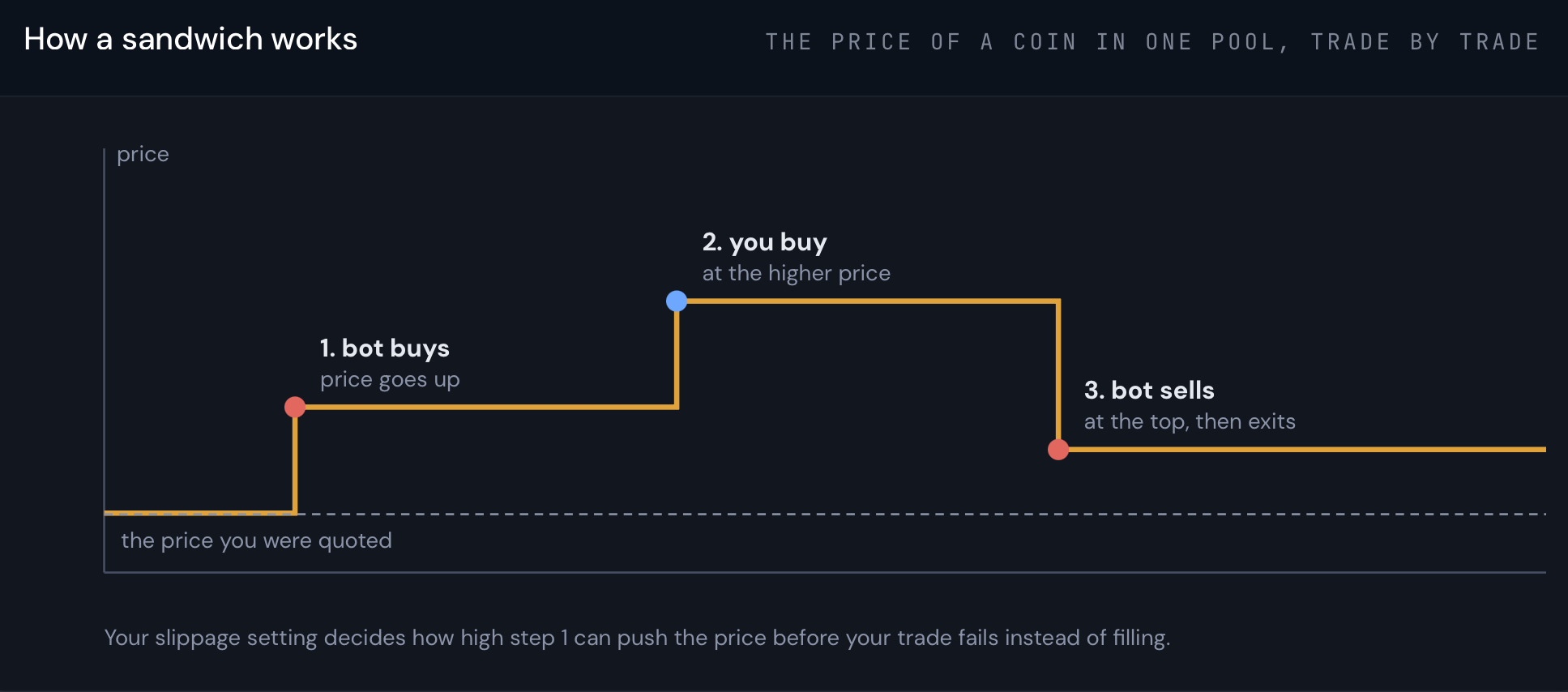
The following month, a Bitquery investigation found that Solana sandwich bots had taken $29.7 million from memecoin buyers over 11 months, before their costs. The bots traded on both sides of the victims' buys and kept the difference. Researchers detected 6,850,144 sandwich attacks by 2,545 bot wallets against 2,154,994 user wallets, and trades with wide slippage were hit most often.
Arbitrage
Arbitrage bots buy a token on a DEX or liquidity pool where it's cheaper and sell it where it's more expensive. This helps keep prices aligned across markets, although failed attempts add network spam and aggressive competition for block space pushes up gas fees.
Arbitrage isn't predatory in itself. It's typical, healthy market activity. Yet bot rivalry can chain strategies that extract value from regular users, for instance by combining arbitrage with sandwich attacks, and such linked attacks are significantly more profitable.
Some bots watch the mempool and copy profitable trades, paying block producers a higher fee so their version is included in place of the original arbitrage transaction. Bots also join the gas-price auctions that raise congestion and fees for everyone else.
The effects reach beyond individual blocks, too. If the MEV available in a block is far larger than the regular block reward, validators may reorganize the chain to capture it themselves, which threatens consensus stability.
Liquidation
The rise of DeFi lending platforms such as Aave and Compound gave bots another way to earn: they hunt for undercollateralized loans and collect a liquidation bonus.
DeFi loans are typically overcollateralized from the start. When a borrower's collateral value falls below the protocol's required threshold, the position becomes eligible for liquidation, which anyone can trigger to earn a bonus. A bot tries to detect that moment as fast as possible and submit a valid liquidation transaction.
In many protocols, the liquidator receives a fee or bonus, often around 5% to 15% of the liquidated position. By carrying out the protocol's built-in function, bots help clear risky loans and keep lending markets solvent. Liquidations in perpetual futures markets work differently, as our explainer on liquidation cascades shows.

Why MEV matters to ordinary DEX traders
MEV comes from how public blockchains order transactions, so it can affect trades on any token or DEX. Not every unfavorable execution is an MEV attack, though. Price movements, liquidity and slippage can produce similar outcomes.
Users may receive fewer tokens than expected or pay a higher effective price. Sandwich attacks raise the cost of a swap, and bot competition can push up transaction fees through congestion. Aggressive slippage settings leave users more exposed in either case.
DEX vs CEX execution models
Ordinary CEX trades aren't exposed to the same public-mempool sandwich attacks as on-chain swaps, because the architecture differs. DEX trades execute through smart contracts on a blockchain, while CEX orders generally go to an internal matching engine and are matched against the exchange's order book. With no public blocks or validators sequencing the order, bots can't pay higher gas fees to jump ahead of it.
A CEX doesn't have to publish each internal trade as a pending transaction, but that doesn't shield users from every form of front-running or manipulation. Blockchain MEV still becomes relevant when users deposit or withdraw assets or interact with DeFi protocols. Moving funds between a wallet and a CEX happens on-chain, so any swaps or interactions beforehand face standard Ethereum MEV.
Custody and transparency bring different risks on centralized platforms, and execution quality can still vary. Some CEXs host institutional market makers and high-frequency trading bots that can front-run large visible orders or snipe stale limit orders on the order book. Sniping stale orders is a form of latency arbitrage, which captures a risk-free or low-risk spread by taking liquidity from resting orders whose prices haven't yet updated after an external market move.
How traders can reduce their exposure to MEV
MEV can't be switched off, but a few habits reduce the exposure on DEX trades.
- Check slippage settings. Set a tolerance no higher than the trade requires, since a wide limit gives bots room to move the price against you.
- Consider liquidity. Low-liquidity pools are more vulnerable to price impact and sandwich attacks, so the same swap can cost more there.
- Use MEV protection where available. Some wallets and services offer private transaction routing, which reduces exposure to the public mempool.
- Review the execution details. Compare the expected and final amounts and account for network fees. A worse price isn't always an attack, since ordinary slippage can look the same.
- Choose the trading environment carefully. Know whether a swap executes on-chain or through an exchange's internal system, because the risks and the kinds of attack differ.
Where your order goes shapes what you pay
The price of a trade depends on more than market movements and trading fees. On public blockchains, transaction visibility and ordering give bots room to profit at traders' expense, and the effect shows up as a worse fill.
Some of that activity does useful work, such as keeping prices aligned across markets and lending protocols solvent. Understanding how an exchange processes orders, whether through a public mempool or an internal matching engine, helps users decide where and how to trade.