Credit line or margin trading? Why borrowing against crypto is not leverage

Suppose you own some Bitcoin and would like to get more market exposure. What if you have no available funds to buy more coins? A fellow holder might say, "Just take out a Bitcoin loan or credit line." Someone else might wonder, "Isn't that just margin?"
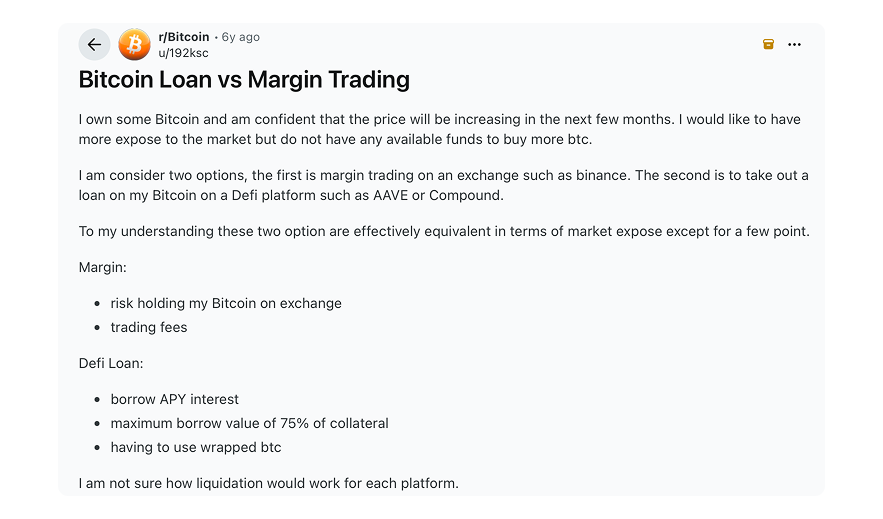
This question has come up in Reddit threads before. The two options work differently, and the choice comes down to what you want to do with the money. A credit line gives you cash without selling; margin trading lets you open a larger position than your own funds would cover, so both gains and losses are amplified.
TL;DR
- A credit line gives you access to fiat or stablecoins without selling your crypto. You put your holdings up as collateral and decide how to use the money.
- Margin trading increases your market exposure. You borrow to open a larger position, which means bigger potential gains and losses.
- A credit line doesn't automatically mean leverage. Your crypto exposure stays the same unless you use the borrowed funds to buy more.
- Your LTV changes as the market moves. If your collateral loses value, the LTV rises even though the amount you owe hasn't changed.
- Both options can lead to liquidation. Margin positions can be closed after relatively minor price moves, while a credit line gives you more room if you keep your LTV low.
- The right choice depends on what you need the money for. A credit line is for accessing funds for any purpose without selling, while margin is a trading tool.
Two tools for two different jobs
Weighing up these options means comparing a trading strategy with a way to get cash. Margin trading involves borrowing to open a bigger trading position than your own balance would allow. You aim to boost potential profit from price moves, and the loan is built into the trade.
Borrowing against crypto happens outside trading. You use the coins you already hold as collateral to get fiat or stablecoins like USDT or USDC without selling. The loan or credit line sits alongside your holdings. How to use the borrowed amount is entirely up to you, whether it's a car repair, vacation, rent, or an unexpected bill.
How margin trading works
Say you have €1,000 and think a coin will rally. On margin, you borrow €4,000 more and open a position worth €5,000, five times your own money. If the coin rises 10%, your position gains €500. That's a 50% gain on your initial €1,000, before fees and interest.
But if the coin falls 20%, the position loses €1,000, equal to your entire initial stake. In practice, the platform may liquidate your position before the loss reaches that amount, depending on its margin requirements and fees. Either way, you could lose all the money you put in.
Risk in margin trading
This tool is built for active traders who want to increase their market exposure, but it also puts their entire stake at risk. It has nothing to do with borrowing for a utility bill or business expenses.
- The borrowed money goes straight into the trade. It becomes part of the position rather than cash you can spend elsewhere.
- You're exposed to a bigger position than you paid for. Gains and losses are both amplified.
- Small moves matter. Crypto can see double-digit gains or losses in a day, and at higher multiples, even a much smaller move can trigger liquidation.
- Positions often carry ongoing charges that build up for as long as the trade stays open.
How a credit line works
Now say you hold €10,000 worth of Bitcoin and need €5,000 for an expense. You put your Bitcoin up as collateral and draw funds from a credit line. This gives you a 50% loan-to-value ratio (LTV), which compares the loan amount with the value of your collateral.
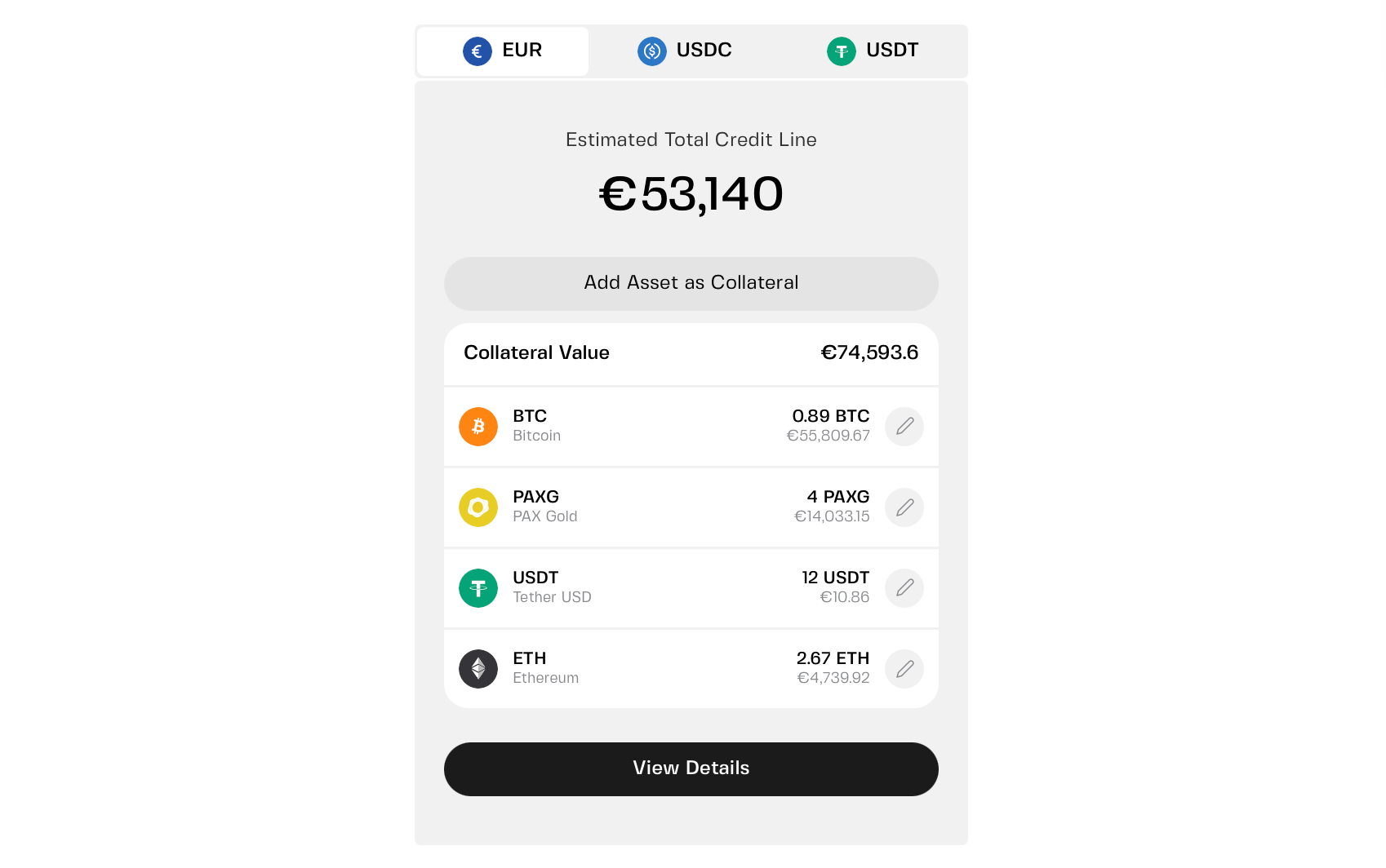
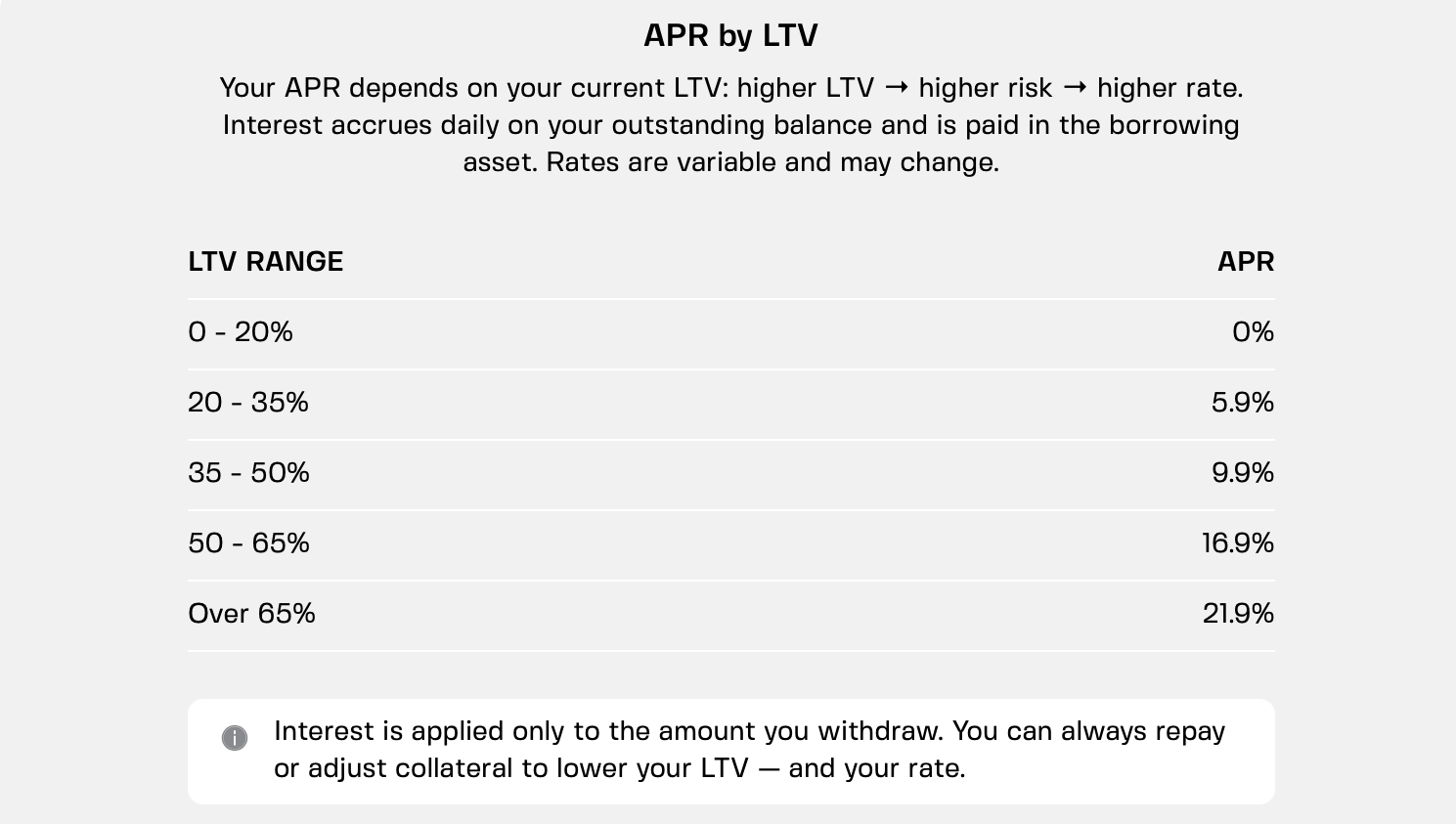
The lender's maximum LTV determines how much you can borrow, but getting as close to that limit as possible is risky when your collateral is volatile. For Clapp credit lines backed by Bitcoin, the ceiling is 70%, while 20% is a more conservative starting point.
Unlike a sale, opening a credit line does not trigger s taxable event in most jurisdictions. The collateral is held by Clapp while the line is open, and an equivalent amount is returned to your wallet when you repay the loan.
Clapp users can also add c — for example, replacing some Bitcoin with stablecoins to take profits in a bull market.
You pay interest on the amount you draw. The APR range on a Clapp credit line is 0–21.9%, and your rate depends on your LTV band (see below). For a step-by-step explanation of the terms, start with borrowing against crypto explained simply.
What happens if the price drops
Back to the example. Bitcoin falls 20%. This isn't an unusual scenario in crypto markets. At the time of writing (November 2026), BTC is down more than 24% over the previous month.
- After a 20% fall, your BTC collateral is worth €8,000.
- With the loan still at €5,000, your LTV has risen from 50% to 62.5%.
Your loan balance hasn't changed, but the collateral backing it is now worth less. That leaves you with a smaller safety buffer. If the price keeps falling and your LTV reaches the platform's liquidation threshold, you may be asked to add collateral or repay part of the loan.
Otherwise, the lender may sell part of your collateral to cover the loan. For a closer look at that scenario, see what happens in a market crash.
Why "not leverage" needs a footnote
Borrowing against crypto isn't the same as using leverage to open a larger trading position. With a credit line, you don't automatically increase your market exposure: you still hold the same amount of crypto as before.
However, there's a nuance. If you use the borrowed money to buy more Bitcoin, you increase your exposure to its price movements. That technically creates a leveraged position. You end up holding more crypto than you started with, using borrowed funds to pay for part of it. That's essentially a leveraged position, even though the loan itself was an ordinary credit line.
Put simply, it boils down to what you do with the money. Spending it on rent or a tax bill is borrowing, while using it to buy more of the same asset is a type of leverage.
Both can end in a forced sale
Either way, your crypto may end up being sold when prices fall far enough. The difference is how the risk builds up and how much room you have to respond.
- With high-multiple margin, a small price move can wipe out a position. When large-scale liquidations happen together, they can accelerate a market decline. Our guide to liquidation cascades explores this dynamic in more detail.
- With a credit line at a modest LTV, the collateral price has more room to fall before reaching the lender's liquidation threshold. You may have more time to react, although a sharp drop can still put your crypto at risk.
The more room you leave, the larger buffer you may have, and your LTV is the main figure to keep an eye on. There's more on the downsides in the risks of borrowing against crypto.
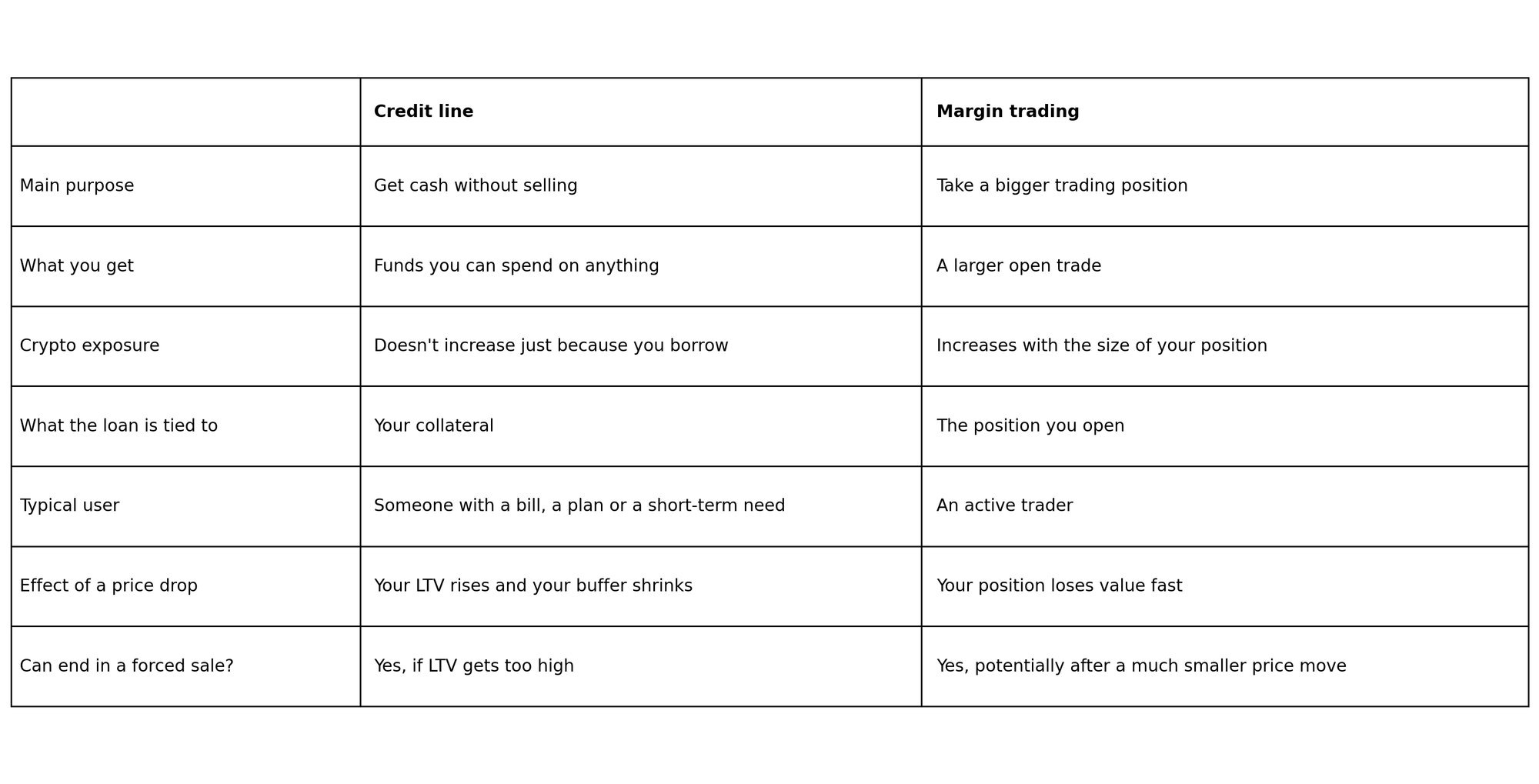
A crypto credit line vs margin, side by side
Crypto exposure is the key distinction. A credit line doesn't increase your market exposure by itself, while margin trading is designed to do exactly that.
Which one fits what you want to do
Ask yourself one question: what is this money for?
You want cash for something in real life: a loan or credit line. Rent, a deposit, a medical bill, a trip. You'd rather not sell your coins, maybe because you think they'll be worth more later, or because selling could trigger a tax bill in your country. That's the classic case for borrowing against your holdings.
You want to make an informed bet on price direction: margin trading. This requires trading experience and a clear understanding of liquidation risks. If you're comfortable with the possibility of losing the money you put in, margin may suit your goals. It's a trading decision, not a financing one.
Borrowing to buy more crypto: think twice. This stacks two risks, because a fall in the asset's price can reduce the value of your holdings while leaving the debt in place. If you decide to do it, keep the LTV low, and avoid using assets you may need for everyday expenses as collateral.
Keys to calmer borrowing
- Borrow well below the maximum. Staying under the lender's max LTV leaves you room for price swings. The post on borrowing conservatively with a low LTV goes deeper on this.
- Have a repayment plan. Know where the money to repay will come from before you draw.
- Keep an eye on your LTV. It moves with the market, even if you do nothing.
- Keep some spare funds or crypto. You may need them to add collateral or repay part of the loan if prices drop.
Crypto prices can fall quickly, and borrowing against crypto is not risk-free. But borrowing conservatively and keeping an eye on your LTV can help you avoid taking on more risk than you can handle.
Margin trading ≠ borrowing against crypto
Both involve a loan, but they're built for different purposes. Margin enables traders to take a bigger trading position. A credit line is a way to get cash without letting go of your coins. Borrowing against crypto doesn't automatically increase your market exposure, but using the funds to buy more crypto does.
Whichever you choose, borrow less than the maximum and know your plan for repaying. If you'd like to see how borrowing against your holdings looks in practice, you can see how the credit line works in the app.
Frequently asked questions
Is borrowing against crypto the same as margin trading?
No. Margin trading means borrowing to open a bigger trading position. Borrowing against crypto means using your coins as collateral to get cash, without opening a new trade. You can use the borrowed funds for other expenses, rather than putting them into a trading position.
Does a crypto credit line use leverage?
Not in the same way as margin trading. Your market exposure stays the same, because you hold the same coins. But if you use the borrowed money to buy more crypto, you create your own leveraged position.
Can I lose my crypto with a credit line?
Yes, in some situations. If prices fall and your LTV climbs too high, you may need to add collateral or repay part of the loan. If you don't, the collateral can be sold to cover what you owe. Keeping your LTV low gives you more room.
What does LTV mean?
LTV stands for loan-to-value. It's the size of your loan compared with the value of your collateral. If you borrow €3,000 against €10,000 of crypto, your LTV is 30%. When the crypto price drops, your LTV goes up.
How much does a credit line cost?
You pay interest on the amount you draw. On a Clapp Credit Line, the APR range is 0-21.9%, and the rate depends on your loan-to-value band. The app shows the rate that applies to you before you confirm.
Which is riskier, a credit line or margin trading?
Both carry risk, but they behave differently. Margin increases your market exposure, and the platform can close your position after a relatively small price move. A credit line at a modest LTV on Clapp gives you a bigger cushion, comes with a lower interest rate, and may give you more time to respond. The risk you take on in the end depends on how much you borrow and what you do with the money.